Is it possible to dress up like a ghost and fool people into thinking they’ve seen the real deal? Happily there is published research to answer this question, research carried out at no lesser institution than Cambridge University. For six nights in the summer of 1959, members of the Cambridge University Society for Research in Parapsychology took turns dressing up in a white muslin sheet and walking around in a well-traversed field behind the King’s College campus. Occasionally they would raise their arms, as ghosts will do. Other members of the team hid in bushes to observe the reaction of passersby. Although some eighty people were judged to have been in a position to see the figure, not one reacted or even gave it a second glance. The researchers found this surprising, especially given that the small herd of cows that grazed the field did, unlike the pedestrians, show considerable interest, such that two or three at a time would follow along behind the “ghost.” To my acute disappointment, “An Experiment in Apparitional Observation and Findings,” published in the September 1959 Journal of the Society for Psychical Research, includes no photographs.
Several months later, the researchers revised their experiment, changing the venue and adding “low moans” and, on one occasion, phosphorescent paint. One trial was set in a graveyard right off a main road and clearly in the sight line of drivers in both directions. Here observers hid in the bushes not only to record reactions, but to “avert traffic accidents” and “reassure anyone who became hysterical.” But again, not a single person of the hundred-plus who saw the figure thought it was a ghost, including two students from India. “Although we are superstitious in our country,” the men told one of the researchers, “we could see his legs and feet and knew it was a man dressed up in some white garment.”
In their final effort, the research team abandoned traditional ghost-apppropriate settings and moved the experiment into a movie theater that was screening an X-rated film. The author of the paper, A.D. Cornell, explained that the X rating was chosen to ensure no children were traumatized by the ghost, as though that somehow explained the choice of a porn theater as a setting for a ghost experiment. This time the “ghost” walked slowly across the screen during a trailer. The phosphorescence was not used this time and presumably low moans were deemed redundant. No mention is made of the specific images showing on the screen behind the ghost, but clearly they were a good deal more interesting: The audience was polled after the film, and forty-six percent of them didn’t notice the man in the sheet. Among those who did, not one thought he’d seen a ghost. (One man said he’d seen a polar bear.)
Spook, by Mary Roach
kelasparmak {{I think?}}:
“occasionally they would raise their arms, as ghosts will do.”
Tags:
#ghost #nsfw text? #anything that makes me laugh this much deserves a reblog #(”presumably low moans were deemed redundant”)
so has anybody got podcast recs? i’m up to date on kuec (twice), x-plain the x-men is on a three month hiatus, hidden almanac is… short. ^_^
the problem is, of course, i get hypersensitive about any little hint of -ism or – really anything at all upsetting, in my podcasts? cos i don’t have auditory filtering, so it’s like… the point of podcasts for me is to feel like i’m chilling with friends and listening to them chatter while i do whatever i’m doing.
so frex – podcasts i’ve tried that haven’t worked for me. “the thrilling adventure hour”, i think i mentioned that i just didn’t really click with the particular form of humor, but also i think scripted podcasts just don’t work as well for me as ones where it’s friends kidding around with the potential to go totally off the rails.
“journey into misery”, a dude explaining comics continuity to his girlfriend, WAY less mansplainy than that sounds – the podcast was her idea. loved it except that lbr comics are ALL FUCKSHITE and i can’t handle sentences like “they gang-raped plastic man’s wife and she died” no matter how much the podcasters agree that it was fuckery.
(note for some other post: despite never having been sexually assaulted, i get full-on triggered by sexual assault stuff? idek why)
“into it”, elle collins. a trans lady (i think? not 100% sure if binary or nonbinary) interviews people about various shit they’re interested in. excellent show, just a tiny bit too structured for me.
“the film reroll”, movies played as rpgs. mostly enjoyable, but in 12 episodes there’s been like… three really awkward jokes that weren’t called out? one super transphobic throwaway line – not even a line, a *phrase* – near the beginning of their epic wizard of oz four-parter, two ableist aspie/autism jokes. so i’m like “ehhhhh”, not quiiiite as comfortable as i like to be with my podcasts? :S also there’s only like 24 episodes so i’m already a good halfway through that one
“comicsverse”, too structured AND way too many people. i do best with two-person podcasts where the voices are pitched well apart, due to my auditory processing troubles. i can handle up to about four people if i don’t actually need to tell any of them apart. ;-)
*******
so. anyway. if you’ve recced me something and it’s not listed here i probably forgot to check it out. y’all know a bunch of my many and varied interests; i’d especially enjoy rpg-type podcasts, the summer specials on x-plain the x-men are some of my favorite comfort relistens, but you understand why i’m hesitant to just go guddling around in gamer nerd territory. ;P
Podcasts I listen to:
The Red Panda Adventures: I want you to like this one, because I love it and I would love to geek out with you about it, but I’m not sure you would like it. It’s scripted and has a largish cast*, so there’s those issues. (AFAIK, there are no public transcripts for you to check if you heard something right**.) It isreassuringly liberal, toning down 1930′s-era bigotry about as much as it can get away with, but “as much as it can get away with” isn’t “everything”. And one of the conventions of the particular superhero sub-genre they’re working in (which they explicitly embrace) is that the heroes never dwell on their own moral ambiguity. I mean, it’s good that they’re avoiding gritty grimdark stuff, but that does mean the occasional moment of being horrified by what the protagonists are doing while knowing it will never come back to bite them.
Talk the Talk: Linguistics podcast out of Australia. I’m still way back in the archives on this one. I think it’s only partially scripted: it definitely doesn’t feel all that scripted. Two hosts, plus sometimes a guest. They occasionally get a bit Discourse-y for my liking, but I think they’ve always been on the liberal side of the argument.
99% Invisible: About infrastructure and suchlike. I’m even further back in the archives on this one, only a couple dozen episodes or so in. One host, with one or two guests. Feels somewhat more scripted.
Science for the People (formerly Skeptically Speaking, but they changed it after realising their podcast hadn’t really been about skepticism for a while): Interviews on neat science things. Audio isn’t really a good format for me for this subject (I prefer to get my neat science things through text, and sometimes video), so eventually I got bored and stopped listening. (The number of trying-to-be-inclusive-and-failing episodes about sexuality was also a factor. I know my standards are too high, but it still bothers me.)
Speaking of, I also dabble in a few kink podcasts. TBH, though, I’m never even sure whether *I* like any of them, let alone whether they’re worth reccing to anyone else.
—
*Although, because each side actor plays several side characters, between episodes you are generally not expected to know who a side character is without context. (Within an episode you’re supposed to keep up, though.)
**Brain: “Yet!”
Me: “We have more than enough other things to do and are not taking on ~60 hours of volunteer transcription.”
Tags:
#I stopped listening to Welcome to Night Vale because I got tired of the horror elements #reply via reblog #recs
Inspired by @maddeningscientist‘s shitpost about throwing things into the Sun via gravity-assist, I thought I’d infodump spaceratblr on the subject of GTOC, “The America’s Cup of Rocket Science” and the most hardcore math contest in the solar system!
Basically it’s a yearly competition of ridiculously unconstrained orbital mechanics optimizations. You need to get [spacecraft] to do [thing] with a minimum amount of fuel, a minimum amount of time, both, or something else entirely.
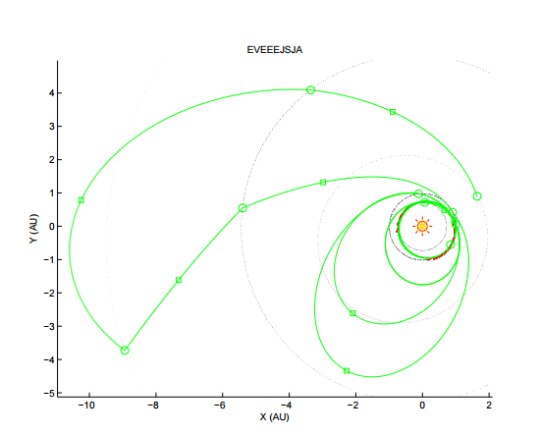
The first year’s competition, for example, was to deliver the most momentum to a particular asteroid within 30 years (say, to prevent it from hitting Earth), given that you have a spacecraft weighing 1500kg initially, with a low-thrust, high-efficiency nuclear-electric engine. So you want to use as little fuel as possible to maximize your mass when you hit the asteroid, but still hit that bad boy like a Rod from God. The winning team from @nasajpl came up with THIS SHIT:
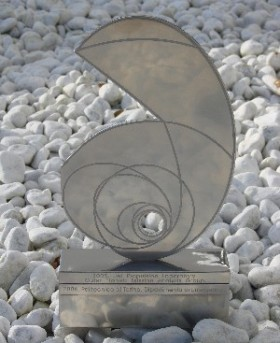
Their spacecraft toodles around the inner solar system for a couple years, banks off Jupiter, TURNS ITSELF AROUND on Saturn, and hits Jupiter again on the way back in towards the target. If you’ve never played KSP, turning a spacecraft around relative to the Sun is virtually impossible. It’s roughly twice as hard to do as just throwing something into the Sun. Humans have literally never put anything in a retrograde heliocentric orbit, and the space wizards from JPL (and their poor, beleaguered supercomputing cluster) found a trajectory that uses the fuel-budget equivalent of two tin cans and a piece of string. The final trajectory output was so badass that the trophy given out for winning the contest is literally a picture of it:
Anyway, the winning team gets to define the next year’s competition, so you’ve basically got the world’s raddest steely-eyed missilepeople challenging each other to optimize-offs every year or two. Man, I wish I’d taken second-level orbital mechanics in college.
The formation of ice from salt water produces marked changes in the composition of the unfrozen water. When water freezes, most impurities are forced out of solution; even ice from seawater is relatively fresh compared with the seawater it is formed from. As a result of forcing the impurities out, sea ice is very porous and spongelike, quite different from the solid ice produced when fresh water freezes.
As the seawater freezes and salt is forced out of the pure ice crystal lattice, the surrounding water becomes more saline. This lowers its freezing temperature and increases its density. The lower freezing temperature means that the surrounding water does not freeze to the ice immediately, and the higher density means that it sinks. Thus tiny tunnels called brine channels are created all through the ice as this supersaline, supercooled water sinks away from the frozen pure water. The stage is now set for the creation of a brinicle.
As this supercooled saline water reaches unfrozen seawater below the ice, it will cause the creation of additional ice. If the brine channels are relatively evenly distributed, the ice pack grows downward evenly. However, if brine channels are concentrated in one small area, the downward flow of the cold water, now so saline that it cannot freeze at its normal freezing point, begins to interact with unfrozen seawater as a flow. Just as hot air from a fire rises as a plume, this cold water descends as a plume. Its outer edges begin to accumulate a layer of ice as the surrounding water, cooled by this jet to below its freezing point, ices up. This is a brinicle: an inverted “chimney” of ice enclosing a downward flow of this supercold, supersaline water.
When the brinicle becomes thick enough, it becomes self-sustaining. As ice accumulates around the down-flowing cold jet, it forms an insulating layer that prevents the cold, saline water from diffusing and warming. As a result, the ice jacket surrounding the jet grows downward with the flow. It is like an icicle turned inside-out; rather than cold air freezing liquid water into layers, down-rushing cold water is freezing the surrounding water, enabling it to descend even deeper. As it does, it creates more ice, and the brinicle grows longer.
A reverse plume of hot air. An inverted icicle. This is my aesthetic.
Bat Bot, a lightweight flier with thin silicone wings stretched over a carbon fiber skeleton, can cruise, dive and bank turn just like its namesake, researchers report February 1 in Science Robotics.
Such a maneuverable machine could one day soar up the towering structures of a construction site, flying in and out of steel beams to help keep track of a building’s progress, study coauthor Seth Hutchinson, a roboticist at the University of Illinois at Urbana-Champaign, said in a news briefing January 31.
Other aerial robots, like some drones, aren’t so agile, relying on four whirling rotor blades to lift off the ground, Hutchinson said. These bots also have trouble flying in the wind, because they can exert force in only one direction, he said. Bat Bot’s flexible wings could make it a more versatile flier.
“Bat flight is the holy grail of aerial robotics,” said study coauthor Soon-Jo Chung, a Caltech aerospace engineer. Bats have more than 40 joints in their wings, which give the animals exquisite control over their flight maneuvers. Chung and colleagues re-created nine of the key joints, so their robot could flap its wings in sync, fold each wing independently and move each of its hind legs up and down. At 93 grams, with a wingspan of 47 centimeters, Bat Bot is roughly the size of an Egyptian fruit bat, Chung said.
#and on a lighter note #bat #the more you know #the power of science #I just saw this on Daily Planet! #like five minutes ago #apparently it can’t fly if it weighs more than about 100g #it was tricky even getting it light enough that it could support its own weight #definitely not a cargo bot #(which doesn’t stop it from being useful in other ways)