Inspired by @maddeningscientist‘s shitpost about throwing things into the Sun via gravity-assist, I thought I’d infodump spaceratblr on the subject of GTOC, “The America’s Cup of Rocket Science” and the most hardcore math contest in the solar system!
Basically it’s a yearly competition of ridiculously unconstrained orbital mechanics optimizations. You need to get [spacecraft] to do [thing] with a minimum amount of fuel, a minimum amount of time, both, or something else entirely.
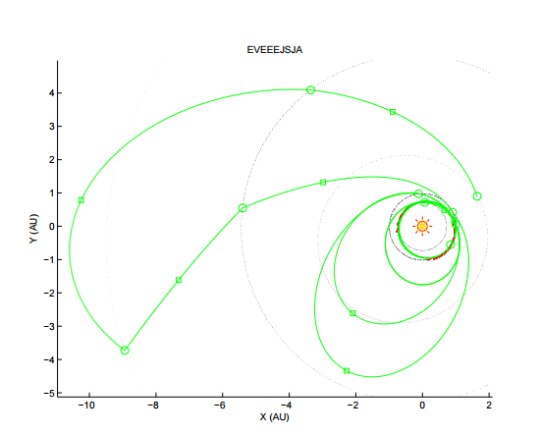
The first year’s competition, for example, was to deliver the most momentum to a particular asteroid within 30 years (say, to prevent it from hitting Earth), given that you have a spacecraft weighing 1500kg initially, with a low-thrust, high-efficiency nuclear-electric engine. So you want to use as little fuel as possible to maximize your mass when you hit the asteroid, but still hit that bad boy like a Rod from God. The winning team from @nasajpl came up with THIS SHIT:
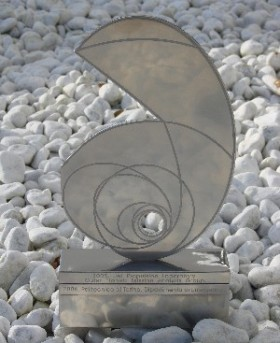
Their spacecraft toodles around the inner solar system for a couple years, banks off Jupiter, TURNS ITSELF AROUND on Saturn, and hits Jupiter again on the way back in towards the target. If you’ve never played KSP, turning a spacecraft around relative to the Sun is virtually impossible. It’s roughly twice as hard to do as just throwing something into the Sun. Humans have literally never put anything in a retrograde heliocentric orbit, and the space wizards from JPL (and their poor, beleaguered supercomputing cluster) found a trajectory that uses the fuel-budget equivalent of two tin cans and a piece of string. The final trajectory output was so badass that the trophy given out for winning the contest is literally a picture of it:
Anyway, the winning team gets to define the next year’s competition, so you’ve basically got the world’s raddest steely-eyed missilepeople challenging each other to optimize-offs every year or two. Man, I wish I’d taken second-level orbital mechanics in college.