Do you want to do hypnosis? Do you want to do hypnosis WITH SCIENCE?
As much as research tends to lag behind what people are actually doing with hypnosis, the last few years have actually seen a pretty big increase in research done on and scientific curiosity about hypnosis. My personal theory is that this is because there’s an increasing number of studies coming out saying that hypnosis is A THING in and of itself (outside of, although often in addition to, the influence of factors like authority and cultural expectations). The hypnosis that shows up in research is obviously differently-applied (and often narrower) than what we tend to do as hypnokinksters/hypno-enthusiasts. A lot of hypnosis research relies on old, old methodologies and constraints of trying to standardize procedures. Still, I really like peeking in at the research that is happening and seeing if I can learn anything.
Also, “facilitative sensory stimulation” is now a fetish on FetLife, which we all should add. It’s the greatest euphemism I’ve heard in a while.
Ella: I’m incredibly curious about what a facilitative sensory stimulation suggestion is and cannot get to the referenced article. Kinesthetic inductions? I have someone imagine they’re on a mountain and play the sound of yodeling in the background? I have no clue.
Okay, so I looked into the article you couldn’t reach (yay university subscriptions!). While it never actually uses the term “facilitative sensory stimulation”, I skimmed the article a bit and found this quote regarding debriefing:
Subjects in the experiential expectancy modification conditions were told the following:
“We tried to help you become hypnotized by making sure that you would have the first few experiences I suggested to you. Remember when I told you to see colors on the wall and to hear music? Whenever I said to imagine a color, we turned on a colored light that made the room look a tiny bit that color. When I told you to imagine that you could hear music, we turned on a tape. We did that only for the lights and the music. Everything else you did entirely on your own, and you did very well indeed.”
So that’s probably what facilitative sensory stimulation means: making the first couple “hallucinations” happen in reality as convincers.
(Sorry to burst anyone’s bubble. But hey, now you know what they were on about!)
Tags:
#sexuality and lack thereof #the more you know #reply via reblog #the power of science
Free-tailed bats have now been clocked flying horizontally at over 160 kilometers per hour (that’s nearly 100 mph!), toppling the previous record-holder, the swift. The record for speed of diving is still held by the peregrine falcon but we’re coming for you next, feathers.
So I haven’t thought about it in AGES, but did anyone else grow up with Muse Magazine? That there was, like, a fundamental part of my childhood.
I did! It was good. Also Odyssey and Cricket and other stuff by the same people.
Yes! Muse was great. I still have a bookshelf full of back issues I saved over the years.
These days I use Daily Planet and science blogs to scratch that itch, since they’re a lot cheaper, but still.
(One time I sent a letter, and they actually published it in the “letters to the editor” section. I was very surprised and kind of weirded out: all I really did was complain about [minor error redacted]*, why would they bother publishing that? My parents were so proud and showed it to everyone we knew, and it was embarrassing.)
*I’m tempted to be more specific about it and just figure that anyone who manages to work out my name given only that information is welcome to it, but nah.
Tags:
#reply via reblog #Muse #my childhood #the power of science
People who are blind from birth will gesture when they speak. I always like pointing out this fact when I teach classes on gesture, because it gives us an an interesting perspective on how we learn and use gestures. Until now I’ve mostly cited a 1998 paper from Jana Iverson and Susan Goldin-Meadow that analysed the gestures and speech of young blind people. Not only do blind people gesture, but the frequency and types of gestures they use does not appear to differ greatly from how sighted people gesture. If people learn gesture without ever seeing a gesture (and, most likely, never being shown), then there must be something about learning a language that means you get gestures as a bonus.
Blind people will even gesture when talking to other blind people, and sighted people will gesture when speaking on the phone – so we know that people don’t only gesture when they speak to someone who can see their gestures.
Earlier this year a new paper came out that adds to this story. Şeyda Özçalışkan, Ché Lucero and Susan Goldin-Meadow looked at the gestures of blind speakers of Turkish and English, to see if the *way* they gestured was different to sighted speakers of those languages. Some of the sighted speakers were blindfolded and others left able to see their conversation partner.
Turkish and English were chosen, because it has already been established that speakers of those languages consistently gesture differently when talking about videos of items moving. English speakers will be more likely to show the manner (e.g. ‘rolling’ or bouncing’) and trajectory (e.g. ‘left to right’, ‘downwards’) together in one gesture, and Turkish speakers will show these features as two separate gestures. This reflects the fact that English ‘roll down’ is one verbal clause, while in Turkish the equivalent would be yuvarlanarak iniyor, which translates as two verbs ‘rolling descending’.
Since we know that blind people do gesture, Özçalışkan’s team wanted to figure out if they gestured like other speakers of their language. Did the blind Turkish speakers separate the manner and trajectory of their gestures like their verbs? Did English speakers combine them? Of course, the standard methodology of showing videos wouldn’t work with blind participants, so the researchers built three dimensional models of events for people to feel before they discussed them.
The results showed that blind Turkish speakers gesture like their sighted counterparts, and the same for English speakers. All Turkish speakers gestured significantly differently from all English speakers, regardless of sightedness. This means that these particular gestural patterns are something that’s deeply linked to the grammatical properties of a language, and not something that we learn from looking at other speakers.
References
Jana M. Iverson & Susan Goldin-Meadow. 1998. Why people gesture when they speak. Nature, 396(6708), 228-228.
Şeyda Özçalışkan, Ché Lucero and Susan Goldin-Meadow. 2016. Is Seeing Gesture Necessary to Gesture Like a Native Speaker? Psychological Science
27(5) 737–747.
Asli Ozyurek & Sotaro Kita. 1999. Expressing manner and path in English and Turkish: Differences in speech, gesture, and conceptualization. In Twenty-first Annual Conference of the Cognitive Science Society (pp. 507-512). Erlbaum.
Incredible! I have nothing to add because I had no idea, but may I just say **WOW**!!!
Tags:
#language #the more you know #the power of science
Alton Brown’s Secret Workshop: Inside the Mad (Food) Scientist’s Lair
Food Network star Alton Brown began hacking (he prefers the term “hacking” over “inventing”) on his food-science show Good Eats. During season one (which aired in 1999), he made an inexpensive fish smoker out of a cardboard box. Since then, his hacks have grown in size and showmanship. Brown’s Mega Bake oven uses 54 one-thousand-watt lights to cook a pizza in three minutes, and his Jet Cream makes carbonated ice cream in 10 seconds using two fire extinguishers—one filled with CO2 and the other with a “top secret” chocolate cream mixture.
Brown has big plans for 2016, including releasing a new cookbook called EveryDayCook and embarking on a second national culinary variety show tour, the Eat Your Science tour, beginning in April in Charleston, South Carolina. In the meantime, Brown took a few minutes to talk with us about his inventions.
@banana-pie-gaige reminded me of an experiment I’ve been wanting to run.
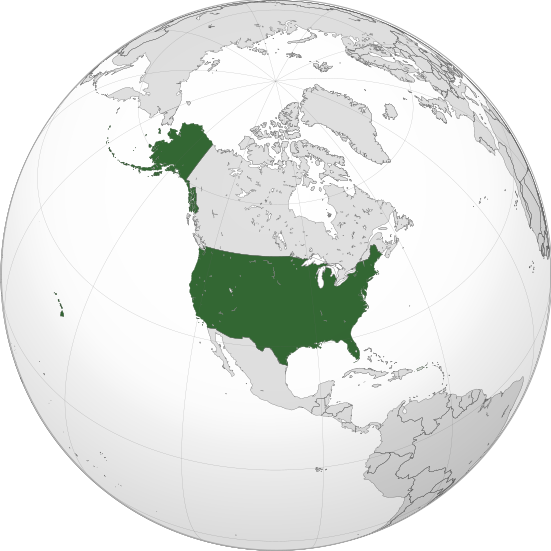
Loose conjecture: I have a book of sleeping tips that suggests that people close their eyes and slowly trace the outside ridges of the United States to trick the brain into starting REM. REM, or dreaming sleep, is often a period where people can be lightly suggestible- for example, you can talk to dreaming people and sometimes influence what happens in their dreams. There’s also the eye flutter that some subjects have when they go under and the eye movements people tend to have when you ask them to imagine a visual image when hypnotized- these may or may not be REM related (or require hypnosis at all).
Hypothesis: You can trigger tranceyness by having someone close their eyes and move them around in a circular way because this mirrors REM. Mirroring REM triggers a person’s mind to start dreaming which increases suggestibility.
Why this is probably bullshit: REM eye movements often look different than someone tracing the borders of the Unites States. People usually go through other sleep stages before getting into REM- you usually only jump in to REM when you’re sleep deprived. (My one time dreaming while hypnotized- which was awesome- was when I was up late and likely sleep deprived.) Moving eyes in a REM-ish way wouldn’t necessarily trigger REM or sleep or tranceyness or anything in particular. If this did put people to sleep or even made them dream,. this wouldn’t necessarily equal a useful hypnotic state. But what if it did?
That would be cool, huh?
Tumblr peeps- this is what I’d you to do:
Would you kindly:
1. Set an alarm for 6 minutes.
2. Close your eyes.
3. Relax. If you know how, let yourself sink into a light trancey/meditative state.
4. Imagine you can see the USA land formation. Gently and comfortable trace around the edges, starting at the top right hand side with Maine. Don’t try and think or stop thinking- thoughts can just happen all by themselves. You can just lazily notice anything that happens.If nothing much happens, just let yourself enjoy the break.
5. Write me feedback about what, if anything, happened. It’s OK to tell me nothing really happened- that’s useful information!
I’ll tell you guys if we collectively discover something cool. :)
Also- please let me know if you have ideas or if this is a thing you solved in 3rd grade.
Feel free to repost, anyone- I’d like to get a lot of minds on this if possible.
Not sure how you knew, but empirical kink is absolutely my thing.
“Would you kindly:”
I see what you did there.
Anyway, my results:
My mind did not wander very much: trying to remember exactly how the outline of the United States goes is a fairly occupying task. I noticed a couple minutes in that the movement of my arm was a bit jerky, as it tends to be in trance. Following up on this, somewhere around Arizona or southern California I tried ceasing to consciously move my arm to see what would happen. Sure enough, my arm continued moving up and to the left, in small jerking movements.
I continued on through the flat stretch of Canadian border, around the Great Lakes, and back to Maine. During my second lap of the East Coast, it felt at times like I was more guiding my arm than actually moving it.
At the tip of Florida, I tried ceasing my conscious movements again. Again, my arm continued up and to the left.
Before I had a chance to try pausing at a point where the next section wasn’t up and to the left, the alarm went off.
So, neat and pretty fast-onset ideomotor effect, but I didn’t get any imagery, nor did the picture of the U.S. in my mind’s eye seem any more vivid than my mind’s eye normally does (which is not that much; I’m towards the low-detail end of the spectrum).
Notes regarding confounds: I got about 8.25 – 8.5 hours of sleep last night (low end of normal for me), I was neither on any stimulants nor in withdrawal from them (I’m not caffeine-dependent; I customarily have some chocolate at this time of day, but I waited until after the experiment), I looked at the linked picture right before the experiment to refresh my memory of the outline, my brother walked in during the experiment (I tried to ignore him, but I was a little distracted worrying he would ask what I was doing and I wouldn’t have a non-embarrassing answer). (He didn’t ask, though I don’t know whether he noticed or what he thought about it if so.) I have avoided looking to see if there are other responses to this post because I didn’t want to contaminate my answers. (I’ll read them afterward, assuming there are any.)
P.S. Okay, so the consensus of the other respondants seems to be that the verb “trace” does not indicate moving one’s hand? Am I the only one who interpreted it that way? Well, this is awkward.
(I hope I’ve given you some interesting data, even if I may have misunderstood the provided protocol.)
Tags:
#reply via reblog #sexuality and lack thereof #for science! #TMI #now it’s time for that chocolate #(perhaps it will soothe the awkward)
In 1994, Patrick R. Michaud and some accomplices (inspired by a Dave Barry column) turned a toaster and an “SPT” into a rudimentary blowtorch and documented it on the then-nascent Web.
This is now one of the oldest webpages still accessible.
“At this point, the researchers also realized that the heat could inadvertently melt the adhesive cellophane and cause the flaming SPTs to suddenly eject from the toaster. Unfortunately, this did not occur.”
Tags:
#food #anything that makes me laugh this much deserves a reblog
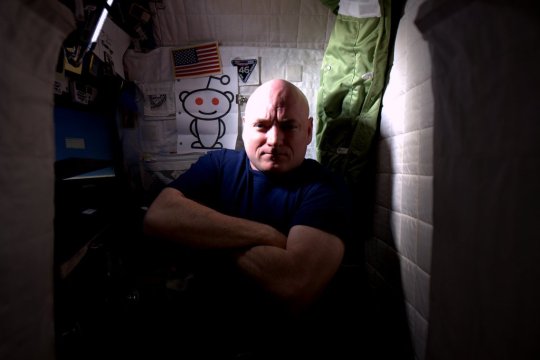
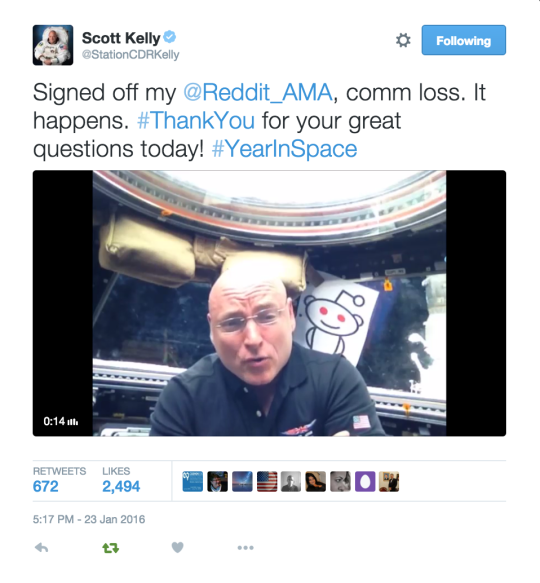
NASA astronaut Scott Kelly hosted a Reddit Ask Me Anything on Jan. 23 where people, well, asked him anything.
Kelly answered a range of questions from whether the crew members play space pranks on one another (“Occasionally…” Kelly said without elaboration.) to whether Kelly’s recovery plan will be different than normal (“I think my rehab plan is the same as if I were here for 6 months, but I’m not positive.”).
To start off, here are a few quick facts we learned about Kelly during the AMA:
The advice he would’ve given himself before going into space on day 1 would be to pack lighter.
His favorite David Bowie song is “Modern Love,” and his favorite non-space related movie is “The Godfather.“
He uses a Nikon D4 when taking pictures (camera settings and lenses vary).
He thought it was cool to watch the movie “Gravity” while he was on the space station, because that’s where the movie took place.
Once he lands, Kelly will miss the challenge of being aboard the space station the most.
Here are a few fun questions that astronaut Scott Kelly answered:
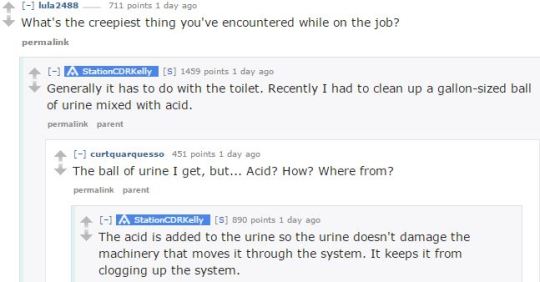
What’s the creepiest thing you’ve encountered while on the job?
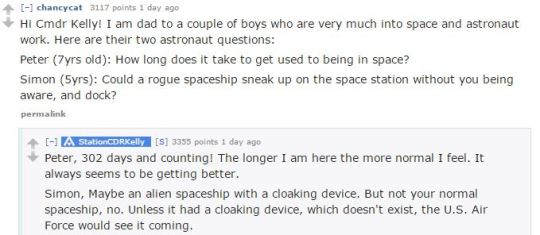
Could a rogue spaceship sneak up on the space station?
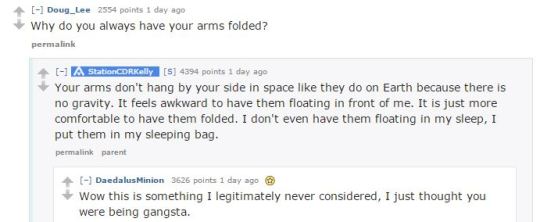
We finally got an answer for one thing so many of you have been curious about…why does Scott Kelly always fold his arms?
When astronauts go up to space, they experience something very few others have and see Earth from a very unique perspective. What’s one thing Kelly will do differently once he returns home?
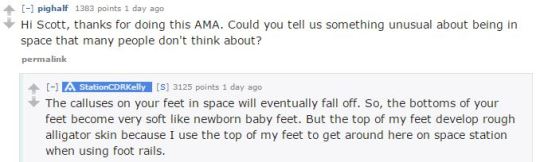
Kelly also told one user something unusual about being in space that people normally don’t think about: feet calluses.
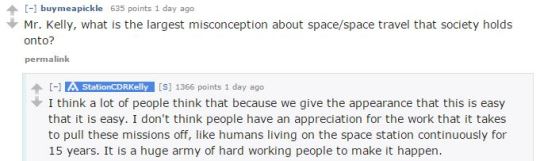
Another user wanted to know what the largest societal misconception about space/space travel is. According to Kelly, it has nothing to do with science.
To read the entire Reddit AMA with Kelly, visit his IAmA thread.
Kelly’s #YearInSpace ends Mar. 2. Follow him until the end of the journey (and beyond) on Twitter, Instagram and Facebook.
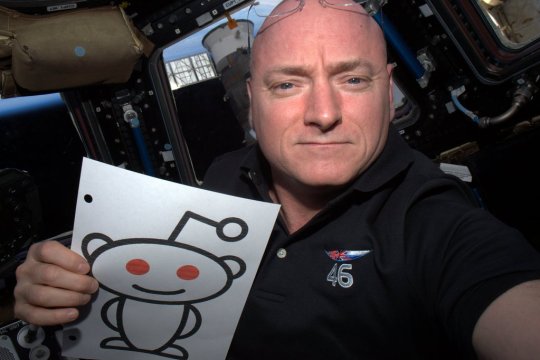
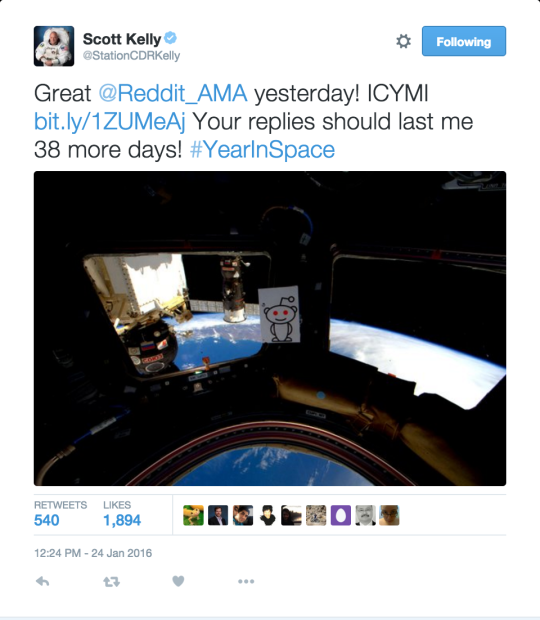
I think my favorite part of Commander Kelly’s AMA was realizing that NASA had to ship up the printed Reddit logo for his AMA verification on one of its cargo flights.
It currently costs about $10,000 to send a pound of cargo to low-Earth orbit. There’s about 100 sheets of paper in a pound, so that was a $100 sheet of paper. Maybe the most expensive single Reddit logo on or off this planet.
Tags:
#space #the brightest star in our sky #the more you know #long post
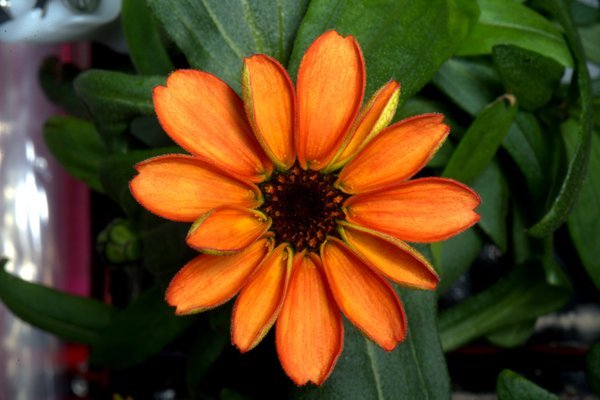
This zinnia flower was not selected for his beauty (although it is super cute!), but because it can help scientists understand how plants flower and grow in microgravity.
“It is a more difficult plant to grow, and allowing it to flower, along with the longer growth duration, makes it a good precursor to a tomato plant” said Trent Smith, Veggie project manager at NASA.