@brin-bellway asked: What’s that unicorn(?) on the kitchen table?
It is an ELEPHANT! :D It’s a Better Homes and Gardens brand wax warmer I found at Walmart for $15. (There was going to be a $6 rebate but I forgot to include my receipt.) You put a lil cube of scented wax in the bottom tray, and then you switch it on, and a little 25watt lightbulb inside the porcelain body of the elephant melts the wax and makes your house smell good.
I’d been thinking about getting a wax warmer for a while, and then I picked up a bunch of Joann’s brand candles on uber-sale that don’t function terribly well as candles because the wicks burn down faster than the wax burns up, so I was looking at wax warmers and I found this one. I think it’s really cute, and also the porcelain and glaze look reminds me of the Red Rose Tea figurines we used to have when I was a kid. You can use a single cube of wax several times till all the smell is gone, so it might be more cost efficient than candles, also. It really depends how often I use one versus the other.
Tags:
#love the decor fandom #huh #I did not know wax warmers were a thing #the more you know #(25 watts is a Lot for a lightbulb these days but I suppose you need the heat) #(and it’s still fairly small in the scheme of things)
So I don’t remember if I’ve mentioned this before, but “overnight oatmeal” is this branded thing that comes in expensive little cups, and I just wanted to mention that it’s not specially treated oatmeal in any way.
You can literally just buy a normal canister of oatmeal, dump a serving or so in a bowl, add enough to cover of milk, water, milk substitute, whatever pleases you – I know I’ve seen it done with apple juice, I don’t think I’d recommend orange juice. Then you stir it up, let it soak in the fridge for 6-8 hours, and you have perfectly edible oatmeal. You can toss in dried fruit, spices, whatever.
In Scotland several centuries ago, this was called “drammach”, and you would make it with water when you were on the run, as sometimes happened in old-timey Scotland. It was handy because it didn’t need cooking, so your enemies could not find you by the smoke of your campfire. Also a bag of dry oatmeal weighs practically nothing and will feed you for days as long as you have water.
(I hear they just get water out of the sky in Scotland. Can’t relate. *desert dweller*)
These days, it’s handy because oatmeal is very cheap and reasonably filling, it requires no special cookware, you can prep it in like three gestures (dump – pour – stir), and if you forget it in the fridge for a day or so it’s still good and nothing catches on fire. So I thought I’d mention again, in case anybody would be interested and hadn’t known, that this is a thing you can do and you absolutely don’t have to pay three bucks for a lil half-cup branded container.
Tags:
#food #the more you know #adventures in human capitalism #I’ve been thinking about getting into porridges #I don’t get enough fibre in my diet unless I actively seek it out #and I’m worried about what my current popcorn-based strategy might be doing to my teeth
they’re one of the fruits where the supermarket variety is the supermarket variety because it survives the trip, not because they’re good
meanwhile tomato plants are really low effort. if you have favorable conditions you can do literally nothing
—
Where are you *finding* conditions that aren’t full of weeds and wildlife-competing-with-you-for-the-food and the occasional blight? A greenhouse?
(…actually, that might not be a bad idea. I *have* heard of people building little personal greenhouses in their backyards, and nothing keeps squirrels from taking one bite out of your mom’s tomato and walking away like a fucking *door*, right?)
Re: surviving the trip, home-grown zucchinis taste about the same but we’ve noticed the shelf life is *vastly* longer. Store-bought zucchinis start to shrivel up and go soft within a few days of bringing them home; home-grown zucchinis can sit in the fridge for several *weeks*. Makes it a lot easier to plan your meals.
Honestly, probably a good part of my problem with gardening is that, because *Mom* loves home-grown tomatoes for some fucking reason, they end up the focal point of the garden and a great deal of my gardening-related labour is thoroughly alienated: I never see the fruits *or* the vegetables of my labour.
A garden optimised for what *I* thought was most worth growing would have zero tomatoes and more garlic and zucchini, with perhaps just enough potatoes to keep in practice so that I can put potatoes in the victory garden. And probably more perennials like mulberries. And possibly mushrooms. And I would want to do a bunch of research and expert-consultation regarding which weeds are secretly edible, since anything *that* easy to grow sounds like something I should take advantage of.
(I’ve been meaning to do some more digging into how to eat dandelions. I’ve heard you can put the new greens in salads and the petals in pancake batter, but I don’t normally eat salads *or* pancakes. Can you just, like, munch on a raw dandelion flower straight-up? Can I fulfil my childhood dream of eating a pretty flower I found in the backyard?)
@larshuluk replied:
Yeah, you can just munch any part of dandelion – I often do that when I’m reading in the garden. Older leaves get bitter and shouldn’t be eaten in big amounts, and roots need cooking. Flower is just fine though.
—
Hell yeah!
—
This is another area where I like a lot of the things the communing-with-nature people are putting out but for completely different reasons. I want to know more about the natural world around me *so that I can exploit it better*. Which wildflowers can I eat? What’s the name of that one plant where when you run through a field of them it sounds like popcorn popping? Can I eat those too?!
(I never stopped wanting to stick interesting plants in my mouth: I just learned to resist it, to assume everything was poisonous until proven otherwise. And for the most part, nobody ever taught me which interesting plants I didn’t have to resist.)
Let’s get a few other cool edible / semi-edible plants out then :)
I mostly like fruits, since they are easy to identify and I don’t really have skills in identifying leaves. (So you see, I’m not an expert, don’t take this as authoritative advice! Also I’m looking up some names in a dictionary, since English is not my native language.) Most suitable for central Europe, since that’s my location.
First: Poisoning yourself is very much a thing which can happen! Be careful!
There’s a lot of stuff which has some poison of the same strength as found in apple seeds, and that poison is removed by cooking. If you find these things on the side of the path and you snack small amounts, realistically nothing bad will happen. Cool examples:
– Elderberries – European beech nuts (different, weaker poison. It is said the taste gets better, too, when lightly roasted. I love them as is already. Taste varies quite a bit from nut to nut, and is not very predictable from the look of it. So if you don’t like it, maybe still try a few more.) – Rowan fruit (they’re disgusting raw, only bother if you want to cook them)
Then there’s stuff which is not commonly eaten, but can:
– ONLY THE FLESH of yew fruit. These are my favourite, they are planted in many locations, especially near graveyards. The pit is *very* toxic. I usually spit it out. – Cornelian cherry fruit. Tastes great, take the very dark red ones. – Blackthorn fruit. Need to be frozen before they become tasty. – Sea-buckthorn berries. Grows on dunes near the sea, and generally on sandy ground. – Hawthorn fruit. Taste somewhat like flour, not a great taste on its own. Take the very ripe, dark ones. Can be used to extend jam. Is often planted near fields as a hedge.
As a rule of thumb, all the stuff which grows on abandoned lots is mostly focused on settling the place *at all*, and therefore doesn’t focus much on poison. (Meaning they are great plants to *investigate* for edibility, not “just snack them, what could possibly go wrong?”)
Notably, thistles, stinging nettles, dandelions, many amaranths / pigweeds, plantains are edible both raw and cooked, including roots and flowers. Artichokes are basically thistles. Roots are hard even after cooking and don’t taste great, so I recommend not to bother. For stinging nettles and thistles, obviously remove / flatten the stingy parts before sticking them in your mouth.
Okay, better exploitation isn’t the *only* reason I want to know more about the nature around me. It also just bugs me to look at a plant or an insect or what-have-you and not know what it is. It feels…a lot like the feeling I get when I hear my co-workers chatting to each other in languages I don’t speak. Like I’m not a full person, missing a way of parsing the world that a person would have.
—
Thanks for the tips!
—
>>First: Poisoning yourself is very much a thing which can happen! Be careful!
I have a food-poisoning phobia and am *very* careful. That’s part of what concerns me about this whole food-security concept space, that I’m not as flexible as most people in what I’m comfortable with eating.
(On the bright side, if I *am* comfortable eating something I will happily eat it every day for years on end. I hear a lot of people worrying about the morale effects of having to resort to a repetitive diet in times of crisis, and I really don’t think that will be a problem for me.)
—
I did a bit of googling and there do seem to be some local homesteads-and-the-like in my area offering classes and advice to people who want more self-sufficiency. They’re intensely Living in Harmony with Nature types, but even with some clashing values I expect there’s still much to be gained by learning what they have to teach.
—
@rustingbridges: >>idk about potatos specifically but I think durable transportable stuff like potatos and onions is the relative advantage of actual farmers. relative to growing fragile vegetables that kind of thing is probably only worth doing to the extent you’re having fun with it
Like I said, the point would be to keep in practice. Potatoes are among the worse things to grow in a regular garden (because you could have just skipped all the bullshit and bought a 10lb bag at the grocery store for like $3 instead), but one of the best things to grow in a victory garden (high calorie-density, stores well, quite a few nutrients).
(…I should probably clarify that I’m using “victory garden” broadly: the disaster-fucking-with-access-to-groceries need not be a *war* specifically.)
Certainly this makes potatoes a lower priority: one would probably not need to grow them in particularly large or frequent quantities under normal circumstances. Indeed, I have enough other safety-net holes to patch that it’s likely not *currently* worth doing at all, completely crowded out by more important tasks.
—
@florescent–luminescence: >>We also had a lot of Critters come sample the garden.
Yeah. That’s almost always been a major problem for us, and it was *especially* bad in 2020. We’re definitely going to have to look further into physical barriers: greenhouses maybe, but at least some sort of cage.
Tags:
#reply via reblog #gardening #food #poison cw #in which Brin has a food poisoning phobia #the more you know #101 Uses for Infrastructureless Computers #apocalypse cw? #is the blue I see the same as the blue you see
1. Since coronaviruses, being dependent on an envelope, are generally one of the easier viruses to destroy, my baseline initial assumption was that standard disinfectants work. I know there *are* some bottles of ammonium-chloride-based disinfectant sprays at the grocery store now advertising themselves as “approved for use against COVID-19”, though I haven’t looked into the details of such approvals myself.
(Also, if you replace store-bought quat wipes with homemade quat wipes, any change in effectiveness will not be because of problems common to all quat-based cleaners.)
2. I gather that SARS-CoV-2 fomites aren’t a big deal, except maybe under extreme circumstances like caring for COVID patients: it’s the airborne stuff you gotta worry about.
This is mostly a general zeitgeist thing and I don’t have many links on hand, but off the top of my head there’s the argument-from-salad-bars [link].
The main reason to disinfect stuff is to prevent COVID *scares*. All else equal, catching a cold during a pandemic is worse than catching a cold under normal circumstances, because now you have to worry about whether it’s actually the plague. Plus if you catch a *really* bad flu and end up hospitalised, that’s one step closer to overwhelming the hospital (and god help you if they’re *already* overwhelmed).
—
I personally haven’t been disinfecting my respirator (I wash my hands after touching it if it’s been out in the last 3 – 4 days; if possible, I also wash *before* touching it), but OTOH I have 15+ years’ experience with tracking potential-fomite statuses in my head and exercising caution in what I touch accordingly. For people who haven’t trained on that until it becomes second nature (perhaps because they didn’t have the threat of horrific colds to motivate them [link]), disinfection often makes sense.
(Plus ULine was out of stock when I bought my filters, so I have the pink-circle ones. There’s only so much disinfection I’d be able to do.)
I *do* disinfect my smartphone after every outing, but I was already in the habit of doing that before COVID-19. (Note that I have a screen protector and a case, though you *might* still be able to get away with it without those.)
—
P.S. Since apparently we’re talking about quaternary ammonium in more than just an aside now, while we’re at it: *don’t* use ordinary cotton for your homemade disinfectant wipes! [a source]
P.P.S. Oh, also, I just noticed the term “handwash” in your ask. That might have something to do with it, since you’re not supposed to use quaternary ammonium as hand sanitiser: it’s a mild skin irritant. (To be completely honest I occasionally end up doing it anyway at work, but that is part of why I use shitloads of moisturiser.)
Tags:
#covid19 #tales from the askbox #illness tw #the more you know
Short version: it’s like a mask, but better. *Much* better.
Let’s put the headline news up front: if you maintain an airtight seal at all times, a P100 respirator blocks 99.97% of incoming viral particles. [source]
Yeah. 99.97%. That’s a *lot*.
(Specifically, we are going to be talking about what’s called “elastomeric” respirators. These have a base unit made of plastic and silicone, with attachment points on the cheeks for swappable filters.)
—
99.97%?! What’s the catch?! There’s gotta be a catch, right?
A few catches, but generally nothing dealbreaking.
The filtered air is very dry: take frequent breaks if you can to go outside (or somewhere else with clean air) and drink some water. I work 4 – 5 hour shifts for 2 – 3 straight days a week with a respirator and no water breaks, and that’s *doable* but dehydrating.
They muffle your voice a bit more than masks do. You’ll have to speak louder and probably be more careful with enunciation than usual, and talking on the phone will be very difficult.
The 99.97% figure is for *incoming* air. An elastomeric respirator does not, by default, filter outgoing air at all. This is okay for two reasons: one, since you can’t spread a disease you don’t have, protecting yourself *is* protecting others. Two, for even more protection of others you can tape a layer of cloth over the valve on the bottom of the respirator.
They cost more up-front (about USD$30 for a base unit and USD$11 per pair of filters), but they last for such a long time (more on that later) that in the long run it’s actually very economical.
—
So why isn’t everyone using them already?
Mostly because people don’t know about them. Cloth masks were supposed to be a stopgap measure until we had a chance to manufacture more respirators, but word never got out when the respirators had caught up. They do *sometimes* go out of stock still, but they’re very often available now.
Also, the kind of respirators we’re going to be talking about here are aimed at construction workers, which means people looking for “medical” masks tend to overlook them. But a particle is a particle, and there’s no reason you can’t use construction respirators against germs. In fact, in some ways they work even *better* against germs than they do against construction fumes.
—
What do I need to know about how to wear them?
First, check the fit. Take off your glasses if you have them, then put the base unit on and adjust the straps until the seal is airtight without being painful. You won’t be able to get an airtight seal if there’s facial hair in the way: you’ll need to at *least* trim it down very far, and probably shave it.
To confirm that the seal is airtight, there are two methods depending on whether the filters are attached right now.
If the filters are *not* attached: cover the attachment points with your palms and try to breathe *in*. If you can’t, the seal is airtight. (Except for the attachment points themselves, of course: *those* are big gaping holes in your seal if they don’t have filters on them. But we’ll be fixing that soon.)
If the filters *are* attached: cover the valve at the bottom with your palm and try to breathe *out*. If you can’t, the seal is airtight.
(You’ll want to confirm the seal every time you put the respirator on.)
Next, take a pair of filters and screw them onto the attachment points. (This is much easier to do if you’re not wearing the respirator while you’re doing it.) Be sure to screw them on very tightly, otherwise they might fall off. (I didn’t screw them on tightly enough my first time, and it was pretty scary when one of them fell off in the middle of a crowded restaurant. But now that I’ve gotten them on correctly, they stay put.)
Now you can wear it. If you have glasses, take them off first, then gently rest them on top of the respirator’s nose once you’ve put it on. Check the seal as above to make sure it’s airtight.
Once a week or after every outing, whichever is less frequent, wipe down the silicone (the part that sticks to your face and forms the seal) with some mild cleaning solution to keep the skin oils from building up. You can also wipe down the outside if you are concerned about fomites, but note that of the two styles of filter (more on that later) you can *only* wipe down the plastic cartridges, *not* the pink cloth circles. Here is the official manufacturer’s guide on cleaning these respirators [link]: note that “quat” is janitorial jargon for the type of cleaning solution that Lysol wipes are dipped in.
(Bonus tip: if you’re having trouble sourcing disinfectant wipes, look for bottles of “quaternary ammonium” *next* to the barren disinfectant-wipe section at the grocery store, put it in a spray bottle diluted to the level stated on the bottle instructions, then heavily spritz a paper towel with it. Voila, a disinfectant wipe!)
According to the CDC [link], the filters last somewhere between a month and a year depending on how much you need to conserve resources and how well you can avoid getting them wet or dirty. The main limiting factor on longevity is that the filters get clogged with fumes and dust from the construction work: if you’re not *doing* construction work or similar fume-heavy activities, they can keep going for ages. If you can still breathe through it and the filter hasn’t been wet, you’re good.
ULine has the water-resistant plastic-cartridge filters, is a very reputable dealer, and sells for a good per-pair price. The only trouble is that they sell 6 pairs at a time: split a pack with a group of 3 people if you can, so that each of you will have one spare set.
The pink-circle filters are *not* water-resistant: try not to stay out in the rain very long or otherwise get them wet, and don’t try to disinfect them (just avoid touching them instead, and wash your hands if you do have to). Also, counterfeits occasionally slip into Amazon’s stocks: try Amazon filters on when you first get them, and if you can still smell anything through them, demand a replacement. You should *not* be able to smell anything through a true P100 filter.
I don’t have links for these on hand. For the base unit, check your hardware and general stores for “3M model 7502 respirators”; for the filters, look for “3M bayonet-style P100 filters” and prefer the plastic cartridges over the pink circles if possible. If you can’t find any of those, try looking into other elastomeric respirators, but I don’t have any experience with other ones so you’d be on your own there. Remember that you should not be able to smell anything through an airtight P100 respirator: if you put the filters on and can still smell stuff, something’s wrong with those filters, go back to the seller and get them to either give you a better set or refund you.
—
Getting a respirator has been a life-changer for me, and I hope it can help you too. If you found this useful or know someone who would, please let people know.
Important correction: You can actually smell lots of things thru a properly working, plain P100 respirator, because many of the things that we can smell are gasses, which particulate filters do nothing against. This is fine for this purpose: SARS-CoV-2 and droplets that carry it are particles.
As I recall, I was surprised that you’d stopped smelling things when you got yours, but found out that the specific filters you were using were P100 filters with nuisance organic vapor filtering. These contain a relatively small amount of activated carbon which absorbs organic vapors at levels below occupational exposure limits that would require heavier vapor protection, as well as most of the vapors you’d smell in ordinary life, at ordinary concentrations.
Huh. That’s very good to know. I defer to your expertise.
(I’d seen multiple reviews saying that the *two* ways of detecting counterfeits were “suspiciously light” and “scent infiltration”, but since the intended audience doesn’t already have experience with these and wouldn’t know when one feels suspiciously light, I only kept the second one in.)
I would, in that case, recommend nuisance organic vapor filtering for the psychological benefits: respirator-specific anosmia is a great way to subconsciously reassure yourself that you’re not getting exposed to anything *else* in the air. (Admittedly this may be more of a me thing: since I’ve been using anti-pollen masks for years, I’m very accustomed to judging air quality by the amount of scent that gets through. (For pollen, the occasional whiff and a *bit* of background is generally fine, but if my sense of smell seems completely unimpaired I need to replace my mask.))
—
@nicdevera [link], I have occasionally tried jogging to work when I was running a bit late, and I find I can’t jog for very long in my respirator: I can’t quite get enough airflow. Biking would probably depend on how hard you’re pushing it.
(I get my exercise on a home treadmill, but I recognise that I am incredibly fortunate to have the housing space and stability for one, and also to have gotten it circa 2014 when demand was quite low and you could often pick a used one up for the price of moving it.)
—
It is becoming increasingly clear that I should have put this post under a read-more: not only is it fairly long, it’s going to need updates. @wingedcatgirl, @moral-autism, @sophia-epistemia, @drethelin: I don’t suppose y’all would be willing to go reblog the read-more version instead?
Tags:
#reply via reblog #covid19 #the more you know #oh look an update #illness tw
Short version: it’s like a mask, but better. *Much* better.
Let’s put the headline news up front: if you maintain an airtight seal at all times, a P100 respirator blocks 99.97% of incoming viral particles. [source]
Yeah. 99.97%. That’s a *lot*.
(Specifically, we are going to be talking about what’s called “elastomeric” respirators. These have a base unit made of plastic and silicone, with attachment points on the cheeks for swappable filters.)
—
99.97%?! What’s the catch?! There’s gotta be a catch, right?
A few catches, but generally nothing dealbreaking.
The filtered air is very dry: take frequent breaks if you can to go outside (or somewhere else with clean air) and drink some water. I work 4 – 5 hour shifts for 2 – 3 straight days a week with a respirator and no water breaks, and that’s *doable* but dehydrating.
They muffle your voice a bit more than masks do. You’ll have to speak louder and probably be more careful with enunciation than usual, and talking on the phone will be very difficult.
The 99.97% figure is for *incoming* air. An elastomeric respirator does not, by default, filter outgoing air at all. This is okay for two reasons: one, since you can’t spread a disease you don’t catch, protecting yourself *is* protecting others. Two, for even more protection of others you can tape a layer of cloth over the valve on the bottom of the respirator.
They cost more up-front (about USD$30 for a base unit and USD$11 per pair of filters), but they last for such a long time (more on that later) that in the long run it’s actually very economical.
—
So why isn’t everyone using them already?
Mostly because people don’t know about them. Cloth masks were supposed to be a stopgap measure until we had a chance to manufacture more respirators, but word never got out when the respirators had caught up. They do *sometimes* go out of stock still, but they’re very often available now.
Also, the kind of respirators we’re going to be talking about here are aimed at construction workers, which means people looking for “medical” masks tend to overlook them. But a particle is a particle, and there’s no reason you can’t use construction respirators against germs. In fact, in some ways they work even *better* against germs than they do against construction fumes.
(Edit: Okay, yes, also they look funny, but people in 2019 would have told you masks looked funny too.)
—
What do I need to know about how to wear them?
First, check the fit. Take off your glasses if you have them, then put the base unit on and adjust the straps until the seal is airtight without being painful. You won’t be able to get an airtight seal if there’s facial hair in the way: you’ll need to at *least* trim it down very far, and probably shave it.
To confirm that the seal is airtight, there are two methods depending on whether the filters are attached right now.
If the filters are *not* attached: cover the attachment points with your palms and try to breathe *in*. If you can’t, the seal is airtight. (Except for the attachment points themselves, of course: *those* are big gaping holes in your seal if they don’t have filters on them. But we’ll be fixing that soon.)
If the filters *are* attached: cover the valve at the bottom with your palm and try to breathe *out*. If you can’t, the seal is airtight.
(You’ll want to confirm the seal every time you put the respirator on.)
Next, take a pair of filters and screw them onto the attachment points. (This is much easier to do if you’re not wearing the respirator while you’re doing it.) Be sure to screw them on very tightly, otherwise they might fall off. (I didn’t screw them on tightly enough my first time, and it was pretty scary when one of them fell off in the middle of a crowded restaurant. But now that I’ve gotten them on correctly, they stay put.)
Now you can wear it. If you have glasses, take them off first, then gently rest them on top of the respirator’s nose once you’ve put it on. Check the seal as above to make sure it’s airtight.
Once a week or after every outing, whichever is less frequent, wipe down the silicone (the part that sticks to your face and forms the seal) with some mild cleaning solution to keep the skin oils from building up. You can also wipe down the outside if you are concerned about fomites, but note that of the two styles of filter (more on that later) you can *only* wipe down the plastic cartridges, *not* the pink cloth circles. Here is the official manufacturer’s guide on cleaning these respirators [link]: note that “quat” is janitorial jargon for the type of cleaning solution that Lysol wipes are dipped in.
(Bonus tip: if you’re having trouble sourcing disinfectant wipes, look for bottles of “quaternary ammonium” *next* to the barren disinfectant-wipe section at the grocery store, put it in a spray bottle diluted to the level stated on the bottle instructions, then heavily spritz a paper towel with it. Voila, a disinfectant wipe!)
According to the CDC [link], the filters last somewhere between a month and a year depending on how much you need to conserve resources and how well you can avoid getting them wet or dirty. The main limiting factor on longevity is that the filters get clogged with fumes and dust from the construction work: if you’re not *doing* construction work or similar fume-heavy activities, they can keep going for ages. If you can still breathe through it and the filter hasn’t been wet, you’re good.
ULine has the water-resistant plastic-cartridge filters, is a very reputable dealer, and sells for a good per-pair price. The only trouble is that they sell 6 pairs at a time: split a pack with a group of 3 people if you can, so that each of you will have one spare set.
The pink-circle filters are *not* water-resistant: try not to stay out in the rain very long or otherwise get them wet, and don’t try to disinfect them (just avoid touching them instead, and wash your hands if you do have to). Also, counterfeits occasionally slip into Amazon’s stocks: try Amazon filters on when you first get them, and if you can still smell anything through them, demand a replacement. You should *not* be able to smell anything through a true P100 filter. Edit: @nuclearspaceheater, who is a more experienced respirator user than I am, reports that many genuine P100 filters *do* let some scent through: I merely happened to have filters with some extra vapor filtration. I’ve seen reviews saying that fakes are suspiciously light, but it’s hard to tell if you don’t already know how much they should weigh, plus that *also* might have been a vapor-vs-nonvapor distinction. It’s possible that the people complaining about counterfeit filters from Amazon are just straight-up mistaken and they’re all fine, but I would still go with ULine for the water resistance if nothing else.
I don’t have links for these on hand. For the base unit, check your hardware and general stores for “3M model 7502 respirators”; for the filters, look for “3M bayonet-style P100 filters” and prefer the plastic cartridges over the pink circles if possible. If you can’t find any of those, try looking into other elastomeric respirators, but I don’t have any experience with other ones so you’d be on your own there. Remember that you should not be able to smell anything through an airtight P100 respirator: if you put the filters on and can still smell stuff, something’s wrong with those filters, go back to the seller and get them to either give you a better set or refund you.Edit: This is not necessarily true and indeed there might not be counterfeits at all: check the edit in the USA section for more details.
—
Getting a respirator has been a life-changer for me, and I hope it can help you too. If you found this useful or know someone who would, please let people know.
—
Postscript, 2021-09-14: It has been my experience that nuisance-vapour filtration wears out after 3 – 4 months. If you value its psychological benefits (I don’t know about you, but nothing reassures my subconscious about air quality quite like respirator-specific anosmia), or have additional uses in mind for your respirator such that you need nuisance-vapour filtration, I recommend planning to replace your filters about that often.
(I gave American links because statistically those are probably the most useful: if you’d like help finding links for other countries, let me know and I will help you look.)
A P100 respirator offers slightly *more* protection to the wearer than the vaccines do. Since people who don’t *have* COVID-19 can’t *spread* COVID-19, this also prevents you from infecting others; for even greater protection of others, tape a layer of cloth over the valve on the bottom of the respirator.
If a filter falls off, it means it wasn’t screwed on tightly enough: I had the same problem my first time, but now that I’ve screwed them on tighter they stay put. A single set of filters can last for months as long as it doesn’t get wet: the way a filter wears out is that it gets clogged with fumes from the construction work you’re (presumably) *not* doing, so as long as you can still breathe through it and it hasn’t gotten wet beyond the occasional raindrop, you’re good. (Note: the ULine link is to water-resistant filters, which are hard to find on Amazon.)
Yes, you won’t be able to eat and drink indoors with your friends, and ideally you should take a break every hour or so to go outside and drink something because filtered air is quite dry, but you can have physical presence.
—
(Edit, re: tags: you know what, I *am* going to write a broader public-service-announcement version of this. If you were thinking of reblogging this post for the info, please wait and I will update you with a better-for-reblogging version when I have finished writing it.)
#covid19 #illness tw #vaccines #the more you know #I disagree with your narrative but I don’t think I can talk you out of it #instead let’s try granting it and talking about how you can *still* make things work #@everyone: feel free to treat this as a respirator PSA #if there is interest I can write a broader respirator PSA with less negativity involved #I said I would never write another Tumblr-hosted OP but for something this important I can probably make an exception #anon hate cw? #tales from the askbox
The day after tomorrow- that is, February 18, 2021- the Perseverance rover will attempt to land on the surface of Mars. It will enter the planetary atmosphere at an acute angle, giving it as much time as possible to experience drag and slow down from orbital velocities. Because Mars’ air is so thin, and the rover is so heavy, this will fail- in the best case, Perseverance would still be going almost a thousand miles an hour when it impacts the surface. To help save itself, the craft will deploy a parachute of advanced design, seventy feet across and able to withstand supersonic velocities. This, too, will fail. Even with a parachute, there is simply not enough air between Perseverance and the Martian surface to slow it down all the way. So this is where the rockets kick in. Once air resistance slows the rover to a bit less than two hundred miles per hour, the heavy heat shield will be jettisoned, and a system of secondary rockets will fire against the direction of motion until it slows to near-hovering. In a final flourish, the rover will descend from the rocket-boosted frame on coiled springs, until it touches down in the western part of Jezero crater in the northern hemisphere of Mars.
As it happens, Perseverance’s destination was one of the very last things we decided about it- not until the craft itself was fairly thoroughly engineered and designed. Formally, the decision was made by the mission directorate. In practice, they follow the consensus of the scientific community, which in turn hashes things out at a series of open-invitation workshops. Things began with a call for white papers- an open suggestion box, basically. In 2015, the first workshop narrowed things down from thirty serious proposals to eight candidates. In 2017, the second workshop further winnowed the list down to three. And in October of 2018, after three days of presentation, debate, and discussion, the final workshop selected Jezero Crater from these final three candidates using a simple vote of all attendees, and passed on the recommendation to the mission leads.
I haven’t been in the business for very long, so the final workshop was the only one of these where I actually participated. It wasn’t a close vote as such, and I didn’t break any ties, and technically we were just making a strongly worded suggestion. Nonetheless, my vote is one of the reasons why the Rover will be going to Jezero Crater instead of Syrtis Major or Gusev, and I think I’m entitled to feel ownership of this mission choice, just a little bit.
(This is, of course, terrifying.)
Having gone through the experience, there were a few surprises worth noting. The first was how small some of the numbers are here. The conference was not very large: only thirty proposals, debated by just a few hundred attendees. I’ve seen book review contests with more entries, and that are read by a wider audience. Which is to say, this is a situation that was, and is, extremely responsive to individual effort. In that small a room, populated by people that are philosophically committed to changing their minds when they see good evidence or a good argument, one person can stand up and change the future in a very real way.
The second surprise was the attendance requirements. Or rather, the lack thereof. The project is public, paid for by American taxpayers, to whom I am profoundly grateful. And one way the process reflected that public-spiritedness is that this is not a walled garden. A small attendance fee (iirc, $40?), and you’re in. You get a vote, if you want to use it. A few non-scientists even took us up on this; there’s one retiree (a former schoolteacher, I think) that’s attended every major conference I’ve been to in the last few years, and sets up a small table in the back with his home mineral collection just for fun. In practice this open-door policy is limited by the obscurity of the event itself; if you don’t move in research circles, you have to be something of a space exploration superfan to hear about it. Still, as symbols go, you could do worse.
And now that we’re coming up on the day itself, the same kind of public-facing mindset is making me think about why I was persuaded to vote for Jezero Crater, what it means to explore there, and how I’d justify that choice to those of you that made the ongoing discovery of Mars possible in the first place.
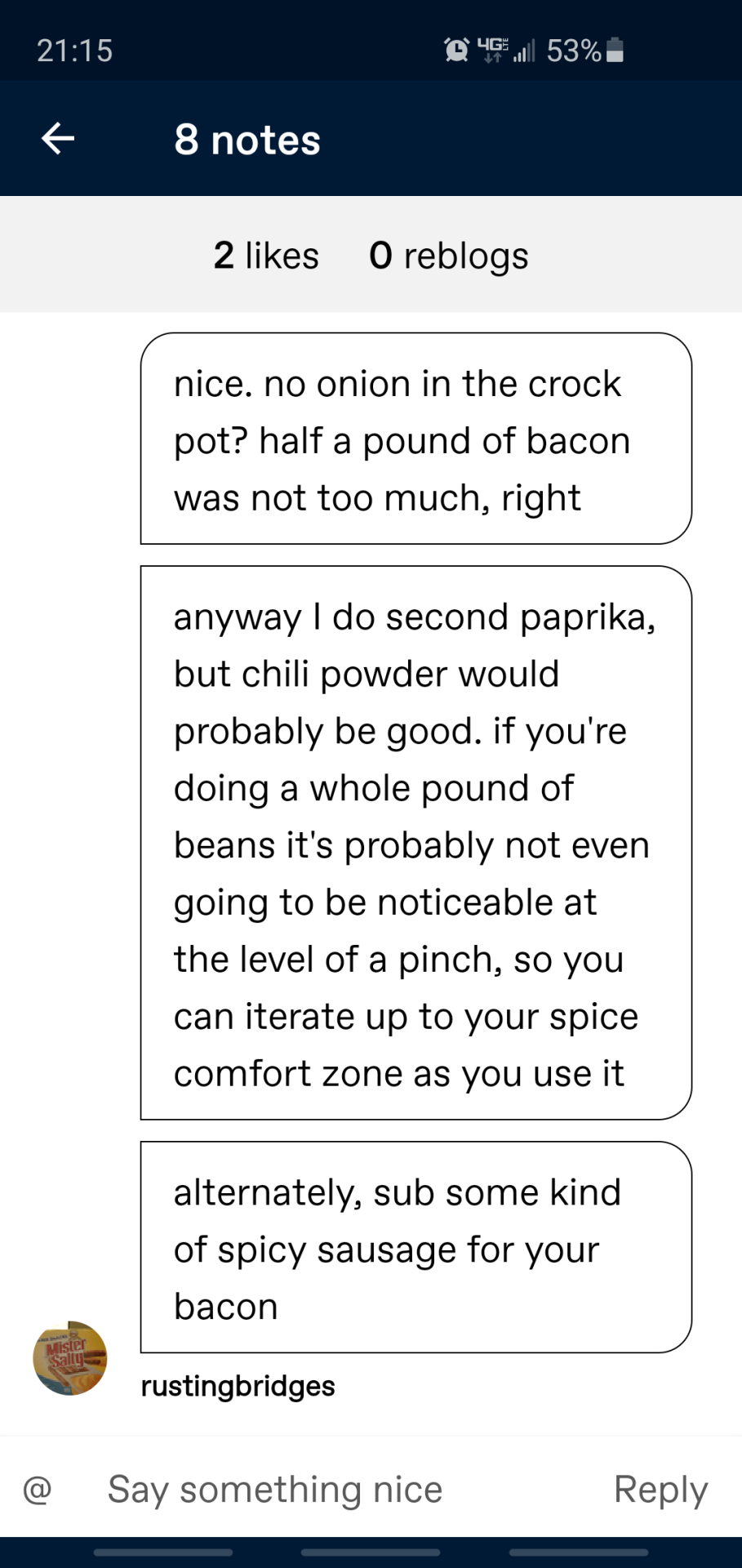
@rustingbridges The bacon pretty much dissolved, just added some flavor. Onion might be a good idea but I absolutely loathe trying to chop the damn things. Do they sell pre-chopped onion?
Sausage might be a good mix-in. Maybe just thaw and chop some breakfast links and toss them in. That might be a good plan.
Onion powder?
—
For my dad’s kidney beans we use hot sauce, Worcestershire sauce, chopped green bell pepper, salt, black pepper, onion, and garlic. When I make hummus I pretty much just embrace the bland, apart from some garlic and salt.
Worcestershire sauce! I definitely need some. I think I had looked for onion powder at Target but they were all out, and in my experience onion powder and paprika don’t really have any flavor anyway. Maybe the bottles my family had were just very stale though
moral-autism replied: “I’ve seen stores sell both fresh prechopped onion and frozen chopped onion potato mixes…”
Tags:
#conversational aglets #food #the more you know #bluespace #replies
Hey everyone! Read Only Mind (ROM) is an inclusive archive for mind control and hypnosis erotica made by a small team that wanted to add features for writers and readers alike, and to help foster a community of content creators. You can find us at our website here!
I am super excited to share this with y’all as we’ve been working on it for a while. Examples of our features include account creation to post and upload your stories at any time, a tagging system (!!), comments, following stories for that anticipated next chapter, statistics for authors to see how readers engage with their content, an advanced search bar, and more.
This is a resource made by and for community, and we hope to grow with everyone’s help and support. Go ahead and check our About section for Rules and our FAQ, and please check it out and discover the stories and features, bookmark it for future content, and write your own stories if you’d like!
Since this is Tumblr and I don’t have CHARACTER limits, I can talk about how I’m excited for this! The other admin and I wanted a website that could offer more than what we were used to, while not having to see racist stories scroll by. This website is the result of that! We have story likes (called ‘snaps’), comments and suggestions (that you have the option to turn off as the author!), you’ll get to see how many people view your story and the number of snaps you’ve received, and a bunch of other stuff! You’re free to post onto ROM and other places at the same time since exclusivity isn’t a requirement, but we have a few authors who’ve already uploaded stories and are making the move over.
Spread the word for this if you can! You can find our official Twitter account here where we’ll post updates, and our current discord link is HERE where you can join us and talk with some other content creators! It’s a first public push and we’re still taking bug reports should we run into any issues.
Thanks so much for reading!
Tags:
#interesting #sexuality and lack thereof #the more you know #nsfw text? #(for those of y’all who are outsiders interested in subcultural anthropology: #yes ”account creation to post and upload your stories at any time” is a big deal in context) #(at the big mind-control-erotica site you submit your stories to the admin and he goes through and puts them up once a week) #(sometimes there are no updates that week because he was on vacation‚ the implications of which are frankly very concerning) #(does Simon bar Sinister have an heir? does the EMCSA pass the bus test??) #(have we actually been trusting a vital piece of community infrastructure to a single fucking dude for the past 20+ years???) #(I’m not plugged into the scene enough to know whether there are answers to these questions floating around #but I *am* plugged in enough to wonder about it) #death mention