so there’s this ‘cursed conlang circus’ running at the moment. and you gotta see some of these entries, like holy shit.
Tags:
#language #anything that makes me laugh this much deserves a reblog #this post was queued because my to-reblog list is too long and I didn’t want to dump it on you all at once
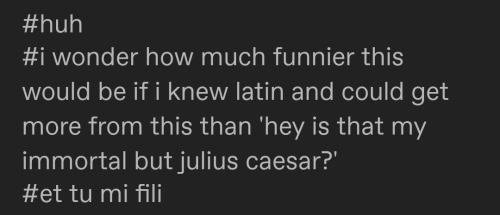
Salvete, Gaius Iuli’us Caesar sum et pilorum album quam nivem habeo et aureos, sed interdum virides lauros et imperium Romanum construxi et eius eram quasi primus Caesar (sic merui nomen meum) et multi indicant mihi me Marcus Crassus similem esse (si non scitis Marcus Crassus, vobis opus est pecunia). Brutus non est filius meus quod est bonum nam ET TU, MI FILI???!?. Iamia sum sed dentes albos et rectos habeo. Pallidam cutem habeo. Etiam, maga sum magicum ludum, nomine Pigverruca, visitans quod desinam (ego sum MMCXIV), veni, vidi, vici. Classicus sum (si vos id non suspexistis) et multas togas emptas in Basilica Iulia habeo. Ratio amo et bellum Gallicum gero. Veluti, hodie omnia Gallia occupata. Omnia Gallia? Certe! Non est vicus parvus inter Aquarium, Babaorum, Laudanum et Brevisbonum. Ambulabam foris Pigverruca. Ninxit et pluvit et Gallia divisa erat in partes tres, quod me fecit felix. Marcus Porcius Cato me observavit. Digitum medium illo monstravi.
My Latin is pretty rusty, but I know enough to say that it’s a bunch funnier, so let me take a stab at translating. I’m breaking down the original so if I make any ridiculous mistakes through not having taken Latin in 15+ years, other people can correct me.
“Salvete, Gaius Iuli’us Caesar sum” – Greetings, all! I am Gaius Julius Caesar
“et pilorum album quam nivem habeo et aureos,” – and I have spears that are whiter than snow and golden
“sed interdum virides lauros” – but sometimes green laurels
“et imperium Romanum construxi” – and I built the Roman empire
“et eius eram quasi primus Caesar (sic merui nomen meum)” – and I was, like, its first Caesar (that’s how I got my name) [note: a more literal translation is “thus I earned my name”, but it’s obvious that this is a direct reference to the line “that’s how I got my name” in the original]
“et multi indicant mihi me Marcus Crassus similem esse (si non scitis Marcus Crassus, vobis opus est pecunia).” – and many people say to me that I seem to be like Marcus Crassus (if you don’t know Marcus Crassus, your work is money). [translator’s note: “your work is money” is not a phrase I’m familiar with. Google Translate suggests “you need money” as a more idiomatic translation. My best guess is it might mean something like “you work for your money instead of being a patrician with a family inheritance”.]
“Brutus non est filius meus quod est bonum nam ET TU, MI FILI???!?.” – Brutus is not my son, which is good because AND YOU, MY SON???!? [note: this is the more classically attested version of Caesar’s last words, famously quoted in English as “et tu, Brute?” or “and you [are killing me too], Brutus?”
“Iamia sum sed dentes albos et rectos habeo.” – I am a [vampire?] but I have white and straight teeth. [note: I’m more familiar with the Lamia as a Greek female monster similar to Scylla but with only one neck. However, Google Translate’s suggestion of “vampire” seems likely accurate from the obvious context.]
“Pallidam cutem habeo.” – I have pale skin.
“Etiam, maga sum magicum ludum, nomine Pigverruca, visitans quod desinam (ego sum MMCXIV), veni, vidi, vici.” – Also, I am a female witch [at?] a magic school, named Hogwarts, which I will stop visiting (I am 2094), I came, I saw, I conquered.“ [note: “Veni, vidi, vici” is famously what Caesar said when deciding to bring his army to Rome and become its ruler.]
“Classicus sum (si vos id non suspexistis) et multas togas emptas in Basilica Iulia habeo.” – I am classical (if you didn’t know) and I have bought many togas in the Julian Basilica.
“Ratio amo et bellum Gallicum gero.” – I love reason and I conduct the Gallic [French] wars.
“Veluti, hodie omnia Gallia occupata. Omnia Gallia? Certe!” – As if, today all Gaul is occupied. All Gaul? Definitely!
“Non est vicus parvus inter Aquarium, Babaorum, Laudanum et Brevisbonum.” – It is not a small village between Aquarium [pun: fish tank], Babaorum [pun: rum cake], Laudanum [pun: opium product] and Short Good.
“Ambulabam foris Pigverruca.” – I was walking outside Hogwarts.
“Ninxit et pluvit et Gallia divisa erat in partes tres, quod me fecit felix.” – It snowed and rained and Gaul was divided into three parts, which made me happy. [note: Caesar’s history of the Gallic Wars famously begins “Gaul is divided into three parts”.]
“Marcus Porcius Cato me observavit. Digitum medium illo monstravi.” – Marcus Porcius Cato [the Younger, a famous opponent of Caesar’s ambitions] stared at me. I put my middle finger up at him.“
The year is 50 B.C. All Gaul is occupied by the Romans. All? No! One small village of indomitable Gauls still holds out against the invaders. And life is not easy for the Roman legionaries who garrison the fortified camps of Babaorum, Aquarium, Laudanum and Petibonum…
#okay so this one is closer to 8 business *months* (2023-05-14) #I don’t think any of the others are nearly so old though #My Immortal #language #oh look an update #this probably deserves some warning tag but I am not sure what #this post was queued because my to-reblog list is too long and I didn’t want to dump it on you all at once
This is just Gardiner’s sign list of Egyptian Hieroglyphics A1-B2 with a couple of repeats thrown in at the end. You’ve thrown a vocabulary list at us.
“Kill them with kindness” Wrong. CURSE OF CEASAR
A B C D E F G H I J K L M N O P Q R S T U V W X Y Z S P Q R
Tags:
#(…this worked when I first saw it but then something broke with my Firefox fonts and now it’s a bunch of hexcode boxes) #((specifically Firefox: it works if I paste it into a notepad)) #(anyway) #language #anything that makes me laugh this much deserves a reblog #this post was queued because my to-reblog list is too long and I didn’t want to dump it on you all at once #(P.S. I looked it up and apparently it’s some sort of interaction with the tracking protection) #(turning off ”block suspected fingerprinters” lets you see Unicode characters again)
God bilingual people are so cool. I’d love to be bilingual someday.
“Aren’t you alrea–” Shut the fuck up I’ve never spoken any language in my life
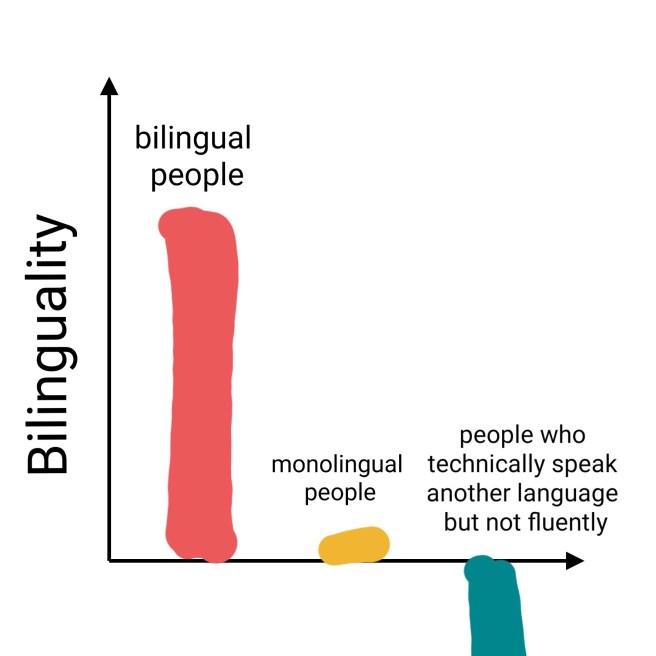
The thing people don’t understand is that mathematically speaking, being slightly bilingual actually makes you LESS bilingual than people who are monolingual. I’ve created a helpful chart to assist:
This is known as the I’d Rather Die Than Attempt to Converse With A Native Speaker paradox, and it has befuddled scholars for centuries
#that one post with the thing #thinking about Sofi’s comment here while listening to Swahili-language music with one of my Indian coworkers #language #this probably deserves some warning tag but I am not sure what #this post was queued because my to-reblog list is too long and I didn’t want to dump it on you all at once
Intentional! So, it’s an extension of the “[thing]-pilled” phraseology, which means approximately that the subject has embraced [thing] (and usually [thing] is positioned to be good, but not always. It’s contextual.)
“Pill me on [thing]” is essentially saying “Convince me that I should embrace [thing]” (with an implication that you have an open mind/want to be convinced.) I picked it up from my roommate @eiko-chatter, for better or for worse.
So, the post you’re referencing– I sent that ask in response to @chilope saying in the tags of a previous post “#im so fucking aeropress pilled,” meaning something like “I have accepted the aeropress into my life and I swear by it.” When I asked her to “pill” me on it, it was a request for information, but with an embedded request for her specifically to make a case for why I should also accept this thing into my life– and the phrasing indicates a lot of receptiveness toward the idea that the thing is good/correct.
Tags:
#this feels like one of those posts to etch into your monolith for the benefit of future historians #language #the more you know #this post was queued because my to-reblog list is too long and I didn’t want to dump it on you all at once
ate 15c., in chess, “to attack the king; to put (the opponent’s king) in check;” earlier (late 14c.) in a figurative sense, “to stop, arrest; block, barricade;” from check (n.1) or Old French eschequier, from the noun in French. A player in chess limits his opponent’s ability to move when he places his opponent’s king in check.
The other senses seem all to have developed from the chess sense, or from the noun: “To arrest, stop,” then “to hold in restraint” (1620s); “to hold up or control” (an assertion, a person, etc.) by comparison with some authority or record (1690s); of baggage, etc., “to hand over in return for a check that serves as a means of identifying” (1846); “to note with a mark as having been examined, etc., mark off from a list” (1928).
Hence, to check off (1839); to check up (1883); to check in or out (in a hotel, of a library book, etc., 1909). To check out (something) “to look at, investigate” is from 1959
check (n.1)
c. 1300, in chess, “a call noting one’s move has placed his opponent’s king (or another major piece) in immediate peril,” from Old French eschequier “a check at chess” (also “chess board, chess set”), from eschec “the game of chess; chessboard; check; checkmate,” from Vulgar Latin *scaccus, from Arabic shah, from Persian shah “king,” the principal piece in a chess game (see shah; also compare checkmate (n.)). Also c. 1300 in a generalized sense, “harmful incident or event, hostile environment.”
As “an exposure of the king to a direct attack from an opposing piece” early 15c. When his king is in check, a player’s choices are severely limited. From that notion come the many extended senses: From the notion of “a sudden stoppage, hindrance, restraint” (1510s) comes that of “act or means of checking or restraining,” also “means of detecting or exposing or preventing error; a check against forgery or alteration.”
Hence: “a counter-register as a token of ownership used to check against, and prevent, loss or theft” (as in hat check, etc.), 1812. Hence also the financial use for “written order for money drawn on a bank, money draft” (1798, often spelled cheque), which was probably influenced by exchequer. Hence also “mark put against names or items on a list indicating they have been verified or otherwise examined” (by 1856).
think i may have already posted this but its so strange that “check” as in “examine” comes from check in chess
Tags:
#what *are* words? we just don’t know #language #history #the more you know #chess #this post was queued because my to-reblog list is too long and I didn’t want to dump it on you all at once
i love the french, i love the way they pronounce Rs like they’re disgusted with them
the english meanwhile seem to have developed some sort of phobia about them
When we were discussing the surgery I’d need for my sleep apnea, the surgeon told me I’d never be able to speak French properly because the French R is a uvular sound and I’d no longer have a uvula.
… that’s okay? I’m not French? I don’t speak French? I’ve always thought it was the weirdest thing for him to say!
Huh. Didn’t know you could have French surgically removed.
sorry i just cannot get this out of my head. Like, “oh you speak french? i hear there’s an operation for that”
Tags:
#anything that makes me laugh this much deserves a reblog #language #this probably deserves some warning tag but I am not sure what #medical cw? #injury cw? #this post was queued because my to-reblog list is too long and I didn’t want to dump it on you all at once
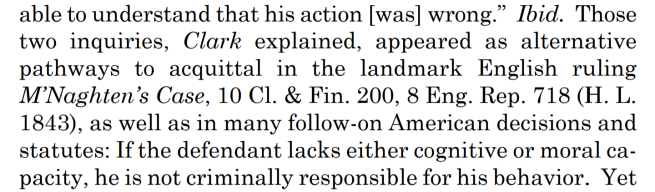
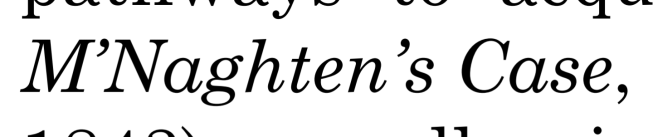
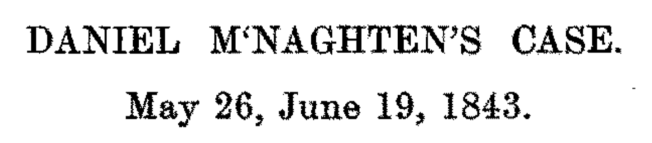
ever since I learned about the “turned comma,” the rotated comma type that typographers once used as a superscript “c,” Michael G. Collins, M‘Culloch and the Turned Comma, 12 Green Bag 2d 265 (2009), I can’t help but notice when people get it wrong
Justice Kagan, for example, got it wrong in Kahler v. Kansas, No. 18-6135, slip op. at 2 (U.S. March 23, 2020):
word processors can’t rotate type, but we could approximate the “turned comma” much better if we used a single open quotation mark (‘) instead of an apostrophe (’), as Justice Kagan does here
or we could just use “c,” as we do for McCulloch v. Maryland, 17 U.S. (4 Wheat.) 316 (1819), even though the report reads:
Tags:
#language #the more you know #embarrassment squick? #this post was queued because my to-reblog list is too long and I didn’t want to dump it on you all at once
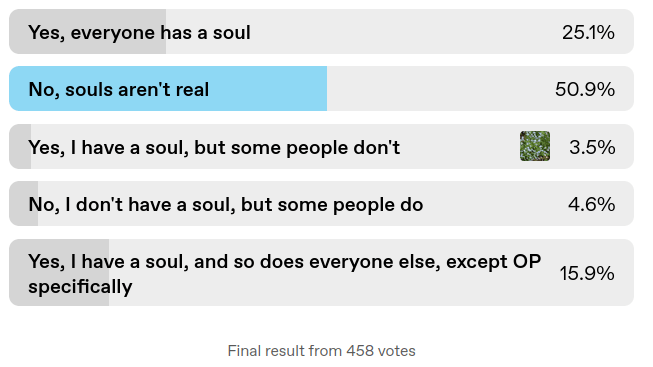
The word “soul” is so semantically overloaded that *all* of the first four options are correct.
Tags:
#I voted for option 3 because I have an unusually stable personality #I am constantly running into people who are‚ like‚ completely different people than they were two years ago #there’s no *core* to them: everything is in flux #those of them I’ve heard discussing it say they like it better that way #(some of them have gone so far as to say it’s morally obligatory) #but it’s really not my style‚ personally #(you’re probably wondering in what sense do I not have a soul but other people do) #(ideally I would answer with a link to that one post by…was it aspire-to-the-light?) #(in which they describe their quale of having a conscience in a thoroughly alien manner) #(but I cannot find it) #reply via reblog #tag rambles #is the blue I see the same as the blue you see #surveys #language
Weird! Neat! I think generally that transition is poorly sourced? Maybe try Google ngrams
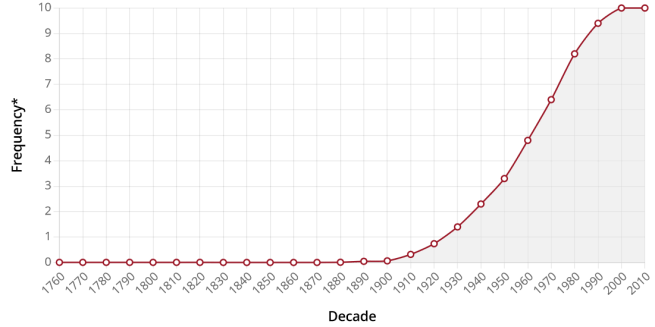
a reasonable estimate is that the popularization of the word “sibling” happened over the second half of the 20th century. before that the word had been active in technical areas, but didn’t seem to pick up steam in other places until the ‘60s. some interesting timestamps sourced from old newspapers:
1943, new york: Henry Hastings Curran (1877–1966, then NYC’s chief magistrate) expressed dismay at the increasing use of the word among probation officers, with a bemusing amount of outrage: “how would you like to be called a scarab? or a scamp? or a coystrel or a curmudgeon? or a tatterdemalion? or a gremlin? or a sibling? how would you like that?” “to me it has a very doubtful sound, dubious, dismal, desparate.” (1 Aug 1943, New York Daily News)
1944, london: at the pensions tribunal at the law courts, Sir Owen Bearsley (could be this Owen Bearsley, unsure) was confused by a psychiatrist’s use of the word in his report. Bearsley’s colleague had to look it up in a medical dictionary.
1953, london: one Alan Dick advocated the use of the word in place of the cumbersome “brother and sister”: “here’s another ugly one—brother-or-sister. you want to ask somebody if he-or-she is an only child or if he-or-she has any brothers or sisters, and it all has to come out at once—bruthussasistus. this is another place for a single word meaning either. the psychologists… invented a word of their own. sibling. what about taking it over for everyday use?” (24 Feb 1953, Daily Herald)
1963, US: William Morris (1913–1994, lexicographer, columnist) mentioned the word in his syndicated column Words, wit and wisdom (5 Nov 1963), stating that the word was “recently popularized” and reporting a difference in the definitions then used in the US (“children born at different times of the same parents”) and in the UK (“children having one or both parents in common”).
for reference, here is the OED’s n-gram for “sibling”:
Tags:
#what the fuck #this is like when I learned yesterday that the two-wheeled telescopic-handle suitcase was invented in *1987* #which is also! the year that scrunchies became a thing! #…what new things do people just a little younger than me assume have been around Forever #language #history #this post was queued because my to-reblog list is too long and I didn’t want to dump it on you all at once