tramampoline:

I feel like everyone should know that late last year, a new version of Prisencolinensinainciusol (the song by Adriano Celentano that was meant to sound like English but was intentionally just English-sounding gibberish) has a new version with a collaborative singer and Benny Benassi remix and music video


Tags:

#music #language #oh my god #(both are great) #(if you haven’t watched the original watch that one too)

justice-turtle:

so has anybody got podcast recs? i’m up to date on kuec (twice), x-plain the x-men is on a three month hiatus, hidden almanac is… short. ^_^

the problem is, of course, i get hypersensitive about any little hint of -ism or – really anything at all upsetting, in my podcasts? cos i don’t have auditory filtering, so it’s like… the point of podcasts for me is to feel like i’m chilling with friends and listening to them chatter while i do whatever i’m doing.

so frex – podcasts i’ve tried that haven’t worked for me. “the thrilling adventure hour”, i think i mentioned that i just didn’t really click with the particular form of humor, but also i think scripted podcasts just don’t work as well for me as ones where it’s friends kidding around with the potential to go totally off the rails.

“journey into misery”, a dude explaining comics continuity to his girlfriend, WAY less mansplainy than that sounds – the podcast was her idea. loved it except that lbr comics are ALL FUCKSHITE and i can’t handle sentences like “they gang-raped plastic man’s wife and she died” no matter how much the podcasters agree that it was fuckery.

(note for some other post: despite never having been sexually assaulted, i get full-on triggered by sexual assault stuff? idek why)

“into it”, elle collins. a trans lady (i think? not 100% sure if binary or nonbinary) interviews people about various shit they’re interested in. excellent show, just a tiny bit too structured for me.

“the film reroll”, movies played as rpgs. mostly enjoyable, but in 12 episodes there’s been like… three really awkward jokes that weren’t called out? one super transphobic throwaway line – not even a line, a *phrase* – near the beginning of their epic wizard of oz four-parter, two ableist aspie/autism jokes. so i’m like “ehhhhh”, not quiiiite as comfortable as i like to be with my podcasts? :S also there’s only like 24 episodes so i’m already a good halfway through that one

“comicsverse”, too structured AND way too many people. i do best with two-person podcasts where the voices are pitched well apart, due to my auditory processing troubles. i can handle up to about four people if i don’t actually need to tell any of them apart. ;-)

*******

so. anyway. if you’ve recced me something and it’s not listed here i probably forgot to check it out. y’all know a bunch of my many and varied interests; i’d especially enjoy rpg-type podcasts, the summer specials on x-plain the x-men are some of my favorite comfort relistens, but you understand why i’m hesitant to just go guddling around in gamer nerd territory. ;P

Podcasts I listen to:

The Red Panda Adventures: I want you to like this one, because I love it and I would love to geek out with you about it, but I’m not sure you would like it. It’s scripted and has a largish cast*, so there’s those issues. (AFAIK, there are no public transcripts for you to check if you heard something right**.) It is reassuringly liberal, toning down 1930′s-era bigotry about as much as it can get away with, but “as much as it can get away with” isn’t “everything”. And one of the conventions of the particular superhero sub-genre they’re working in (which they explicitly embrace) is that the heroes never dwell on their own moral ambiguity. I mean, it’s good that they’re avoiding gritty grimdark stuff, but that does mean the occasional moment of being horrified by what the protagonists are doing while knowing it will never come back to bite them.

Talk the Talk: Linguistics podcast out of Australia. I’m still way back in the archives on this one. I think it’s only partially scripted: it definitely doesn’t feel all that scripted. Two hosts, plus sometimes a guest. They occasionally get a bit Discourse-y for my liking, but I think they’ve always been on the liberal side of the argument.

99% Invisible: About infrastructure and suchlike. I’m even further back in the archives on this one, only a couple dozen episodes or so in. One host, with one or two guests. Feels somewhat more scripted.

Science for the People (formerly Skeptically Speaking, but they changed it after realising their podcast hadn’t really been about skepticism for a while): Interviews on neat science things. Audio isn’t really a good format for me for this subject (I prefer to get my neat science things through text, and sometimes video), so eventually I got bored and stopped listening. (The number of trying-to-be-inclusive-and-failing episodes about sexuality was also a factor. I know my standards are too high, but it still bothers me.)

Speaking of, I also dabble in a few kink podcasts. TBH, though, I’m never even sure whether *I* like any of them, let alone whether they’re worth reccing to anyone else.

*Although, because each side actor plays several side characters, between episodes you are generally not expected to know who a side character is without context. (Within an episode you’re supposed to keep up, though.)

**Brain: “Yet!”

Me: “We have more than enough other things to do and are not taking on ~60 hours of volunteer transcription.”


Tags:

#I stopped listening to Welcome to Night Vale because I got tired of the horror elements #reply via reblog #recs
“Quoth” the raven? The heartwarming tale of a defective verb

allthingslinguistic:

amaranthine-ephemerality:

It is one of the most well-known lines English poetry has to offer: “Quoth the raven, ‘Nevermore.’” It is an eerie verse found in Edgar Allan Poe’s “The Raven”, and we all know what the the first word in it means. It’s a weird, extremely uncommon verb in the past tense meaning ‘to say’. Now use the same verb to ask if the raven said “nevermore.” Did the raven… and now most of you – excluding you language and etymology enthusiasts out there – are struggling because you don’t know what the infinitive of quoth is. What has happened?

The English language is fairly old, so it isn’t surprising to find out that many words have died out, i.e. they aren’t in use anymore and can oftentimes not be understood by native speakers. Look, for instance, at the Old English noun costnunge and try to guess what it means. No idea? Maybe the context will help. It can be found in the sentence And ne gelæd ðū ūs on costnunge, found in an OE version of the Lord’s Prayer. It means ‘temptation’, or rather meant that, seeing as it hasn’t been used for a very long time. If you read Middle English versions of the prayer, you’ll see that the noun had already been replaced by a ME form of temptation.

What does this have to do with quoth? Quite a bit, actually, only that it is a far more interesting word. It belongs to a class of verbs we call defective verbs. These are verbs exhibiting an incomplete conjugation, which means the verb doesn’t have a (modern) form for every tense, aspect, mood, or person. Modal auxiliaries are prime examples; take can for example, which has a preterite form, could, but it doesn’t have a present or past participle. The verb must is an even more extreme case as there isn’t even a past form. An example of a lexical defective verb would be beware because bewares, bewared, or bewaring aren’t normally used in present-day English. With quoth, we have the 1st and 3rd person sing. past tense form still being known to speakers, which is rather interesting and unusual, and if it weren’t for “The Raven”, who knows if we would still know about this verb. We also don’t use it anymore unless we want to write a fancy poem with archaic language.

Quoth comes from the ME verb quethen, from OE cwethan. According to the Oxford English Dictionary, all forms of the verb save for the one in question were no longer in use by the end of the 16th century. But why did people stop using the verb? We cannot look into the heads of the people who spoke English a thousand years ago, but one reason is certainly the competition the verb had to face. The most common verbs in Modern English that have the same or a similar meaning are say, speak, and tell. And man, are they common. They were already around in Old English times, when we had secgan, sprecan, and tellan. Believe it or not, it gets even more interesting.

The exact same thing happened in German, another West Germanic language! In Old High German, the verb quedan, cognate with OE cwethan, was still used very frequently, but then it disappeared. Its competitors were the same as in English. In present-day German, we still find sagen (OHG sagēn), sprechen (OHG sprehhan), and (er)zählen (OHG zellen).

It’s the sad little story of a verb we know was once there because of a poem, but that left us a long time ago. Or did it? Turns out the verb actually managed to find a backdoor to stay alive! Maybe you’ve even had it in mind for some time now. The verb I mean is bequeath, a very formal word. All it took for it to survive throughout the centuries was the prefix be-, which also made it gain new meanings, among them the ones the word still has today. The etymology section in the Oxford English Dictionary includes the following sentences:

An ancient word, the retention of which is due to the traditional language of wills. Originally, like its radical cweðan, a strong verb; but having only weak inflection since 1500.

Bequeath is a regular lexical verb whose forms can all be used, and since it turned into a weak verb, the preterite form today is bequeathed, not *bequoth. Let’s see if it’ll manage to stay around in the future. Its odds are certainly much better than those of the word it was derived from, for it has found a comfy place in formal English and legalese, and its competitors aren’t nearly as fearful either. Congratulations. You can now show off in front of your friends when discussing “The Raven” ;)

I think I’d always assumed that quoth was related to quote, but Etymonline says they’re from totally different roots:

late 14c., coten, “to mark (a book) with chapter numbers or marginal references,” from Old French coter, from Medieval Latin quotare “distinguish by numbers, number chapters,“ from Latin quotus “which in order? what number (in sequence)?,” from quot “how many,“ from PIE *kwo-ti-, from pronomial root *kwo– (see who). 

Related: last week’s discussion of Indo-European question words, a hilariously anachronistic vlog adaptation of The Raven by shipwreckedcomedy.


Tags:

#huh #I’d always assumed it was an archaic variant of ”quote” #the more you know #history #language

A Guide To Caribbean Memes – Pt 1

sinesalvatorem:

thetransintransgenic:

sinesalvatorem:

Well, actually, just to the memes that were popular around me while I was in college. Most of these come from songs. I am tired of memeing around my American friends and having them be like “wut???”, so I am educating you all now.

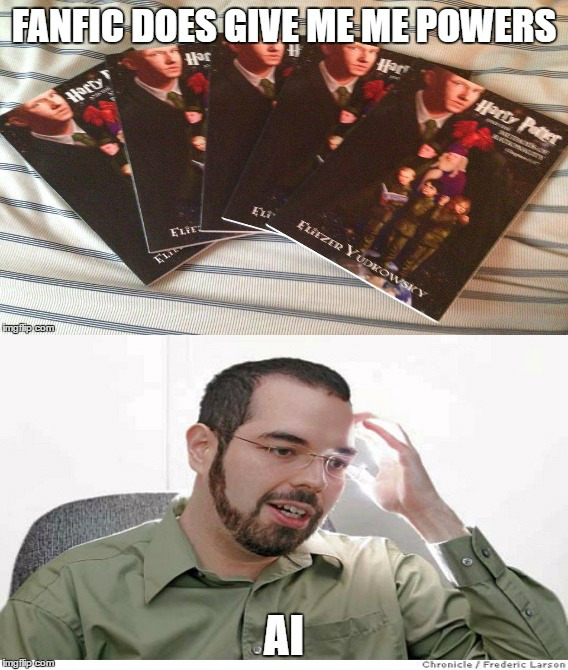
I. [X] does give me me powers

The origin of this meme is the song Phenomenal by Benjai. It come from the line “Soca does gi’ me me powas; ey-ay”. ie: “[Caribbean music genre] makes me powerful; [sound of enthusiasm]”. The specific way this is used varies a lot.

Most commonly, it’ll be a comment on how something has given you the ability to do stupid things faster with more energy. “coffee”, “ganja”, “cocaine”, “manga”, and “pumpum” (ie: vagina) are all things I heard people say gave them powers (it has to be two syllables to fit the song). Alternatively, if your friend has just done something stupid, you can comment on it this way – usually attributing their sudden energy to something silly as a form of ribbing.

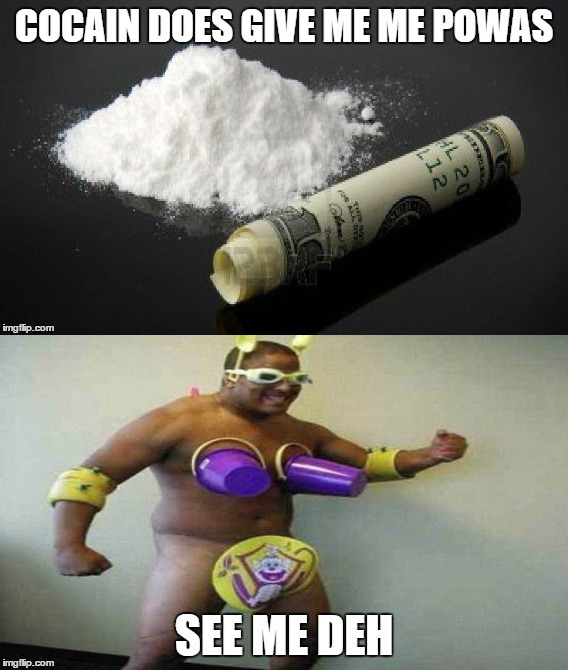
Alternatively, you can use it as an image macro, as we often do on WhatsApp (yes, we’re whatsappers). The general format here is a call-and-response macro. The first image is of the thing giving the powers, with the caption “[thing] does give me me powers”. The second image shows someone doing something silly, with either the caption “Ey Ay”/”Eh I” or the caption “See me deh/dey/there”.

Example from WhatsApp:

Soca Powers 1

However, the punning potential is great and terrible

Soca Powers 2

(I’m a horrible person, I know)

And, thus, you have been educated! Which is great, because I am constantly tempted to use this meme, and then have to refrain from it to avoid confusion. But no more! Go forth and meme like a true rudeboy

How does “[X] does give me me powers“ parse syntactically?

Specifically, what is each “me” doing? Do they both mean the same thing, and were just repeated for the meter to work? (Or for emphasis? Does [Redacted]-dialect repeat nouns for emphasis?)

Or are they doing different things? Are they both ~something about the speaker~ (with some grammatical effects), or is one of them totally unrelated?

“me” is the first person singular pronoun.

Yes, there aren’t first person singular pronouns. There is only one. It does the work of English I, me, and my.

So, replacing the ‘me’s with their equivalents, we get “Soca does give me my powers”.

But wait! What’s the “does” doing here?

It puts the sentence in the present tense, because “Soca give me my powers” would be past tense. The unmarked form of a verb in my dialect generally is.

So the sentence parses as “Soca gives me my powers” in standard English.

Ah, so that’s what the “does” was for.

(The doubled “me” didn’t confuse me, personally: my language-parsing module saw the second one, said “ah, it’s the cockney ‘me’”, and continued on. Apparently I’ve consumed enough British media for “’me’ can be used as a possessive” to be an available thought.)

On an unrelated note: is it just me*, or does that song–especially the chorus–sound very…itself? Like, a song they would play over a location-establishing shot. “HAVE WE MENTIONED YET THAT WE’RE IN THE CARIBBEAN??”

Not in a bad way, just…intensely Caribbean.

*It might just be me and my lack of experience with the genre.


Tags:

#reply via reblog #language #the more you know #music #also #anything that makes me laugh this much deserves a reblog #because that was indeed a great and terrible pun


{{next post in sequence}}

incendavery:

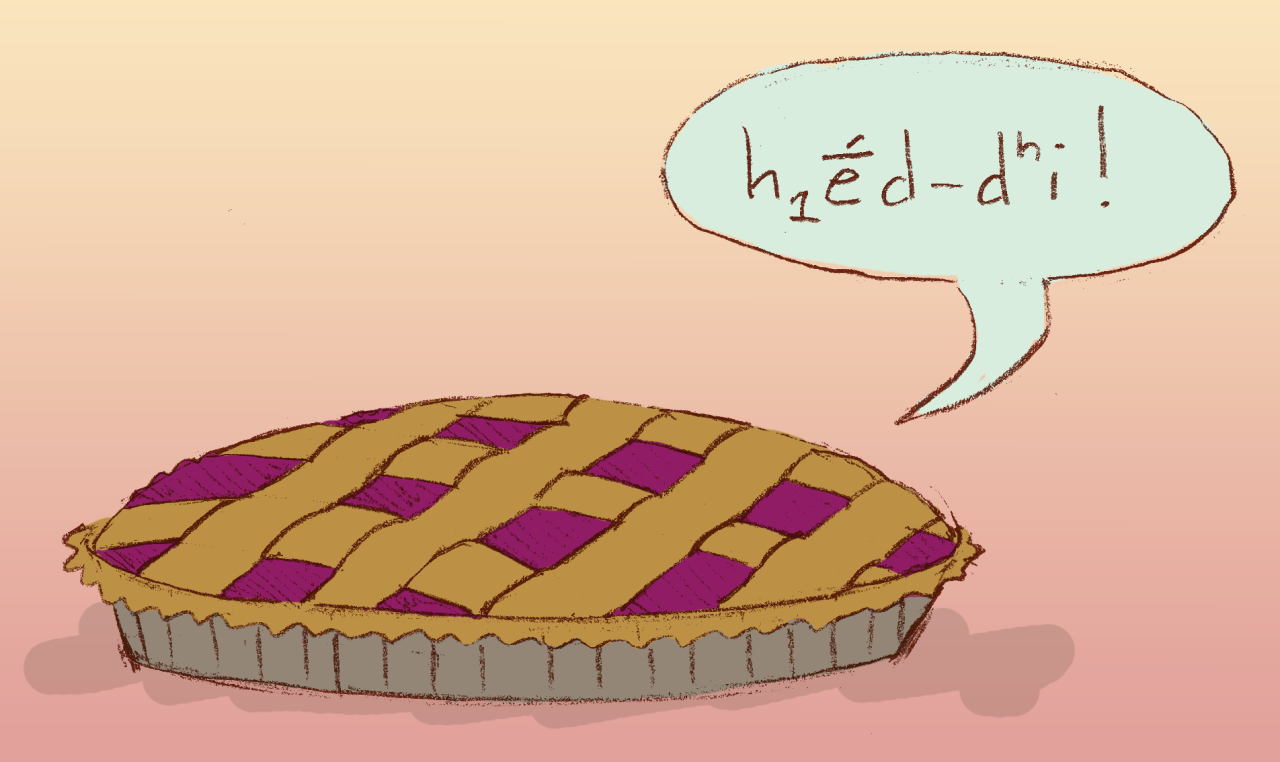
a PIE pie

I spent so much fucking time trying to figure out how to translate eat me to make this joke and it probably isn’t even correct don’t look at me 


Tags:

#language #food #puns #(I have absolutely no idea whether the translation is correct but I appreciate the effort) #Pi Day #now if you’ll excuse me I need to go eat some pie

argumate:

another-normal-anomaly:

Unpopular opinion: if it’s true, it should always be acceptable to say “I can’t pronounce that; it has phonemes not present in my native language.”

or I have a lisp or other speech impediment or hearing impediment etc. etc.


Tags:

#yes this #fun wif forn fronting #there’s plenty of names from my *own* culture I can’t pronounce let alone other people’s #(sometimes) #(if I think about it for a while) #(it bothers me a little that I’ve never heard my father’s name) #(not the way it’s *meant* to be heard) #(qualia are weird) #(I suppose that means this qualifies for the tag) #is the blue I see the same as the blue you see #racism cw #ableism cw

na-vidya-na-avidya:


sinesalvatorem:

pinkplasticpen:


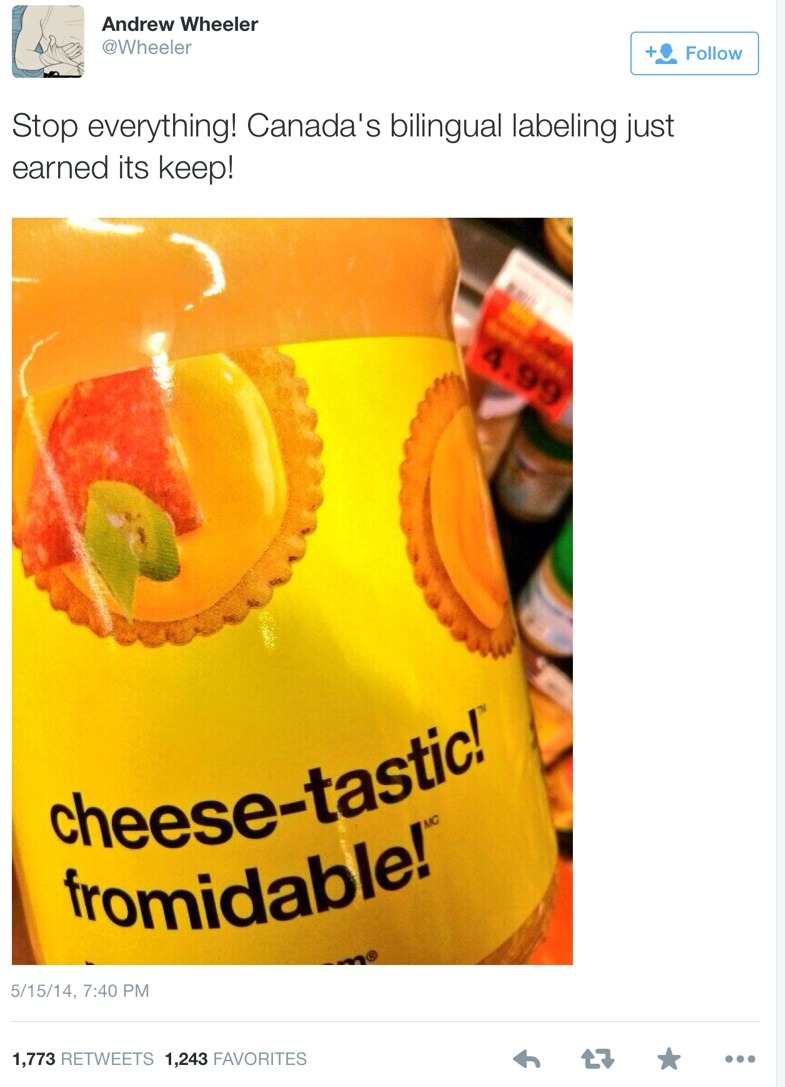
this pun is entirely worth breaking my tumblr silence for

FROMIDABLE

As an ex-French-student, I approve

My personal favourite bilingual packaging (so far) is a brand of toilet paper that, in its description, emphasises how it’s made from recycled wood.

English: Tree-sponsible!

French: Respons-arbre!


Tags:

#our home and cherished land #language #puns #my second favourite is Dr. Bronners #I don’t speak French well enough to get the full effect on that one #but I’ve been told it captures the weirdness really well

endreal:

the-fucking-turtlebear:

Peter Piper probably never picked a peck of pickled peppers for the peppers can’t have been pickled prior to picking. The pickling procedure takes place post picking, and the possibility of Peter piper picking a peck of pickled peppers is preposterous. The paradoxically penned poem positing Peter’s picking of the pickled peppers is past probability due to its postulating on peppers that were pickled pre-picking.

Perhaps Peter is a petty pilferer, picking a peck of peppers from the platform of a plant where peppers are processed for pickling in preparation for purchase by the populace?


Tags:

#say that one time fast