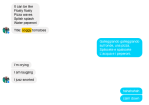
2/2 so I was wondering if large birds just hate human transportation or something haha. Thanks for your post, very interesting.
(In reference to a comment I made about kayaks being incredibly rude in Swan Culture)
I’ve been looking at my inbox like “I am not some kind of ECCENTRIC BIRD WHISPERER,” but I actually know the answer to this one, and it’s hilarious.
Large birds don’t have a particular hateboner for human transportation, but wild turkeys have two unique properties that make them behave ridiculously when they collide with human populations. For those who aren’t familiar with them, wild turkeys are large, boisterous birds that tend to interact with humans most frequently around the autumn which is convenient for Thanksgiving and mating season in early spring. Most of the time, they live peaceable lives in the woods, but around November they run around in flocks bothering innocent citizens and picking fights with vending machines, and then they usually go away again.
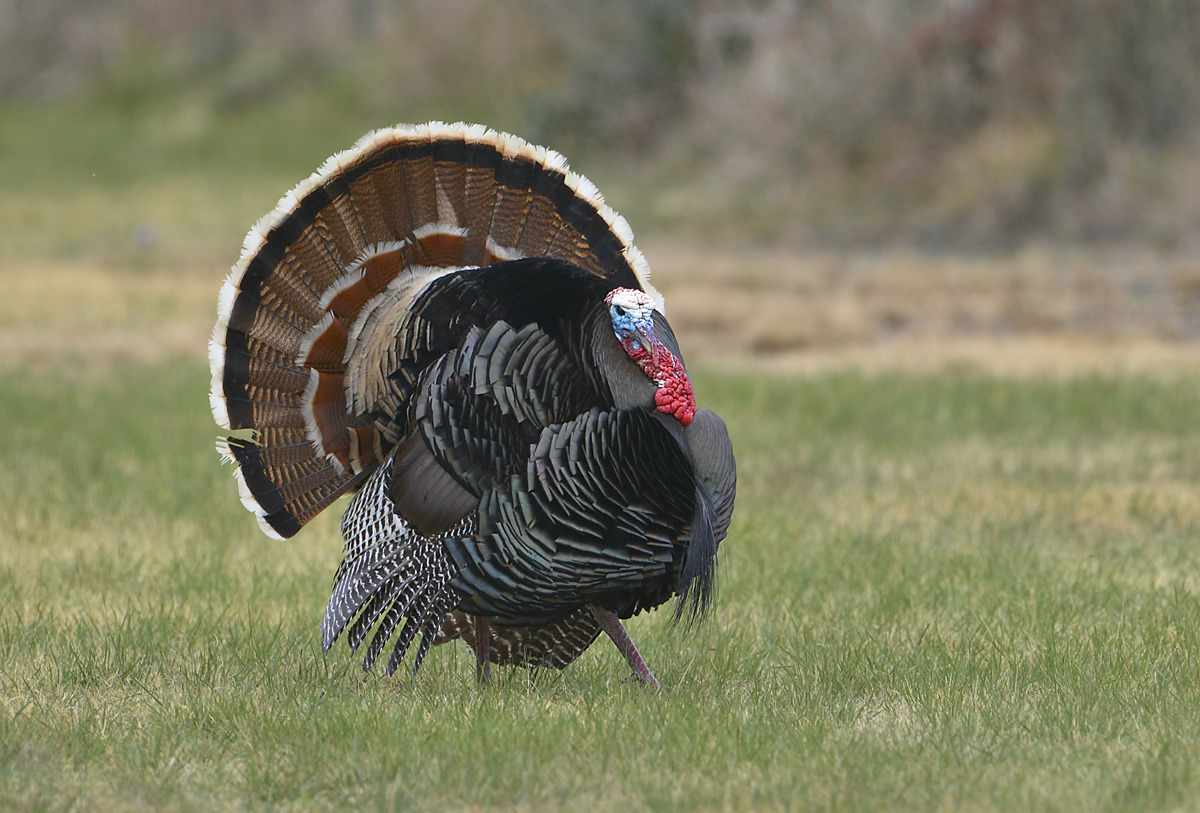
The toms, or dominant males, can stand up to 4 feet tall and weigh up to 24 pounds. They’re the ones that do the fancy displays:
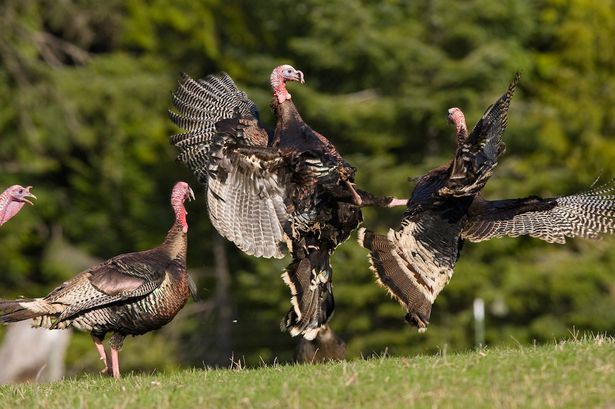
The First Unique Turkey Property: Now, wild turkeys are a little bit like betta fish, in that they perceive any shiny/reflective surface that shows them a reflection as actually containing Another Turkey, and they react accordingly. When they react to the Other Turkey – usually by posturing aggressively and flaring their fins feathers majestically – the Other Turkey ESCALATES THE SITUATION by posturing as well. At some point the real turkey loses its temper and attacks, pecking and scratching and trying to take the fucker apart, only to find that the Other Turkey has protected itself with some kind of force field.
So to a wild turkey that has encountered enough autumnal car-related psychic battles, the completely logical conclusion to take away from them is that cars contain demonic spiritsthat must be subdued. Other examples of things that wild turkeys are compelled to vanquish include… well, other reflective things.
To address this, cover reflective things (you can rub soap on your car to make it less reflective) and frighten off the turkey if it’s keeping you from leaving your car.
The Second Unique Turkey Property: This is a little bit embarrassing for all concerned, but you have to think about it like a turkey would. You see, humans are oddly compelling creatures to a hormonal turkey. We have bare faces with interestingly positioned lumps of flesh, we gobble our speech in a way that almost sounds like Turkey, we strut about on two feet showing off our long sexy legs, we strut about in family groups, we often have access to really good food, our clothing is big and bright and colorful. Turkey faces change color with their mood; human faces are all kinds of fascinating colors, plus additional fantastic decorations. To wild turkeys, humans are a type of turkey, and further: many humans are either Intimidating Sexual Threats, or Exciting Sexual Beings.
Now, I am very sorry about this, but not only can wild turkeys be kind of reverse furries, they also have unexpected ideas about gender and sexuality. So to some female turkeys, “male” humans are excitingly sexy and they will follow one around for embarrassingly long periods of time, cooing attractively – meanwhile, the tom turkey and the subordinate males will be OUTRAGED by the COMPETITION presented by the interloper, and will attempt to subdue “him.” And “female” humans are likewise at risk of being passionately seduced by the dominant toms, or quietly propositioned by subordinate males – or the females may attempt to recruit you into their existing social system – as a junior member, of course. They have a strict pecking order.
Unfortunately for humans, your preferred gender may not necessarily actually translate to the gender that turkeys decide you are. And some turkeys may decide you’re “male” while others will decide that you’re “female,” so that will be confusing, and some dominant female turkeys have “male” sexual traits – like beards and tail fans – anyway. They recognize and remember humans, so if you had a particularly exciting encounter with a specific turkey, it will probably remember you.
Also unfortunately for humans, the fine distinctions between Turkey Seduction, Turkey Competition, and Turkey Networking are usually a little bit lost, and all of this behavior seems to be the same thing – it mostly consists of a large dinosaur-like bird trotting at you, possibly screaming and pecking and flapping, and can be worrying. If you are in the car and the turkey can see you, and it wishes to continue a previous encounter, it may well insist upon this in a frightening way.
Turkeys don’t give a shit about human “gender” and “authority,” as the many available videos on the internet of turkeys attacking police officers, reporters and mailmen will assure you. They just make logical decisions that are perfectly natural and reasonable to turkeys, and humans react by running away.
So what do you do about this? Well, DO NOT RUN AWAY, this means you that you are a Submissive Turkey and their behavior will escalate. Turkeys can learn the meaning of “no,” and you don’t have to be bullied by them.
And the Massachusetts Fish and Game website has a huge resource explaining all the subtleties of wild turkey behavior and how to combat the nuisances. Essentially, you must not attempt to make friends with them or attract them; once they arrive, you must “be bold” and establish Dominance, and encourage everyone to do the same.
If the turkeys are aggressive around children and the elderly, all sources agree that if they become a danger, you can contact the relevant authorities and have the turkeys removed or destroyed.
Anyway, that’s why turkeys attack cars. The take-home message is: the cars are too shiny and you are possibly a sexy turkey.
I don’t know what you want to make of that
Wait.
You’re saying turkeys a) have a strict pecking order, b) have confusing-looking behaviors that are well-understood by the right people, and c) sometimes view humans as participating in that behavioral communication whether the human means to or not.
What do I have to do before I get to utter the sentence “band of wild turkeys that accepted me as their leader”?
#…who’s giving my name to ship memes? #and why? #it’s not that I mind I’m just confused #I mean at least Adam has vaguely compatible kinks so that kind of made sense #I have no idea where me/Nate comes from #reply via reblog
(I may teach my child to call me by my first name, because (1) that’s what everyone else calls me, and (2) I’m going to call my child by their first name, so it’s only fair that they get to do the same for me)
(In India, there are specific titles for “older brother” and “older sister”, such that younger siblings typically don’t address their elder siblings by name. Elder siblings, however, do address their younger siblings by name. It eventually started to feel to me like the main purpose of these words was to enforce age-hierarchical relationships, and so I was happy that English doesn’t do that. But American English still has the norm of not calling your parents by their first name, and while I don’t think most parents have the intention of using this to enforce a hierarchical dynamic, I wonder if it has the same effect.)
(This is a really tentative hypothesis, and even if it’s true, I imagine the effect would be really small. And so I don’t think that teaching your kids to call you “Mom” or “Dad” [or “Zaza”] is wrong. But I personally don’t see a good reason for the terms “Mom” or “Dad” to exist, and I definitely want my child to know that they can address me by name if they’d like.)
My stepmother specifically said that she wanted her son (my half brother) to call her ‘mum’ to enforce a hierarchical relationship. She’s generally very liberal.
When parents get pissy that their child called them by their first name, you know it’s a dominance thing. Most parents get pissy about it. It’s not just convention. I’ve never met any that haven’t.
I once called my mother by her first name and she looked at me like I’d started speaking a foreign language. She didn’t, like, say it was wrong, or something, but she did seem to think it was hella weird.
And, like, it felt weird in my mouth, and no other kids did that, so I immediately switched back to “mummy”. It feels more natural.
But, now that you mention it, I think most parents do get upset about it. Yikes, even more hidden dominance shit.
OTOH, not having any special way of referring to one’s parents (or *children or other relatives) feels even weirder to me. Ideally, every relationship relative to the speaker should have a lexical title, for ease of sorting people. Maybe I could go by “Mother Alison”, the way nuns do?
*The child title in my culture is “Likl [name]”, from English “little”. I also like how our community has settled on “Baby” for “Baby Andromeda” and “Baby Merlin”, though that probably won’t last throughout childhood.
This reminds me that, earlier today, my cousin asked me if he could call me ‘Aunty Alison’, since that’s the adult female familiar title. I am So Touched.
All other relatives, at least American-style, do go by title/relationship-name though? Like, Grandma Jane, Uncle Phil. Parents are the only ones that don’t, I think. Cousins don’t because that’s an equal relationship, not a powered one.
I wonder how much of the resistance to alternate family structures, like multiple and blood-unrelated parents, is because of this. If you don’t have ownership of the kid, then you have no title, and if you don’t have a title, a separate title, then you have no way to know who the kid is referring to. And no way for other adults to refer to you. It’s all very set in 2-opposite gender parents for each kid, zero flexibility. If there were other names or flexibility, there wouldn’t be so much reason to resist.
What’s the neutral name for a parent, that isn’t parent? It just sounds way too formal to go “Parent Haley”. Maybe that would work for places like schools to address the family, and I think that’s how they’ve handled same-sex relationships, but I don’t think a kid could do that. Are there other languages or cultures that have some kind of Name-(affectionate additive) or Title type thing that would fit this? Make one up?
My maternal grandmother is “Granny”, my paternal grandmother is “Grandma”, my maternal grandfather is “Granddad”, and my paternal grandfather is “Grandpa”.
I was 10 by the time I learned it was possible to use language such that The Four Grandparents might be ambiguous.
Likewise, if I had two parents of each gender, they’d be “mummy”, “mama”, “daddy”, and “papa”. Do other varieties of English not have two kid words for each parent-gender? This certainly wouldn’t be a problem for someone who grew up with my variety.
Although, really, now that I’m aware of the potential creepy ownership stuff, I think I’ll just have [title] + [name] for all relatives; people of equal or lower social status included.
I need to learn, and raise my kids with, a language that handles all this stuff better. Language nerds!, any suggestions?
I, too, distinguish the four grandparents by using different variants of “grandma” and “grandpa” rather than by name. There doesn’t seem to be a consistent mapping among families that do this, though: mine are “Gramma” for maternal grandmother, “Grampa” for maternal grandfather, “Granny” for paternal grandmother, and “Grampy” for paternal grandfather (though by the time I was old enough to talk Grampy was dead, so that term never got a whole lot of use). The lack of consistency always annoyed me a bit, that if I were speaking to someone outside my family, I couldn’t just say “Gramma” to communicate that I was talking about my maternal grandmother.
(Region notes: my grandparents lived in Massachusetts, part of New England. My parents moved to New Jersey after marrying, which is too far south for New England but still part of the broader Northeast.)
“Mama” and “Papa” sound slightly foreign or old-fashioned (I think I’ve only encountered them in historical novels, people from the South, and possibly-Brits-but-those-might-have-also-been-historical, never from speakers of my own dialect), but not so weird that they wouldn’t suffice if “Mom” and “Dad” were taken.
—
Another difference I’ve seen is in how a child refers to parents of other children. Apparently “Mr/Mrs X” is very common, and in many places the only polite form of address. I never did that: if I knew the parent through the child, I called them “[Child’s] mom/dad”, and if I knew the parent directly, I called them by their first name.
I love when ghost hunting shows are in a fucking ancient ruin and ask their questions in english
“what is your name” homeboy I was a viking several hundred years ago I don’t know what the fuck you’re saying
Is anyone else imagining “J.R.R. Tolkien: Ghost Hunter”
“Alright, now I’m going to try 8th century Anglo-Norse”
YES
#Hm no how about 4th century Gothic #Welsh? No? #Let’s try good ol’ Latin #this could go on and on #safe bet he wouldn’t accidentally insult the ghost’s mother or anything
Is “identifying foreign words by phoneme cluster” a thing that many/most people have trouble with? It’s something I’ve been instinctively able to do for as long as I can remember, but quite a few people have told me lately what an uncanny ability it is.
I’ve studied only a couple of foreign languages, and both of them were Romance-based. I pick up languages and grammatical rules very quickly, though. Even when I don’t understand the language being used, I can almost always pick out which language it is, or at least which language family.
This comes so naturally to me that I’ve never thought of it as weird, but recently people have been downright awed that I can, say, pick out the Thai dishes from the Vietnamese ones on a pan-Asian menu. Even though Thai and Vietnamese have totally different phonemic structures! It’s not that hard! People are often frequently baffled when I identify someone’s ethnic extraction by their surname, which, like – I dunno, all I can say is it’s not that hard!
I swear this isn’t me humblebragging – I am legitimately confused that this does not seem to be a common thing.
I too do the thing. I always figured most people’s lack of ability to do the thing was primarily related to most people’s disinterest in learning even the tiniest bit of foreign languages unless the language in question is going to be directly useful to them in a way they can quantify. But also I’m hyperlexic so, maybe that’s a factor too.
In my case people have more frequently expressed surprise at my ability to pronounce surnames, but that’s directly tied to recognizing their derivation – when you know what language a name derives from, and have a vague idea of the pronunciation rules of that language, it’s generally not too hard to at least come really close to correct pronunciation of the name.
Hyperlexia nation checking in! @ozymandias271 is the only other hyperlexic I know off the top of my head; do they also do the thing?
Same re: pronunciation. Weirdly enough, though, that often leads to me pronouncing it incorrectly, or at least what the person in question considers incorrectly. French names are very common where I live, but most of them have been Anglicized to the point where the original pronunciation becomes wrong.
I’m hyperlexic and okay but not great at this? (I can’t distinguish Swedish and Norwegian, and I can tell the difference between Korean and {Chinese, Japanese} but I can’t tell Chinese and Japanese apart, etc.)
I am pretty good at doing the thing, because I pick up linguistics rules really easily. (My project for the past two days has been teaching myself the grammar of Classical Sanskrit (hence the Bhagavad-Gita blogging), which I expect to take about a week to get mostly-down. I’m not planning to memorise Panini’s entire generative grammar, though.)
However, I am really awful at remembering vocabulary, which is why I’m monolingual. Give me the words, and I’ll successfully make sentences in half a dozen languages. If I’m allowed to make the sentences really simple, I could probably do two dozen languages. However, expecting me to remember any of those words the next day is a lost cause.
Despite hyperlexia, I’m not all that good at distinguishing languages by phoneme usage.
I’m a lot better at picking up vocabulary than grammar. I mentioned “read[ing] okay Packaging French, but don’t expect me to write it” recently: when presented with an everyday French sentence of the sort one might see on a sign or a bag of food, there’s a fair chance I’ll be able to work out the gist of it. If you ask me what the French word for [insert thing here] is, a significant-though-still-fairly-small amount of the time I will be able to answer. (As long as I am allowed to submit my answer in writing.) I cannot predict the grammatical structure of a sentence that isn’t currently staring me in the face, and I might not recognise it in a sentence that is currently staring me in the face.
Ingredient lists, which have almost no grammar and consist mostly or entirely of terms that any Canadian who doesn’t grow all their own food would be naturally exposed to†, are easiest. I am frequently able to read entire French ingredient lists without any guessing at all.
(One time, I actually understood the French side of the package better than the English.
Me, in grocery store: *looks at chocolate bar*
Me: “Chocolate with marzipan”. What is marzipan, anyway?
Me: *reads French side* “Chocolate with almond paste”. Oh.)
†Though I can’t promise how much attention other people pay.
Tags:
#combine me and Alison and you get someone who almost knows what they’re doing #language #reply via reblog #food mention #our home and cherished land
People who are blind from birth will gesture when they speak. I always like pointing out this fact when I teach classes on gesture, because it gives us an an interesting perspective on how we learn and use gestures. Until now I’ve mostly cited a 1998 paper from Jana Iverson and Susan Goldin-Meadow that analysed the gestures and speech of young blind people. Not only do blind people gesture, but the frequency and types of gestures they use does not appear to differ greatly from how sighted people gesture. If people learn gesture without ever seeing a gesture (and, most likely, never being shown), then there must be something about learning a language that means you get gestures as a bonus.
Blind people will even gesture when talking to other blind people, and sighted people will gesture when speaking on the phone – so we know that people don’t only gesture when they speak to someone who can see their gestures.
Earlier this year a new paper came out that adds to this story. Şeyda Özçalışkan, Ché Lucero and Susan Goldin-Meadow looked at the gestures of blind speakers of Turkish and English, to see if the *way* they gestured was different to sighted speakers of those languages. Some of the sighted speakers were blindfolded and others left able to see their conversation partner.
Turkish and English were chosen, because it has already been established that speakers of those languages consistently gesture differently when talking about videos of items moving. English speakers will be more likely to show the manner (e.g. ‘rolling’ or bouncing’) and trajectory (e.g. ‘left to right’, ‘downwards’) together in one gesture, and Turkish speakers will show these features as two separate gestures. This reflects the fact that English ‘roll down’ is one verbal clause, while in Turkish the equivalent would be yuvarlanarak iniyor, which translates as two verbs ‘rolling descending’.
Since we know that blind people do gesture, Özçalışkan’s team wanted to figure out if they gestured like other speakers of their language. Did the blind Turkish speakers separate the manner and trajectory of their gestures like their verbs? Did English speakers combine them? Of course, the standard methodology of showing videos wouldn’t work with blind participants, so the researchers built three dimensional models of events for people to feel before they discussed them.
The results showed that blind Turkish speakers gesture like their sighted counterparts, and the same for English speakers. All Turkish speakers gestured significantly differently from all English speakers, regardless of sightedness. This means that these particular gestural patterns are something that’s deeply linked to the grammatical properties of a language, and not something that we learn from looking at other speakers.
References
Jana M. Iverson & Susan Goldin-Meadow. 1998. Why people gesture when they speak. Nature, 396(6708), 228-228.
Şeyda Özçalışkan, Ché Lucero and Susan Goldin-Meadow. 2016. Is Seeing Gesture Necessary to Gesture Like a Native Speaker? Psychological Science
27(5) 737–747.
Asli Ozyurek & Sotaro Kita. 1999. Expressing manner and path in English and Turkish: Differences in speech, gesture, and conceptualization. In Twenty-first Annual Conference of the Cognitive Science Society (pp. 507-512). Erlbaum.
Incredible! I have nothing to add because I had no idea, but may I just say **WOW**!!!
Tags:
#language #the more you know #the power of science
why would she sell sea shells by a sea shore when you can just pick them off of the ground for free that’s not how you run a business
She’s sold sea shells by the seashore since shapely seashore seashells stay scarce. Since she sells superior shells searchers spend centuries searching for, seldom selling simple shells, so she still sustains solid savings.
prumngle (PRUM-gull): • when you try to ball up something (like a plastic wrapper for food) but it expands back into almost its original form when you release your grip. • can be used metaphorically, as in someone having a bad experience and their thoughts and feelings about it just keep rising up
examples: • “man i hate how water bottles prumngle back up if you dont put the cap back on after you squish them” • “dude dont even try to ball that wrapper up it’ll just prumngle right back” • “man my emotions are just rly prumngling on me today can u give me a little break”