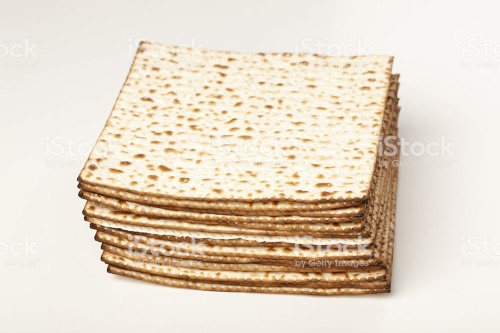
hmm I wonder if there are regional patterns in how matzah is spelled. I didn’t know matzo was a valid spelling. possibly this is because I only interact with matza in verbal conversation. tbh none of those spellings feel right
I think it’s Hebrew vs. Yiddish (same with Shabbat vs. Shabbos), but I haven’t actually checked that. Also: Matza is great – matza coffee, matza brie, the leftovers make great breakfast!
hmm I would expect to have been exposed to the yiddish version, since all the jews I knew were germanic and had jokes about older relatives making yiddish expressions, so I might have just not been paying attention closely enough to pick up the difference. alternately the kids I knew didn’t learn much yiddish outside of the oy vey tier, and did have to go to hebrew school.
The secret to good matzah is to tell the “egg matzah is ~only for invalids~” rabbis to go fuck themselves. Egg matzah is pretty good.
(And yeah, we use surprisingly little Yiddish (and correspondingly more Hebrew) in my family. I remember having a joke fly over my head as a pre-teen because I didn’t know what a yarmulke was: we always called them kippot. (singular kippah)
And all those times on Wikipedia where I was reading about genetic disorders and Ashkenazim were more prone to damn near everything, and I was just kind of like “huh, sucks to be them”, and then when I was about seventeen I found out *I* was Ashkenazic.
(Only half-Ashkenazic, though, so I guess that dilutes the inbreeding. And most of the really terrible ones are things I would have noticed by now.))
Tags:
#*knocks on wood* #reply via reblog #Judaism #Passover #food #language #illness mention
whenever the show refers to species as “humanoid” or “not humanoid” – I tend to make an assumption that it’s a universal translator thing, because why would other species also refer to themselves as humanoid???
soooo:
– Julian learns Kardasi and discovers that the Cardassians have been saying the equivalent of “Cardassian-lite” the entire time (essentially “like Cardassians, but worse” folded into one word)
– Benjamin realises that Bajorans call non-Bajoran bipedal beings the “acceptably unfaithful” (it sounds better in Bajoran)
– Klingons say “weaker than Klingons.” B’Elanna takes offence, Worf is like “this is reasonable” (B’Elanna and Worf arguing Klingon linguistics based on their own relationships to tho)
– Betazoids and Vulcans independently of one another coming to the conclusion that they’ll call the other species “the talkies” (Betazoids for obvious reasons, Vulcans because humans just talk too much for no reason???)
– Dax once told Benjamin that the Trill phrase is roughly the same as “why don’t they have spots?” based on the alleged first words uttered when they encountered spotless species
– Ferengi call other species “fools.” Occasionally also “tall.”
« Nonsense can be made to make sense by supposing some alternative context for it. At the start of his revolutionary work Syntactic Structures (1957), Noam Chomsky cooked up a nonsense sentence in order to explain what he saw as the fundamental difference between a meaningful sentence and a grammatical one. “Colorless green ideas sleep furiously” was proposed as a fully grammatical sentence that had no possible meaning at all.
Within a few months, witty students devised ways of proving Chomsky wrong, and at Stanford they were soon running competitions for texts in which “Colorless green ideas sleep furiously” would be not just a grammatical sentence, but a meaningful expression as well. Here’s one of the prize-winning entries:
It can only be the thought of verdure to come, which prompts us in the autumn to buy these dormant white lumps of vegetable matter covered by a brown papery skin, and lovingly to plant them and care for them. It is a marvel to me that under this cover they are labouring unseen at such a rate within to give us the sudden awesome beauty of spring flowering bulbs. While winter reigns the earth reposes but these colourless green ideas sleep furiously. »
— David Bellos, Translation and the Meaning of Everything
On China’s transition from disdaining the English language to considering it very important for individual success:
“English fever” settled on waiters, CEOs, and professors, and elevated the language into a defining measure of life’s potential—a force strong enough to transform your résumé, help attract a spouse, or vault you out of a village. Men and women on Gong’s dating site often included their English proficiency in descriptions of themselves, alongside mention of cars and houses. Every college freshman had to meet a minimal level of English comprehension, and it was the only foreign language tested. In a novel called English, the author, Wang Gang, a teacher in a rural school, says, “If I rearranged the words in the [English] dictionary, the entire world would open up before me.”
This was a sharp reversal from the past. In nineteenth-century China, English was held in contempt as the language of the middlemen who dealt with foreign traders. “These men are generally frivolous rascals and loafers in the cities and are despised in their villages and communities,” the reformist scholar Feng Guifen wrote in 1861. But Feng knew that China needed English for diplomatic purposes, and he called for the creation of special language schools. “There are many brilliant people in China; there must be some who can learn from the barbarians and surpass them,” he wrote. Mao favored Russian for the country, and he expelled so many English teachers that, by the sixties, China had fewer than a thousand high school English teachers nationwide. After Deng opened China’s doors to the world, English fever took hold. Eighty-two percent of those polled in 2008 thought it was vital to learn English. (In America, 11 percent thought it was vital to learn Chinese.) By 2008 an estimated 200 million to 350 million Chinese were studying English.
On Li Yang, a celebrity English teacher
Li peered at the students and called them to their feet. They were doctors in their thirties and forties, selected by Beijing hospitals to work at the following summer’s Olympic Games. But like millions of English learners in China, they had almost no confidence speaking the language that they had spent years studying by textbook. Li had made his name with an ESL technique that a Hong Kong newspaper called English as a Shouted Language. Shouting, Li argued, was the way to unleash what he called the “international muscles.” Li stood before the students, his right arm raised in the manner of a tent revivalist, and launched them into English at the top of their lungs. “I!” he thundered. “I!” they thundered back.
One by one, the doctors tried it out. A woman in stylish black glasses said, “I would like to take your temperature.” Li gave a theatrical shake of his head and made her do it again. Her cheeks flushed, and in a sudden burst, she bellowed, “I would like to take your temperature!” Then came a thickset man in a military uniform who needed no encouragement—“I would like to take your temperature!”—followed by a tiny woman, who let out a paint-peeling scream. Around the room we went, each voice a bit more confident than the one before. I wondered how a patient might react, but before I could ask, Li was out the door, and on to another group in the adjoining classroom.
…
He favored flamboyantly patriotic slogans such as “Conquer English to Make China Stronger!” On his website, he declared, “America, England, Japan—they don’t want China to be big and powerful! What they want most is for China’s youth to have long hair, wear bizarre clothes, drink soda, listen to Western music, have no fighting spirit, love pleasure and comfort! The more China’s youth degenerated, the happier they are!”
Tags:
#language #anything that makes me laugh this much deserves a reblog #(”I wondered how a patient might react”) #China #interesting #this probably deserves some warning tag but I am not sure what
I had a productive day at work today browsing through the website of Karl Hagen, who seems like a pretty erudite and knowledgeable person. He has this very nice quiz, which is a “real grammar quiz”, in that it tests your understanding of morphosyntactic concepts (nouns, verbs, agreement, phrase structure, etc.) rather than the memorization of arbitrary rules about spelling, punctuation and word choice. It does suffer a little from the problem of a lot of morphosyntactic concepts not having particularly widely agreed-upon precise definitions, but I think most of the questions were reasonably unambiguous. I got 32/35 (you can see my marked results here).
gonna pull the “this is not my native language” card
Tags:
#interesting #language #(22/35) #(there were a few where I tried and got it wrong) #(and there were *also* a few where I was just like #”I have never heard that jargon before in my life‚ how the hell should I know which of these answers fits it”) #(if I had no idea whatsoever I skipped the question rather than trying to guess) #(it’s not like a school exam where having a high grade is instrumentally useful in itself) #(so my grade here should purely reflect how much I know and not how lucky I am)
Today’s aesthetic: a footnote inside a parenthetical inside an interjection inside a subordinate clause.
(You can tell how many levels of academia somebody is on based on whether this post makes them feel offended, traumatised, or just vaguely called out.)
Tags:
#…academia? #I thought we were talking about writing blog comments #relatable #language
The Universal Translator is the most boring invention in Star Trek, which is why I tend to ignore it. It’s useful for first contact, but the idea that everything someone says is translated means that we never get any depiction of linguistic diversity in Star Trek, particularly in something like DS9. Imagine the possibilities:
Kira being sent on a crash-course on Federation Standard when she is made liaison officer.
Bashir sitting with several dictionary PADDs and a grammar, trying to figure out if the translation matrix Garak ran the Cardassian novel through has messed up or if Garak is playing a very intricate practical joke on him, because surely it can’t mean that.
Molly cheerily code-switching between Japanese, Irish and English. Sometimes she throws in some Bajoran too – Aunt Nerys taught it to her.
Sisko asking for Kira’s help to get better at Bajoran. They meet over coffee and practice Bajoran.
Dax sometimes dreaming in languages she no longer knows, but previous hosts were well-versed in.
Kira and Odo always speaking Bajoran to one another and only switching to Standard when Starfleet folks are there.
The entire storyline of Garak, Kira and Odo with the Cardassian Resistance being in Cardassian
Kira learning Cardassian properly only then – before that she spoke only a Bajoran-Cardassian pidgin which developed during the Occupation.
Nog teaching Jake Ferengi as a way of returning the favour of Jake teaching him how to read.
Garak eavesdropping on everyone. No one is sure how many languages he understands.
The chatter of dozens of languages on the Promenade – the gutturals of Klingon, the uvulars of Cardassian, the retroflex liquids of Bajoran.
Julian gets really confused because there are about fifteen different past tenses in Cardassian and according to Garak he’s using the wrong one every single time. There is only one future tense.
Jake trying to write a story in Bajoran – which he thinks should be easy, because he’s been living among Bajorans for so long he can speak it almost as easily as Federation Standard – only to be hopelessly tripped up by the fact that there are actually three forms of Bajoran (colloquial spoken/written, formal/religious spoken, and formal literary) and he really only knows colloquial Bajoran
Jake, along with a lot of Bajoran writers who grew up during the Occupation and so did not have much formal schooling, start a literary movement of writing in mostly colloquial Bajoran. It’s very controversial, with some saying the more formal written forms of Bajoran are being lost and that’s another thing the Cardassians took from us, and others saying, what, so we can’t move forward and change just because we were occupied?
Has anybody written a series with this premise yet? Because I love it. As someone who writes in a language that’s not her own, and if she did, would do it in her our dialect instead of a neutral, I feel so attracted to this idea.
Yeah, it’s only “Canadian Thanksgiving” in contexts where the default assumption is American. Likewise, “American Thanksgiving” in contexts where the default assumption is Canadian.
Mom has been known to call the American one “Pilgrim Thanksgiving”, but I think she’s been doing that less lately.
(We celebrate both, in honor of our American heritage. I don’t know how Canadian-only people are supposed to cope with the fact that one can of pumpkin makes two pies: we get to just make both Thanksgivings’ pumpkin pies at once, keeping the second one in the freezer until it’s time.)
Tags:
#Thanksgiving #our home and cherished land #home of the brave #language #reply via reblog #food