officialgeorgecostanza:

As a linguistics nerd, I’d like to formally suggest “Nespring” as a nonbinary equivalent to niece/nephew and “Avaun” as a nonbinary equivalent to aunt/uncle

Nespring: literally meaning “the offspring of my sibling” from the old English roots “offspring” which is just ‘of spring’ and the Latin root “nepos” that both niece and nephew are derived from

Avaun: derived from the roots of both “aunt” and “uncle,” the anglo-French “aunte” and the Latin “avunculus”

@nonbinary-culture


Tags:

#language #gender #interesting idea #(fun fact: I used the word ”prumngle” in my thoughts a couple weeks ago) #(and then I stopped and looked at myself and went) #(”huh. I actually found a use for that word. neat.”) #(whereas these words would be *much* easier to find uses for)

asexualbrittaperry:

you can make nearly any object into a good insult if you put ‘you absolute’ in front of it

example: you absolute coat hanger


ggiornojo:

as well u can just add ‘ed’ to any object and it’s sounds like you were really drunk

example: i was absolutely coat hangered last night


asexualbrittaperry:

#i was gazeboed mate #i was absolutely baubled


animatedamerican:

Meanwhile, “utter” works for the first (e.g., “you utter floorboard”) but somehow “utterly” doesn’t seem to work as well for the second (“I was utterly floorboarded”).


nentuaby:

Utterly doesn’t work for drunk because it’s the affix for turning random objects into terms for *shocked*, obviously.


animatedamerican:

… huh.  I thought that might just be the similarity to “floored”, and yet “I was utterly coat hangered” does seem to convey something similar.

I have to tell you, I am utterly sandwiched at this discovery.


thepioden:

Completely makes the phrase mean “super tired”.

“God, it’s been a long week, I am completely coat-hangered.”


derinthemadscientist:

Something is

Something is wrong with our language


rooksandravens:

Is it a glitch or a feature?


cardboardfacewoman:

Feature


maxofs2d:

we don’t have anything like this in French and it offers a range of expressibility that I wish we could properly translate back. it is a feature, i concur


Tags:

#language

{{previous post in sequence}}


rustingbridges:

brin-bellway:

femmenietzsche:

I’m grateful that the ability to call people bitches has survived wokeness more or less unscathed. I figured it would, but you can never be 100% sure about these things

…it has?

I mean I guess under a model where it’s important that swearwords be *transgressive*–and where (somewhat) greater acceptance of swearing has thus made them less potent–one could argue that wokeness has *encouraged* “bitch” by shoring up its transgressiveness. But to me it definitely feels like it’s in that transgressive-but-not-totally-beyond-the-pale zone, and for primarily SJ reasons.

(Noticeably further into the zone than calling something “insane”, likely because of the remaining force of the obscenity. I might use “insane” colloquially after some hesitation or if my emotions were running high, but would probably not use “bitch”.)

intragender bitch seems to have survived, intergender seems fairly dicey at present


Tags:

#language #our roads may be golden or broken or lost #conversational aglets

femmenietzsche:

I’m grateful that the ability to call people bitches has survived wokeness more or less unscathed. I figured it would, but you can never be 100% sure about these things

…it has?

I mean I guess under a model where it’s important that swearwords be *transgressive*–and where (somewhat) greater acceptance of swearing has thus made them less potent–one could argue that wokeness has *encouraged* “bitch” by shoring up its transgressiveness. But to me it definitely feels like it’s in that transgressive-but-not-totally-beyond-the-pale zone, and for primarily SJ reasons.

(Noticeably further into the zone than calling something “insane”, likely because of the remaining force of the obscenity. I might use “insane” colloquially after some hesitation or if my emotions were running high, but would probably not use “bitch”.)


Tags:

#reply via reblog #our roads may be golden or broken or lost #language


{{next post in sequence}}

r00ib0s:

love the idea that infernal is a language tieflings don’t have to learn, they just have it built in from birth, and they quickly discover that they can say anything they want out loud in infernal, since almost nobody else understands any of it.

thieves have thieves’ cant, tieflings have the secret language of satan


falyros:

Yes, good post, I love this. In my head it’s kind of a subconscious language at first. Babies might babble some words in infernal, but as they learn their parents’ language, that’s gonna be what they use to communicate. Kids might shout in infernal during emotional outbursts without quite knowing what they said or where they learned it. As a young tief grows up they will grasp and truly understand the language they have inside them more and more, along with learning to control and understand their inherent magic.


mszegedy:

hmm i need to digest this before i buy it and inevitably start conlanging it. a system of language with much, much stronger and more specific universals is a really interesting concept. imagine the breadth of individual variation

(until now i’ve treated tieflings who know infernal as, like, people who learned a heritage language. which really resonated with me as a first gen immigrant)


mszegedy:

Okay, so. It’s not done digesting yet, but I’ve developed a couple notes on one possible way to do this:

  • Vocabulary emerges from the kiki-boba effect turned up to eleven. Instead of associating a bunch of characteristics with one sound like we do (e.g. /k/ is hard, cold, metallic, and spiky, while /b/ is soft, warm, organic, and round), they associate a single concept with a sequence of sounds. Which, well, is how vocabulary works anyway when you’ve learned a language, but in Infernal language acquisition the associations are fuzzy and lead to…
  • Polysemy and autantonyms. Consider the word “dust” in English. It’s a noun, but it’s also a verb, and the verb can mean to add dust, or to remove dust. Infernal vocabulary items all have a whole bunch of meanings they can acquire, but they only acquire a subset of them for any given speaker. So one speaker might have “dust” just mean the noun, but another speaker might have it also mean “to add dust to”, while another speaker has just “to remove dust from”. So two Infernal speakers might have the same words as antonyms of each other!
    And unlike in English, this effect applies to every single vocabulary item. A linguist studying Infernal can make a list of, let’s say 600-odd word roots and all the different meanings they tend to acquire. Any particular Infernal speaker’s idiolect has the territory of meaning partitioned and parceled out between these roots in a unique way, but not unique enough for Infernal speakers to not understand each other.
  • Since the kiki-boba effect isn’t strong at all in case marking for human languages but word order effects are pretty strong, I think, if we’re imitating human language acquisition, it makes the most sense to have Infernal as a strongly isolating, analytic language. Combined with the word class flexibility described above, this makes it grammatically similar to Classical Chinese or Yoruba. Because I am unoriginal and have studied too many Papuan languages (and just love this feature anyway), I’m gonna say that serial verb constructions are a universal feature of Infernal. This can get a little hairy if many words can be both verbs and nouns, but that’s part of the fun.
  • Since SVO is the most common word order, I’m gonna go with SVO(VO…) for the word order.
  • Since language acquisition otherwise works like human language acquisition just with universals that are several orders of magnitude stronger, Infernal still develops dialects and regional variation. Areas more densely populated with Infernal speakers will be more linguistically homogeneous, while more sparsely populated areas will have more unique idiolects. That scenario that @koolkevk wrote about where two Infernal speakers who are siblings grow up together thinking it’s their secret made-up language is totally possible and in fact probably very common among tiefling siblings (but probably not extremely common, because there are probably tiefling siblings who are part of tiefling communities with their own dialects).

This has also more broadly inspired me to think about alternate ways languages could arise in a fantasy world, rather than just the usual way of getting cooked up through people’s language lazily drifting across the vast world of possible languages over the course of millennia and millennia. What other ways can you have? Well…

  • Everyone knows Arcane is just an inexplicable programming language embedded into the universe that you have to replicate if you want magic to happen when you say things. Its phonology is luckily lax enough to be able to be picked up by all sorts of races with a wide variety of phonological capabilities. I quite like Sam Hughes’s take on it in his online novel Ra.

  • Primordial is actually just thermal noise, the only thing all elementals share. They put absolutely no effort into communicating using it; they exert a passive effect where the noise somehow “learns” the information that one elemental wants to share, and assembles itself into a pattern that is personally meaningful to another elemental and gets that information across. To “learn” Primordial, you need to have a permanent enchantment cast on you that allows you to passively influence thermal noise in this way.

  • Celestial is an Ithkuil-like conlang that was designed by a large committee of gods. Its source text is bound in a holy book in a sanctum somewhere in the Celestial planes. If you alter the source text, all Celestial speakers will have to alter their language accordingly. (Many will do so automagically, because they are enchanted to speak in whatever language the book says.) Breaking into the sanctum to make an important change could be a fun adventure. For example, imagine that you need to change the ruling of a Celestial court to be semantically ambiguous, because it’s imprisoned one of your party members or something.
    (What language is this book written in? Well, Celestial, obviously. Good luck.)

  • Abyssal is not actually a language. It’s whatever grunts, screams, and body language you can use to convey your message to a demon. Its linguistic universals are the same linguistic universals that mammals have when communicating with each other. Do you know how to communicate with your cat/dog? Great, you can figure out Abyssal, too.

  • Dark Speech is a telepathic language, or more precisely an empathic language. The only way to evoke the correct telepathic signals to “speak” it is to voice aloud your most credible insecurities, fears, and intentions of self-destruction in a way where you know someone will understand you. It doesn’t matter what language you use for that; you point is that you have to authentically claim darker and yet darker thoughts out loud. The telepathic flavor of your pain is what communicates the information. Because everyone’s pain is different, everybody can only speak a small subset of Dark Speech. The pairs of people who can communicate the best using it are people who share similar kinds of pain, and the individual people who communicate the best using it are people who have experienced many differenty kinds of pain. The psychological toll of speaking it destroys all speakers eventually, except for fiends.
    Unlike other entries in this list, Dark Speech could actually be subject to significant variation and language change if it had enough speakers, and should arguably be classified as a whole language type rather than just one language or even just one primary language family. In practice, however, its speaking community is so small that there is only one Dark Speech worth learning. (It is, nevertheless, constantly evolving, like human languages.)
    (I don’t really need to say this because people naturally avoid this sort of thing, but do not try conlanging this IRL. It is meant to be psychologically destructive to speak; designing it would be exponentially more so. It would require you to consider all possible traumas that people can undergo and assign semantics and grammar to them. If you have conlanged it and not caused yourself significant psychological harm, either you’ve done it wrong or you’re incapable of… something. Regardless, this could be an actual language, for people who are capable of discerning complex emotions from speech. I guess you could consider it if you’re running a death cult or something.)

I also have half-baked ideas about languages that are actually the genetic code of living, symbiotic entities that connect people (and “speech” is these entities having sex), languages that arise when a certain astronomically- or meteorologically-obsessed species sees a pattern in the stars or sunspots or pulsar waves or clouds or wind or whatever and bases its communication around it, languages that elven children acquire first in their written form from patterns in tree bark and are later taught pronunciation rules for, and are transmitted by people carving the patterns they want their kids to see in the tree bark, oligosynthetic languages that arise from ephemeral gatherings of a particularly linguistically intelligent species, where they construct a new language for each gathering based on just a couple linguistic universals they all share but also based on geographically local traits…


Tags:

#language #story ideas I will never write #this probably deserves some warning tag but I am not sure what

prokopetz:

That meme where people misspell “ingredients” as “ingredience” is fascinating from a linguistic standpoint because morphologically, “ingredience” really ought to mean something like “the quality of being ingredient” or “the attribute which makes a thing ingredient” – i.e., it would something you have, not something you are. What is ingredience? Do I have it? Do you?


johnthedragon:

wouldn’t ingredience be a rating of how many things include you in recipes? So flour has a high ingredience; it’s included in many things. Humans have a low ingredience; not many recipes out there that include human (at least that we know of).


bigscaryd:

Ingredience is formally defined as the probability that, given a random valid recipe not including the ingredient, adding the ingredient will result in a valid recipe. As an example, salt has an ingredience of .98.

A significant problem is that there is no known analytic method to validate a recipe, and it must be done experimentally. Of course, because recipespace is infinite, this means that all ingredience values are approximate.

The question of whether a recipe validator is even possible is a central question of formal culinalysis.


lithnin:

The study of culinalgebra is complicated by the fact that ingredients do not form a basis in recipespace – adding one ingredient may affect the necessary quantities of others.  Adding soy sauce to a recipe increases the amount of salt; adding an acidic ingredient in baking may require the use of more baking soda to maintain the previous pH. An existing ingredient whose quantity is not altered by a given change to the recipe is known as an eigengredient.


Tags:

#food #math #language #unreality cw

mornyavie:

deadpanwalking:

wongbal:

Klingon tumblr is called tm’blarr and if you post a nipple they stab you

dfff21a80b5a54782d8a40c60fac0dd0f29489f2

With all due respect this is not proper klingon phonology.

  • A klingon syllable must have a medial vowel.
  • /bl/ is not an allowed consonant cluster.
  • rr isn’t in the orthography really it’d just be r

Constructing the Klingon verson of the word, the main problem is what you want to do with the u (/ə/) in tumblr. You could leave it u, pronounced oo (/u/), though I personally would make it I, pronounced like in kit (/ɪ/), because in my dialect that’s pretty close to the schwa (the uh sound in tumblr). In order to keep the random glottal stop (’), because that sounds very klingon (it uses those a lot), I’m going to stick it in the syllable between the b and the l (since, remember, that’s not an allowed consonant cluster, unless it spans a syllable boundary). This is a little odd, as you’d probably just stick your neutral vowel between them, but klingon doesn’t really like CV (consonant-vowel) syllables and it sounds cooler. I like using ih in neutral syllables, but you could always follow the original post’s choice and make it a instead.

It’s probably tImbI’lar (/tɪm’bɪʔ.lar/). tim-bi’-lar (roll the r). Stress  on the central syllable.

Edit: in honor of wongbal I have translated the original post as ngech mIllogh Dalabchugh, DaDuQlu’, “if you post a nipple you get stabbed.”

More accurately, as “if you transmit a picture of a woman’s cleavage, you will certainly be stabbed.” The online klingon dictionary is incapable of using normal words and I spent a solid ten minutes searching as many synonyms for upper-chest-areas-of-the-body as I could think of. Also, disclaimer that I’ve only been studying this language for a few months.


Tags:

#Star Trek #The Last Tumblr Apocalypse #language #anything that makes me laugh this much deserves a reblog #(”your post was flagged [zalgo]DISHONORABLE”)

{{previous post in sequence}}


nikkifromtabs:

i wish i was capable of writing narratively because there is absolutely a fanfiction wanting to exist where the crew of ds9 collectively comes to the agreement that “wormhole aliens” is a really shitty and disrespectful way to refer to your coworker’s sincerely held religious beliefs re: her gods so the bulk of the episode has all non-bajorans randomly trying on different ways to refer to them without saying they are gods because starfleet has a stick up its ass about admitting any given religion can be provably correct. episode ends with an exasperated kira telling everybody that wormhole aliens is way better than anything theyve come up with so please just drop it

the comedy b-plot is odo futilely trying to recycle the euphemisms into explaining to weyoun that he’s not divine and the Founders are not infallible, but it’s small versus far away and weyoun just cant grasp it


Tags:

#oh look an update #story ideas I will never write #Star Trek #DS9 #language #embarrassment squick

cawcawoedipus:

witchofeindor:

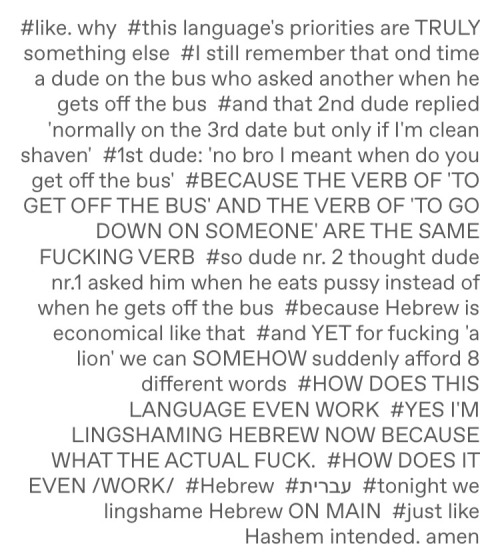
Hebrew: ‘This one verb is used to mean 10 different things, I’m an economical language like that, good luck figuring out what this verb means each time’

Also Hebrew: *Has about 8 different words meaning ‘lion’*

349843dfd1001ca662fe0e953fdee0a51ce7da4d

I feel like every single person deserves to read OP’s tags cause fuck they are accurate.

Also like…

Hebrew: every single word is heavily gendered and there are Very Strict Rules for gendering every word and number and shit

Also Hebrew: these words SOUND like they’re female words, you will gender them like female words, and you will be WRONG.

Also also Hebrew: except for knives and the sun. These two can be whatever gender you like. And everyone will argue because they’re sure only their gendering is right.


Tags:

#language #nsfw text? #I didn’t actually laugh aloud but it still amused me enough to reblog