In case you’re a buffoon (like me) and thought someone was out here meticulously hand-poisoning applesauce:
An FDA spokesperson said that one of the agency’s theories for the WanaBana cinnamon applesauce contamination was “economically motivated adulteration.” (…)
Economically motivated adulteration, or “food fraud,” can occur when a cheaper ingredient is added to a product to enhance it or bulk it up, but is not disclosed, according to the FDA. One example, the agency said, is when lead-based dyes are added to spices to give the product a certain color.
We love cutting corners to maximize profit at the expense of our consumers
Turmeric is also frequently affected by this. A lead compound with a bright yellow color can be used.
I’m not gonna dox myself by saying precisely what I do for a living, but I am involved in public environmental health, and in the past have conducted home investigations in child lead poisoning cases. For years, foreign spices have been a problem, particularly for immigrant families who visit relatives overseas and bring spices back from south asia in particular.
During and immediately after covid, however, we started finding domestically sold spices coming back from lab testing with high lead results. Sam’s club, wal-mart, etc. We used to tell families to buy domestically instead of bringing things back from India, Pakistan, etc, but even that isn’t safe anymore.
You might – might – be safer with higher end organic products but I really just don’t trust anything anymore. This isn’t a new issue, but it’s definitely becoming more widespread.
if the spice you’re using is water-soluble, you can mix it with water and then use a water testing kit. they sell water-testing kits at the hardware store; ones that you send off to a lab are more reliable (but also more expensive).
you can also buy lead-testing swabs on the Internet. some of these are not reliable, so I’d recommend testing the lead-testing swabs. use a swab on something that you know is lead (a fishing sinker, a car battery, etc) and another swab on something that you know is lead-free (most things in your home, hopefully) and make sure you get the expected results.
note that lead-testing kits are not food-safe, so you should not just put pipettes / test swabs / etc into your spice jar. spoon out a small amount (onto a plate or whatever), test that small amount, and then throw that small amount away. (and then wash the plate.)
gonna add this consumer reports investigation from a couple of years back that made the rounds. they looked into a bunch of american spice brands and found that this is a huge problem across brands, regardless of whether or not it’s organic (exact quote: “CR’s tests could not determine whether one brand was consistently better or worse than any other. And organic products did not have consistently lower levels than conventionally grown ones”).
I highly recommend reading through the article @alugard linked because it gives a lot of good information.
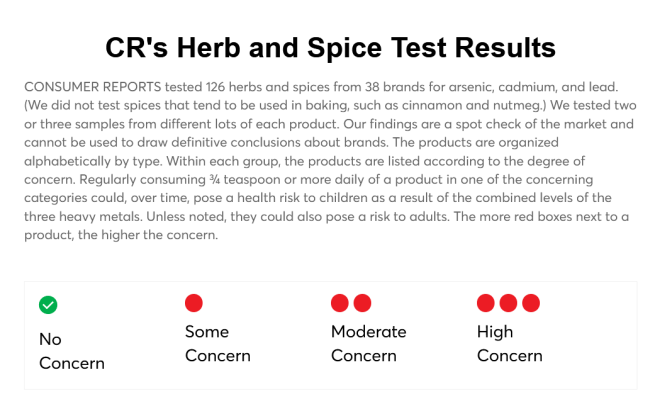
Also, close to the bottom, it gives a rundown of the spices that were tested with a helpful visual graphic for which brands and which spices were more concerning or less concerning, starting with this disclaimer and table:
[Text description: A screenshot with the header in larger bold text that says “CR’s Herb and Spice Test Results”. Below it in smaller text is a paragraph that reads, “CONSUMER REPORTS tested 126 herbs and spices from 38 brands for arsenic, cadmium, and lead. (We did not test spices that tend to be used in baking, such as cinnamon and nutmeg.) We tested two or three samples from different lots of each product. Our findings are a spot check of the market and cannot be used to draw definitive conclusions about brands. The products are organized alphabetically by type. Within each group, the products are listed according to the degree of concern. Regularly consuming ¾ teaspoon or more daily of a product in one of the concerning categories could, over time, pose a health risk to children as a result of the combined levels of the three heavy metals. Unless noted, they could also pose a risk to adults. The more red boxes next to a product, the higher the concern.” Below the paragraph is a graphic of four categories: a green circle with a white checkmark in it, labeled ‘No Concern’; a single red circle labeled ‘Some Concern’; two red circles next to each other labeled ‘Moderate Concern’; and three red circles next to each other labeled ‘High Concern’. /end text description]
Whiiiich is definitely helpful if you’d like to be more careful with what spices you use based on the information available. (That said, they only tested 38 brands, and there are a lot more out there than that. Again, I highly recommend reading the article.)
Tags:
#here’s the other thing I was referring to re: turmeric #food #home of the brave #PSA #poison cw #what’s the warning tag for brain damage‚ I feel like that should have a specific tag


One thought on “”