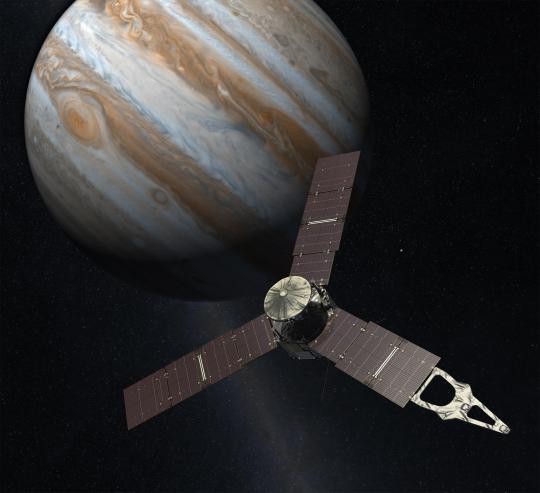
Our Juno mission arrived at the King of Planets in July 2016. The intrepid robotic explorer has been revealing Jupiter’s secrets ever since.
Here are 10 historic Juno mission highlights:
1. Arrival at a Colossus
After an odyssey of almost five years and 1.7 billion miles (2.7 billion kilometers), our Juno spacecraft fired its main engine to enter orbit around Jupiter on July 4, 2016. Juno, with its suite of nine science instruments, was the first spacecraft to orbit the giant planet since the Galileo mission in the 1990s. It would be the first mission to make repeated excursions close to the cloud tops, deep inside the planet’s powerful radiation belts.
2. Science, Meet Art
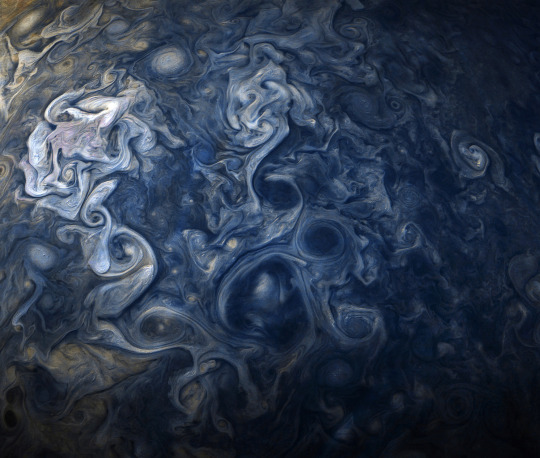
Juno carries a color camera called JunoCam. In a remarkable first for a deep space mission, the Juno team reached out to the general public not only to help plan which pictures JunoCam would take, but also to process and enhance the resulting visual data. The results include some of the most beautiful images in the history of space exploration.
3. A Whole New Jupiter
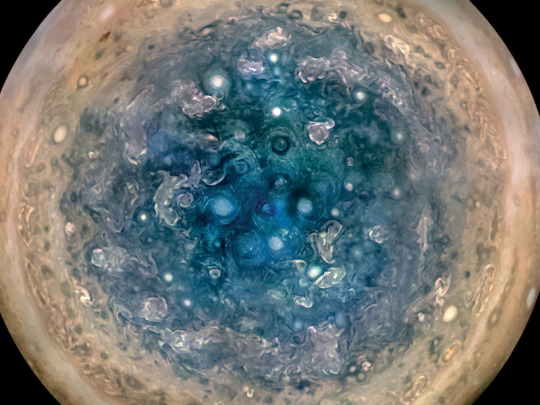
It didn’t take long for Juno—and the science teams who hungrily consumed the data it sent home—to turn theories about how Jupiter works inside out. Among the early findings: Jupiter’s poles are covered in Earth-sized swirling storms that are densely clustered and rubbing together. Jupiter’s iconic belts and zones were surprising, with the belt near the equator penetrating far beneath the clouds, and the belts and zones at other latitudes seeming to evolve to other structures below the surface.
4. The Ultimate Classroom
The Goldstone Apple Valley Radio Telescope (GAVRT) project, a collaboration among NASA, JPL and the Lewis Center for Educational Research, lets students do real science with a large radio telescope. GAVRT data includes Jupiter observations relevant to Juno, and Juno scientists collaborate with the students and their teachers.
5. Spotting the Spot
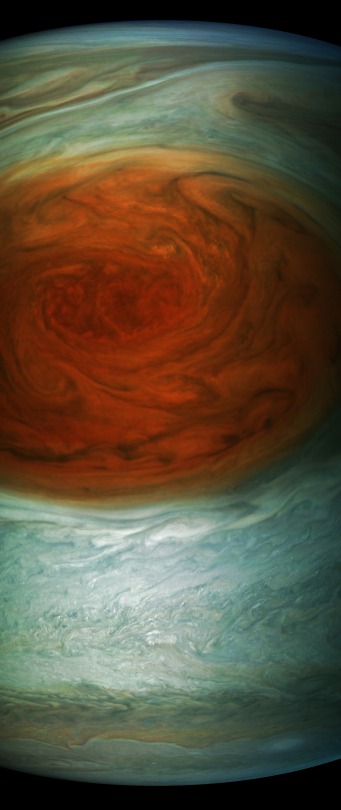
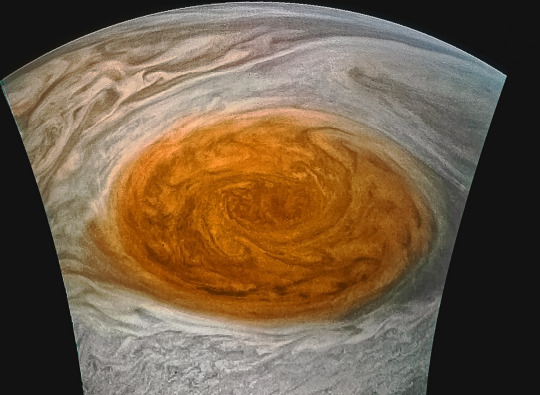
Measuring in at 10,159 miles (16,350 kilometers) in width (as of April 3, 2017) Jupiter’s Great Red Spot is 1.3 times as wide as Earth. The storm has been monitored since 1830 and has possibly existed for more than 350 years. In modern times, the Great Red Spot has appeared to be shrinking. In July 2017, Juno passed directly over the spot, and JunoCam images revealed a tangle of dark, veinous clouds weaving their way through a massive crimson oval.
“For hundreds of years scientists have been observing, wondering and theorizing about Jupiter’s Great Red Spot,” said Scott Bolton, Juno principal investigator from the Southwest Research Institute in San Antonio. “Now we have the best pictures ever of this iconic storm. It will take us some time to analyze all the data from not only JunoCam, but Juno’s eight science instruments, to shed some new light on the past, present and future of the Great Red Spot.”
6. Beauty Runs Deep
Data collected by the Juno spacecraft during its first pass over Jupiter’s Great Red Spot in July 2017 indicate that this iconic feature penetrates well below the clouds. The solar system’s most famous storm appears to have roots that penetrate about 200 miles (300 kilometers) into the planet’s atmosphere.
7. Powerful Auroras, Powerful Mysteries
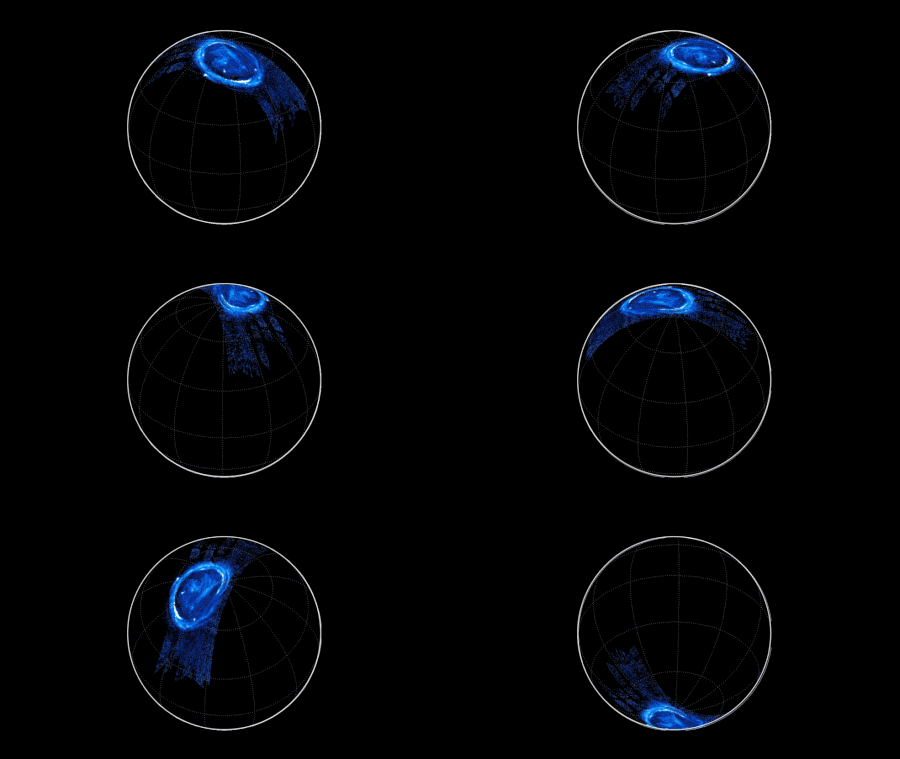
Scientists on the Juno mission observed massive amounts of energy swirling over Jupiter’s polar regions that contribute to the giant planet’s powerful auroras – only not in ways the researchers expected. Examining data collected by the ultraviolet spectrograph and energetic-particle detector instruments aboard Juno, scientists observed signatures of powerful electric potentials, aligned with Jupiter’s magnetic field, that accelerate electrons toward the Jovian atmosphere at energies up to 400,000 electron volts. This is 10 to 30 times higher than the largest such auroral potentials observed at Earth.
Jupiter has the most powerful auroras in the solar system, so the team was not surprised that electric potentials play a role in their generation. What puzzled the researchers is that despite the magnitudes of these potentials at Jupiter, they are observed only sometimes and are not the source of the most intense auroras, as they are at Earth.
8. Heat from Within
Juno scientists shared a 3D infrared movie depicting densely packed cyclones and anticyclones that permeate the planet’s polar regions, and the first detailed view of a dynamo, or engine, powering the magnetic field for any planet beyond Earth (video above). Juno mission scientists took data collected by the spacecraft’s Jovian InfraRed Auroral Mapper (JIRAM) instrument and generated a 3D fly-around of the Jovian world’s north pole.
Imaging in the infrared part of the spectrum, JIRAM captures light emerging from deep inside Jupiter equally well, night or day. The instrument probes the weather layer down to 30 to 45 miles (50 to 70 kilometers) below Jupiter’s cloud tops.
9. A Highly Charged Atmosphere
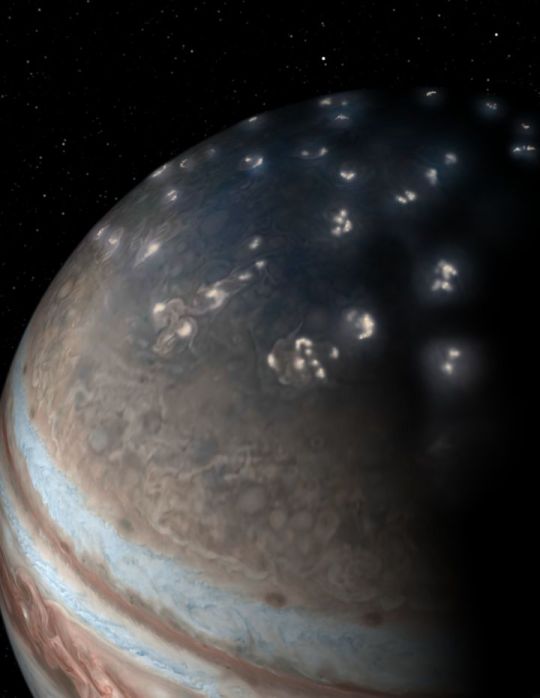
Powerful bolts of lightning light up Jupiter’s clouds. In some ways its lightning is just like what we’re used to on Earth. In other ways,it’s very different. For example, most of Earth’s lightning strikes near the equator; on Jupiter, it’s mostly around the poles.
10. Extra Innings
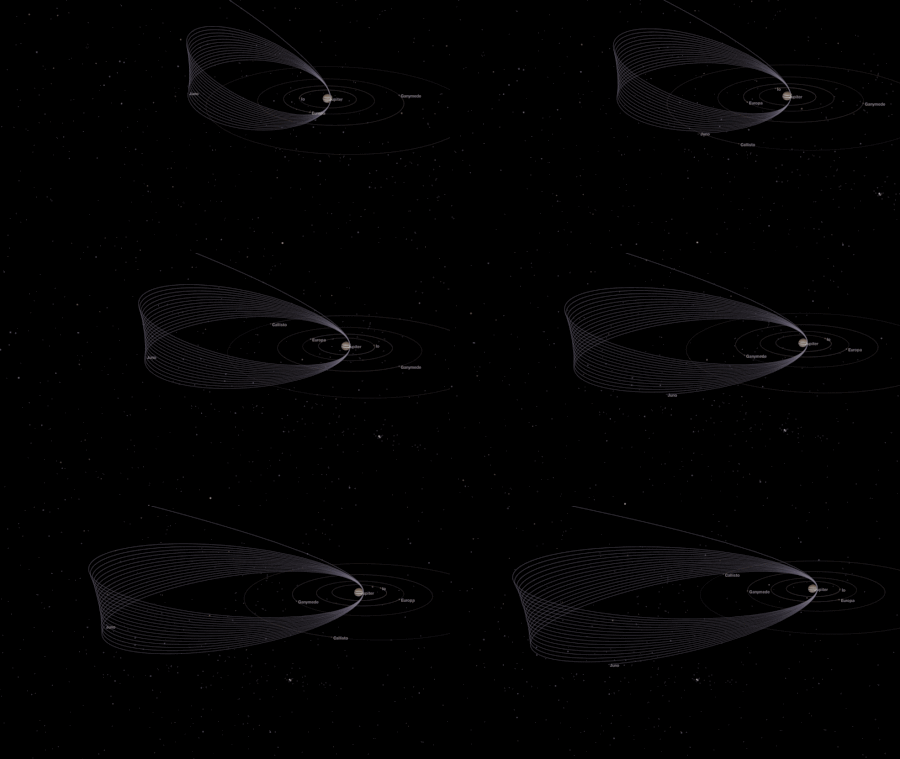
In June, we approved an update to Juno’s science operations until July 2021. This provides for an additional 41 months in orbit around. Juno is in 53-day orbits rather than 14-day orbits as initially planned because of a concern about valves on the spacecraft’s fuel system. This longer orbit means that it will take more time to collect the needed science data, but an independent panel of experts confirmed that Juno is on track to achieve its science objectives and is already returning spectacular results. The spacecraft and all its instruments are healthy and operating nominally.
Read the full web version of this week’s ‘Solar System: 10 Things to Know’ article HERE.
For regular updates, follow NASA Solar System on Twitter and Facebook.
#in search of replacement sources of sci-tech news I have followed the NASA Tumblr #this appears to have been a good decision #space #the power of science #the more you know #Juno
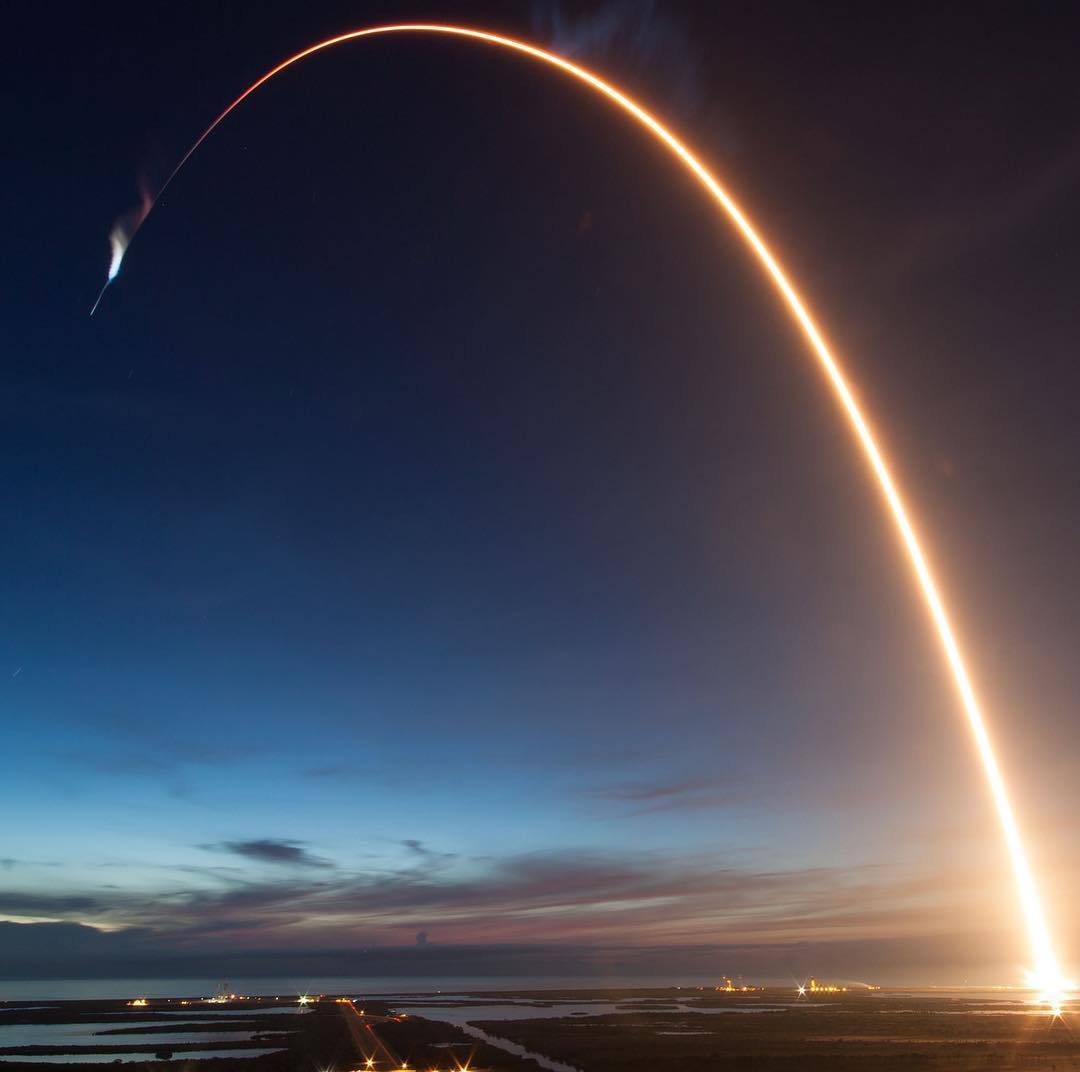
Launching into the sunrise is beautiful. @spacex (at Cape Canaveral, Florida)
Tags:
#indeed it is #pretty things #the power of science #the brightest star in our sky #(the description on the original SpaceX Instagram post says) #(that this is a launcher for a cargo vessel bringing supplies to the ISS)
Inspired by @maddeningscientist‘s shitpost about throwing things into the Sun via gravity-assist, I thought I’d infodump spaceratblr on the subject of GTOC, “The America’s Cup of Rocket Science” and the most hardcore math contest in the solar system!
Basically it’s a yearly competition of ridiculously unconstrained orbital mechanics optimizations. You need to get [spacecraft] to do [thing] with a minimum amount of fuel, a minimum amount of time, both, or something else entirely.
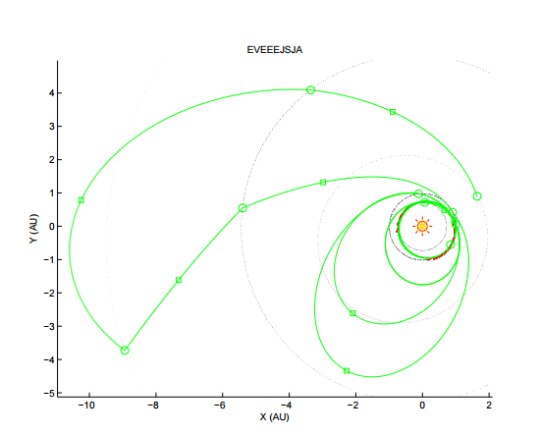
The first year’s competition, for example, was to deliver the most momentum to a particular asteroid within 30 years (say, to prevent it from hitting Earth), given that you have a spacecraft weighing 1500kg initially, with a low-thrust, high-efficiency nuclear-electric engine. So you want to use as little fuel as possible to maximize your mass when you hit the asteroid, but still hit that bad boy like a Rod from God. The winning team from @nasajpl came up with THIS SHIT:
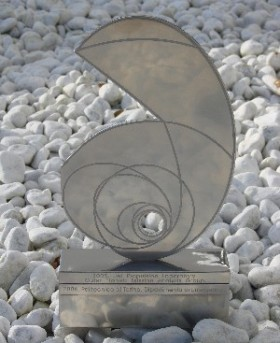
Their spacecraft toodles around the inner solar system for a couple years, banks off Jupiter, TURNS ITSELF AROUND on Saturn, and hits Jupiter again on the way back in towards the target. If you’ve never played KSP, turning a spacecraft around relative to the Sun is virtually impossible. It’s roughly twice as hard to do as just throwing something into the Sun. Humans have literally never put anything in a retrograde heliocentric orbit, and the space wizards from JPL (and their poor, beleaguered supercomputing cluster) found a trajectory that uses the fuel-budget equivalent of two tin cans and a piece of string. The final trajectory output was so badass that the trophy given out for winning the contest is literally a picture of it:
Anyway, the winning team gets to define the next year’s competition, so you’ve basically got the world’s raddest steely-eyed missilepeople challenging each other to optimize-offs every year or two. Man, I wish I’d taken second-level orbital mechanics in college.
Okay so here’s one of those rare gems of moments where retail is actually kind of okay.
I’m gonna start by revealing the well-kept secret that I live in Ohio… in case all the buckeye references flew by you. And Ohio… is obsessed with space travel. I mean- it makes sense. We’ve got a couple astronauts in our history, there’s the National Aeronautics and Space Museum in Dayton, and on those quiet summer nights, where the sky is clear and the stars are twinkling in the distance, it is hard to not look up at the darkness and wonder if there is intelligent life out there. (Not here.)
Anyhow, all the fourth graders have a big space-related project around this time of year and this means that we, as craft retailers, have to be problem solvers. The number one problem is ‘oh gods, please tell me that you’re going to put a primer down on that styrofoam before you spray paint it.’
Because- you guessed it- everyone is making a damn solar system model.
That is to say… their parents are making the solar system model.
I was just finishing up explaining the use of a styrofoam primer and which spray paints are safe to use with styro to the mother of one ten-year-old when the mother of another ten-year-old rounds the corner looking desperate.
“Is this a good paint for cardboard?”
It’s not. So I round her back to where her son and daughter are waiting and explain them what will work. She needs green, and there are three different kinds of greens. The mom holds them up and has her daughter choose.
“Which one do you want for your face?”
I freeze because putting acrylic on your skin is a great way to get a rash. “Hold on, you’re not putting this on your skin, are you?”
“No, gosh no. We’re painting a box and putting the box on her head.”
…
Okay, I’m curious. “Can you explain what you’re making?”
The daughter chimes in. “We have to do a project for school and I’m gonna dress up like a alien!”
Instantly, I love this child. Not just because she considers dressing up as an alien to be an acceptable school project, but because she’s not leaving it to her mom to do all the work.
So we talk for a minute about project stuff and she tells me that her brother is going to be the first man on Mars. Her brother is five. Her brother concurs- he is going to be the first man on Mars. Their mom tells me about the Neil Armstrong museum nearby. Like… this is a family of people excited about the future of space travel.
“Did you hear about those new planets,” I asked.
The little girl starts jumping up and down. “Yes! Yes! Yes!”
Mom: “Can you remember what they said about the new planets?”
“They said…. they said that they can… uhhh… sustain life! There might be aliens!”
Mom: “Now, they said they can sustain life, but I think they also said that it isn’t very advanced life.”
The little girl looks off into space- contemplating this new information. She is formulating a very important thought.