comparativelysuperlative:

The MPAA allows a maximum of one “f-word” to retain a rating of PG-13.

There is some wiggle room on this. But not infinite amounts of wiggle room.

The decimal expansion of pi contains all possible finite substrings. The same is true in any other finite base. This includes base 36. 

The base-36 expansion of pi includes more than one (an infinite number) of instances of a forbidden four-character string. Math is therefore rated R.


jadagul:

While we believe this is true, I’m pretty sure it’s still a conjecture and not yet proven.


the-moti:

The first couple trillion digits of the base ten expansion of pi are known. Presumably it should not be difficult to calculate at least the first trillion digits of the base 36 expansion which heuristically should contain hundreds of thousands of f-bombs. Checking this should be enough to secure the R-rating, without proving the full normality conjecture.


king-of-men:

Also, think how immensely interesting it would be if the heuristic is wrong and there’s no f-bombs in the first trillion digits!


Tags:

#math #I didn’t actually laugh aloud but it still amused me enough to reblog #fun with loopholes
prokopetz:

That meme where people misspell “ingredients” as “ingredience” is fascinating from a linguistic standpoint because morphologically, “ingredience” really ought to mean something like “the quality of being ingredient” or “the attribute which makes a thing ingredient” – i.e., it would something you have, not something you are. What is ingredience? Do I have it? Do you?


johnthedragon:

wouldn’t ingredience be a rating of how many things include you in recipes? So flour has a high ingredience; it’s included in many things. Humans have a low ingredience; not many recipes out there that include human (at least that we know of).


bigscaryd:

Ingredience is formally defined as the probability that, given a random valid recipe not including the ingredient, adding the ingredient will result in a valid recipe. As an example, salt has an ingredience of .98.

A significant problem is that there is no known analytic method to validate a recipe, and it must be done experimentally. Of course, because recipespace is infinite, this means that all ingredience values are approximate.

The question of whether a recipe validator is even possible is a central question of formal culinalysis.


lithnin:

The study of culinalgebra is complicated by the fact that ingredients do not form a basis in recipespace – adding one ingredient may affect the necessary quantities of others.  Adding soy sauce to a recipe increases the amount of salt; adding an acidic ingredient in baking may require the use of more baking soda to maintain the previous pH. An existing ingredient whose quantity is not altered by a given change to the recipe is known as an eigengredient.


Tags:

#food #math #language #unreality cw

the-real-numbers:

The 5 signs of math poisoning:

  1. You become increasingly pedantic to the point of absurdity
  2. Stock art photos of random white symbols, incomprehensible formulas, and geometrical diagrams on a green background make you foam at the mouth
  3. You catch yourself instigating arguments about the technical definition of a sandwich, just to rope unsuspecting, curious people into a never-ending dinner debate
  4. In order to be internally consistent with your idealization of the abstract, you yourself strive to have zero total practical uses
  5. When you see random UTF-8 character strings, you catch yourself looking for an operator or an equals sign


lgthpt:

You were absurdly pedantic before the math


the-real-numbers:

Define “absurdly pedantic”.


the-real-numbers:

Wait


Tags:

#anything that makes me laugh this much deserves a reblog #math #embarrassment squick?

{{previous post in sequence}}


sinesalvatorem:

brin-bellway:

Consider the set S of people living in the town of Newville. Which of the following correspondences specify a function? Explain.

(A) Each person in Newville (input) is paired with his or her mother (output).

[…]

[Answer section:]

(A) This correspondence specifies a function; each person has exactly one mother.

@sinesalvatorem, saw this in my math textbook and thought of you.

(“But have you considered lesbians? Therefore, your argument is invalid.”)

:D

I am happy that my memes have spread! I am a good replicator! Are you proud of me, mom(s)?


Tags:

#(October 2015) #conversational aglets #math #adventures in University Land #high context jokes

{{previous post in sequence}}


sigmaleph:

@brin-bellway not reblogging the whole post but

The method of addition described in the OP [adding 7+6 by observing that 7+3=10, 6=3+3, so 7+3+3=10+3= 13] is implicitly being contrasted with some “normal” way, and I’m curious what that normal way actually is. Anyone know?

I don’t know if this is the “normal” way, but I do mental arithmetic by having all the single-digit additions cached (so 7+6=13 is a one-step result of the method), and doing stuff similar to the OP if I am unsure/forgot/dealing with longer numbers I don’t want to do digit-by-digit. Note that OP is implicitly doing some results caching of their own to remember that 7+3=10 and 3+3=6

[previously on]

I find 3+3=6 much more intuitive and cache-y than 7+6=13, because the first one isn’t overflowing into another digit.

The way you echo back the description of the method, while not wrong really, makes it sound a lot more abstract than it feels in my brain. It feels more like the numbers are made of something with the consistency of dough or soft clay, and I tear a chunk off of one number and stick it onto the other one, then look at the sizes of the resulting two piles of number. Or maybe pouring water from one jug to another until it’s full and then looking at the amount leftover in the first jug, kind of like that puzzle in Die Hard with a Vengeance†. (I always did like that movie as a child, though I would tend to forget that not all of the movie was puzzles and end up unpleasantly surprised by the beginning and end.)

Quite possibly caching everything is the normal way, yeah. I know it’s the normal way to do 1×1-digit multiplication. The kids in my Girl Scout troop made fun of me for not having the times tables memorised: I never bothered and just worked them out on the fly as needed. Some of them have ended up ingrained through sheer use, but I never did put any deliberate effort into ingraining them.

(ingrained-through-sheer-use rather than through any deliberate effort is also how I learned to touch-type [link])

†For those of you unfamiliar: you get a 3-gallon jug, a 5-gallon jug, and a fountain (from/to which you may both take and give water). Measure out 4 gallons. (also do it in two minutes or a bomb goes off, because supposedly this is an action movie and not edutainment)


Tags:

#my childhood #math #reply via reblog #is the blue I see the same as the blue you see #death mention #bullying mention

naxzella:

finding out people dont usually add numbers by first adding something to make a ten (for example 7+6= 7 plus 3 is 10 plus another 3 is 13) & that its actually an adhd thing is the WILDEST shit literally ive lived like 10 years (or however old i was when i learned to add and stuff) thinking thats how everyone does it. what the fuck


cabronallorona:

What


overherewiththequeers:

It’s also an autism thing, apparently.


teaboot:

W H A T


leap-yeap:

Oh yeah! This is also part of why autistic people/people with adhd struggle in math classes. Our brains process math and numbers in a totally different way. Many people on the spectrum struggle with the “show your work” part of math because we can’t exactly tell you why it works/how it works. We just kinda do it


black-infinity-parked-outside:

It’s also a maths dyslexia thing!


maryellencarter:

So I don’t innately do this but I was taught to do it? Now I’m really confused.

(I wonder if a disproportionate number of people who homeschool for primarily religious reasons, and/or of the people who create curricula marketed to that audience, are autistic or ADHD or otherwise neurodivergent. It would sure explain the absolute scathing scorn for the idea that children need “socialization”, and possibly the popularity of theme-integrated “unit studies” and self-directed “unschooling”… and it could evolve pretty easily by those originally being the kids who did a *lot* better homeschooled than in public schools… hmm.)

(Every so often I circle back around to the question of whether any of the things that make me think I’m autistic are inborn or whether they all come from my upbringing. Because my sperm donor is definitely autistic and also an abusive asshole, and my bio-incubator may be autistic or ADHD or something else along those lines but by *god* does she have the executive dysfunction in spades. And they’re both controlling as fuck. So the only way to socialize Correctly was his way, and the only way to get anything done was her way, and given childhood neuroplasticity… does it really matter if I was born autistic or whatever I am? Am I just irreversibly whatever-it-is now and I should be learning to work with it, or am I accidentally meandering back toward neurotypicality (and what does that mean for my online friendships if so), or was I actually neurodivergent all along and it’s just the extroversion confusing me? :P)

Not sure about fundies as such, but FWIW I was in secular homeschool groups (though this included a fair number of relatively laid-back religious types who didn’t mind hanging out with the rest of us) and they were very autistic. And they got distilled to increasingly high concentrations of autism the older they got, because allistics were a lot more likely to leave for public school. Groups of homeschooled teenagers tended to be upwards of 50% autistic, and a lot of the rest had autistic siblings.

The method of addition described in the OP is implicitly being contrasted with some “normal” way, and I’m curious what that normal way actually is. Anyone know?


Tags:

#autism #homeschool #my childhood #is the blue I see the same as the blue you see #abuse cw #math #reply via reblog


{{next post in sequence}}

GleasSpty/MATH-104—–Introduction-to-Analysis

Title link: https://github.com/GleasSpty/MATH-104—–Introduction-to-Analysis/blob/master/Gleason%2C%20Jonathan%20-%20Introduction%20to%20Analysis.pdf

the-axiom-of-choice:

the-axiom-of-choice:

the-axiom-of-choice:

Jonathan Gleason was my friend who committed suicide just over a month ago… and I just found out that he wrote this 800+ page analysis textbook. By himself. Because he was teaching analysis and he was dissatisfied with the textbook he was assigned so he just…. wrote his own.

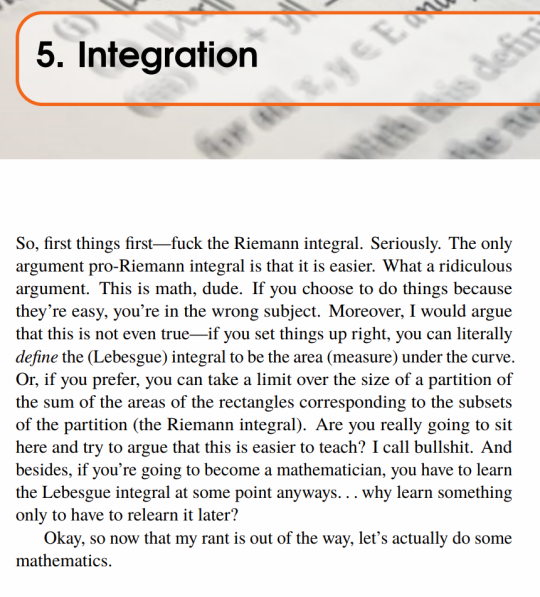
Even if you haven’t done any math… please just take a look at this. Scroll through it as fast as you like. It’s incredible that he put so much work and so much free time into this… I’m still in awe and I really want everyone to see it. In particular, if you want a good laugh, look at chapter 5 of the analysis textbook. The opening paragraph is SO Johnny.

He also wrote a linear algebra textbook, here. 

I really want to thank everyone who has reblogged/liked this, and even anyone who just clicked on the link to check it out. I wasn’t expecting more than a handful of notes on this, so knowing that his hard work gets shared and even appreciated by a few strangers really means a lot.

I’ve taken some of the best/easiest to follow snippets and provide them here, I hope you enjoy them as much as I have:

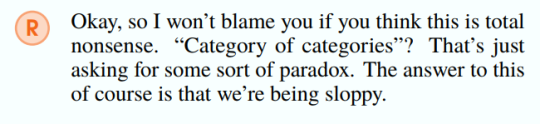
“Da fuq”.

Oh thank god.

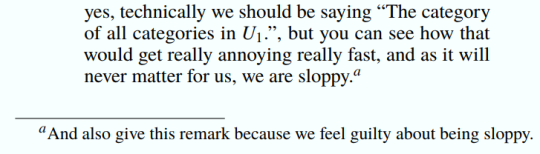
At least he admits when he’s being sloppy.

God, I wish more math textbooks read like this.

And last but not least, my absolute favorite part, the opening to the chapter on integration.

There are so many more tidbits like this and I wish literally all of my textbooks could be written like this.

Jonothan Gleason died Jan 16th, 2018 and it means so much to me that so many people got a kick out of the little pieces of him that are in this book. Thanks for all of the rb’s and likes, I’m so happy that even just a few hundred people got to enjoy his writing and hard work.


Tags:

#math #suicide cw #I didn’t actually laugh aloud but it still amused me enough to reblog

{{previous post in sequence}}


slepaulica:

brin-bellway:

slepaulica:

asapscience:

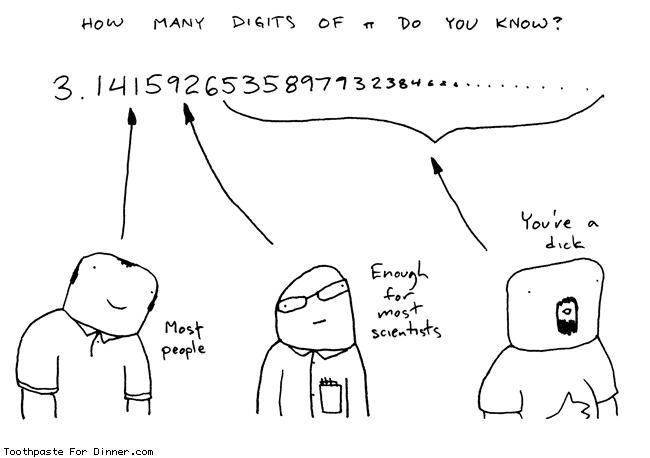
How many digits of π do you know?

I’m a dick!

…I was under the impression that “3.14159265” was the amount you couldn’t help but learn just by living in a culture where the concept of pi is this well-known. Certainly while I remember learning “358” and a little later “9793238” (circa age ten or eleven; I was reading Muse magazine and they had a bit on pi, and I was like “oh hey, more pi digits! that ‘979323’ is a nice pattern, I bet it would be easy to memorise. think I’ll throw in one more while I’m at it”), I don’t remembering learning the first…do you count from before or after the decimal point? Anyway, I don’t remember learning the part in my first sentence because I was so young.

(I suppose it’s not that surprising, really. I frequently have trouble telling the difference between common knowledge and stuff I happened to pick up on the way.)

Most people stop at 3.14. I used 31415926 as the pin for my old phone (I can say this now because it’s not the pin for my current phone and is not a current pin or password for anything). it seemed reasonably secure because most people just picked four digit pins and a random pickpocket probably wouldn’t guess that I had those digits memorised.

and the 535 8 979 323 is a neat pattern too (though the 8 in the middle kinda ruins it)


Tags:

#(February 2014) #conversational aglets #math #my childhood