{{previous post in sequence}}


maryellencarter:

calware:

how many digits of pi (after the decimal point, so 3.?????? etc) do you have memorized?

pi-memorisation-poll

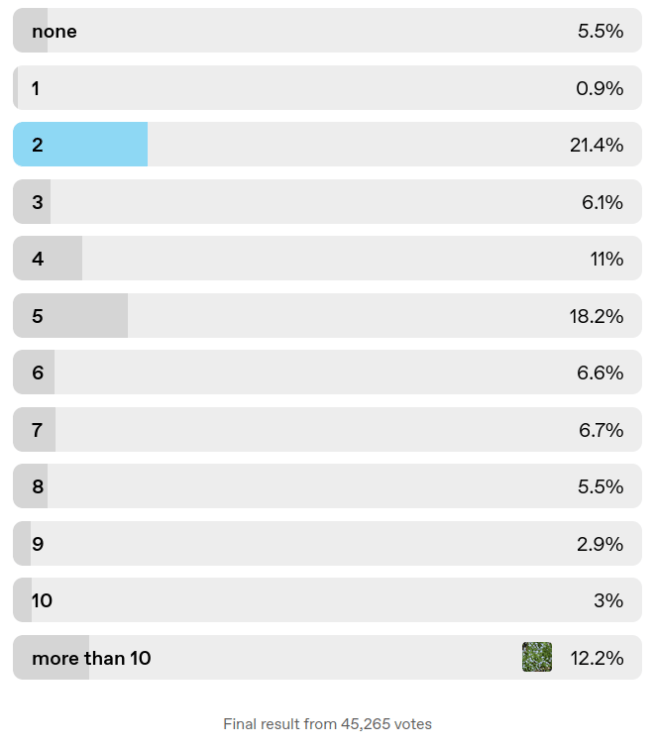
“anyway I am surprised that 5 is such a popular answer, I can understand 2, but why 5, it’s so lopsided” (via @brin-bellway )

I answered 5! In my case, it’s because I once saw a nerdy math cheer that included those digits – something along the lines of “local math team, we’re so fine, 3.14159” – and it stuck.


Tags:

#conversational aglets #math #pi #the more you know #is the blue I see the same as the blue you see #surveys

calware:

how many digits of pi (after the decimal point, so 3.?????? etc) do you have memorized?

pi-memorisation-poll


Tags:

#…this reminds me of that post going around with the #”which field do you think normal people know one or two feldspars in (and quartz of course)” #me: ”yeah I know 18 is an unusually large number of pi digits to have memorised‚ most people only know 8” #(I had a specific copy of that post I was going to show you alongside this) #(but guess what! Tumblr just up and banned them last night for no apparent reason!) #(my pile of tabs-to-consider-reblogging is *actively linkrotting*‚ so I guess I’d better get a move on with sorting through them) #((particularly in case Tumblr decides to finish the job they did on me)) #(I still have several lizardywizard posts in my queue‚ and Tumblr claims those reblogs will go ahead as scheduled) #(we’ll see) #((with careful use of the right-click ”bookmark tab” button I was able to save all but one of the URLs)) #((so if they manage to get their account back I might still be able to retrieve those)) #anyway‚ I am particularly surprised that 5 is such a popular answer #I can understand 2 #but why *5* #it’s so lopsided #math #surveys #is the blue I see the same as the blue you see #amnesia cw

max1461:

clusterduck28:

hanavesinauttija:

7a9f2afa9ae3193e528122d051e185babd962c83

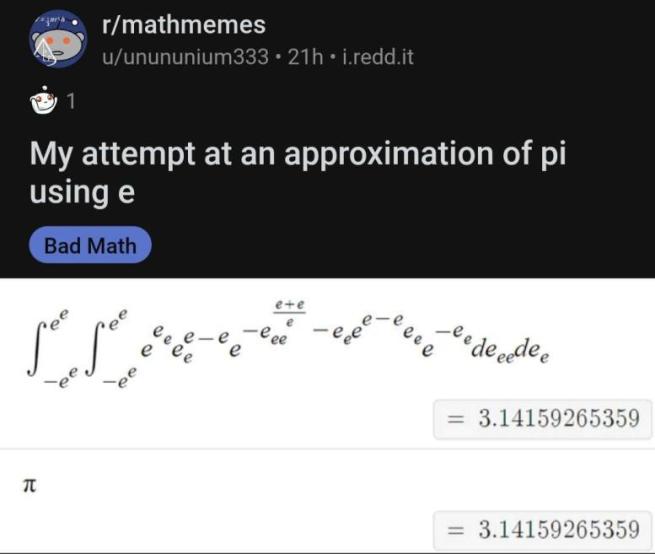
So how is one supposed to say this expression out loud? Like not just going EeEEeeEEEeee but in proper mathematical terms? Say if a mathematician was tasked with communicating this whole thing to another mathematician verbally (over a phone line for example) how would they do it?

“The integral from minus e to the e to e to the e of the integral from minus e to the e to e to the e of e to the e sub e times e sub e to the e minus e times e to the minus e sub e e to the e plus e over e minus e sub e times e to the e minus e times e sub e all times e to the minus e sub e, d e sub e e d e sub e” is how I would say it, with intonation clarifying most of the bracketing.


Tags:

#reading that meme feels like riding a rollercoaster #math #fun with loopholes #this post was queued because my to-reblog list is too long and I didn’t want to dump it on you all at once
jadagul:

Today on the blog I start a new project: where do numbers come from?

By which I mean, mathematicians deal with lots of weird kinds of numbers. Real numbers, complex numbers, p-adic numbers, quaternions, surreal numbers, and more. And if you try to describe the more abstract types of “numbers” you sound completely incomprehensible.

But these numbers all come from somewhere. So I’m going to take you through a fictional history of numbers. Not the real history of the actual people who developed these concepts, but the way they could have developed them, cleaned up and organized. So in the end you can see how you, too, could have developed all these seemingly strange and abstract concepts.

This week in part 1, we cover the most sensible numbers. We start with the basic ability to count, and invent negative numbers, fractions, square roots, and more.

But that will still leave some important questions open—like, what is π? So we’ll have to come back for that in part 2.


Tags:

#math #meta #anything that makes me laugh this much deserves a reblog #(footnote 4) #this post was queued because my to-reblog list is too long and I didn’t want to dump it on you all at once

31b7dca0bc1ddf99da44e324874fef2bce703091

f9b59e0d79c03b1d7b0601733f8930d110895125

a451dcea17aa501b87191aa724676858696f1918

56f04e9ee95f6f2f56edb2275e01a4c57b101699

qwantzfeed:

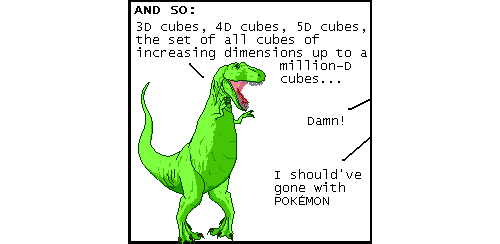
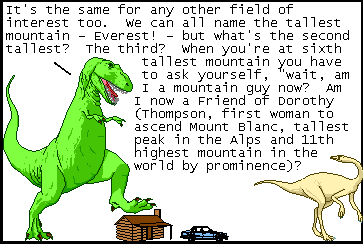
the thing with pokemon is they all stop at 3 dimensions.  there’s no 10-dimensional geodudes.  i know nothing of pokemon but i feel like i would’ve heard about it if there were hypergeodudes.  i have explicitly arranged my life such that if this were the case someone probably would’ve told me


Tags:

#anything that makes me laugh this much deserves a reblog #fun with loopholes #Dinosaur Comics #comics #(3.141592653589793238) #this probably deserves some warning tag but I am not sure what #this post was queued because my to-reblog list is too long and I didn’t want to dump it on you all at once
abalidoth:

abalidoth:

tamberoo:

abalidoth:

Fun little math trick I find really helpful: the ratio of a mile to a kilometer is within 1% of the Golden Ratio. That means that if you have a good memory for Fibonacci numbers (1 2 3 5 8 13 21 34 55 89) you can convert pretty accurately by taking consecutive Fibonacci numbers.

For example, 89 kilometers is really close to 55 miles (55.3). Or, say you need to convert 26 miles to kilometers: 26 can be written as 21 plus 5, so taking the next Fibonacci number up gives 34 and 8, meaning it should be around 42 kilometers. Sure enough, it’s 41.8 km!

8cf2d63ccf09bd6b674d8e864ac50c46c86837be

i need several moments, math like this scares me

Not gonna lie, as much as I want to be helpful and comprehensible, I am very proud of provoking that reaction image.

4a0db743bff1acd1e0faebb1b887c195c107826d

I can actually answer this!

Pi: whenever you have a math problem where you’re adding the square of one thing to the square of another thing, which is really common across a ton of disciplines, you can model that geometrically as a circle, and therefore you naturally get pi a lot of the time.

Golden ratio: thanks to something called Continued Fractions, the golden ratio is the HARDEST number to approximate by fractions. Every other number has a better relationship between [size of denominator] and [accuracy of approximation] than the golden ratio does. This sounds bad, but it’s GREAT if you’re, for example, a plant trying to decide how to space your leaves. If you put a leaf directly over another leaf, that’s bad because you are shading the bottom leaf. If you space them out by the golden ratio, you get the minimum overlap.


Tags:

#math #the more you know #fun with loopholes

abalidoth:

booty shorts that say

x^n + y^n ≠ z^n when n ≥ 3 and x, y, z ∈ Z.

I have discovered a truly marvelous proof of this, which these shorts are too small to contain.


Tags:

#clothing #math #I didn’t actually laugh aloud but it still amused me enough to reblog