It Should Be Legal To Have Sex In Public

{{previous post in sequence}}


danksy-lives:

brin-bellway:

danksy-lives:

By what right does a government, entrusted with the preservation of liberty, see fit to prohibit consensual acts? This question, which was the catalyst of the Sexual Revolution, has led this author to reconsider all manner of social taboos.

While considering the rise of PDAs on campus, I considered how the right to show affection had superseded the expectation of those around them to feel comfortable. This is a positive change, primarily because the taboo against this act is rooted in the belief that people have the right to control the expression of their peers. This value has no place in a free society. From this position, I considered more extreme examples of the same principle. If society has no right to prohibit public signs of love, why should it prohibit its members from the literal act of love? It is this question that led me to my thesis, that it should be legal to have sex in public.

The first objection that will be raised against this is that the other people do not consent to seeing this. This response misrepresents the nature of consent. Many of you have seen a video in which consent is explained using the metaphor of giving someone tea. In this video, consent is understood to be a state in which the two people involved in sex agree to the act. Nowhere in that explanation does the opinion of those around them come into consideration. Because of this, saying that public sex violates the rights of passersby, or that they should just “get a room”, holds no weight.

The second point is that public sex does no harm to those who witness it. As with PDAs, there is no injustice that one can point to in order to justify its prohibition. The most likely grievance one could have is that people having sex on the ground would cause people to move around them. This is certainly an inconvenience, but not one that warrants government intervention. The worst-case scenario is that the coitus occurs in an exit or other narrow location. In this scenario, the appropriate action would be to use applicable fire codes to identify this as a safety violation. They could then be punished accordingly, public sex not being relevant to the matter. In neither case can the public claim harm that comes directly from the act of making love, but from factors that would be relevant whether or not sex was involved.

As I end this, I should address the reader’s assumption that the author is a crazed sex maniac. On the contrary, I am only interested in freedom for its own sake. I have no desire to partake in the act, nor would I gain sexual pleasure from seeing this in my daily life. I am content to know that the government will not interfere with those who chose to do so. Being free does not require that you partake in an act, it only requires that you reserve the right to do so, should the desire come. That is why I write this, so that we may all be a little more free.

People should not have sex in public because–given the fluids involved–it is unsanitary and against the interests of public health. They also should not talk in public for the same reason.

would you then support the idea that those having sex should be responsible for the cleanup of their own fluids?

I highly doubt that would be enforceable in practice. Our current public-health measures are unreliable and generally inadequate: we can’t even prevent restaurants from serving rotting food!

(while you could argue the *later* instances were a natural punishment for forcing service workers into proximity with them during a plague, those poor bastards who simply ordered the least popular variant of chicken during Christmas break absolutely did not deserve what they got)

By requiring people who have sex to do so in (ideally) their own space or (at minimum) a space owned by people in a good position to trace the sex back to them, we both increase the probability that they will have disinfectant available and ensure that, if they fail to use it (or fail to use it thoroughly enough), it will either harm *themselves* or harm someone with the capacity to figure it out and seek restitution. One of many situations where we eliminate the tragedy of the commons by eliminating the commons.


Tags:

#reply via reblog #discourse cw #unsanitary cw #nsfw text #in which Brin has a job #in which Brin has a food poisoning phobia #illness mention
It Should Be Legal To Have Sex In Public

danksy-lives:

By what right does a government, entrusted with the preservation of liberty, see fit to prohibit consensual acts? This question, which was the catalyst of the Sexual Revolution, has led this author to reconsider all manner of social taboos.

While considering the rise of PDAs on campus, I considered how the right to show affection had superseded the expectation of those around them to feel comfortable. This is a positive change, primarily because the taboo against this act is rooted in the belief that people have the right to control the expression of their peers. This value has no place in a free society. From this position, I considered more extreme examples of the same principle. If society has no right to prohibit public signs of love, why should it prohibit its members from the literal act of love? It is this question that led me to my thesis, that it should be legal to have sex in public.

The first objection that will be raised against this is that the other people do not consent to seeing this. This response misrepresents the nature of consent. Many of you have seen a video in which consent is explained using the metaphor of giving someone tea. In this video, consent is understood to be a state in which the two people involved in sex agree to the act. Nowhere in that explanation does the opinion of those around them come into consideration. Because of this, saying that public sex violates the rights of passersby, or that they should just “get a room”, holds no weight.

The second point is that public sex does no harm to those who witness it. As with PDAs, there is no injustice that one can point to in order to justify its prohibition. The most likely grievance one could have is that people having sex on the ground would cause people to move around them. This is certainly an inconvenience, but not one that warrants government intervention. The worst-case scenario is that the coitus occurs in an exit or other narrow location. In this scenario, the appropriate action would be to use applicable fire codes to identify this as a safety violation. They could then be punished accordingly, public sex not being relevant to the matter. In neither case can the public claim harm that comes directly from the act of making love, but from factors that would be relevant whether or not sex was involved.

As I end this, I should address the reader’s assumption that the author is a crazed sex maniac. On the contrary, I am only interested in freedom for its own sake. I have no desire to partake in the act, nor would I gain sexual pleasure from seeing this in my daily life. I am content to know that the government will not interfere with those who chose to do so. Being free does not require that you partake in an act, it only requires that you reserve the right to do so, should the desire come. That is why I write this, so that we may all be a little more free.

People should not have sex in public because–given the fluids involved–it is unsanitary and against the interests of public health. They also should not talk in public for the same reason.


Tags:

#one hot take deserves another #nsfw text #discourse cw #unsanitary cw #reply via reblog


{{next post in sequence}}

{{previous post in sequence}}


tototavros:

being adjacent to cancel-heavy (or at least, cancel-anxious) groups for a few years has unfortunately infected me with an ability to write shitty thinkpiece theses, the two today so far have been “male/female designations of cables are transphobic” and “my sharona is pedophilic”


rendakuenthusiast:

I had the same thought re: cables some years ago but without the assumption that transphobia is bad or that people shouldn’t resist trans activists who try to make them stop referring to cables that way.


alexanderrm:

In the same vein of thought where wanting to know a stranger’s assigned gender at birth as soon as you meet them is equivalent to wanting to know what’s in their underwear or their private medical history, maybe there’s a hot take to be had that we should call them “penis” and “vagina” cables, which takes no longer to say, and is what we actually mean when we say “male/female” cables.


tototavros:

That would work, except no way in hell am I going to ask “Hey, anyone got any usb-vagina-wall-outlet-penis or micro-usb-penis-wall-outlet-penis cords?” in the office slack


rustingbridges:

I wouldn’t say that in the office, but on the other hand my girlfriend will absolutely live to regret your post


brin-bellway:

Huh. @tototavros, you *would* be willing to call them “male” and “female” in the office slack? I wouldn’t be comfortable with that myself: to me “male” and “female” feels like the barest fig leaf over the obvious genitalia references, still very crude overall.

(And indeed, “WTF, why are you referring to them so crudely” was my very first thought the first time I heard someone refer to them that way in my mid to late teens. I was boggled that she was not calling them “prongs” and “outlets” (sometimes “plugs” and “sockets”, though “plug” can be ambiguous as it is also an umbrella term) as I considered to be the norm, and even more boggled when I worked out that *most* subcultures in my meta-cultural neighbourhood consider comparing plugs to genitals to be the *standard* way of referring to them.)


shieldfoss:

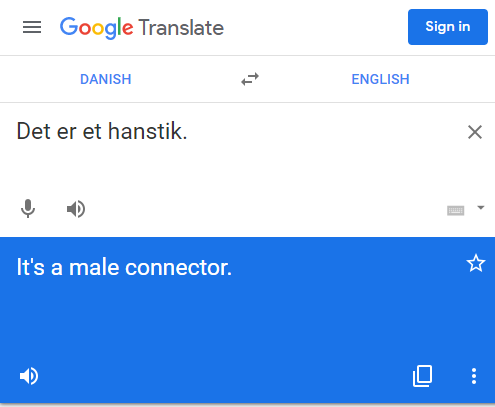
According to google, the correct terminology ( in Danish ) translates into “male connector” in English (and I’ve been using male/female connector when writing in English since forever)

So

I mean

Yeah I’d absolutely use the correct technical terminology in places where I wouldn’t use “penis” and “vagina” terminology, even though it’s clearly just a figleaf for the exact same meaning.

2ac1cb8339202706457181b26f2d4331dd37cc3b

(see also)

…you seem upset that my dialect has different terminology for this, and that it is non-obvious to an outsider that male/female dialects (or languages) allow their terms in *every* context including contexts famously scrupulous about not discussing sexuality?

(From my perspective, it would not have surprised me in the least if male/female dialects had some painfully circumlocutious politically-correct euphemism *specifically* for use in offices: indeed, it seemed the most likely outcome. Since my native dialect is already so politically correct, I’d figured I could afford to wait until I actually *got* an office job to confirm this: I could just ask somebody for a double-outletted adapter and they’d teach me the local euphemisms then.)


Tags:

#reply via reblog #language #our roads may be golden or broken or lost #gender #is the blue I see the same as the blue you see #discourse cw #scrupulosity cw? #nsfw text


{{next post in sequence}}

{{previous post in sequence}}


sinesalvatorem:

brin-bellway:

sinesalvatorem:

brin-bellway:

@sinesalvatorem, about the r/k thing that I’m not going to reblog under my no-guilt-trips policy:

Keep reading

I am confused to say the least. My post doesn’t have anything to do with violence? Or exploiting other people? Or taking advantage of other people’s unwillingness to push back against assholes?

(Unless you consider applying to lots of jobs even if they aren’t your ideal to be assholish behaviour? But that would be odd and surprising? Like, I don’t think it’s actually valuable to be cautious with a company’s time – they set up their hiring channel for a reason.)

My post is about why people should be willing to take actions that are low cost even if they’re unlikely to succeed in full. But, like, I’m kind of a utilitarian – if I’m counting how costly something is, I’m definitely counting how costly it is to /everyone/.

Putting one’s sketches online isn’t hurting you /or/ bystanders, so it counts as taking a low-cost opportunity. Shoplifting may not hurt you (depending on the consequences of being caught), but it’s still taking money out of someone else’s pocket, so it’s still A Bad.

If cowardice is the only lever you have to avoid acting on impulses to hurt others, then OK, in your specific case I endorse cowardice. But almost no one I know works like this? Generally, a lot of factors go into decisions about whether to engage in violence, and they tend to be rather divorced from what makes someone decide whether to try a new food.

If you have only one inhibitory mechanism, it makes sense to keep it at the level that helps you interface with society, but most people are using several different kinds of inhibitory signals. I just want them to put less stock in the “People will ignore/reject/laugh at me and then I will DIE” one.

Basically, for the vast majority of people my post is directed at, the negative outcome you describe just isn’t related to the thing my post is about. The fear of embarrassment stops people from dancing in public, but I don’t think it’s a major factor in stopping people from punching each other. In fact, in most cultures, bullying and strong-arming others is the opposite of embarrassing.

But I still think people shouldn’t do that because 1) hurting others is bad, and 2) whether something is embarrassing is a crappy way to judge if it’s a good idea.

I think I draw the boundary lines in different places than you do.

>>In fact, in most cultures, bullying and strong-arming others is the opposite of embarrassing.<<

Bullying people and embarrassing yourself in front of them are both members of the category “things that increase the likelihood that people will treat you badly in the future”. They increase it by different *amounts*–and I’ll accept that for many cases of embarrassment the increase is negligible–but I don’t know that I’d say they’re different in *kind*.

(And I don’t think it’s far-fetched to say they’re both forms of hurting people, though again by very different amounts. I understand that it is not *useful* to react this way, and I try very hard to avoid doing so, but my *instinct* is to treat “inflicting secondhand embarrassment on me” as a hostile act deserving of a hostile response.)

>>they tend to be rather divorced from what makes someone decide whether to try a new food.<<

This, on the other hand, I *would* say is different in kind. Is it at all common for people to get annoyed with someone for trying a new food?

I’m not sure how to tell how many inhibitory mechanisms I have except by removing one and seeing if things still work, and I think it’s pretty clear that that’s *not* an area where failure is cheap. And while I’ve occasionally caught glimpses of a conscience around here somewhere, I’ve never caught one while angry (even when I wasn’t as good at cowardice as I am now), so I doubt that’s one of the mechanisms for this.

There is a distinct possibility that I don’t have insight into what’s actually going on here, but from the inside it feels like the thing that caused a shift to being consistently non-violent was spending a couple years on the Internet practising my flight response on bits of Discourse, until eventually I could run away from infuriating things offline too. Here, I learned how to grovel, how to phrase things carefully so as to minimise the chances of sparking a fight with anyone, how to keep my mouth shut entirely and quietly slip out. (not doing too well at that last bit tonight, but nobody’s perfect)

In an environment of *relative* safety and much more time to think than IRL, I could have the lesson hammered home that I’m almost always better off reacting to an argument or provocation by surrendering or (if available) pretending not to have noticed, rather than prolonging the pain by trying to fight.

>>Like, I don’t think it’s actually valuable to be cautious with a company’s time – they set up their hiring channel for a reason.<<

Eh, I’ve definitely encountered people with hiring responsibilities complaining about completely unsuitable people wasting their time. I guess bigger companies can probably arrange better filters that put less stress on the employees involved?

I think the largest disagreement here is that I don’t think “things that increase the likelihood that people will treat you badly in the future” is a meaningful category in the first place.

I think there are lots of inputs into the specific way people will treat you, but that none of these look like increasing a “bad treatment” variable, or anything that could be a proxy for such. I think things might influence how deferent or hostile or helpful or avoidant people are in interacting with you, but that any presentation style you choose will pull on a bunch of these, and whether the end result looks like being treated well or poorly just depends on what you as a person want out of interactions.

For example, being more agreeable will tend to make people less hostile, avoidant, and/or argumentative toward you – but will increase their willingness to push your boundaries and ignore your opinions. Which direction looks more like bad treatment? This entirely depends on your priorities! I recently intentionally lowered my agreeableness because, to me, getting more confrontations was worth getting less casual boundary-crossing. Meanwhile, past!me would have put more emphasis on not having to confront people.

And neither of these poles at all looks like people deciding they want to treat you worse. Instead, it’s them shifting their interaction pattern into the path of least resistance. For conflict-averse people, conflict is high-resistance, so they avoid disagreeable people. Meanwhile, if you’re unwilling to cuss out the asshole who touches you inappropriately, they’ll go ahead and do it again, because it’s low-resistance. Is being avoided bad treatment? Is being touched inappropriately bad treatment? Quite possibly both are, but the tradeoffs are built into the interaction style.

(Of course, there are ways to avoid having either of these outcomes by seeming approachable but also like you don’t take shit. Currently, my reduction in agreeableness doesn’t seem to be scaring people off, because I still try to be approachable. But, like, there are other tradeoffs. There are always tradeoffs.)

A behavioral pattern – and all the different personality traits that influence it – sets you up as a person that it’s most convenient to interact with in some ways vs others. And everyone is going about trying to pursue their own social goals while moving through a landscape where some things are easy and some are hard. The key to getting good treatment is making sure other people believe that the best way to get what they want is to treat you the way you most want to be treated. (Where the way you most want to be treated will vary a lot by person.)

And this is why I wouldn’t put embarrassment and bullying in the same category. Even if they both lead to things you don’t want, they do so through completely different avenues. At worst, embarrassment makes you seem incompetent, so people will work less hard to gain your favour since they consider your support low-value. Meanwhile, being a bully will make you seem dangerous, so people will avoid you on the assumption that interactions are high-cost. Being high cost and being low value are really different social tags, and treating them as interchangeable will make it v v difficult to reason about the social landscape.

Again, if you happen to only have one lever to work with, by all means set it to the position that best helps you navigate the world. But you’ll still be operating at a massive handicap, because your single variable will miss almost everything that determines how interactions can go. If there were anything I could point at as the ultimate “get treated badly” variable, I would say it’s not having options.

>>At worst, embarrassment makes you seem incompetent, so people will work less hard to gain your favour since they consider your support low-value. Meanwhile, being a bully will make you seem dangerous, so people will avoid you on the assumption that interactions are high-cost.<<

Thing is, I contested this in my previous post:

(And I don’t think it’s far-fetched to say they’re both forms of hurting people, though again by very different amounts. I understand that it is not *useful* to react this way, and I try very hard to avoid doing so, but my *instinct* is to treat “inflicting secondhand embarrassment on me” as a hostile act deserving of a hostile response.)

Embarrassing yourself in front of people causes them pain (in the form of negative affective empathy), so they’ll want to cause you pain in return. Punching people causes them pain (in the form of physical damage), so they’ll want to cause you pain in return.

And yes, this is in large part projection. Other people almost never act in ways that would make sense if they considered “inducing negative affective empathy” to be a hostile act, and mostly don’t even act in ways that would make sense if they were inclined to see it that way but consciously overriding that. But you can’t have projection without proof of concept: it’s empirically untrue that the worst thing someone will do to you if you embarrass yourself in front of them is work less hard to gain your favour.

(Although I tend to react a lot worse to people telling me explicitly-labelled embarrassing *stories* about themselves than to them actually *doing* embarrassing things, I think because with the stories it’s very clear that they could have easily chosen to not do this to me. Accidents I can forgive relatively easily, even tradeoffs; signposting “I’m going to do something embarrassing now, specifically for the purpose of having you witness how embarrassing it is”, though, not so much.)

P.S. Went to check my use of “affective empathy” and found this suspiciously relevant-looking Wikipedia article.

P.P.S. Apparently I got ninja’d by @kit-peddler. I’m glad to see someone else picking up on my quoted paragraph.

Looking at the notifications continuing to come in as I write this, it looks like now would probably also be a good time to emphasise the very first sentence (not counting “so, about that post”) of my first post:

I suspect we’re both projecting our own selves onto the rest of society and ending up skewed.


Tags:

#reply via reblog #discourse cw #violence cw #scrupulosity cw #is the blue I see the same as the blue you see #long post

{{previous post in sequence}}


sinesalvatorem:

brin-bellway:

@sinesalvatorem, about the r/k thing that I’m not going to reblog under my no-guilt-trips policy:

Keep reading

I am confused to say the least. My post doesn’t have anything to do with violence? Or exploiting other people? Or taking advantage of other people’s unwillingness to push back against assholes?

(Unless you consider applying to lots of jobs even if they aren’t your ideal to be assholish behaviour? But that would be odd and surprising? Like, I don’t think it’s actually valuable to be cautious with a company’s time – they set up their hiring channel for a reason.)

My post is about why people should be willing to take actions that are low cost even if they’re unlikely to succeed in full. But, like, I’m kind of a utilitarian – if I’m counting how costly something is, I’m definitely counting how costly it is to /everyone/.

Putting one’s sketches online isn’t hurting you /or/ bystanders, so it counts as taking a low-cost opportunity. Shoplifting may not hurt you (depending on the consequences of being caught), but it’s still taking money out of someone else’s pocket, so it’s still A Bad.

If cowardice is the only lever you have to avoid acting on impulses to hurt others, then OK, in your specific case I endorse cowardice. But almost no one I know works like this? Generally, a lot of factors go into decisions about whether to engage in violence, and they tend to be rather divorced from what makes someone decide whether to try a new food.

If you have only one inhibitory mechanism, it makes sense to keep it at the level that helps you interface with society, but most people are using several different kinds of inhibitory signals. I just want them to put less stock in the “People will ignore/reject/laugh at me and then I will DIE” one.

Basically, for the vast majority of people my post is directed at, the negative outcome you describe just isn’t related to the thing my post is about. The fear of embarrassment stops people from dancing in public, but I don’t think it’s a major factor in stopping people from punching each other. In fact, in most cultures, bullying and strong-arming others is the opposite of embarrassing.

But I still think people shouldn’t do that because 1) hurting others is bad, and 2) whether something is embarrassing is a crappy way to judge if it’s a good idea.

I think I draw the boundary lines in different places than you do.

>>In fact, in most cultures, bullying and strong-arming others is the opposite of embarrassing.<<

Bullying people and embarrassing yourself in front of them are both members of the category “things that increase the likelihood that people will treat you badly in the future”. They increase it by different *amounts*–and I’ll accept that for many cases of embarrassment the increase is negligible–but I don’t know that I’d say they’re different in *kind*.

(And I don’t think it’s far-fetched to say they’re both forms of hurting people, though again by very different amounts. I understand that it is not *useful* to react this way, and I try very hard to avoid doing so, but my *instinct* is to treat “inflicting secondhand embarrassment on me” as a hostile act deserving of a hostile response.)

>>they tend to be rather divorced from what makes someone decide whether to try a new food.<<

This, on the other hand, I *would* say is different in kind. Is it at all common for people to get annoyed with someone for trying a new food?

I’m not sure how to tell how many inhibitory mechanisms I have except by removing one and seeing if things still work, and I think it’s pretty clear that that’s *not* an area where failure is cheap. And while I’ve occasionally caught glimpses of a conscience around here somewhere, I’ve never caught one while angry (even when I wasn’t as good at cowardice as I am now), so I doubt that’s one of the mechanisms for this.

There is a distinct possibility that I don’t have insight into what’s actually going on here, but from the inside it feels like the thing that caused a shift to being consistently non-violent was spending a couple years on the Internet practising my flight response on bits of Discourse, until eventually I could run away from infuriating things offline too. Here, I learned how to grovel, how to phrase things carefully so as to minimise the chances of sparking a fight with anyone, how to keep my mouth shut entirely and quietly slip out. (not doing too well at that last bit tonight, but nobody’s perfect)

In an environment of *relative* safety and much more time to think than IRL, I could have the lesson hammered home that I’m almost always better off reacting to an argument or provocation by surrendering or (if available) pretending not to have noticed, rather than prolonging the pain by trying to fight.

>>Like, I don’t think it’s actually valuable to be cautious with a company’s time – they set up their hiring channel for a reason.<<

Eh, I’ve definitely encountered people with hiring responsibilities complaining about completely unsuitable people wasting their time. I guess bigger companies can probably arrange better filters that put less stress on the employees involved?


Tags:

#reply via reblog #is the blue I see the same as the blue you see #discourse cw #violence cw #scrupulosity cw


{{next post in sequence}}

@sinesalvatorem, about the r/k thing that I’m not going to reblog under my no-guilt-trips policy:

I suspect we’re both projecting our own selves onto the rest of society and ending up skewed. (Intellectually I’m willing to believe you’re closer to the truth than I am, although I’m really not sure how we could *tell*.)

I deliberately cultivate cowardice as a way of coping with my violent urges. It’s true that fear holds me back, but there are some things I very much *should* be held back from, and I feel like the price of being also held back from some things I *shouldn’t* hold back from is worth it given the stakes.

(and no, it’s *not* just intrusive thoughts)

I try to avoid anything that might piss people off because that would make it harder for *them* to hold back, and I know how hard that can be sometimes. I try to make it as easy as possible for them to keep their violent urges reined in, and (I hope) they’ll do the same for me, and this fragile truce between a whole lot of murder-monkeys that we call “society” will keep functioning.

(Each approach has its disadvantages, and one of the disadvantages of cowardice is that people who *would* advocate cowardice are, of course, less willing to speak out against the people advocating bravery. As such, bravery advocates tend to stand unopposed. I’ve seen other posts like this in the past, some of them shading *much* further than yours does into “you should exploit situations where people’s fear makes them unwilling to fight back against assholes”.)


Tags:

#you want me to be brave? fine. I’ll post this. #(this is the third version of this post I’ve written) #(I tried to balance ”not being more hostile than necessary” with ”the hostility is kind of the point”) #(there’s only so much I can defang a post about how sharp teeth can be) #((I’m not *exactly* angry but writing this post still makes me very aware of how unfulfilling the lack of violence in my life is)) #((but I’d rather have a life whether I neither give nor receive violence to one where I do both)) #((and I’ve made my choices accordingly)) #this post technically qualifies as: #oh look an original post #but is closer to the spirit of: #reply via reblog #is the blue I see the same as the blue you see #discourse cw #violence cw #posts I am almost certainly going to regret


{{next post in sequence}}

{{previous post in sequence}}


brin-bellway:

*

Quite apart from whether their arguments are correct, the main problem I have with kink-critical and porn-critical feminism is that their definitions of “kink” and “porn” feel *really* weird to me.

I would say that I’m kinky and that I consume porn. And I think it’s reasonable of me to define these terms in ways that cover me (what terms should I use, if not these?). But I’m not into pain and I’m not into power exchange (let alone non-con) and I’m not into video, so I end up in this unnerving grey area where people *appear* to oppose me, but none of the reasons they give for *why* they oppose me actually *apply* to me, so do they oppose me or not?

Like, am I vanilla-by-default in their worldview, not being into the things they define as “kink”? In what universe do *I*, of all people, qualify as vanilla?

(…maybe the universe I encountered in this post?)


Tags:

#not really ”vagueblogging” so much as inspired by the general discourse going on around me lately #sexuality and lack thereof #discourse cw #oh look an original post #our roads may be golden or broken or lost #(sort of) #nsfw text

{{previous post in sequence}}


tinierpurplefishes:

justice-turtle:

So @brin-bellway mentioned that being born into liberal feminism is apparently “vanishingly rare, to the point that I’ve seen people who will actually base an argument they’re making on the assumption that everyone comes from somewhere else. (“Nobody’s born spouting feminist doctrine! Give people a chance to learn!” Dude, I *was* born spouting feminist doctrine *that is now two decades out of date*.)”

Thing is, being a convert (so to speak) from hyperconservatism is also vanishingly rare – I know of one other person besides me who switched, and the most common argument I see against tone policing is “Nobody ever changed a hyperconservative’s mind by talking to them.” Which, I mean, tone policing is in fact wrong, but that argument is invalid, because I’m sitting right here not being hyperconservative anymore. ^_^

So what we were wondering is: where the fuck did all the rest of y’all come from? O_O Is there some large pool of mildly apolitical families out there that we just don’t hear about? (And in today’s polarized political climate, how’d you manage that? ;P)

Well, I more or less was born into liberal feminism, as were a number of my friends. But, that said, I think that, pre-9/11, there was a much larger pool of mildly apolitical families in the US. The polarization had been building since before I was born, but it felt like it really hit an inflection point around that time.

I suspect there are also a bunch of people from families that are liberal, but not explicitly feminist. That kind of think that they’re post-feminist, that the fight’s all done and everything is equal now. I rather suspect most of those folks think the same about race as well. Kids from those families might well end up getting shook up a bit when they start having to deal with the world outside their bubble.

But that’s the problem I’m having, that even when people acknowledge the existence of their own fucking culture they use derogatory words like “bubble” to describe it and act like it shouldn’t exist. Isn’t that what feminists want, isn’t that the point? A world where every child grows up that way, and they never have to learn better because there is no better to learn. Every child that does grow up that way is a step in the right direction, a little piece of the utopian future made manifest.

Even assuming the war is eventually won, it will not be won all at once, could never have been won all at once. You want your culture to win out over the other cultures, your mores to be the mores, and the way that happens is with little pockets where your culture has won, little “bubbles”, that expand until they encompass everything. Try to destroy your own strongholds at every opportunity and you’ll never get anywhere.


Tags:

#in which Brin has strong feelings about subcultural validity #again #reply via reblog #a movement does not survive on converts alone #discouraging the existence of non-convert feminists is a *bad* move #I am tempted to tag this #proud citizen of The Future #though that is not the usual meaning of that tag #(the following category tag was added retroactively:) #our roads may be golden or broken or lost

sinesalvatorem:

I am amused to see a bunch of posts saying “tag 12 followers…” in my social sphere, because

Like,

The 12 is a lie. The OP that I got the meme from said “20”. It just so happens that, when I wrote my entry, I only thought of 12 people to tag off the top of my head.

Then I thought “Should I look at my follower list? Why? Because a meme told me to? HA! I am an independent black woman and I don’t need no meme tellin me what to do.” And I snapped my fingers three times to level up my inner goddess.

And now there are a bunch of people using something that I pulled out of my arse as if it had been declared by G-d Himself. I’m no long sure whether my name is ‘Alexander Hamilton’ or ‘Moses’.

…are you okay? The level of superiority oozing off this post is really out of character for you.

I’m not sure whether the problem is with the sender or the receiver, but clearly at least one of us is fucked up right now.


Tags:

#or ‘was fucked up at the start’ I guess #I mean definitely I’m fucked up *now* #because *damn* does this hit my ‘following rules is against the rules’ buttons #eventually I managed to come up with a reasonably polite phrasing for this post #the original had a lot more swearing and italics #reply via reblog


{{next post in sequence}}

I Am Depressed And Need To Argue About Something

{{previous post in sequence}}


sinesalvatorem:

I am feeling low-key suicidal (In the sense of “I would like to die” rather than “I expect to kill myself”. I have high self-control.) and need to distract myself from how awful being alive is. The best distraction that was recommended to me was passionately arguing about something.

As such, I am appealing to Tumblr to send me asks, or reblog this post, with questions about controversial subjects, unpopular opinions, blatant edge-lordery, links to terrible (but reasonably short) Tumblr posts, or anything else that could put me in a fiery state of “someone is Wrong on the Internet”.

I may not be able to reply to All The Things, because bad brains, and my responses may be poor-quality or not endorsed by sane!Alison, but I will feel better while writing what I can.

If you can’t think of anything (you don’t need to reply with anything good, but if you still can’t) but would like to help, reblogging this post at all increases the likelihood that someone will want to edge-lord in my direction.

(Oh, and sending my complimentary asks (even without anything to argue about) helps a lot.)


thatismyright:

Claims that public (non-nude) kink is unethical or immoral are stupid purity instincts and have no connection to real consequences. I don’t care if you think that “you’re part of my scene and don’t consent to it”; that’s a fact about your state of mind, not about a state of reality, and my and my sub’s right to do what we want trumps your desire not to be uncomfortable.


sinesalvatorem:

…I think I agree with this, actually? IDK if it’s just the fact that I lack purity instincts and can’t properly understand the people who have them, but this seems really reasonable to me and always has.

If something seemed perfectly OK (if quaint) to you when you didn’t know the motivation for it was sexual, it does not become bad upon you learning that it is, in fact, sexual. The goodness or badness of an action is separate from it’s intentions and motivation. It’s about consequences. If wearing a collar as a fashion statement is OK (because it harms no one), then doing so because it turns you on is no better or worse.

Why do people oppose this, anyway? Followers with purity instincts? Followers who agree regardless of squick reactions? Followers who disagree but know how to steelman it? What exactly is going on here?


brin-bellway:

This is going to sound weird, please bear with me, but the main reason I value my discomfort around public sexual acts (for broad definitions of such) is precisely because I don’t have an explanation behind it.

Okay, look. I often worry that I don’t have any moral sense of my own, that I only do what I do and think what I think because I have been told to do and think these things. I mean, how could I tell whether a belief in something’s wrongness is really mine or just someone else’s? I can trace nearly everything back to people telling me what to think; maybe I would have thought that way anyway, maybe I wouldn’t. Who can say?

Note that word. Nearly everything.

Because then I look back, and I see a girl, perhaps nine or ten years old. Her Girl Scout meeting has just ended, and the kids are passing the time while they wait for their parents to come pick them up. One of the others pulls a yo-yo out of her bag and swings it in front of another kid’s face. She intones “You are getting veeery sleeepyyy…”

Our protagonist yells at them. “Don’t do that! It’s wrong!”

Kid 3 (the one watching the yo-yo): “Why?”

Kid 2 (the one holding it): “It’s not like I’m really hypnotizing her. It’s just a game.”

She can’t explain why it’s wrong. She doesn’t know. There’s just something in her, bone-deep, visceral, screaming protest at this situation. Can’t they hear the alarm bells going off in their heads?

(Maybe they can’t. The other children’s thought processes are often alien. Perhaps this is just another instance.)

Nobody told that girl to believe that it was wrong. Nobody had even given her enough information to extrapolate that it was wrong. (It will be several more years before she learns about hypnosis fetishism, before she learns that the word she was looking for here was “indecent”.) But she thought it was wrong anyway.

That girl is still part of me. She was clearly not entirely lacking in innate moral sense, and by extension neither am I.

Now, I’m not saying that we as a society should all abide by my moral sense. I mean, if nothing else I can’t think of a way of making it practical. It’s all very well for me to avoid doing erotic things in public and avoid spectating when other people do unintentionally erotic things in public (and I do try to), but what about…if I understood correctly, you yourself recently said you tend to pick up any kink you learn about. How are people like that supposed to get by in the world? The set of things they’re allowed to do would be ever more limited.

So, I agree to let people do public sexual acts, but I do it grudgingly. I don’t really want to be okay with it. Not being okay with it is something I can point to as unambiguously myself, and I do not have enough of those to spare.

P.S. I’m curious, on what grounds do you carve out an exception for nudity-involving things in the “public kink is okay” view? What makes nudity less okay than anything else?


sinesalvatorem:

This is very fascinating and cool. Thank you.

In terms of the things related to me:

I do, in fact, pick up pretty much any kink I have sufficient exposure to. This does not at all make it harder to get by. My natural state (sans- brain mods) is asexual, and sufficiently so that I have no visceral reactions or associations with sex. System one believes sexual activity is just the sum of its parts, with no particular significance for being sex.

Also, when I started modifying in the direction of allosexuality, being-disgusted-by-indecency seemed like a wholly sub-optimal trait to have. So I never added it to myself. As such, I will never understand what other people find so weird about a public D/s scene.

I personally wouldn’t make an exception for nudity. I would prefer to live in a world where public nudity was OK; just on the basis that I might, at some point, not want to bother with clothing; while there’s zero downside to me if other people do the same. I used to argue about this as basic liberty thing. However, at this point, I have accepted that every other human being is sufficiently insane that this would probably not be feasible.


ozymandias271:

I think it is wrong to do public sex acts that other people will perceive as being sex acts. Therefore, there is nothing wrong with subtle public D/s, fucking in public places you’re unlikely to get caught in, or wearing lingerie under your clothes because it turns you on to do so. But there is something wrong with slapping your partner’s face, fucking on the train, or similar. 

Imagine Alice, who loves public sex, and Bob, who is disgusted by seeing closed-mouth kissing. In a lot of circumstances, they can just go to different places– if Bob goes to the kink event, it is kind of his own fault. But there are other spaces, like the train, where people with a wide variety of preferences meet. The obvious way to do this rule is “Alice and Bob can both do whatever they like on the train”. The problem with that is that every public space now follows Alice’s preferences and none of them follow Bob’s, which is tremendously unfair to Bob, because now he can’t use the train without being upset. So instead we come up with compromise rules: Alice can mostly only do things that don’t upset Bob, and Bob has to avert his eyes when people are doing closed-mouth kissing.


sinesalvatorem:

But why draw the line there? Why not be more permissive or more restrictive? Or is it just “the current set of values we have is a Schelling point and we shouldn’t try to mess with it too much”?


ozymandias271:

I mean, AFAIK very few people want to have public sex and cannot have their desires fulfilled by fucking in the bathroom or in a sex party, and most people do not wish to see others having public sex, so that’s a rule I’m p comfortable with. Similarly, it seems like a bad precedent to require people to not do behaviors no one can tell they’re doing, so I’m p comfortable with subtle public D/s. 

I can see reasonable disagreement around the acceptability of PDAs in general (I’m pro-PDA but willing to be convinced) and around the acceptability of kinky PDAs (for the same reason that I can hold hands with two partners in public, a woman should be allowed to call her partner “mistress” in public). 


tartapplesauce:

The appeal of public sexual acts is their transgressiveness and the outrage they evoke in the mundanes.  After all, if you’re not breaking boundaries, you’re not pushing limits, so what’s the point?

Your thrill depends in large part on imagining my shock/horror/disgust and the patting yourself on the back over how much more liberated and free and natural and open to pleasure you are than repressed prudes like me.

(You have no idea what kind of filthy kink is in my head, you’re going by your idea of what I’m like by my external appearance).

That means that, without my consent, I am being made part of your game.  And if I don’t want to play, I don’t get a choice or the chance to refuse.  And you’re not playing in private, because you need to evoke a reaction from me so you have to show as much as you can get away with, without being arrested.

Even if I’m not morally opposed, or I am morally opposed but agree you’re entitled to go to hell in your own way, or I am not shocked/horrified/disgusted but simply bored or eye-rolling about “Dammit, all I wanted was to get home and decompress on the bus journey or walk home after my crappy day”, I still get your idea of fun shoved in my face.

Just as a bunch of drunken guys may be having a great time yelling and shouting and messing about, but it’s less fun for the sober people around them, then you and your partner may be having a fine time fucking like dogs in public or showing off your D/s credentials or whatever, but that does not mean I get the same enjoyment.

And since this is a public space, so nobody has a greater entitlement to it than another, the rule is compromise: the least annoying thing for the greatest number.

So you turn down your music if it’s leaking through your headphones on public transport rather than swearing at and threatening violence to the person who asks you to turn it down.

And you don’t fuck where people are watching, unless they’re all there by invitation and/or have consented beforehand or at the very least know what’s going to be going on.

It’s common courtesy, consideration, politeness, civilisation.


notyourbusinessanyway:

People who likes to make sex in public spaces are thrilled by the chances of being caught, but not always by the actual fact of being caught. Most of them freak out if they actually are. They like the idea, but not the fact. You know, it’s like BDSM. It is a performance. There are very few people who love to perform as a sex slave that would like the idea of being an actual sex slave. So if you see people having sex in a public place it’s not that they like to shock you, they don’t mind you, they’re too focused on themselves to actually know about you. That’s why drunken sex on the beach is so profitable to thieves. The witness is not part of the pleasure. The witness is totally out of the picture. If they were so turned on by the idea of people looking at them, they will pay attention and realize that the peeping-tom is not just looking, but fucking stealing they i-phones.

So it’s not about kinks, it’s about lack of good manners and/or intoxication. Like urinating in front of people. It’s not that they love to do it, they do it because they’re too wasted and don’t fucking care.

But what was the main post about? I remember something about “don’t do unrelated things that I find alluring in front of me because it’s obscene”. Well, no. You find it obscene, it’s your problem. If you’re turned on by feet, don’t tell me not to show my toes, my toes are mine and it’s not me who has the problem. Learn how to control yourself. It’s like that tale about Muhammad talking to a girl and the disciple looking at her tits like a pervert. He pushed the disciple’s face aside: it was his fault, not hers. And we’re talking about tits, body parts that most people will find alluring, not kinky stuff. So, if even a religious major figure from the sixth century agree with the “if you’re horny it’s you who’s got the problem, not us” thing, maybe it’s not as progressive as it seems. It’s common sense.


brin-bellway:

‘But what was the main post about? I remember something about “don’t do unrelated things that I find alluring in front of me because it’s
obscene”.’

Really? The main post certainly doesn’t say that (the OP doesn’t mention sex at all), and the only thing like that I see anywhere in this reblog-chain is me describing the thought processes of a freaked-out ten-year-old running on instinct. @sinesalvatorem asked her followers what it’s like having a purity instinct, so I told her. As far as I can tell, nobody actually endorsed making people stop doing unrelated things that someone around them happens to find alluring.


notyourbusinessanyway:

I must confess I didn’t go back to the start and re-read it, I just kept on writing. I didn’t thought someone would actually read my input. But you’re right.

Thank you. I’m glad we understand each other.

(I saw your reblog because I was looking at the notes of the thread to see what else people had added.)


Tags:

#reply via reblog #:)