tanadrin:

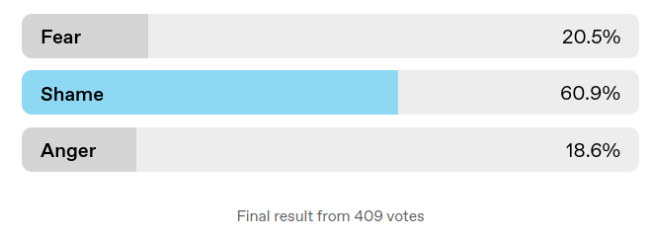
An evil wizard holds you at gunpoint and requires you to choose one of the following emotions to lose forever. You will not feel the faintest trace of it ever again. Which do you pick?
evil-wizard-negative-emotion-poll

tanadrin:

Mildly surprised by the results of this poll, given that it’s a dead heat between the three for me. I suppose it shouldn’t be entirely surprising that shame wins, since it is in some ways a very social emotion, and how others perceive us (and our worries about how they perceive us) occupies a lot of our thoughts. But though I would gladly dispense with all three emotions, if I somehow could, a small sense of shame seems the most useful, since it is at least sometimes a useful key to whether others might be put off or annoyed by our actions.

jadagul:

I’m confused by the idea that this is an evil wizard. Losing shame and losing anger both seem clearly net positive to me?

kata4a:

oh wow. fear and shame both seem straightforwardly useful to me in a way that anger does not

apricops:

“What could possibly go wrong with losing my sense of shame,” I say five minutes before shitting myself in public

tanadrin:

There was a woman born with a congenital condition that prevents her feeling fear interviewed on, I think Radiolab a while back; something that struck me about the interview was that feeling no fear didn’t interfere with her life 99% of the time; it certainly didn’t make her more inclined to play in traffic as a kid or anything. Her cognitive ability to predict and avoid harm was perfectly intact. They did indicate (though did not really detail) that there were a handful of occasions in her life where a lack of being able to feel fear led her into riskier situations, but this was more akin to what a naive or trusting person might experience–if anything, someone who feels no fear would be less likely to be, say, an adrenaline junkie who takes risks because they experience a fear response in a particular way.

I think if you were cognitively normal except unable to experience shame, you probably wouldn’t shit your pants more often in public (so to speak); you would retain your ability to predict which situations might cause you to accrue negative social capital and to avoid them. I think a lot of what fear and shame (and all our other emotions do) is help us cache those calculations, or reinforce the desire to avoid behaviors, but we don’t depend on them to act like, in basically sane and rational ways. If you had no trace of shame I do expect your behavior would be at least a little different, unless it was really working hard to restrain some deeply unpopular compulsion, but I don’t think it would actively incentivize acting in weird ways.

discoursedrome:

more than anything else this poll made me feel perplexed about how different I am than others. I picked anger because it seems, like, really obviously the best choice, but it’s the least popular! Shame and fear are both defensive emotions, in the sense that they’re designed to protect you from threats, but anger is largely an offensive emotion; I’m much more concerned about compromising my defensive capabilities than my offensive ones, since society doesn’t feel like the kind of situation where you can just plow through everything with a strong preemptive assault. I think maybe the square-jawed dynastic banker guys can pull that off, which is why they do so much cocaine? But it’s not, like, usual. Having no sense of anger feels much safer than the other two.

I suppose the results are complicated by people’s individual tendencies, though, too. Someone who has way too much of a particular thing would probably be biased to get rid of it, so at least some of this might be that the reclusive tunnel-dwellers of Tumblr have more fear and shame than anger on the balance.

togglessymposium:

Anger is absolutely a useful, load-bearing element of my life. It’s motive, in a way that the others are not; it’s one of the basic things that distinguishes between the world I live in and the world as I want it to be. Reducing that better world to a mere ‘would be nice’ is… extremely disturbing to me.

So I guess I can agree that it’s ‘safer’ to get rid of anger, in that it’s not likely to result in dangerous situations for you or anybody else. But it’s also a life of extreme complacency, in a way that’s directly counter to many of my core values. Without anger, there’s no sense of unfairness; without unfairness, there’s no aspiration to justice. Most notably, I really hate death, to the point of being slightly loony about it- without that, I’m fairly sure my baseline personality would look very different.

Man, reading this thread makes me feel like one of those colourblind people wondering why people are making such a big deal about subtle variations in shades of brownish-gray.

I read through the notes, and almost *every* example that *every* person brings up for *every* emotion on this list parses as fear to me.

I’m reblogging this particular version primarily because of how surprising it is to see someone describe the-painful-awareness-of-the-gap-between-how-the-world-is-and-how-it-ought-to-be as *anger*, when as I experience it…okay, some of it is disgust† and a fair bit of it is simply pain (which is not exactly an emotion per se), but the rest is basically a *central example* of fear to me.

By the time I saw this post it was too late to vote on it, but I’d have gone with anger. I can’t say I’d be *fully* comfortable with “dealing with my inability to (safely, ethically, etc) satisfy my bloodlust†† by cutting it out of my soul”, but I have to admit it *would* be the most practical approach.

(I’m not going with shame because I absolutely do not understand what it would mean to cut out shame but leave fear intact, and I’m not fucking with that. At least there is *a* thing that it would mean to me to cut out anger while leaving the others, even if I’m not drawing that line in the same place as anyone else.)

†shitting myself in public would *also* be disgust, BTW: shitting myself in private does not seem like it would be significantly less unpleasant modulo bathroom access

††I cannot *begin* to wrap my head around what “non-violent anger” would be like as a quale, I suppose next you’re going to tell me eths can be placed at the ends of syllables


Tags:

#this also happens a lot when people are talking about sadness #reply via reblog #is the blue I see the same as the blue you see #anger management #surveys #unsanitary cw #violence cw? #this probably deserves some other warning tag but I am not sure what
Finally, A Personality Quiz Backed By Science

{{previous post in sequence}}


{{Title link: https://projects.fivethirtyeight.com/personality-quiz/?group=-MLnw84-zDddzbQsP6ta }}

brin-bellway:

rustingbridges:

voxette-vk:

TIL 538 has a personality test

Follow the link above to be in the “group” I made so that you can compare your score against the average. (Hopefully. It seems not to want to load the results when I refresh the page…)

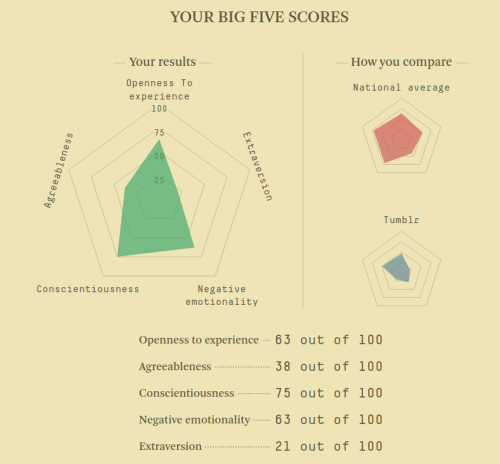
c7f813ba153e5b17bb4cf97bd1a2bcff06a6571a

we’re doin big 5 I guess:

9687af0eccb13aa6f1d4cd1764ad61a4ca562d69
30ccfc5eb49856a1b965b3797179e9514352f62e

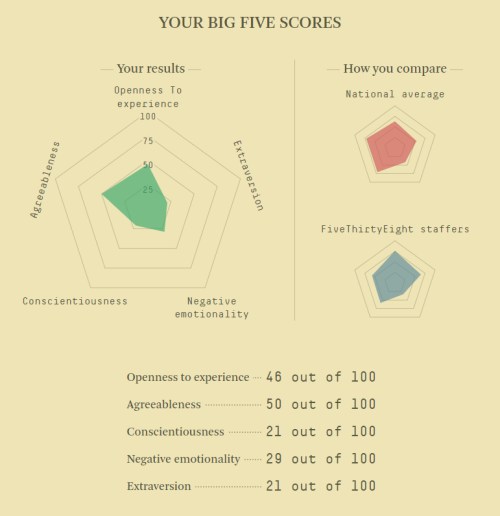
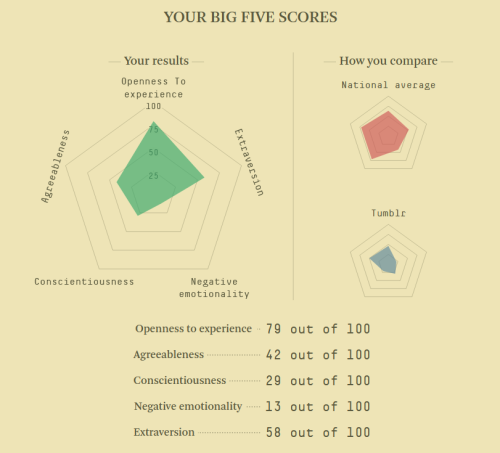
My first thought was that it was attempting to tell me what I want to hear: most of these are rather “better” figures than I was getting on Open Psychometrics a couple years back.

Then I looked at the more detailed breakdown, and a lot of my supposed middle-of-the-road-ness is from having very high scores in some subcategories and very low scores in others, which “averages out” when seen at lower resolutions. Are you very anxious but not depressed? Congratulations, your negative emotionality is “moderate”.

(Except conscientiousness, which is a nice symmetric equilateral triangle with every vertex at ~75.)

((…wait, how does the *average* American have *75th* percentile conscientiousness))

This version seems to place somewhat more emphasis on *treating* people well when it comes to agreeableness, as opposed to Open Psychometrics’ questions which were pretty much purely about how you felt about them on the inside, and that difference is most of what dragged me from 12 up to 38. I am a proverbial kitten who thinks of nothing but murder.

You might also have a low opinion of your own looks.” I look plain in a vaguely pleasant manner, which is *exactly how I like it*, thank you very much

Some scientists think low extraversion has protected humans from disease — you can’t pick up a bug from people if you avoid people.” saaame

@voxette-vk​ replied: “These aren’t percentile scores


Hmm, I suppose I read too much into this bit:

A lot of the outcomes that correlate with low agreeableness, like being chronically bullied (or bullying) or having a criminal record, don’t kick in until someone’s score is down in the 10th percentile.

I guess that makes the two sets of numbers not directly comparable, then.

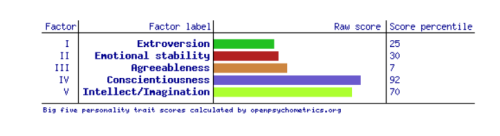
I just went and took the Open Psychometrics one again to see how they portray their results, and it looks like this:

c31f342c50cfecbaa18afb1f16b267ce561ef5c3

And yeah, you can really see the difference grading on a curve makes, huh. Like, if you hear “your score is 7 out of 100″ you would not intuitively expect so much of the agreeableness bar to be filled, but I guess their other test-takers are so agreeable that moderately low agreeableness is enough to make you way below average.


Tags:

#is the blue I see the same as the blue you see #memes #surveys #anger management #replies

Finally, A Personality Quiz Backed By Science

{{Title link: https://projects.fivethirtyeight.com/personality-quiz/?group=-MLnw84-zDddzbQsP6ta }}

rustingbridges:

voxette-vk:

TIL 538 has a personality test

Follow the link above to be in the “group” I made so that you can compare your score against the average. (Hopefully. It seems not to want to load the results when I refresh the page…)

c7f813ba153e5b17bb4cf97bd1a2bcff06a6571a

we’re doin big 5 I guess:

9687af0eccb13aa6f1d4cd1764ad61a4ca562d69
30ccfc5eb49856a1b965b3797179e9514352f62e

My first thought was that it was attempting to tell me what I want to hear: most of these are rather “better” figures than I was getting on Open Psychometrics a couple years back.

Then I looked at the more detailed breakdown, and a lot of my supposed middle-of-the-road-ness is from having very high scores in some subcategories and very low scores in others, which “averages out” when seen at lower resolutions. Are you very anxious but not depressed? Congratulations, your negative emotionality is “moderate”.

(Except conscientiousness, which is a nice symmetric equilateral triangle with every vertex at ~75.)

((…wait, how does the *average* American have *75th* percentile conscientiousness))

This version seems to place somewhat more emphasis on *treating* people well when it comes to agreeableness, as opposed to Open Psychometrics’ questions which were pretty much purely about how you felt about them on the inside, and that difference is most of what dragged me from 12 up to 38. I am a proverbial kitten who thinks of nothing but murder.

You might also have a low opinion of your own looks.” I look plain in a vaguely pleasant manner, which is *exactly how I like it*, thank you very much

Some scientists think low extraversion has protected humans from disease — you can’t pick up a bug from people if you avoid people.” saaame


Tags:

#reply via reblog #memes #surveys #is the blue I see the same as the blue you see #anxiety #anger management


{{next post in sequence}}

karnalesbian:

minatokun:

Accounting majors who hurt you

i read this as the beginning of a list, not as a question


Tags:

#first thought: ”I mean I *do* have a bit of a sadistic streak” #second thought: ”wait this was a *question*? I thought it was a concept” #third thought: ”how dare you assume it must be a reaction to something traumatic” #fourth thought: ”…the people who laid off my dad in 2006” #fifth thought: ”……the people who forced my dad’s *ancestors* to become a mercantile caste #thereby accidentally creating what was effectively a breeding program selecting for accounting talent” #(if the way to obtain enough resources to feed/house/etc lots of kids is to be good at your job) #(and all the jobs available to you are in finance) #(and this keeps on being true for many generations…) #tag rambles #adventures in University Land #evolution #Judaism #adventures in human capitalism #anger management

etirabys:

I deserve more credit for not picking stupid fights on the internet than a nice person who doesn’t pick fights does, because I have an unpleasant personality and it’s harder for me


Tags:

#anger management #not sure I’d go so far as to *entirely* endorse this but it’s certainly #relatable #we will get through this together‚ Eti

{{previous post in sequence}}


gasmaskaesthetic:

brin-bellway:

gasmaskaesthetic:

Why does anger feel good? Most of my undesirable emotions are painful in addution to themselves, so I actively want them to stop. Anger is the one I hesitate to soothe. When I’m angry, it makes me angrier to try to talk myself down instead of letting the rage play out. I can still do it, but it takes a very different kind of effort compared to sadness, or anxiety, fear, or irritation.

Sadness is something I impulsively indulge in, sometimes, but my natural tendency is to do so by seeking comfort, so it’s self-regulating.

When I’m anxious or afraid, I want to get out of that state immediately. This doesn’t always generate *effective* behavior but I’m not resisting the attempt to feel better out of an active desire to stay that way.

Irritation isn’t the same thing as anger. It’s excessive sensitivity. It can turn into anger, but I never want to remain irritable.

Anger moves me to take action. It’s satisfying to direct anger at a target. It feels *good* to rail against some real or imagined wrong. Some of the clearest thinking I’ve ever experienced has been at the peak of justified anger. The risk of indulgence here is pretty obvious. Given how much satisfaction I get from anger, I think I do a pretty good job of staying away from rage-bait. I’m also lucky in that I’m not easily driven to anger in the first place. Most of my anger-management is preventative. I’m not sure what I’d do if that got, say, 40% harder.

I’m curious about other people. Answer all or just some of these, if you want:

Do you work yourself up over things, intentionally or otherwise?

Do you seek out material that triggers anger but does little else for you?

When you are angry, do you ever want to stay angry?

Does that ever change depending on why you’re angry?

Do you find it difficult to notice that being angry is making you less effective?

*Does* anger make you less effective, and how do you tell either way?

Do you ever want to stay angry even after acknowledging that it would be better (for whatever reason) to stop being angry?

>>It’s satisfying to direct anger at a target.<<

Personally, I find anger the *exact opposite* of satisfying.

Anger, for me, is very much about violence. Anger is a desire to hurt the entity that wronged me; if the entity that wronged me is not capable of experiencing pain (like if a rock fell on my foot) or I don’t expect I will be able to successfully hurt them (so, always; violence is far too risky for me to seriously attempt it), this will often spread out into a more generalised longing to cause pain. Getting angry tends to wind up as a period of feeling intensely unfulfilled regarding the utter lack of beating-people-up in my life.

When angry, I tend to feel conflicted about ceasing to be angry in much the same way that I feel conflicted about any other attempt to deal with unfulfilled desires by ceasing to want the thing.

>>Do you seek out material that triggers anger but does little else for you?<<

Only under orders. Eventually I learned to treat “pressures you to experience anger” as a major red flag.

I can also be conflicted about ceasing to be afraid: yes, I want to be unafraid, but I specifically want to be unafraid *because the scary thing is gone*. Deep-breathing exercises and other such techniques, things about trying to trick your brain into feeling safe independently of whether it actually *is* safe, are repulsive. The closest I get is fear also increasing my desire to defend against *other* bad things than the one I’m actively being menaced with: to use the most recent example, I tend to be more interested in making my smartphone resilient against loss of Internet if I’m experiencing a lot of financial anxiety, even though my level of Internet access is effectively unrelated to how much money I have (I don’t expect to ever be poor enough to lack home Internet (it’s profitable on net!), nor rich enough to be comfortable buying [a personal mobile data connection with plenty of buffer]).

However, I usually *do* endorse ceasing to be sad even if nothing about the thing that was making me sad improves.

The bit about fear is really interesting! I tend to believe that I’ll be better able to handle whatever I’m afraid of if I’m not experiencing the physical symptoms of fear.


Tags:

#(September 2018) #conversational aglets #not sure why I didn’t get this one during the first pass #is the blue I see the same as the blue you see #violence cw #anger management


{{next post in sequence}}

rustingbridges:

So in movies and shit people are always getting really angry and flipping tables and smashing their own shit. Not to spite anyone or anything, but just because they’re all mad or something.

Is this supposed to be relateable? Do people actually do this? Or is it just supposed to be dramatic shorthand?

Violence against entities that can’t feel pain is entirely unsatisfying, so eventually I stopped bothering with property damage because it wasn’t any better than repressing it.


Tags:

#reply via reblog #violence cw #is the blue I see the same as the blue you see

etirabys:

me: [mad at myself for some inadequacy]

the giant: you know that 99% of people don’t meet the standard you’re flagellating yourself for failing

me:

me, biting and then swallowing the bullet: then I hate them too, just as much

the giant: asldkjflskdjf, no,


Tags:

#this is not a feel that I am experiencing at this particular moment but it is definitely a feel that I know #it weirds me out that so many people recommend ways of dealing with self-loathing that #casually assume you loathe *specifically* yourself #and that if you merely judged yourself the same way you judge others you’d be fine #I suppose I understand why people would want to focus their ways-of-dealing-with-self-loathing discussions on #forms of loathing that don’t extend to the interlocutor #but it does make the advice pretty useless to me #is the blue I see the same as the blue you see #scrupulosity cw #this probably deserves some other warning tag but I am not sure what
{{previous post in sequence}}


sinesalvatorem:

brin-bellway:

sinesalvatorem:

brin-bellway:

@sinesalvatorem, about the r/k thing that I’m not going to reblog under my no-guilt-trips policy:

Keep reading

I am confused to say the least. My post doesn’t have anything to do with violence? Or exploiting other people? Or taking advantage of other people’s unwillingness to push back against assholes?

(Unless you consider applying to lots of jobs even if they aren’t your ideal to be assholish behaviour? But that would be odd and surprising? Like, I don’t think it’s actually valuable to be cautious with a company’s time – they set up their hiring channel for a reason.)

My post is about why people should be willing to take actions that are low cost even if they’re unlikely to succeed in full. But, like, I’m kind of a utilitarian – if I’m counting how costly something is, I’m definitely counting how costly it is to /everyone/.

Putting one’s sketches online isn’t hurting you /or/ bystanders, so it counts as taking a low-cost opportunity. Shoplifting may not hurt you (depending on the consequences of being caught), but it’s still taking money out of someone else’s pocket, so it’s still A Bad.

If cowardice is the only lever you have to avoid acting on impulses to hurt others, then OK, in your specific case I endorse cowardice. But almost no one I know works like this? Generally, a lot of factors go into decisions about whether to engage in violence, and they tend to be rather divorced from what makes someone decide whether to try a new food.

If you have only one inhibitory mechanism, it makes sense to keep it at the level that helps you interface with society, but most people are using several different kinds of inhibitory signals. I just want them to put less stock in the “People will ignore/reject/laugh at me and then I will DIE” one.

Basically, for the vast majority of people my post is directed at, the negative outcome you describe just isn’t related to the thing my post is about. The fear of embarrassment stops people from dancing in public, but I don’t think it’s a major factor in stopping people from punching each other. In fact, in most cultures, bullying and strong-arming others is the opposite of embarrassing.

But I still think people shouldn’t do that because 1) hurting others is bad, and 2) whether something is embarrassing is a crappy way to judge if it’s a good idea.

I think I draw the boundary lines in different places than you do.

>>In fact, in most cultures, bullying and strong-arming others is the opposite of embarrassing.<<

Bullying people and embarrassing yourself in front of them are both members of the category “things that increase the likelihood that people will treat you badly in the future”. They increase it by different *amounts*–and I’ll accept that for many cases of embarrassment the increase is negligible–but I don’t know that I’d say they’re different in *kind*.

(And I don’t think it’s far-fetched to say they’re both forms of hurting people, though again by very different amounts. I understand that it is not *useful* to react this way, and I try very hard to avoid doing so, but my *instinct* is to treat “inflicting secondhand embarrassment on me” as a hostile act deserving of a hostile response.)

>>they tend to be rather divorced from what makes someone decide whether to try a new food.<<

This, on the other hand, I *would* say is different in kind. Is it at all common for people to get annoyed with someone for trying a new food?

I’m not sure how to tell how many inhibitory mechanisms I have except by removing one and seeing if things still work, and I think it’s pretty clear that that’s *not* an area where failure is cheap. And while I’ve occasionally caught glimpses of a conscience around here somewhere, I’ve never caught one while angry (even when I wasn’t as good at cowardice as I am now), so I doubt that’s one of the mechanisms for this.

There is a distinct possibility that I don’t have insight into what’s actually going on here, but from the inside it feels like the thing that caused a shift to being consistently non-violent was spending a couple years on the Internet practising my flight response on bits of Discourse, until eventually I could run away from infuriating things offline too. Here, I learned how to grovel, how to phrase things carefully so as to minimise the chances of sparking a fight with anyone, how to keep my mouth shut entirely and quietly slip out. (not doing too well at that last bit tonight, but nobody’s perfect)

In an environment of *relative* safety and much more time to think than IRL, I could have the lesson hammered home that I’m almost always better off reacting to an argument or provocation by surrendering or (if available) pretending not to have noticed, rather than prolonging the pain by trying to fight.

>>Like, I don’t think it’s actually valuable to be cautious with a company’s time – they set up their hiring channel for a reason.<<

Eh, I’ve definitely encountered people with hiring responsibilities complaining about completely unsuitable people wasting their time. I guess bigger companies can probably arrange better filters that put less stress on the employees involved?

I think the largest disagreement here is that I don’t think “things that increase the likelihood that people will treat you badly in the future” is a meaningful category in the first place.

I think there are lots of inputs into the specific way people will treat you, but that none of these look like increasing a “bad treatment” variable, or anything that could be a proxy for such. I think things might influence how deferent or hostile or helpful or avoidant people are in interacting with you, but that any presentation style you choose will pull on a bunch of these, and whether the end result looks like being treated well or poorly just depends on what you as a person want out of interactions.

For example, being more agreeable will tend to make people less hostile, avoidant, and/or argumentative toward you – but will increase their willingness to push your boundaries and ignore your opinions. Which direction looks more like bad treatment? This entirely depends on your priorities! I recently intentionally lowered my agreeableness because, to me, getting more confrontations was worth getting less casual boundary-crossing. Meanwhile, past!me would have put more emphasis on not having to confront people.

And neither of these poles at all looks like people deciding they want to treat you worse. Instead, it’s them shifting their interaction pattern into the path of least resistance. For conflict-averse people, conflict is high-resistance, so they avoid disagreeable people. Meanwhile, if you’re unwilling to cuss out the asshole who touches you inappropriately, they’ll go ahead and do it again, because it’s low-resistance. Is being avoided bad treatment? Is being touched inappropriately bad treatment? Quite possibly both are, but the tradeoffs are built into the interaction style.

(Of course, there are ways to avoid having either of these outcomes by seeming approachable but also like you don’t take shit. Currently, my reduction in agreeableness doesn’t seem to be scaring people off, because I still try to be approachable. But, like, there are other tradeoffs. There are always tradeoffs.)

A behavioral pattern – and all the different personality traits that influence it – sets you up as a person that it’s most convenient to interact with in some ways vs others. And everyone is going about trying to pursue their own social goals while moving through a landscape where some things are easy and some are hard. The key to getting good treatment is making sure other people believe that the best way to get what they want is to treat you the way you most want to be treated. (Where the way you most want to be treated will vary a lot by person.)

And this is why I wouldn’t put embarrassment and bullying in the same category. Even if they both lead to things you don’t want, they do so through completely different avenues. At worst, embarrassment makes you seem incompetent, so people will work less hard to gain your favour since they consider your support low-value. Meanwhile, being a bully will make you seem dangerous, so people will avoid you on the assumption that interactions are high-cost. Being high cost and being low value are really different social tags, and treating them as interchangeable will make it v v difficult to reason about the social landscape.

Again, if you happen to only have one lever to work with, by all means set it to the position that best helps you navigate the world. But you’ll still be operating at a massive handicap, because your single variable will miss almost everything that determines how interactions can go. If there were anything I could point at as the ultimate “get treated badly” variable, I would say it’s not having options.

>>At worst, embarrassment makes you seem incompetent, so people will work less hard to gain your favour since they consider your support low-value. Meanwhile, being a bully will make you seem dangerous, so people will avoid you on the assumption that interactions are high-cost.<<

Thing is, I contested this in my previous post:

(And I don’t think it’s far-fetched to say they’re both forms of hurting people, though again by very different amounts. I understand that it is not *useful* to react this way, and I try very hard to avoid doing so, but my *instinct* is to treat “inflicting secondhand embarrassment on me” as a hostile act deserving of a hostile response.)

Embarrassing yourself in front of people causes them pain (in the form of negative affective empathy), so they’ll want to cause you pain in return. Punching people causes them pain (in the form of physical damage), so they’ll want to cause you pain in return.

And yes, this is in large part projection. Other people almost never act in ways that would make sense if they considered “inducing negative affective empathy” to be a hostile act, and mostly don’t even act in ways that would make sense if they were inclined to see it that way but consciously overriding that. But you can’t have projection without proof of concept: it’s empirically untrue that the worst thing someone will do to you if you embarrass yourself in front of them is work less hard to gain your favour.

(Although I tend to react a lot worse to people telling me explicitly-labelled embarrassing *stories* about themselves than to them actually *doing* embarrassing things, I think because with the stories it’s very clear that they could have easily chosen to not do this to me. Accidents I can forgive relatively easily, even tradeoffs; signposting “I’m going to do something embarrassing now, specifically for the purpose of having you witness how embarrassing it is”, though, not so much.)

P.S. Went to check my use of “affective empathy” and found this suspiciously relevant-looking Wikipedia article.

P.P.S. Apparently I got ninja’d by @kit-peddler. I’m glad to see someone else picking up on my quoted paragraph.

Looking at the notifications continuing to come in as I write this, it looks like now would probably also be a good time to emphasise the very first sentence (not counting “so, about that post”) of my first post:

I suspect we’re both projecting our own selves onto the rest of society and ending up skewed.


Tags:

#reply via reblog #discourse cw #violence cw #scrupulosity cw #is the blue I see the same as the blue you see #long post

{{previous post in sequence}}


sinesalvatorem:

brin-bellway:

@sinesalvatorem, about the r/k thing that I’m not going to reblog under my no-guilt-trips policy:

Keep reading

I am confused to say the least. My post doesn’t have anything to do with violence? Or exploiting other people? Or taking advantage of other people’s unwillingness to push back against assholes?

(Unless you consider applying to lots of jobs even if they aren’t your ideal to be assholish behaviour? But that would be odd and surprising? Like, I don’t think it’s actually valuable to be cautious with a company’s time – they set up their hiring channel for a reason.)

My post is about why people should be willing to take actions that are low cost even if they’re unlikely to succeed in full. But, like, I’m kind of a utilitarian – if I’m counting how costly something is, I’m definitely counting how costly it is to /everyone/.

Putting one’s sketches online isn’t hurting you /or/ bystanders, so it counts as taking a low-cost opportunity. Shoplifting may not hurt you (depending on the consequences of being caught), but it’s still taking money out of someone else’s pocket, so it’s still A Bad.

If cowardice is the only lever you have to avoid acting on impulses to hurt others, then OK, in your specific case I endorse cowardice. But almost no one I know works like this? Generally, a lot of factors go into decisions about whether to engage in violence, and they tend to be rather divorced from what makes someone decide whether to try a new food.

If you have only one inhibitory mechanism, it makes sense to keep it at the level that helps you interface with society, but most people are using several different kinds of inhibitory signals. I just want them to put less stock in the “People will ignore/reject/laugh at me and then I will DIE” one.

Basically, for the vast majority of people my post is directed at, the negative outcome you describe just isn’t related to the thing my post is about. The fear of embarrassment stops people from dancing in public, but I don’t think it’s a major factor in stopping people from punching each other. In fact, in most cultures, bullying and strong-arming others is the opposite of embarrassing.

But I still think people shouldn’t do that because 1) hurting others is bad, and 2) whether something is embarrassing is a crappy way to judge if it’s a good idea.

I think I draw the boundary lines in different places than you do.

>>In fact, in most cultures, bullying and strong-arming others is the opposite of embarrassing.<<

Bullying people and embarrassing yourself in front of them are both members of the category “things that increase the likelihood that people will treat you badly in the future”. They increase it by different *amounts*–and I’ll accept that for many cases of embarrassment the increase is negligible–but I don’t know that I’d say they’re different in *kind*.

(And I don’t think it’s far-fetched to say they’re both forms of hurting people, though again by very different amounts. I understand that it is not *useful* to react this way, and I try very hard to avoid doing so, but my *instinct* is to treat “inflicting secondhand embarrassment on me” as a hostile act deserving of a hostile response.)

>>they tend to be rather divorced from what makes someone decide whether to try a new food.<<

This, on the other hand, I *would* say is different in kind. Is it at all common for people to get annoyed with someone for trying a new food?

I’m not sure how to tell how many inhibitory mechanisms I have except by removing one and seeing if things still work, and I think it’s pretty clear that that’s *not* an area where failure is cheap. And while I’ve occasionally caught glimpses of a conscience around here somewhere, I’ve never caught one while angry (even when I wasn’t as good at cowardice as I am now), so I doubt that’s one of the mechanisms for this.

There is a distinct possibility that I don’t have insight into what’s actually going on here, but from the inside it feels like the thing that caused a shift to being consistently non-violent was spending a couple years on the Internet practising my flight response on bits of Discourse, until eventually I could run away from infuriating things offline too. Here, I learned how to grovel, how to phrase things carefully so as to minimise the chances of sparking a fight with anyone, how to keep my mouth shut entirely and quietly slip out. (not doing too well at that last bit tonight, but nobody’s perfect)

In an environment of *relative* safety and much more time to think than IRL, I could have the lesson hammered home that I’m almost always better off reacting to an argument or provocation by surrendering or (if available) pretending not to have noticed, rather than prolonging the pain by trying to fight.

>>Like, I don’t think it’s actually valuable to be cautious with a company’s time – they set up their hiring channel for a reason.<<

Eh, I’ve definitely encountered people with hiring responsibilities complaining about completely unsuitable people wasting their time. I guess bigger companies can probably arrange better filters that put less stress on the employees involved?


Tags:

#reply via reblog #is the blue I see the same as the blue you see #discourse cw #violence cw #scrupulosity cw


{{next post in sequence}}