anarchywoofwoof:

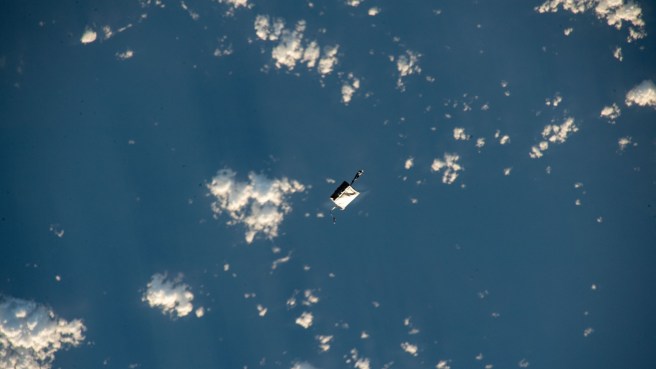
so international space station astronauts apparently dropped a tool bag during a spacewalk. and if you look outside when the ISS is in your region, you can see it with binoculars

The tool bag is now orbiting our planet just ahead of the ISS with a visual magnitude of around 6, according to EarthSky. That means it is slightly less bright than the ice giant Uranus, the seventh planet from the sun. As a result, the bag  —  officially known as a crew lock bag  —  is slightly too dim to be visible to the unaided eye, but skywatchers should be able to pick it up with binoculars.

To see it for yourself, first find out when you can find spot the space station over the next few months (NASA even has a new app to help you). The bag should be floating two to four minutes ahead of the station. As it descends rapidly, the bag is likely to disintegrate when it reaches an altitude of around 70 miles (113 kilometers) over Earth.

150fdf06be05b19fabab691c1933f7646173a9b9

she’s fucking magnificent

roach-works:

everyone enjoy earth’s newest and silliest satellite while she lasts


Tags:

#(apparently it’s now more than four minutes‚ increasing with time) #(but still up there for the time being) #the more you know #space #the brightest star in our sky #embarrassment squick?

nasa:

dff16017d81370b04799ef5da31c21bf588cfc75

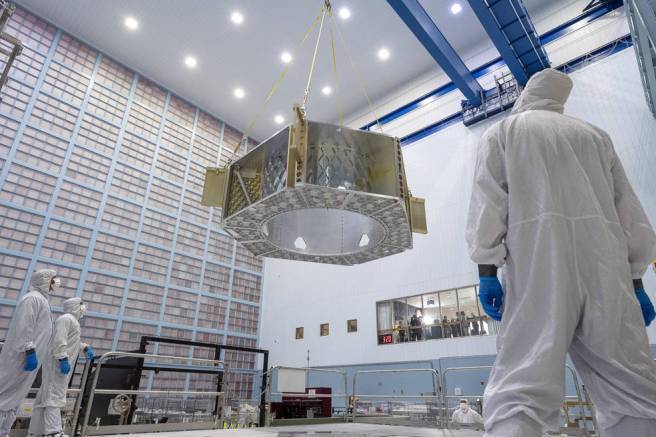
Roman’s primary structure hangs from cables as it moves into the big clean room at NASA’s Goddard Space Flight Center.

What Makes the Clean Room So Clean?

When you picture NASA’s most important creations, you probably think of a satellite, telescope, or maybe a rover. But what about the room they’re made in? Believe it or not, the room itself where these instruments are put together—a clean room—is pretty special.

Keep reading

{{below the cut:}}

A clean room is a space that protects technology from contamination. This is especially important when sending very sensitive items into space that even small particles could interfere with.

There are two main categories of contamination that we have to keep away from our instruments. The first is particulate contamination, like dust. The second is molecular contamination, which is more like oil or grease. Both types affect a telescope’s image quality, as well as the time it takes to capture imagery. Having too many particles on our instruments is like looking through a dirty window. A clean room makes for clean science!

bb6f7b4c4ee245eb280c155082c2c410df01857c

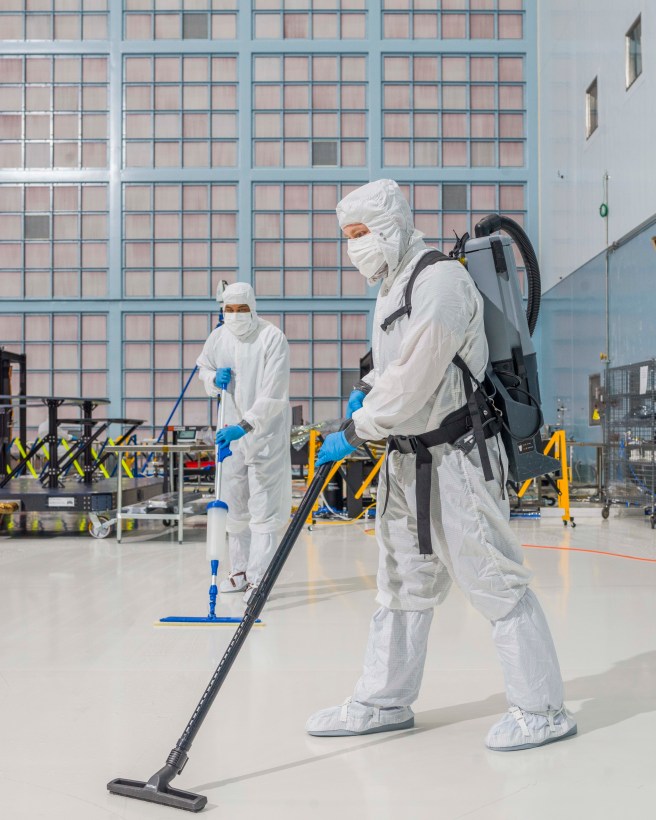
Two technicians clean the floor of Goddard’s big clean room.

Our Goddard Space Flight Center in Greenbelt, Maryland has the largest clean room of its kind in the world. It’s as tall as an eight-story building and as wide as two basketball courts.

Goddard’s clean room has fewer than 3,000 micron-size particles per cubic meter of air. If you lined up all those tiny particles, they’d be no longer than a sesame seed. If those particles were the size of 16-inch (0.4-meter) inflatable beach balls, we’d find only 3,000 spread throughout the whole body of Mount Everest!

c3f97f8d9e7791d368a064d52f9363439ef90b77

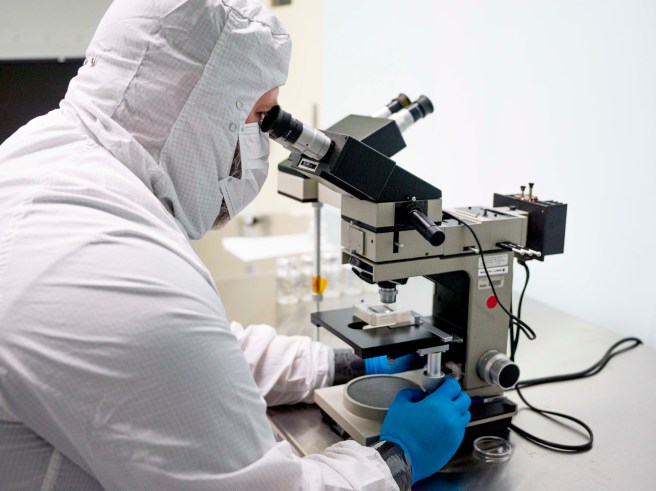
A clean room technician observes a sample under a microscope.

The clean room keeps out particles larger than five microns across, just seven percent of the width of an average human hair. It does this via special filters that remove around 99.97% of particles 0.3 microns and larger from incoming air. Six fans the size of school buses spin to keep air flowing and pressurize the room. Since the pressure inside is higher, the clean air keeps unclean air out when doors open.

9302f78118ead99440351365b4d37b92bf99c23a

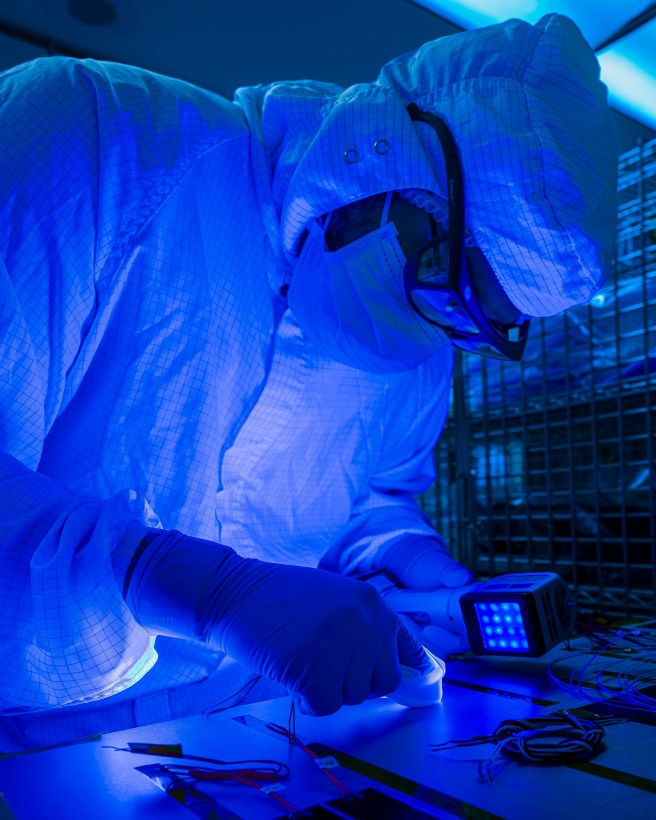
A technician analyzes a sample under ultraviolet light.

In addition, anyone who enters must wear a “bunny suit” to keep their body particles away from the machinery. A bunny suit covers most of the person inside. Sometimes scientists have trouble recognizing each other while in the suits, but they do get to know each other’s mannerisms very well.

0fd43b388b6a5bf40d45eedab6aa6f7f7abebd6c

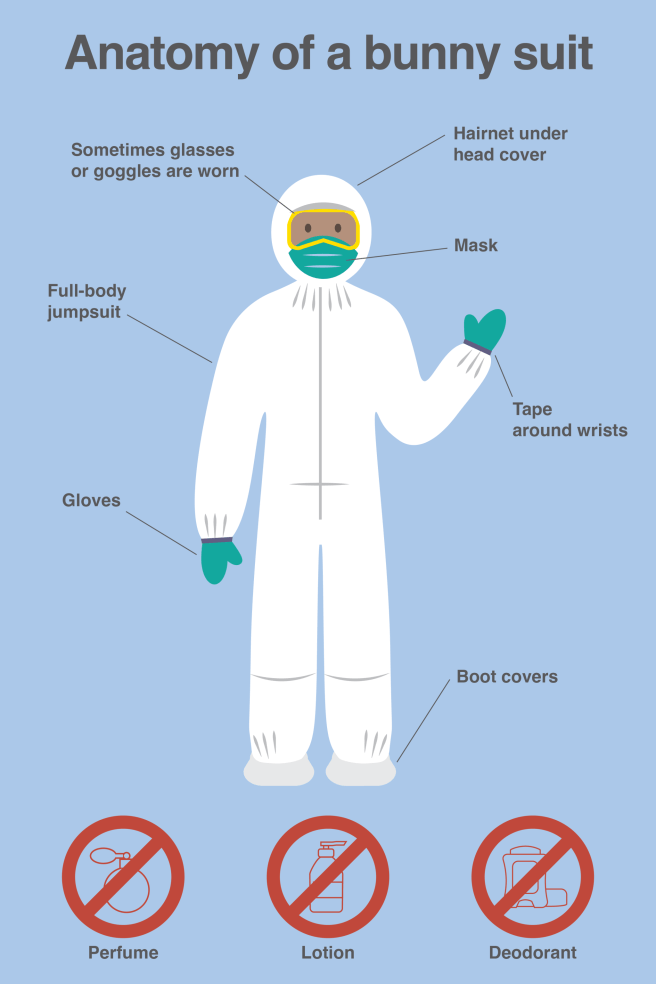
This illustration depicts the anatomy of a bunny suit, which covers clean room technicians from head to toe to protect sensitive technology.

The bunny suit is only the beginning: before putting it on, team members undergo a preparation routine involving a hairnet and an air shower. Fun fact – you’re not allowed to wear products like perfume, lotion, or deodorant. Even odors can transfer easily!

f7846622b5c8785a6f8bcc0e6714ee03fd832fad

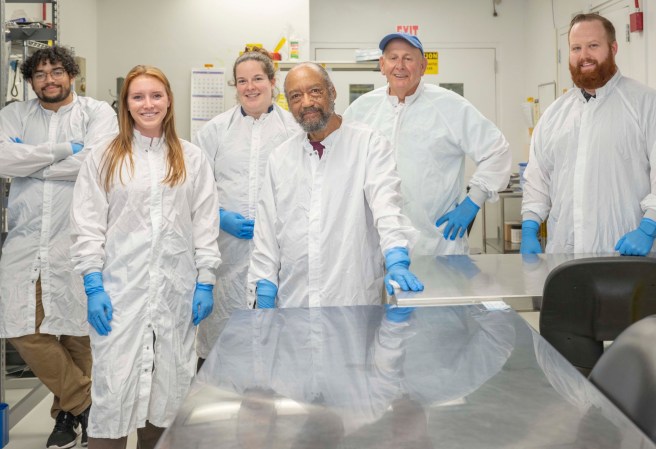
Six of Goddard’s clean room technicians (left to right: Daniel DaCosta, Jill Bender, Anne Martino, Leon Bailey, Frank D’Annunzio, and Josh Thomas).

It takes a lot of specialists to run Goddard’s clean room. There are 10 people on the Contamination Control Technician Team, 30 people on the Clean Room Engineering Team to cover all Goddard missions, and another 10 people on the Facilities Team to monitor the clean room itself. They check on its temperature, humidity, and particle counts.

cc3f8ab8981f05d90cdc15e4e2c856d018c0ad08

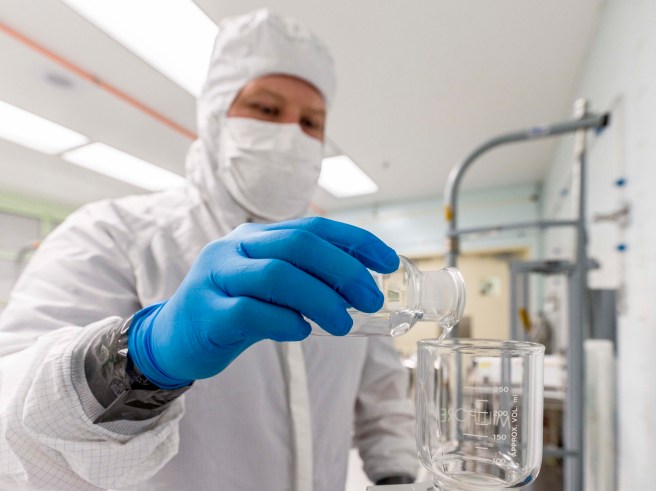
A technician rinses critical hardware with isopropyl alcohol and separates the particulate and isopropyl alcohol to leave the particles on a membrane for microscopic analysis.

Besides the standard mopping and vacuuming, the team uses tools such as isopropyl alcohol, acetone, wipes, swabs, white light, and ultraviolet light. Plus, they have a particle monitor that uses a laser to measure air particle count and size.

The team keeping the clean room spotless plays an integral role in the success of NASA’s missions. So, the next time you have to clean your bedroom, consider yourself lucky that the stakes aren’t so high!

Make sure to follow us on Tumblr for your regular dose of space!


Tags:

#space #the power of science #proud citizen of The Future #disappointed permanent resident of The Future #this post was queued because my to-reblog list is too long and I didn’t want to dump it on you all at once
wonders-of-the-cosmos:

823dfc1b75fe081db38171cf82072c437fa2fa84

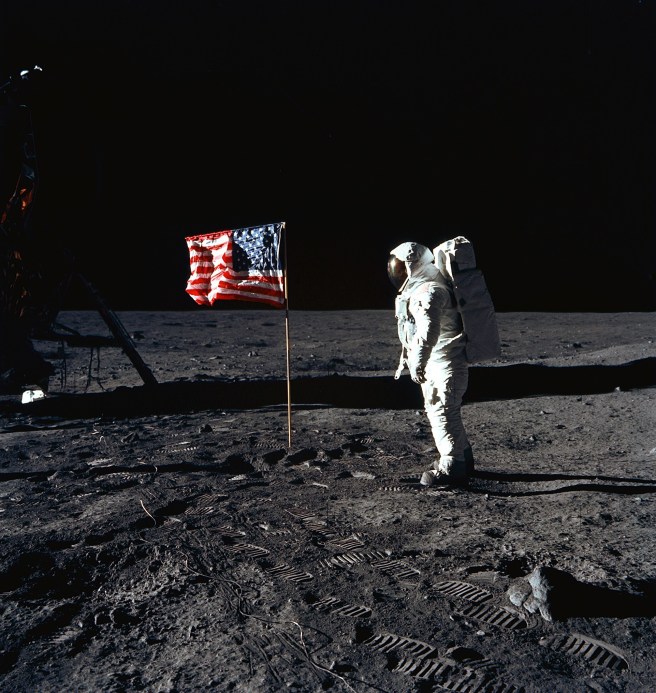
(20 July 1969) Astronaut Edwin E. Aldrin Jr., lunar module pilot of the first lunar landing mission, poses for a photograph beside the deployed United States flag during Apollo 11 extravehicular activity on the lunar surface.

Credit: NASA


Tags:

#Moon Landing Day #proud citizen of The Future

moral-autism:

tanadrin:

silly story ideas, free to a good home:

  • political thriller set in a high fantasy world without technological stasis, so it’s got like 1990s technology
  • magical realist high fantasy: a fantasy world with rigorous magical systems and detailed worldbuilding where sometimes inexplicable shit happens simply because the emotional logic of the narrative demands it
  • elaborate hard-SF Larry Niven style except there’s also secret wizards hiding their existence from the rest of the universe (that the wizards did not in fact build the macguffin the plot is concerned with is a minor plot point)
  • postapocalyptic science fiction but the mood is farce
  • alternate history with a very carefully worked out single point of divergence, but also it’s magical realism and sometimes inexplicable things happen just because the emotional logic of the narrative demands it.
  • high fantasy, but the world not only has magic, but radically different mundane physical laws whose implications have been carefully worked out in the manner of a Greg Egan story.
  • contemporary urban fantasy but the story is literally just about wizards trying to run their own space program in secret
  • contemporary urban fantasy but the story is about the wizards from the previous story trying to run a space program in the parallel hell-dimension they discovered, because it has its own unique cosmological properties they’re fascinated by
  • urban fantasy but instead of being set in “our” world, it’s set in a world with radically different physical laws that are nonetheless worked out with diamond-hard realism, in the style of greg egan. but, you know. also with secret wizards.
  • who are running a space program
  • i’m gonna be real with you, if i discovered magic was real, and i personally was a wizard, my first thought would be, “how could i use this to advance the exploration of space?” i would settle for the exploration of the ocean or something in a pinch, but mostly i would be thinking about space

“high fantasy, but the world not only has magic, but radically different mundane physical laws whose implications have been carefully worked out in the manner of a Greg Egan story.”

I think I play in a TTRPG setting like this?

“contemporary urban fantasy but the story is literally just about wizards trying to run their own space program in secret”

this isn’t actually a scholomance fanfic I’ve seen but the characters in other scholomance fanfic have definitely discussed a secret moon colony


Tags:

#anything that makes me laugh this much deserves a reblog #story ideas I will never write #space

{{ https://va.media.tumblr.com/tumblr_r6f9khmnn31u8qrq3.mp4 }}

andmaybegayer:

blondebrainpower:

Europa & Io passing over Jupiter’s Great Red Spot, shot from space probe Cassini.

for everyone asking if this is real footage: yeah!

It is an extremely accelerated timelapse made by Kevin Gill, the movement here is more a matter of Cassini whipping past Jupiter at astounding speeds than the motion of the moons, which is why there’s such a large parallax shift, but it’s actual images taken during the Cassini flyby. They did another one of Titan orbiting Saturn, you can see that at the end of this video. [Flickr link]


Tags:

#space #the power of science #proud citizen of The Future

How We Decided

togglesbloggle:

The day after tomorrow- that is, February 18, 2021- the Perseverance rover will attempt to land on the surface of Mars.  It will enter the planetary atmosphere at an acute angle, giving it as much time as possible to experience drag and slow down from orbital velocities.  Because Mars’ air is so thin, and the rover is so heavy, this will fail- in the best case, Perseverance would still be going almost a thousand miles an hour when it impacts the surface.  To help save itself, the craft will deploy a parachute of advanced design, seventy feet across and able to withstand supersonic velocities.  This, too, will fail.  Even with a parachute, there is simply not enough air between Perseverance and the Martian surface to slow it down all the way.  So this is where the rockets kick in.  Once air resistance slows the rover to a bit less than two hundred miles per hour, the heavy heat shield will be jettisoned, and a system of secondary rockets will fire against the direction of motion until it slows to near-hovering.  In a final flourish, the rover will descend from the rocket-boosted frame on coiled springs, until it touches down in the western part of Jezero crater in the northern hemisphere of Mars.

c802a800c604822be5c59dd461905b841cc14f9d

As it happens, Perseverance’s destination was one of the very last things we decided about it- not until the craft itself was fairly thoroughly engineered and designed.  Formally, the decision was made by the mission directorate.  In practice, they follow the consensus of the scientific community, which in turn hashes things out at a series of open-invitation workshops.  Things began with a call for white papers- an open suggestion box, basically.  In 2015, the first workshop narrowed things down from thirty serious proposals to eight candidates.  In 2017, the second workshop further winnowed the list down to three.  And in October of 2018, after three days of presentation, debate, and discussion, the final workshop selected Jezero Crater from these final three candidates using a simple vote of all attendees, and passed on the recommendation to the mission leads.

I haven’t been in the business for very long, so the final workshop was the only one of these where I actually participated.  It wasn’t a close vote as such, and I didn’t break any ties, and technically we were just making a strongly worded suggestion.  Nonetheless, my vote is one of the reasons why the Rover will be going to Jezero Crater instead of Syrtis Major or Gusev, and I think I’m entitled to feel ownership of this mission choice, just a little bit.

(This is, of course, terrifying.)

Having gone through the experience, there were a few surprises worth noting.  The first was how small some of the numbers are here.  The conference was not very large: only thirty proposals, debated by just a few hundred attendees.  I’ve seen book review contests with more entries, and that are read by a wider audience.  Which is to say, this is a situation that was, and is, extremely responsive to individual effort.  In that small a room, populated by people that are philosophically committed to changing their minds when they see good evidence or a good argument, one person can stand up and change the future in a very real way.

The second surprise was the attendance requirements.  Or rather, the lack thereof.  The project is public, paid for by American taxpayers, to whom I am profoundly grateful.  And one way the process reflected that public-spiritedness is that this is not a walled garden.  A small attendance fee (iirc, $40?), and you’re in.  You get a vote, if you want to use it.  A few non-scientists even took us up on this; there’s one retiree (a former schoolteacher, I think) that’s attended every major conference I’ve been to in the last few years, and sets up a small table in the back with his home mineral collection just for fun.  In practice this open-door policy is limited by the obscurity of the event itself; if you don’t move in research circles, you have to be something of a space exploration superfan to hear about it.  Still, as symbols go, you could do worse.

And now that we’re coming up on the day itself, the same kind of public-facing mindset is making me think about why I was persuaded to vote for Jezero Crater, what it means to explore there, and how I’d justify that choice to those of you that made the ongoing discovery of Mars possible in the first place.

Keep reading


Tags:

#space #Mars #Perseverance #the power of science #the more you know #apocalypse cw