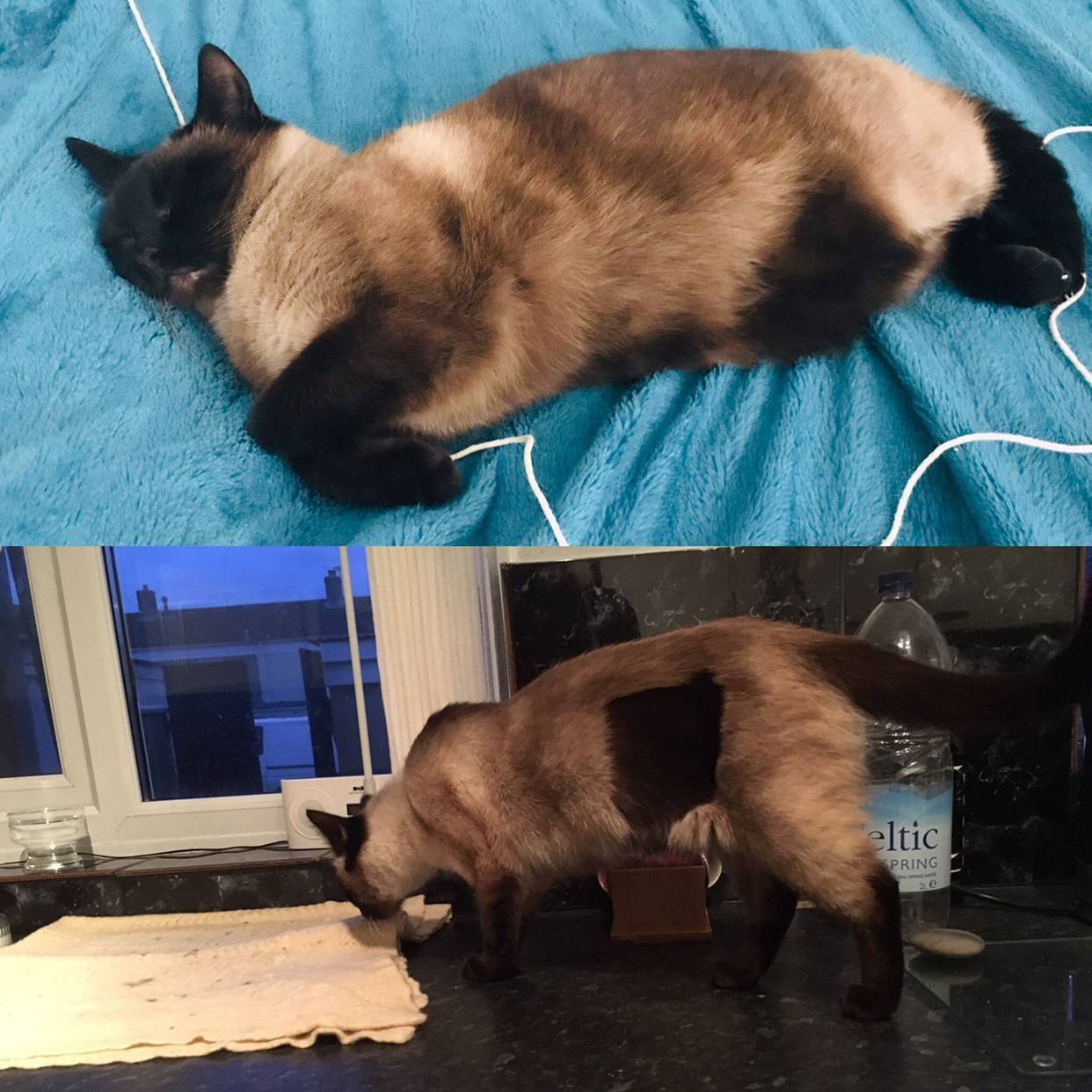
when they get shaved the new fur grows in darker than it would normally be cuz they’re colder in that area!
Tags:
#it got better #cats #the power of science #the more you know #adorable #this post was queued because my to-reblog list is too long and I didn’t want to dump it on you all at once
a few years back zinc acetate lozenges were doing the rounds and I love a good superstition so I went ahead and incorporated that into my belief system. been a while so I thought I’d check to see if the state of the science on the subject had shifted since then
afaict there hasn’t been much work on the subject in the intervening time, and nothing much to change your mind one way or the other. good work everyone, you may return to your superstition behavior.
some details:
one study¹ recently reported a null result, but based on the going theory for zinc lozenges that’s what you would expect (zinc acetate was administered by capsules). also the study was lacking in other ways.
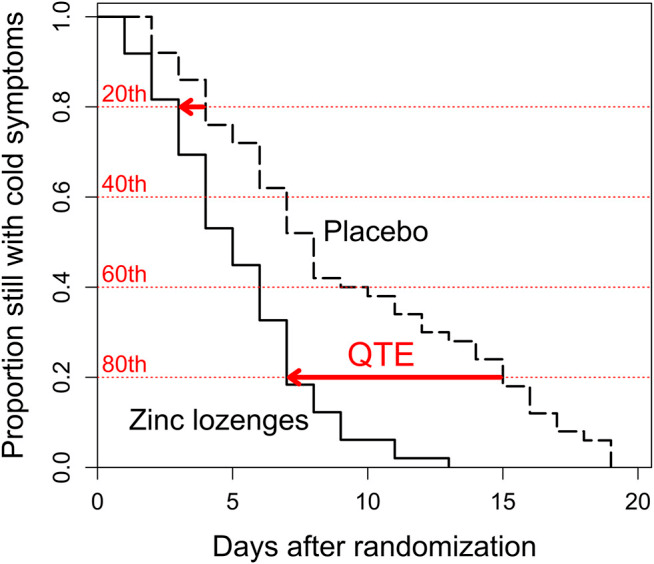
another² has a good looking graph and is maybe positive for the concept. haven’t read the fully study yet
that’s maybe about it? my method for researching this research was to search pubmed for “(zinc) AND ((acetate) OR (gluconate)) lozenge” plus some other words instead of lozenge, as there were too many results without an additional keyword for filtering. I am sure there are other places results are published besides pubmed. feel free to catapult relevant studies into my inbox
yeah that sounds fucked up! had no idea that was the case for some people, I always thought of a cold as a 1-3 day kind of thing. but presumably if someone gets 20 day colds they’re probably very glad to cut a week off that
The third week of a cold sucks a lot less than the first week so, like, maybe only as much as a normal person’s cold, but yeah if there’s a pill for cutting that third week off, I’m interested regardless of whether it helps with the main brunt of the cold. Gonna have to look into this.
you want zinc acetate, or if that’s not available, zinc gluconate. it has to be a lozenge or otherwise dissolve in your mouth, since the theoretical method of action is coating some tissue or receptor or something with ionic zinc. preferably with as few additives as possible. if it doesn’t taste bad and feel astringent, it’s not working. in the US everyone buys the life extension ones. idk about elsewhere
it is ideal to start as soon as possible. preferably in the not-sure-if-im-actually-sick-yet phase. starting once the infection is well developed seems to be much less effective
tbh I will actually take one prophylactically if I feel like I was in a high exposure environment. this is a not the protocol the research was done on but it seems reasonable and as long I don’t do this every day it is at worst a bad tasting zinc supplement
iirc the studies mostly had a protocol along the lines of one lozenge (of varying size and type?) every 1.5-2 hours while awake until symptoms subside. that’s a lot. it seems to produce some effect in the studies. I do not know that anyone has done any real study on taking more or less to compare, so it’s unclear what the optimal amount is, or how long it is worthwhile to persist in taking them
…well, I tried a Life Extension zinc-acetate lozenge (not to be confused with a Life Extension zinc-oxide/gluconate + citric acid lozenge, which I previously got by accident and which are much wimpier), and, uh, that was kind of scary.
I *didn’t even get a full dose*! I ended up running out of time before bed and having to spit two-thirds of it out! And it *still* took about *17 hours* for my sense of taste to stop being blunted!
(my sense of smell still worked, FTR, so I’m *probably* not just leaving a proverbial bad Yankee Candle review)
…I’ll *consider* giving it one more try the next time I’m *confident* I’m sick, but I cannot do this at-first-sign-of-illness when my first-sign-of-illness has a 99%+ false-positive rate.
yeah that sounds like a bad reaction, don’t think I’d bother with that either
from a single lozenge I do notice astringency but the effects on taste are minor. I hardly notice them, I don’t mind them much when I do, and they last at most a few hours if that
For me, TheraZinc lozenges pretty consistently stop colds if I start using them as soon as I notice a sore throat (haven’t tried Life Extension, have tried Cold-Eeze and they were bullshit.) they do indeed fuck up my sense of taste for days, and that’s a decent tradeoff for me because my colds have a tendency to turn into bronchitis. but it’s hard for me to voluntarily inflict that much unpleasantness on myself >_< so sometimes I don’t.
Yeah, the “as soon as I notice a sore throat” aspect is probably the main hurdle here. This could maybe have been a very valuable antidepressant for, like, 2015!me, but these days…well, these were some of my tags on that recent reblog:
(the current ratio is *mostly* because I have other forms of throat irritation way more often now, but partly because I have fewer colds thanks to more other layers in my security I’m literally writing this while wearing a P100 because my sick housemate was recently puttering about in our kitchen completely bare-faced like an asshole)
I have a really hard time doing QALY analyses on myself because my brain’s response to being queried on how much lifespan it would give up in exchange for not experiencing X suffering is “we do not negotiate with terrorists”, but ‘hypogeusia is more than 1% as bad as severe depression’ seems like a very plausible statement to me.
Tags:
#reply via reblog #the power of science #is the blue I see the same as the blue you see #illness tw #death tw? #venting cw? #he *has* at least been refraining from hanging out in the living room or in our parents’ room #and *sometimes* he wears a KF94 (unsealed‚ but he might not *know* how to seal a mask around facial hair) when he’s fetching food/water #I don’t know why he’s landed on ”sometimes” and I don’t dare ask
a few years back zinc acetate lozenges were doing the rounds and I love a good superstition so I went ahead and incorporated that into my belief system. been a while so I thought I’d check to see if the state of the science on the subject had shifted since then
afaict there hasn’t been much work on the subject in the intervening time, and nothing much to change your mind one way or the other. good work everyone, you may return to your superstition behavior.
some details:
one study¹ recently reported a null result, but based on the going theory for zinc lozenges that’s what you would expect (zinc acetate was administered by capsules). also the study was lacking in other ways.
another² has a good looking graph and is maybe positive for the concept. haven’t read the fully study yet
that’s maybe about it? my method for researching this research was to search pubmed for “(zinc) AND ((acetate) OR (gluconate)) lozenge” plus some other words instead of lozenge, as there were too many results without an additional keyword for filtering. I am sure there are other places results are published besides pubmed. feel free to catapult relevant studies into my inbox
yeah that sounds fucked up! had no idea that was the case for some people, I always thought of a cold as a 1-3 day kind of thing. but presumably if someone gets 20 day colds they’re probably very glad to cut a week off that
The third week of a cold sucks a lot less than the first week so, like, maybe only as much as a normal person’s cold, but yeah if there’s a pill for cutting that third week off, I’m interested regardless of whether it helps with the main brunt of the cold. Gonna have to look into this.
you want zinc acetate, or if that’s not available, zinc gluconate. it has to be a lozenge or otherwise dissolve in your mouth, since the theoretical method of action is coating some tissue or receptor or something with ionic zinc. preferably with as few additives as possible. if it doesn’t taste bad and feel astringent, it’s not working. in the US everyone buys the life extension ones. idk about elsewhere
it is ideal to start as soon as possible. preferably in the not-sure-if-im-actually-sick-yet phase. starting once the infection is well developed seems to be much less effective
tbh I will actually take one prophylactically if I feel like I was in a high exposure environment. this is a not the protocol the research was done on but it seems reasonable and as long I don’t do this every day it is at worst a bad tasting zinc supplement
iirc the studies mostly had a protocol along the lines of one lozenge (of varying size and type?) every 1.5-2 hours while awake until symptoms subside. that’s a lot. it seems to produce some effect in the studies. I do not know that anyone has done any real study on taking more or less to compare, so it’s unclear what the optimal amount is, or how long it is worthwhile to persist in taking them
Tags:
#conversational aglets #recs #is the blue I see the same as the blue you see #the power of science #illness tw
a few years back zinc acetate lozenges were doing the rounds and I love a good superstition so I went ahead and incorporated that into my belief system. been a while so I thought I’d check to see if the state of the science on the subject had shifted since then
afaict there hasn’t been much work on the subject in the intervening time, and nothing much to change your mind one way or the other. good work everyone, you may return to your superstition behavior.
some details:
one study¹ recently reported a null result, but based on the going theory for zinc lozenges that’s what you would expect (zinc acetate was administered by capsules). also the study was lacking in other ways.
another² has a good looking graph and is maybe positive for the concept. haven’t read the fully study yet
that’s maybe about it? my method for researching this research was to search pubmed for “(zinc) AND ((acetate) OR (gluconate)) lozenge” plus some other words instead of lozenge, as there were too many results without an additional keyword for filtering. I am sure there are other places results are published besides pubmed. feel free to catapult relevant studies into my inbox
i assume this is the promising-looking graph in question
you know, i don’t love the idea that colds get dragged out that long. 19 days? some poor assholes get colds for 19 days?
yeah that sounds fucked up! had no idea that was the case for some people, I always thought of a cold as a 1-3 day kind of thing. but presumably if someone gets 20 day colds they’re probably very glad to cut a week off that
The third week of a cold sucks a lot less than the first week so, like, maybe only as much as a normal person’s cold, but yeah if there’s a pill for cutting that third week off, I’m interested regardless of whether it helps with the main brunt of the cold. Gonna have to look into this.
Tags:
#I am very big on Simply Not Getting Sick in the First Place but it’s always good to have more layers in the Swiss cheese #especially when one of your housemates is a line cook #reply via reblog #the power of science #is the blue I see the same as the blue you see #illness tw
Roman’s primary structure hangs from cables as it moves into the big clean room at NASA’s Goddard Space Flight Center.
What Makes the Clean Room So Clean?
When you picture NASA’s most important creations, you probably think of a satellite, telescope, or maybe a rover. But what about the room they’re made in? Believe it or not, the room itself where these instruments are put together—a clean room—is pretty special.
A clean room is a space that protects technology from contamination. This is especially important when sending very sensitive items into space that even small particles could interfere with.
There are two main categories of contamination that we have to keep away from our instruments. The first is particulate contamination, like dust. The second is molecular contamination, which is more like oil or grease. Both types affect a telescope’s image quality, as well as the time it takes to capture imagery. Having too many particles on our instruments is like looking through a dirty window. A clean room makes for clean science!
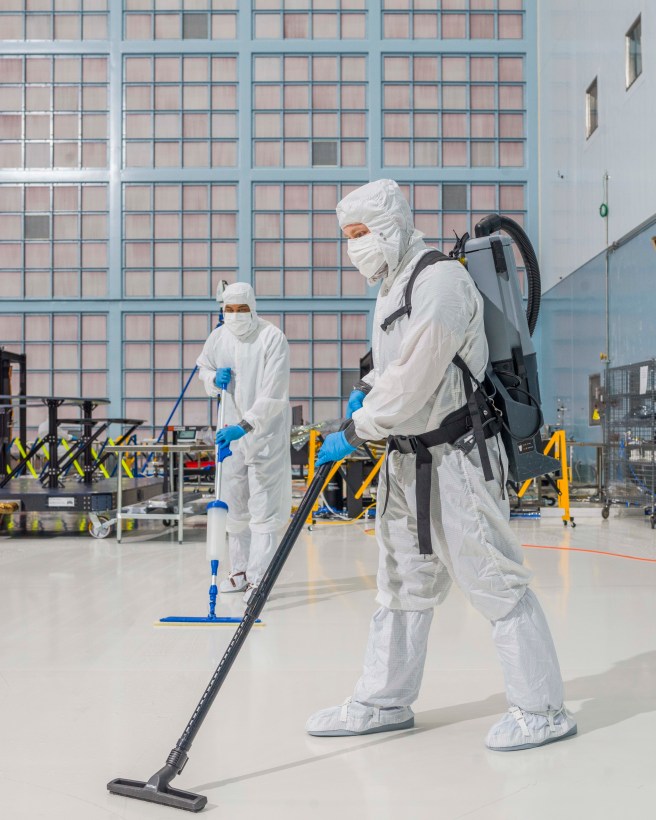
Two technicians clean the floor of Goddard’s big clean room.
Our Goddard Space Flight Center in Greenbelt, Maryland has the largest clean room of its kind in the world. It’s as tall as an eight-story building and as wide as two basketball courts.
Goddard’s clean room has fewer than 3,000 micron-size particles per cubic meter of air. If you lined up all those tiny particles, they’d be no longer than a sesame seed. If those particles were the size of 16-inch (0.4-meter) inflatable beach balls, we’d find only 3,000 spread throughout the whole body of Mount Everest!
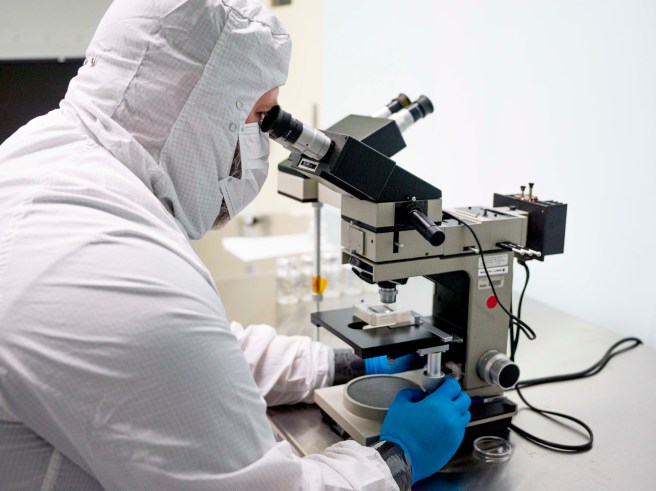
A clean room technician observes a sample under a microscope.
The clean room keeps out particles larger than five microns across, just seven percent of the width of an average human hair. It does this via special filters that remove around 99.97% of particles 0.3 microns and larger from incoming air. Six fans the size of school buses spin to keep air flowing and pressurize the room. Since the pressure inside is higher, the clean air keeps unclean air out when doors open.
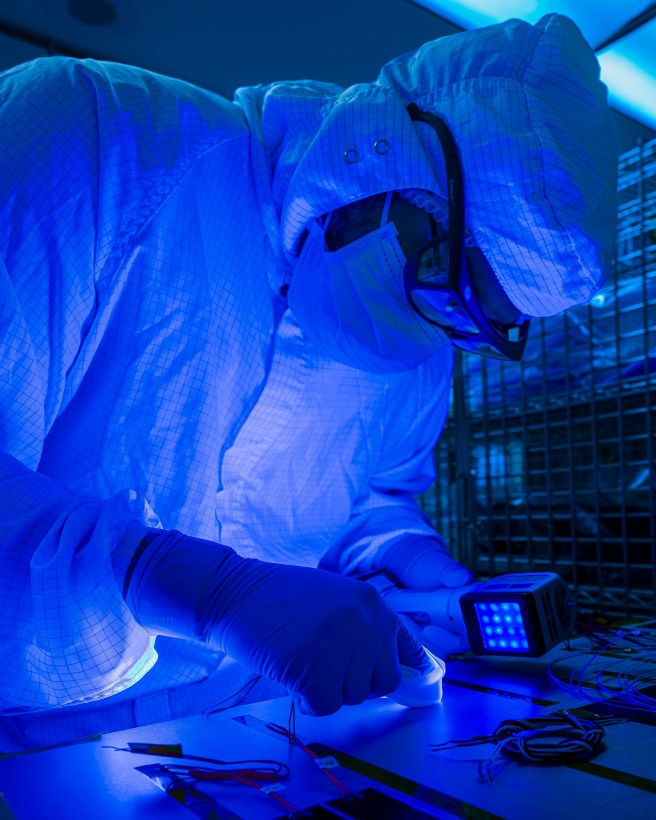
A technician analyzes a sample under ultraviolet light.
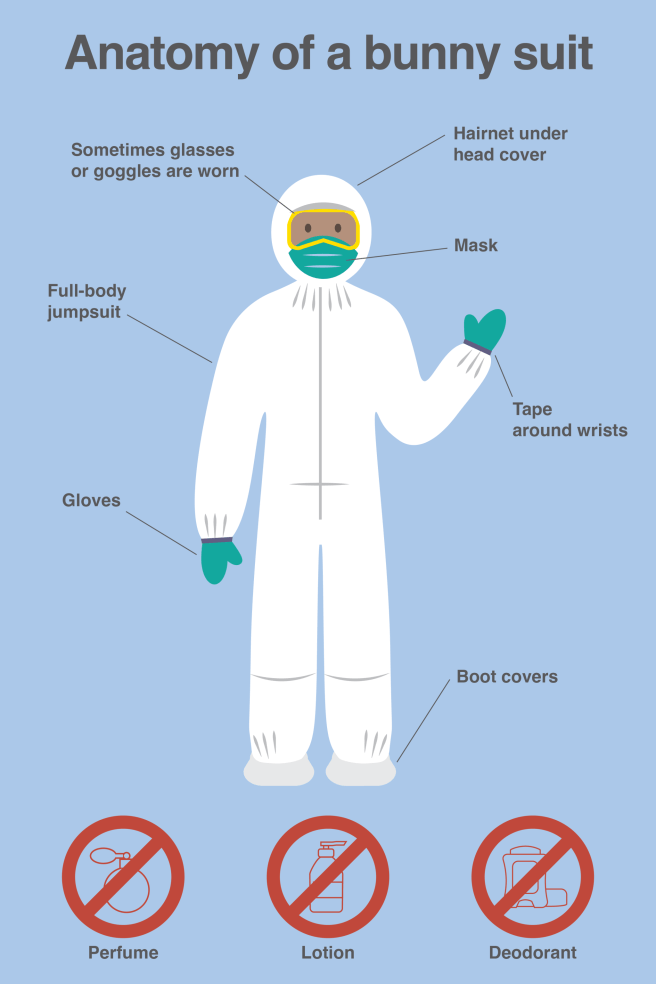
In addition, anyone who enters must wear a “bunny suit” to keep their body particles away from the machinery. A bunny suit covers most of the person inside. Sometimes scientists have trouble recognizing each other while in the suits, but they do get to know each other’s mannerisms very well.
This illustration depicts the anatomy of a bunny suit, which covers clean room technicians from head to toe to protect sensitive technology.
The bunny suit is only the beginning: before putting it on, team members undergo a preparation routine involving a hairnet and an air shower. Fun fact – you’re not allowed to wear products like perfume, lotion, or deodorant. Even odors can transfer easily!
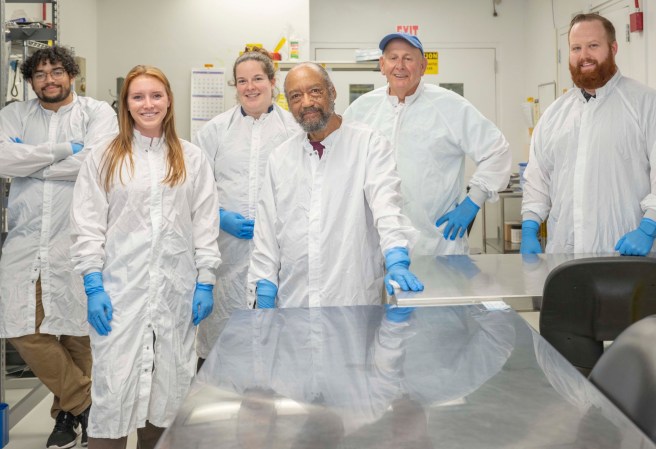
Six of Goddard’s clean room technicians (left to right: Daniel DaCosta, Jill Bender, Anne Martino, Leon Bailey, Frank D’Annunzio, and Josh Thomas).
It takes a lot of specialists to run Goddard’s clean room. There are 10 people on the Contamination Control Technician Team, 30 people on the Clean Room Engineering Team to cover all Goddard missions, and another 10 people on the Facilities Team to monitor the clean room itself. They check on its temperature, humidity, and particle counts.
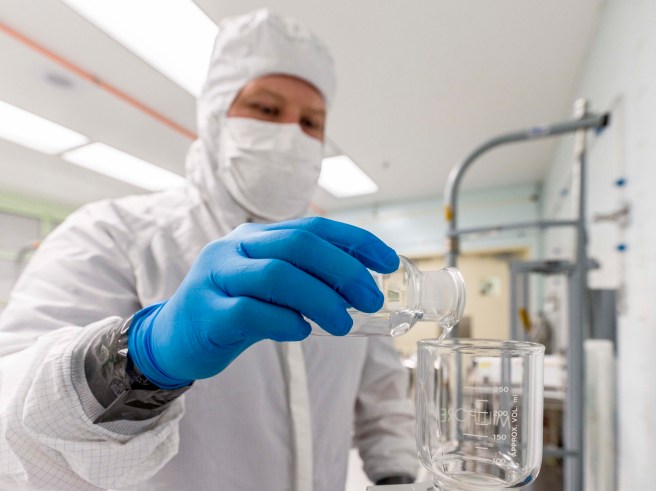
A technician rinses critical hardware with isopropyl alcohol and separates the particulate and isopropyl alcohol to leave the particles on a membrane for microscopic analysis.
Besides the standard mopping and vacuuming, the team uses tools such as isopropyl alcohol, acetone, wipes, swabs, white light, and ultraviolet light. Plus, they have a particle monitor that uses a laser to measure air particle count and size.
The team keeping the clean room spotless plays an integral role in the success of NASA’s missions. So, the next time you have to clean your bedroom, consider yourself lucky that the stakes aren’t so high!
#space #the power of science #proud citizen of The Future #disappointed permanent resident of The Future #this post was queued because my to-reblog list is too long and I didn’t want to dump it on you all at once
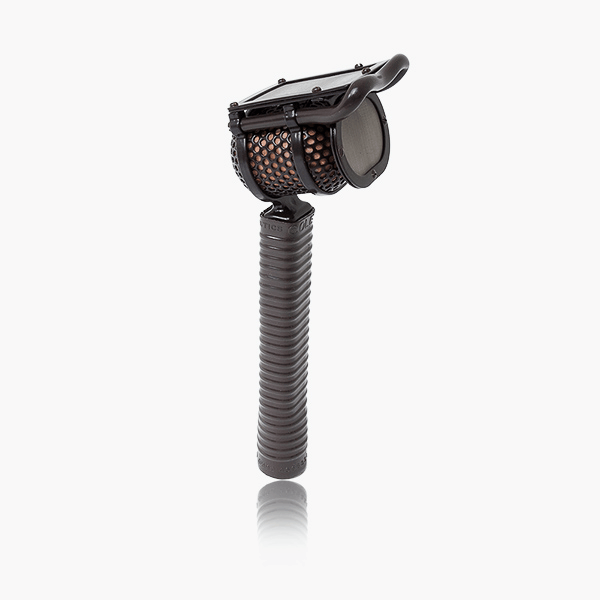
If you have seen Ted Lasso you may have noticed these unusual microphones used by the football commentators.
Despite being a microphone nerd, I had never seen anything like them before. So I decided to go into research mode and discovered these microphones are quite fascinating.
They are called “Lip-Ribbon” or “Commentator’s” microphones.
They were specially designed by the BBC in the 1950s for extremely noisy environments. Soccer Football stadiums have peaked at 130 decibels so they needed something that would not get overwhelmed in that circumstance.
They use several very clever techniques to make sure only the voice is picked up and everything else is rejected.
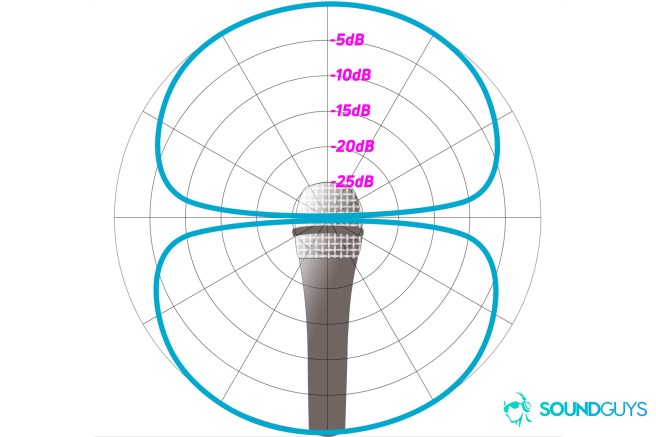
First, they use a bidirectional polar pattern.
That means it will accept sound from two directions, but reject any sound coming in from the sides. And since the diaphragm is only exposed on one side, that helps reject sound coming from the other direction.
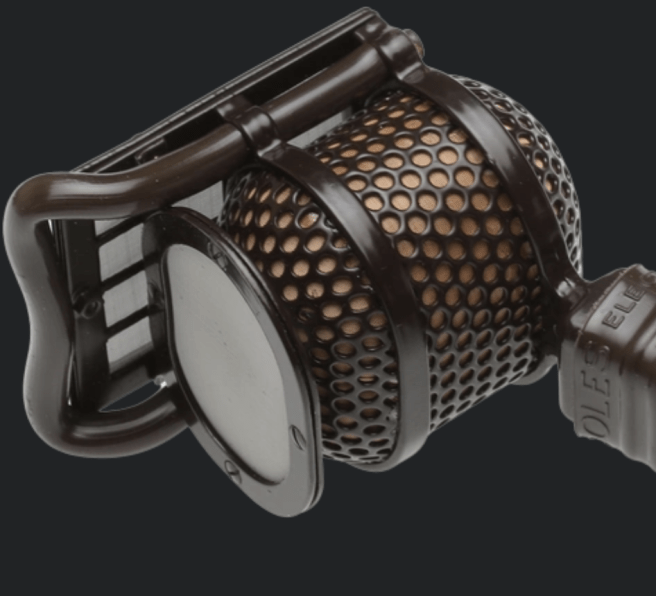
Next, the microphone is not very sensitive so you literally have to hold it up to your lips (hence “lip-ribbon”) in order for your voice to have enough sound energy to vibrate the diaphragm.
That top part rests directly on your lip and there is a little pop filter to keep your plosives in check.
There is a built-in high pass filter so it rejects any sound below the frequencies typically used by the human voice.
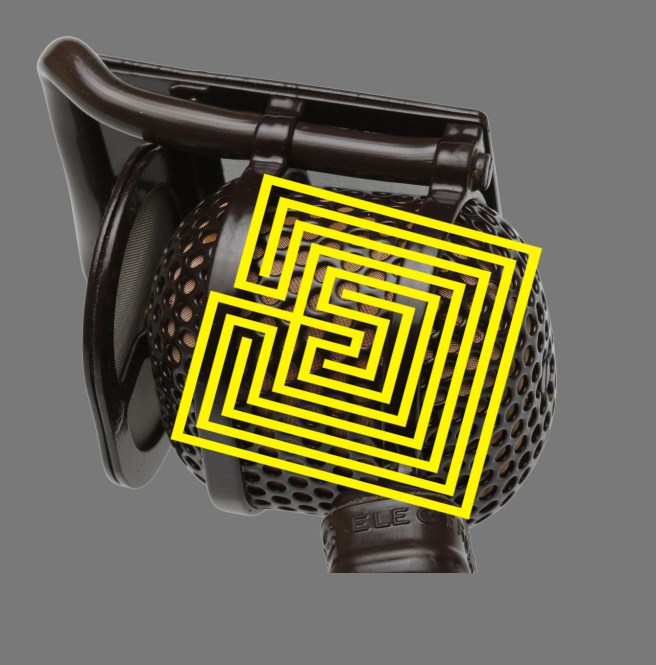
But my favorite trick… a labyrinthian internal baffle system.
(I found a diagram of this when researching but then I lost the tab and I cannot find it again. So you’ll just have to accept this crude photoshop I did in 30 seconds to help you understand.)
Sound is energy. And that energy is diminished the farther it travels. The inverse square law for sound states that the intensity of sound decreases by approximately 6 dB for each doubling of distance from the sound source. Sound also diminishes when it reflects off a surface.
That is a very sciency way of saying… make sounds go through a tiny maze and only sounds with the most energy will prevail.
So if you have your lip pressed up against the front of the mic, your voice’s energy will make it through the labyrinth of baffles without issue. But every other sound in the stadium will have a much harder time getting through.
These mics may even be vuvuzela-proof.
And even more amazing… this microphone was designed in the 1950s and they have yet to create anything better for incredibly noisy environments.
Isn’t that neat?
I think it is neat.
Tags:
#the power of science #the more you know #this post was queued because my to-reblog list is too long and I didn’t want to dump it on you all at once
#the power of science #I sure am having emotions about this video but they’re mostly not the intended emotions #let me see if I can convey the emotions in words: #the world that was big enough to contain science museums was an illusion #built atop the sand in an hourglass #I was one of those cheering kids once (not this exact group‚ not this exact demo‚ but the general area of concept-space) #and then I grew up and realised just how much had been stolen from my future to build that happy present #in the end‚ there are only two kinds of people: those who are independently wealthy‚ and those who are not #my parents failed to treat their dependency on my father’s career as the emergency it was #(they even failed to treat the *absence* of my father’s career as the emergency it most certainly was) #they could have been *fine* #*we could all have been fine* #if they’d *prioritised* correctly #but they didn’t‚ and now I’m going to spend the rest of my life cleaning up after their mistakes #Mom had the fucking gall recently to say ”I’m glad things didn’t get bad until you guys were old enough to understand” #what the fuck do you even say to someone who has missed the point that completely #the only good thing to be said about it is that I know‚ firsthand‚ the better world that might one day come to be #it has never yet existed‚ not truly #but it might‚ someday #tag rambles #venting cw #adventures in human capitalism #my childhood
Europa & Io passing over Jupiter’s Great Red Spot, shot from space probe Cassini.
for everyone asking if this is real footage: yeah!
It is an extremely accelerated timelapse made by Kevin Gill, the movement here is more a matter of Cassini whipping past Jupiter at astounding speeds than the motion of the moons, which is why there’s such a large parallax shift, but it’s actual images taken during the Cassini flyby. They did another one of Titan orbiting Saturn, you can see that at the end of this video. [Flickr link]
Tags:
#space #the power of science #proud citizen of The Future