NASA scientists announced today that they’ve assembled strong evidence that liquid water flows on the Martian surface. There isn’t any indication that this means there’s life on Mars, but when you keep in mind that everywhere we find water on Earth we find living things, it’s exciting stuff.
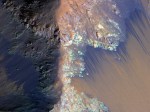
After studying years worth of images collected by the Mars Reconnaissance Orbiter, a particular feature jumped out (tour the gorgeous HiRise image library at beautifulmars). Dark streaks called Recurring Slope Lineae (RSL) appeared on a seasonal basis, coinciding with conditions that could support liquid water in the form of salty brines.
Animation of seasonal flows in Hale Crater:
Think of these RSL streaks (visible in the image gallery up top) like water flowing downhill through sand, causing it to change color as the wet stuff seeps toward the valleys below. If you’re picturing rushing rapids, it’s really more like a wet sponge. These brines, made of chlorate and perchlorate minerals, are much saltier than our own seas, which allows this water to remain liquid in Mars’ frigid climate. Saltwater is especially intriguing for astrobiologists, as salty stuff has higher odds than freshwater for supporting biological chemistry.
NASA billed this report of liquid saltwater as “major”, but this isn’t the first news of water on Mars. Martian hydrology has a long, exciting history. As far back as Mariner 9, dry river and lake beds suggested that the red planet was once much wetter, and later missions told of an ocean-covered Mars several billion years ago. As recently as April 2015, the Mars Curiosity rover found similar brines near the surface at night. We’ve also known for a while that the Mars of today is home to significant amounts of frozen water ice, enough to cover the planet in a thin, wet, puddle if it melted.
What makes today’s announcement so interesting isn’t that water exists on Mars, but that it still flows near the surface on a seasonal basis. Mars super-thin atmosphere led many to believe that any liquid water near the surface would boil away, and the dynamic nature of the wet stuff means that we’ve got a lot to learn about our planetary neighbor.
So, let’s talk about whales. A group of mammals so highly adapted to aquatic life that some people still mistake them for fish. A group that includes some of the largest and most intelligent living creatures.
Although their earliest evolutionary ancestors were a mystery until the late 1970s, today cetacean fossils make up one of the most striking examples of transitional forms. Combined with molecular analysis, we now know them to be descendants of early even-toed ungulates, with their closest living relatives being hippos.
Every day this month I’ll be posting a new image highlighting points in whale evolution, from their terrestrial origins all the way through to modern times.
This is Indohyus, a member of an extinct group of ungulates called raoellids – the closest known sister group to cetaceans. The very earliest whales probably looked similar to this, small hoofed creatures completely unrecognizable compared to their modern aquatic descendants.
Around 60cm long (23.5in), Indohyus lived in what would become India and Pakistan about 50-48 million years ago. It had very dense bones similar to those of hippos, and probably led a semi-aquatic lifestyle comparable to modern water chevrotains, diving into water and remaining submerged to evade predators. But its main link to whales actually comes from its ear bones, with its skull showing evidence of a special structure called the involucrum.
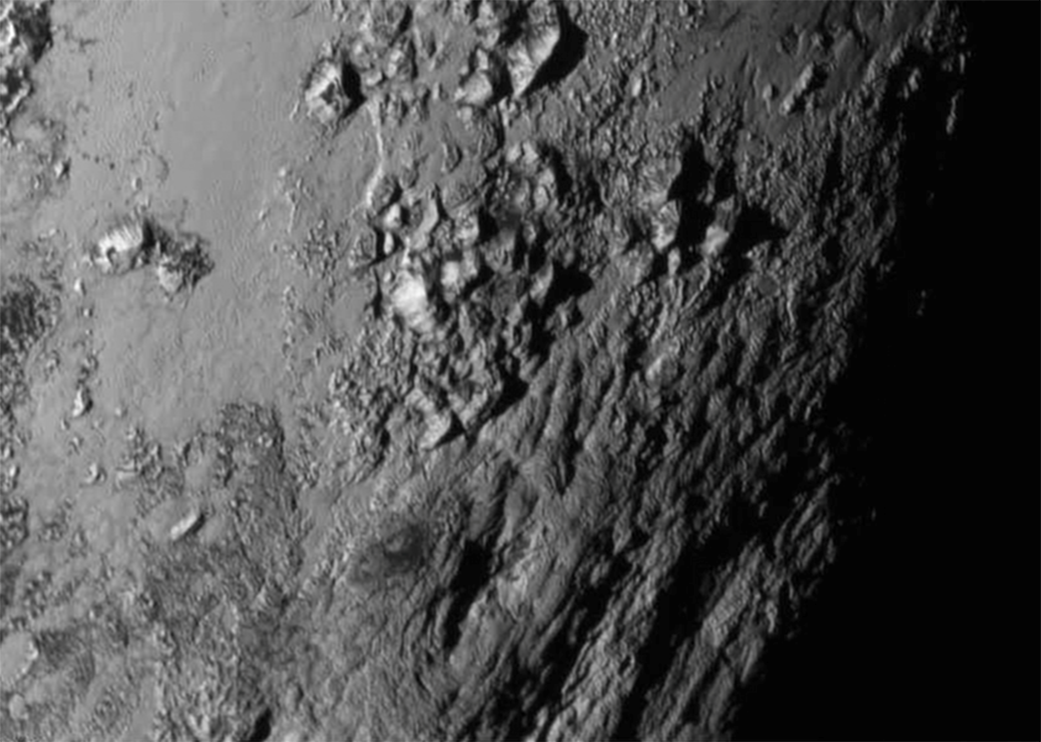
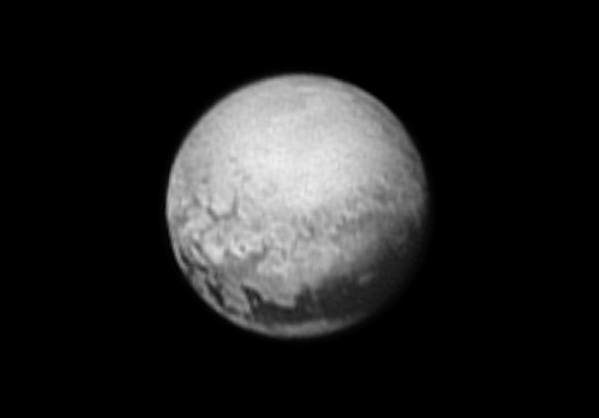
Just one day after its successful Pluto Flyby, NASA’s New Horizons spacecraft sent back the first close-up photos of the dwarf planet and its largest moon, Charon.
Not only does Pluto have a mountain range with peaks 3500 meters high which formed no more than 100 million years ago – quite young for a celestial object in a 4.56-billion-year-old solar system -, but Charon looks completely different with cliffs and canyons (one being 7 to 9 km deep!).
The spacecraft also sent new information about Pluto’s outermost known moons, Hydra. We now know that it is about 43 by 33 kilometers with an almost entirely icy surface.
These discoveries are quite impressive, but are also just the beginning. It will take up to 16 months to receive and collect all the data that New Horizons is sending. The spacecraft is now continuing its mission into the Kuiper Belt – a region of space beyond the planets consisting mainly of icy objects.
NASA’s New Horizons probe completed its fly-by of the dwarf planet Pluto this morning at 7:49 AM ET, completing a 9+ year, 3 billion mile journey to our favorite Kuiper belt object and is now continuing off into the outer reaches of the solar system.
On its way by Pluto, New Horizons snapped the clearest and most hi-resolution images ever taken of the dwarf planet, but since the probe can’t upload data back to Earth while it’s scienceing, we won’t see the best ones until tomorrow (also keep in mind that it takes 4.5 hours for signals to travel between Earth and Pluto, even at the speed of light!). New Horizons’ multiple instruments are collecting so much data that it will take nearly 16 months to get it all sent back to Earth! So keep following the NASA mission page and official Twitter account for plenty of Pluto updates over the next year.
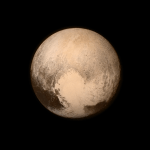
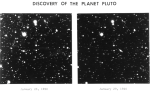
Above is a collection of Pluto as we’ve seen it through the years, from its 1930 discovery at Lowell observatory (bottom), to Hubble’s 100-pixel Atari version taken in 1996 (middle), to New Horizons’ most recent color image taken July 13, 2015.
Here’s to the New Horizons team, congratulations from everyone on Earth!
(scale image of Pluto and its moon Charon compared to Earth)
Interesting side note: The dwarf planet Pluto’s name was suggested in a letter by an 11-year-old schoolgirl named Venetia Burney. But what about this Pluto?
While there’s no documentation to back up the claim, Disney’s Pluto character debuted just nine months after the dwarf planet’s discovery in 1930, and it’s widely assumed that Walt Disney’s animators were capitalizing on Pluto fever. I’d say we’ve got it again, wouldn’t you?
Tags:
#history #space #the power of science #Pluto #oh look an update