Hey. You there. Do you not want to be mistaken for a bot, but you’ve also grown attached to the default icon you got when you signed up? Great news! Worry no longer because now you can customize your very own icon!
Usage notes: (1) Due to how the website works, it will struggle in mobile portrait mode. Try viewing the page in landscape or stick to desktop. (2) Use the cube option + the color selector to change the shape of your icon. (3) I think legally this counts as fanart, so remember that Tumblr, and all other referential items, belong to their respective creators and very much not me! Non-commercial only.
Thank you so much to the fine folks at @meikerio! Without their platform, this wouldn’t be possible!
#Tumblr: a User’s Guide #the more you know #icons #this post was queued because my to-reblog list is too long and I didn’t want to dump it on you all at once
even if you think there’s no way they’ll have the game u want. they probably do anyway. when i first downloaded flashpoint i thought for sure theres no way they will have the obscure flash game i played for hours as a kid that was only even available on the internet for like 2 months in 2006. but you know what. they had it. seriously, download flashpoint
Tags:
#101 Uses for Infrastructureless Computers #the more you know #as it happens they do not have my Flash-game white whales‚ the pair of Wild Thornberrys wildlife-rescue games I played as a kid #but there *is* a lot of nostalgic Neopets stuff on there #(…and it seems that the Internet Archive has‚ not technically either of the wildlife-rescue games‚ but a *third* variant upon them) #(I’ll have to try poking that on a VM: it doesn’t look like that one’s been vetted) #games #my childhood
wildgifthorses: I think you can get raw counts from the API
Yeah, and you can also get the vote percentages to six decimal places in web debugger, thanks to a truly wild web design choice:
Sticking the raw percentage directly into the width attribute is just a delightfully bonkers way to implement that, and I love it. And with six decimal places that’s enough to derive the raw count unless you go really mega-viral (and maybe even then it just adds more decimal places).
But it would be nice to have a way I can see right on the dash without having to tinker.
Tags:
#The Great Tumblr Apocalypse #fun with loopholes #fun with statistics #the more you know
Cooking With Tumblr: “Why Are We Here? Just to Suffer?” Edition
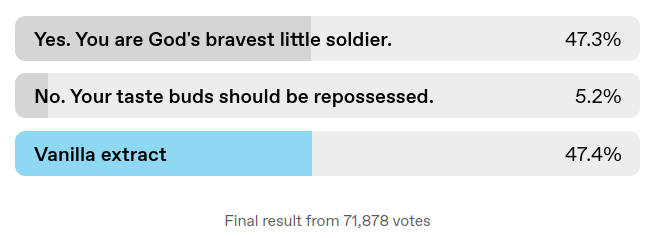
Tumblr, I come to you as a woman on the verge of fulfilling her destiny. Thanks to a viral poll by @relientk, the newest meme on Tumblr is vanilla extract, specifically the act of using too much of it. Pure vanilla extract is, of course, expensive and also strong in small amounts. Who among us has that much vanilla extract on hand and is foolish enough to attempt this?
Me.
For personal reasons, I have a lot of vanilla extract in my apartment. It was here before the meme, and it will be here after. I had all the ingredients for the horrible poll cake except for milk, so I went out and bought some milk. It is three in the morning and very cold outside. Why am I doing this now instead of waiting for the poll to finish? Two reasons: the first being how fickle the internet in burning through memes, and the second being that five days gives my better judgement enough time to convince me not to do this.
Will God stop my sinful hands before the cake makes it into the oven? Let’s find out!
Mise en Place
Here are all the ingredients in their Tumblr-approved quantities. No, your eyes are not deceiving you! That is indeed a teacup of vanilla extract. I laid everything out in twee little teacups to try and lessen the blow of this culinary affront to man about to occur in my kitchen. The baking powder is in a souvenir shot glass because I ran out of twee little teacups.
The exact measurements come courtesy of @princessmuk, who carefully adjusted a white cake recipe (LINKED HERE!) to the proportions of the poll. The percentages at the time she wrote her addition (left) are only negligibly different from the percentages now (right), so there’s no need to adjust.
I’ve cut the her quantities in half because even I have limits, but the cooking time, temperature and everything else will match the recipe she based her post on.
Okay.
Tumblr, I’ll be frank with you. This does not look, feel or smell like cake batter. For those who didn’t read princessmuk’s post, I’d like to inform you that the source recipe is called “Simple White Cake”. This is not white, and nothing about this can be called “simple”.
That said, I’ve put it in a buttered and floured cake pan and am baking it for at least 40 minutes in a 350 degree oven. I don’t know off the top of my head how the poll will affect the cook time because I’m very tired, but I will be checking the internal temperature just in case. Now, all there is to do is wait!
The Moment of Truth
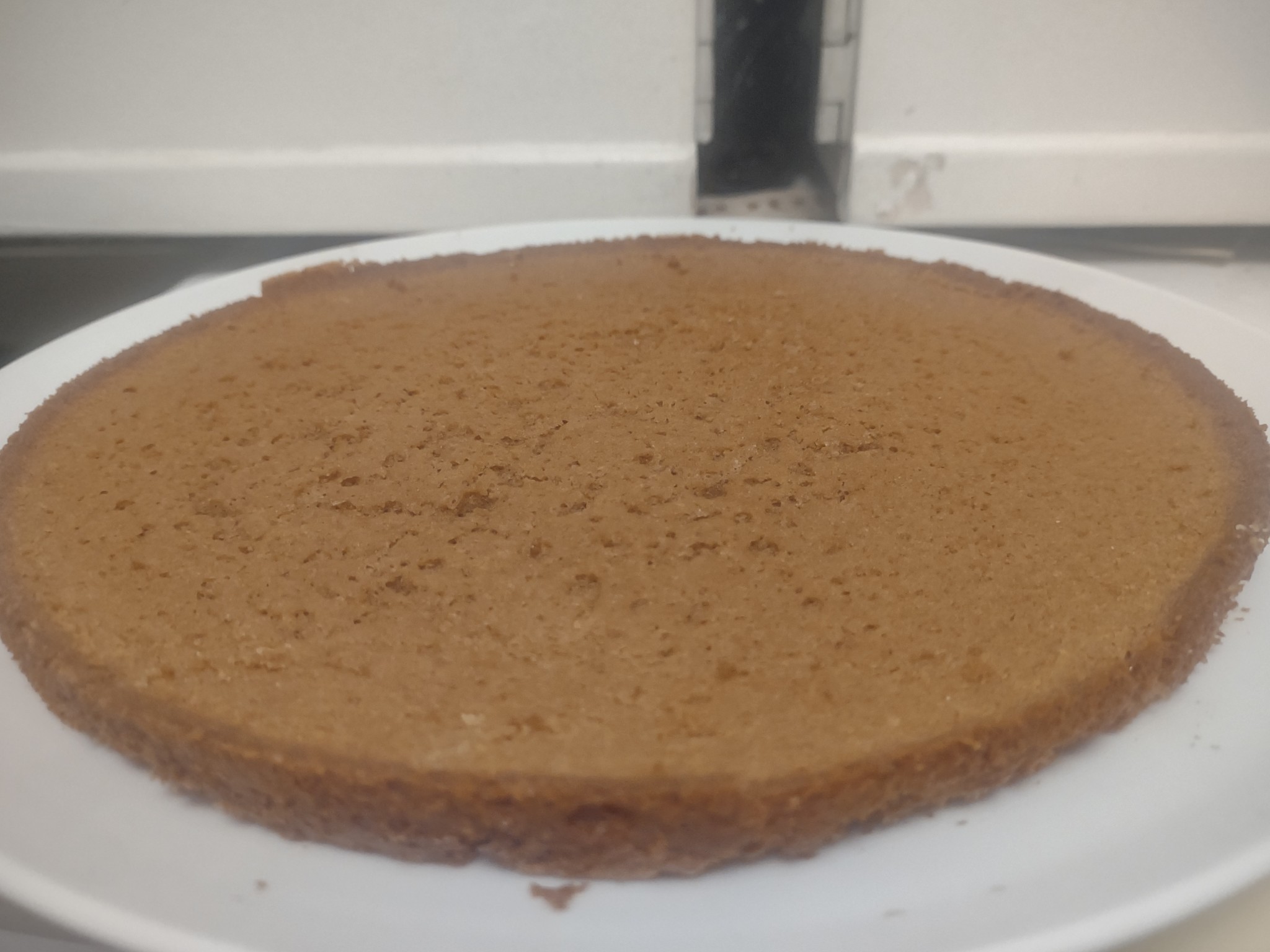
My entire apartment smells like vanilla. It’s not unpleasant, but it is definitely apparent. After fifty minutes, I opened the oven and found what appeared to be a firm enough cake. After cooling it in the refrigerator, I removed it from the pan and laid it on a plate.
Physically? It doesn’t seem that bad. There’s a distinctly crispy-looking crust around the rim. While it’s certainly denser than most cakes, it springs back when pressed and feels fully cooked. My kitchen thermometer read an internal temperature of just over 200 degrees Fahrenheit or 93 degrees Celsius. Many had predicted it would become an amorphous, soupy sludge due to having nearly twice as much liquid as necessary, but the batter was still thick enough to form a cohesive solid mass.
Tumblr won’t let me insert the video directly, because of course it won’t. I should also preface this by saying that this is the first and only instance of my face and voice on the internet, so if you misgender me I will force-feed you the rest of the cake.
With that out of the way: it’s honestly not that bad??? Is it good? No. Of course it isn’t. It’s a cake with several dozen times’ more vanilla extract than required. But is it inedible? I honestly can’t say that it is. I should point out for those uninformed that vanilla extract is a tincture, meaning that the active ingredient is dissolved into alcohol. In this case, 35% alcohol, the low average alcohol content of gin and dark rum. Minors have actually gotten drunk by drinking vanilla extract. That overwhelming bitterness you associate with the ingredient? Part of that is the vanilla itself, but most of it is the alcohol that typically evaporates away in the oven. Because of that, the cake is bitter but not overpowering.
The texture alone is actually quite pleasant. Its texture is best compared to that of banana bread, with a rich, heavy moistness and a slight chew along the rim. Its thin shape and density makes it ideal to be eaten by hand. I personally enjoy bitterness to the point where I’d seriously consider this palatable if the sugar content was at least doubled. It wouldn’t be better than a regular piece of cake, but it would be good.
To those that feel disappointed, I express my sincerest apologies. Even I was legitimately hoping for some sort of Cake From the Black Lagoon that would explode in the oven and taste like paint thinner. To remedy any disillusionment, I will end this culinary journey in hubris with a poll. Thank you.
Tags:
#*salute* #food #overly literal interpretations #the more you know
In our ongoing efforts to give you more tools for curating your Archive experience, we’re rolling out a new interface to let you hide content by specific users.
Muting hides content from your view of the Archive. Blocking stops another user from interacting with you. This muting functionality is a really exciting update following on from the announcement of comment blocking back in June of last year.
Many thanks to the volunteers on AD&T who coded these changes and to the volunteers who tested and reviewed the code as well. I’m so thankful for all of your hard work ❤️
Tags:
#AO3 #interesting #the more you know #this post was queued because my to-reblog list is too long and I didn’t want to dump it on you all at once
From the moment I started using computers, I wanted to help other people use them. I was everyone’s tech support for years, which prepared me for the decade or so when I was a CIO-for-hire. In the early days of the internet, I spent endless hours helping my BBS friends find their way onto the net.
Helping other people use technology requires humility: you have to want to help them realize their goals, which may be totally unlike your own. You have to listen carefully and take care not to make assumptions about how they “should” use tech. You may be a tech expert, but they are experts on themselves.
This is a balancing act, because it’s possible to be too deferential to someone else’s needs. As much as other people know about how they want technology to work, if you’re their guide, you have to help them understand how technology will fail.
For example, using the same memorable, short password for all your services works well, but it fails horribly. When one of those passwords leak, identity thieves can take over all of your friend’s accounts. They may think, “Oh, no one would bother with my account, I’ve got nothing of value,” so you have to help them understand how opportunistic attacks work.
Yes, they might never be individually targeted, but they might be targeted collectively, say, to have their social media accounts hijacked to spread malware to their contacts.
Paying attention to how things work without thinking about how they fail is a recipe for disaster. It’s the reasoning that has people plow their savings into speculative assets that are going up and up, without any theory of when that bubble might pop and leave them ruined.
It’s hard to learn about failure without experiencing it, so those of us who have lived through failures have a duty to help the people we care about understand those calamities without living through them themselves.
That’s why, for two decades, I’ve always bought my hardware with an eye to how it fails every bit as much as how it works. Back when I was a Mac user — and supporting hundreds of other Mac users — I bought two Powerbooks at a time.
I knew from hard experience that Applecare service depots were completely unpredictable and that once you mailed off your computer for service, it might disappear into the organization’s bowels for weeks or even (in one memorable case), months.
I knew that I would eventually break my laptop, and so I kept a second one in sync with it through regular system-to-system transfers. When my primary system died, I’d wipe it (if I could!) and return it to Apple and switch to the backup and hope the main system came back to me before I broke the backup system.
This wasn’t just expensive — it was very technologically challenging. The proliferation of DRM and other “anti-piracy” measures on the Mac increasingly caused key processes to fail if you simply copied a dead system’s drive into a good one.
Then, in 2006, I switched operating systems to Ubuntu, a user-centric, easy-to-use flavor of GNU/Linux. Ubuntu was originally developed with the idea that its users would include Sub-Saharan African classrooms, where network access was spotty and where technical experts might be far from users.
To fulfill this design requirement, the Ubuntu team focused themselves on working well, but also failing gracefully, with the idea that users might have to troubleshoot their own technological problems.
One advantage of Ubuntu: it would run on lots of different hardware, including IBM’s Thinkpads. The Thinkpads were legendarily rugged, but even more importantly, Thinkpad owners could opt into a far more reliable service regime that Applecare.
For about $150/year, IBM offered a next-day, on-site, worldwide hardware replacement warranty. That meant that if your laptop broke, IBM would dispatch a technician with parts to wherever you were, anywhere in the world, and fix your computer, within a day or so.
This was a remnant of the IBM Global Services business, created to supply tech support to people who bought million-dollar mainframes, and laptop users could ride on its coattails. It worked beautifully — I’ll never forget the day an IBM technician showed up at my Mumbai hotel while I was there researching a novel and fixed my laptop on the hotel-room desk.
This service was made possible in part by the Thinkpad’s hardware design. Unlike the Powerbook, Thinkpads were easy to take apart. Early on in my Thinkpad years, I realized I could save a lot of money by buying my own hard-drives and RAM separately and installing them myself, which took one screwdriver and about five minutes.
The keyboards were also beautifully simple to replace, which was great because I’m a thumpy typist and I would inevitably wear out at least one keyboard. The first Thinkpad keyboard swap I did took less than a minute, and I performed it one-handed, while holding my infant daughter in my other hand, and didn’t even need to read the documentation!
But then IBM sold the business to Lenovo and it started to go downhill. Keyboard replacements got harder, the hardware itself became far less reliable, and they started to move proprietary blobs onto their motherboards that made installing Ubuntu into a major technical challenge.
Then, in 2021, I heard about a new kind of computer: the Framework, which was designed to be maintained by its users, even if they weren’t very technical.
The Framework was small and light — about the same size as a Macbook — and very powerful, but you could field-strip it in 15 minutes with a single screwdriver, which shipped with the laptop.
I pre-ordered a Framework as soon as I heard about it, and got mine as part of the first batch of systems. I ordered mine as a kit — disassembled, requiring that I install the drive, RAM and wifi card, as well as the amazing, snap-fit modular expansion ports. It was a breeze to set up, even if I did struggle a little with the wifi card antenna connectors (they subsequently posted a video that made this step a lot easier):
The Framework works beautifully, but it fails even better. Not long after I got my Framework, I had a hip replacement; as if in sympathy, my Framework’s hinges also needed replacing (a hazard of buying the first batch of a new system is that you get to help the manufacturer spot problems in their parts).
My Framework “failed” — it needed a new hinge — but it failed so well. Framework shipped me a new part, and I swapped my computer’s hinges, one day after my hip replacement. I couldn’t sit up more than 40 degrees, I was high af on painkillers, and I managed the swap in under 15 minutes. That’s graceful failure.
That was more than a year ago. In the intervening time, I’ve got to discover just how much punishment my Framework can take (I’ve been back out on the road with various book publicity events and speaking engagements) and also where its limits are. I’ve replaced the screen and the keyboard, and I’ve even upgraded the processor:
I’m loving this computer so. damn. much. But as of this morning, I love it even more. On Thursday, I was in Edinburgh for the UK launch of “Chokepoint Capitalism,” my latest book, which I co-authored with Rebecca Giblin.
As I was getting out of a cab for a launch-day podcast appearance, I dropped my Framework from a height of five feet, right onto the pavement. I had been working on the laptop right until the moment the cab arrived because touring is nuts. I’ve got about 150% more commitments than I normally do, and I basically start working every day at 5AM and keep going until I drop at midnight, every single day.
As rugged as my Framework is, that drop did for it. It got an ugly dent in the input cover assembly and — far, far worse — I cracked my screen. The whole left third of my screen was black, and the rest of it was crazed with artefacts and lines.
This is a catastrophe. I don’t have any time for downtime. Just today, I’ve got two columns due, a conference appearance and a radio interview, which all require my laptop. I got in touch with Framework and explained my dire straits and they helpfully expedited shipping of a new $179 screen.
Yesterday, my laptop screen stopped working altogether. I was in Oxford all day, and finished my last book event at about 9PM. I got back to my hotel in London at 11:30, and my display was waiting for me at the front desk. I staggered bleary-eyed to my room, sat down at the desk, and, in about fifteen minutes flat, I swapped out the old screen and put in the new one.
That is a fucking astoundingly graceful failure mode.
Entropy is an unavoidable fact of life. “Just don’t drop your laptop” is great advice, but it’s easier said than done, especially when you’re racing from one commitment to the next without a spare moment in between.
Framework has designed a small, powerful, lightweight machine — it works well. But they’ve also designs a computer that, when you drop it, you can fix yourself. That attention to graceful failure saved my ass.
If you hear me today on CBC Sunday Magazine, or tune into my Aaron Swartz Day talk, or read my columns at Medium and Locus, that’s all down to this graceful failure mode. Framework’s computers aren’t just the most exciting laptops I’ve ever used — they’re the most exciting laptops I’ve ever broken.
[Image ID: A disassembled Framework laptop; a man’s hand reaches into the shot with a replacement screen.]
Wow, this reminds me of the last laptop that I didn’t absolutely despise in six months: my old Panasonic Toughbook that I used to have for the regular fieldwork I had to do. Heavy, clunky, thick, and nigh indestructible.
I’ve had one of these for about a year now and it’s pretty fantastic. I don’t do all that much with it, but it was fantastically simple to put together (I also got the DIY edition), and it’s going strong with Linux. Pretty much every problem I’ve had with it is with Linux and not the underlying hardware.
If you need a new laptop (and can afford the Framework), please consider getting it. You’ll have a laptop you can maintain and upgrade easily, while also supporting a company committed to DIY and treating their customers with respect.
Tags:
#huh #*poke* #a Framework with loosely equivalent specs to what I currently have costs more than three times as much #and of course the trouble with highly repairable and upgradeable tech is that *people don’t dump it on eBay* #so you’re always paying that new-car premium #I’m glad that this exists though #maybe someday #the more you know #disappointed permanent resident of The Future #this post was queued because my to-reblog list is too long and I didn’t want to dump it on you all at once
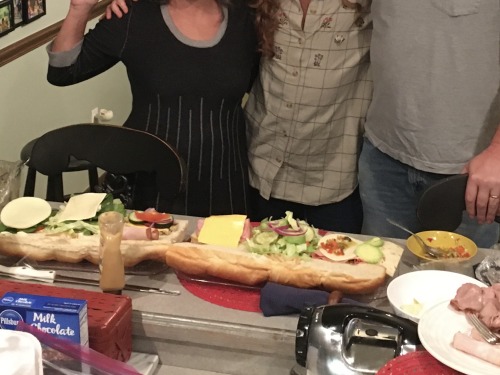
when i was a child my dad made up a fake holiday called big sandwich night the weekend after thanksgiving, during which we got the longest bread we could find and built a big sandwich together and then cut it up and ate it. we got really fancy ingredients and each built our own section of sandwich before cutting it. building the sandwich together represents community or teamwork or something. and then we would put our christmas tree up and the holiday season was officially kicked off with big sandwich night.
i grew up believing this was a real holiday that americans everywhere celebrated until when i was like 8 i asked a friend if they were excited for big sandwich night and they were like what the hell are you talking about riley. kind of shattered my worldview. but we still celebrate it and ive spread the tradition to friends and partners.
big sandwiches of years past:
as weve included more people weve started having to graft loaves together to make a sandwich big enough for everyone. but it still communicates the core idea of everyone eating the same sandwich together in fellowship.
This is a good holiday tradition.
Tags:
#this seems related to the previous post #food #is the blue I see the same as the blue you see #the more you know
It doesn’t get talked about enough, but This Discord Has Ghosts In It is a rad example of how you can adapt game design to your surroundings.
Basically, This Discord Has Ghosts In It is a digital larp. It’s Phasmophobia played by chat. Your group creates a discord server to function as a haunted house, then you all explore it, building new ‘rooms’ out of channels as you go.
Some players take the roles of ghosts, and are muted but can affect the environment in the haunted house.
Other players take the roles of explorers, and can talk, but the ghosts are all listening.
Discord wasn’t built to be gamified this way, but that doesn’t matter.
As long as you can guarantee consistent behavior from a thing, you can build mechanics off of it.
Anything in your environment can be turned into a game.
And in this particular case, it’s a really good one!
The mechanics lend themselves well to the kinds of pacing, limited communication, and untrustworthy setting that any good ghost story needs.
Gävlebocken has stood unharmed since the unveiling on November 27 through December and into january 1st 2023
See yall in 11 months or so, hoping for better luck then
Tags:
#Christmas #Gävlebocken #the more you know #(the burning is amusing and all but I’m glad the organisers were able to keep it standing the way they wanted)
Making friends with people from other countries is so crazy. I sent my group chat a Big Bird gif.
And this one girl says, “why isn’t he blue?”
I’m like, the fuck you mean??
So today I learned that in the Dutch version of Sesame Street, they do, in fact, have a blue Big Bird.
I was baffled by this so I went on Muppets Wiki and guess what.
In Mexico, Big Bird is green and his name is Abelardo.
Turkish Big Bird (aka Minik Kus) is apparently fucking orange.
This looks like a fuckin alternate universe or smth. I can’t.
Actually, in the Mexican version (which is the one I saw here in Colombia, and was probably streamed in other countries in Latin America) we had both the yellow and the green bird. That is because Abelardo (the green bird) is the Mexican cousin of Big bird. Initially it was supposed to be the Mexican version of Big Bird, but then it was decided to leave both characters and make them cousins to help explain the kids about the migration wave between USA and Mexico in the 90s
There is even a chapter of the show were Abelardo travels to the US to visit his cousin Big Bird
Later, they decided that all the different birds, from all the versions around the world, would be “cousins” too, with the idea of showing the diversity of cultures and teach the kids about unity and acceptance against racism and discrimination
Sorry sorry hold on sorry. sorry????
Cookie Monster’s name in Spanish is LUCAS EATSCOOKIES????
Tags:
#[I don’t know how to write it down‚ but please imagine me singing ”Cham Me’od Hayom” here] #((okay *wow* that’s ungoogleable)) #((here: https://www.youtube.com/watch?v=WoYXYSQAfJs )) #Sesame Street #the more you know


























 Brinens and Things - Tumblr Mirror