unpretty:

do microwaves in other countries have different quick setting buttons? are american microwaves the standard? do people outside the u.s. have a potato button, is what i want to know.


joehabana:

Mexican here, we have potato button


thegoldheart:

I’m in Brazil and here we don’t have a potato button, we have a rice button.


heartfilledminds:

I’m from the Netherlands and we have a potato button:)


hollydonlan:

In Scotland and we have a potato button but not on all microwaves just the nice ones.


slytherinlynx:

In France I had a microwave with a chicken button and a breadloaf button


findingnewnormal:

I’m from England and I didn’t know potato buttons were even a thing


unpretty:

Potato Button:

  • United States
  • Mexico
  • Canada
  • Netherlands
  • Posh Scotland

Rice Button:

  • Brazil

Breadloaf Button???:

  • France

No Dedicated Carbs Button:

  • England


unpretty:

okay i got sick of waiting for answers so i hopped onto some international versions of amazon and here is what i found:

  • australian amazon only sells books?? what the fuck
  • same for chinese amazon but that’s not as surprising
  • german microwaves have a potato button, but only when there are buttons. most of these things have dials. like… what. only weird fancy american microwaves have dials. also i saw a yogurt button.
  • indian microwaves seem to generally feature a ‘stuffed veg’ button instead of a potato-specific button. there is also a rice button. but do you know what else is standard. A GODDAMNED CHICKEN TANDOORI BUTTON. FUCK ME.
  • german and indian microwaves both had beverage buttons, which was not a surprise, but they also both had pizza buttons, which WAS a surprise. the indian microwaves called it a bread snack but it was clearly a picture of a pizza. why is the pizza button more universal than the potato button??
  • japanese microwaves have rice buttons and not potato buttons. no surprises there. the big surprise is that they also favor the dial. for that matter india had a lot of microwaves with dials, too. what gives. why the dials. where are your flat, easy to clean buttons.
  • according to italian amazon, in italian you call a kitchenaid stand mixer a “robot da cucina”. that is the cutest fucking thing i have ever heard. but back to microwaves. once again i’m seeing a lot of dials. you know these aren’t real ovens, right? why are you adjusting the strength so much. keep it on high and hit the one minute button. stop complicating things with dials. a lot of these are just rebranded german microwaves, so there is a potato button, and also a yogurt button.
  • see above for spain. y’all just have the same microwave. spain’s amazon is a lot less intuitive than every other country’s. i don’t know why. spanish amazon, please fix your menu system. it is wrong.

This concludes my fact-finding mission. Australia, why are your microwaves so mysterious.


medusasmirror:

I love the words “potato button”


destinationtoast:

I deeply admire the OP’s devotion to cross-cultural microwave studies and potato button data.


Tags:

#food mention #the more you know #I never pay attention to microwave presets #so I didn’t know there was such a thing as a potato button even though my microwave has one #(but mostly the ”the more you know” tag is referring to the fact-finding mission)

Eclipse Phase, Second Edition Open Playtest

plain-dealing-villain:

posthumanstudios:

The Eclipse Phase, Second Edition Kickstarter is going awesome! We’ve unlocked sweet stretch goals like Your Whispering Muse Series 1, NPC File Volume 2, and a raise for our freelancers!

Today’s update also brings the start of the Open Playtest, so check it out if you’re curious about the mechanics of EP2 and helping shape them!

Bay Area people! Anyone want to run a session of this? I’ll GM.


Tags:

#Eclipse Phase #the more you know #(note: I’m not in the Bay Area) #I’ve never actually played this game but the sourcebooks are a fun read #so I’m happy to hear there will be more sourcebooks

compromised-by-castiel asked: Sam, you seem like a bread person, have you ever had Langos?

copperbadge:

So first of all, “you seem like a bread person” is possibly the most accurate thing said to or about me this week. :D 

I have not had Langos in specific – I had to google it to see what it was – but it’s apparently very similar to Beaver Tails (also known as Frybread, Elephant Ears, or Fried Dough depending on which State Fair you’re attending). It looks like Langos is traditionally served with savory toppings, as opposed to the usually-sweet toppings you get on fried dough, but I gotta tell you fried dough with garlic or sour cream and cheese sounds frankly fucking amazing.

There’s probably a Hungarian place in Chicago that serves Langos, I’ll have to find out. Thanks for the tip!

Can confirm, lángos is fantastic. There’s a stand in one of the farmers’ markets around here that sells them.


Tags:

#reply via reblog #food #hat tip to slepaulica #who isn’t actually on Tumblr anymore but who introduced me to langos #(they don’t live around here) #(but the only reason I stopped at that stand and bought one is because I remembered them talking about langos on their blog)

cumaeansibyl:

themarginalthinker:

morbidlyqueerious:

battlships:

theweirdwideweb:

:-O

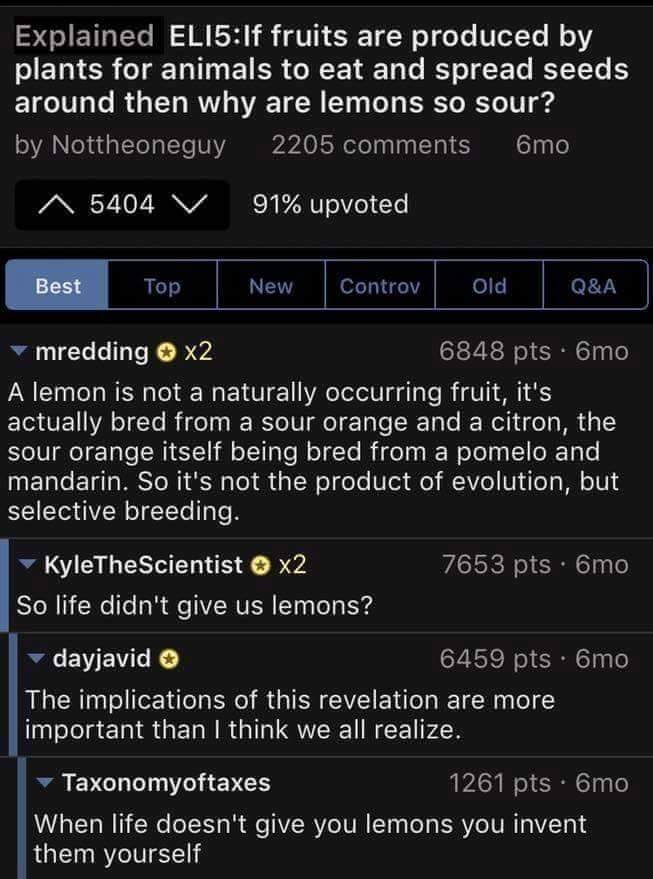
It’s not actually known if lemons were made by humans or if they were just natural hybrids of citrons and sour oranges. Apparently it’s super common for citrons to fertilize basically anything they’re near.

great now we gotta kinkshame the fruit

Everything about this post is going in so many directions at once 

lime/lemon fic classifications had a basis in reality


Tags:

#well this post was a wild ride #food #nsfw text? #anything that makes me laugh this much deserves a reblog

“Quoth” the raven? The heartwarming tale of a defective verb

allthingslinguistic:

amaranthine-ephemerality:

It is one of the most well-known lines English poetry has to offer: “Quoth the raven, ‘Nevermore.’” It is an eerie verse found in Edgar Allan Poe’s “The Raven”, and we all know what the the first word in it means. It’s a weird, extremely uncommon verb in the past tense meaning ‘to say’. Now use the same verb to ask if the raven said “nevermore.” Did the raven… and now most of you – excluding you language and etymology enthusiasts out there – are struggling because you don’t know what the infinitive of quoth is. What has happened?

The English language is fairly old, so it isn’t surprising to find out that many words have died out, i.e. they aren’t in use anymore and can oftentimes not be understood by native speakers. Look, for instance, at the Old English noun costnunge and try to guess what it means. No idea? Maybe the context will help. It can be found in the sentence And ne gelæd ðū ūs on costnunge, found in an OE version of the Lord’s Prayer. It means ‘temptation’, or rather meant that, seeing as it hasn’t been used for a very long time. If you read Middle English versions of the prayer, you’ll see that the noun had already been replaced by a ME form of temptation.

What does this have to do with quoth? Quite a bit, actually, only that it is a far more interesting word. It belongs to a class of verbs we call defective verbs. These are verbs exhibiting an incomplete conjugation, which means the verb doesn’t have a (modern) form for every tense, aspect, mood, or person. Modal auxiliaries are prime examples; take can for example, which has a preterite form, could, but it doesn’t have a present or past participle. The verb must is an even more extreme case as there isn’t even a past form. An example of a lexical defective verb would be beware because bewares, bewared, or bewaring aren’t normally used in present-day English. With quoth, we have the 1st and 3rd person sing. past tense form still being known to speakers, which is rather interesting and unusual, and if it weren’t for “The Raven”, who knows if we would still know about this verb. We also don’t use it anymore unless we want to write a fancy poem with archaic language.

Quoth comes from the ME verb quethen, from OE cwethan. According to the Oxford English Dictionary, all forms of the verb save for the one in question were no longer in use by the end of the 16th century. But why did people stop using the verb? We cannot look into the heads of the people who spoke English a thousand years ago, but one reason is certainly the competition the verb had to face. The most common verbs in Modern English that have the same or a similar meaning are say, speak, and tell. And man, are they common. They were already around in Old English times, when we had secgan, sprecan, and tellan. Believe it or not, it gets even more interesting.

The exact same thing happened in German, another West Germanic language! In Old High German, the verb quedan, cognate with OE cwethan, was still used very frequently, but then it disappeared. Its competitors were the same as in English. In present-day German, we still find sagen (OHG sagēn), sprechen (OHG sprehhan), and (er)zählen (OHG zellen).

It’s the sad little story of a verb we know was once there because of a poem, but that left us a long time ago. Or did it? Turns out the verb actually managed to find a backdoor to stay alive! Maybe you’ve even had it in mind for some time now. The verb I mean is bequeath, a very formal word. All it took for it to survive throughout the centuries was the prefix be-, which also made it gain new meanings, among them the ones the word still has today. The etymology section in the Oxford English Dictionary includes the following sentences:

An ancient word, the retention of which is due to the traditional language of wills. Originally, like its radical cweðan, a strong verb; but having only weak inflection since 1500.

Bequeath is a regular lexical verb whose forms can all be used, and since it turned into a weak verb, the preterite form today is bequeathed, not *bequoth. Let’s see if it’ll manage to stay around in the future. Its odds are certainly much better than those of the word it was derived from, for it has found a comfy place in formal English and legalese, and its competitors aren’t nearly as fearful either. Congratulations. You can now show off in front of your friends when discussing “The Raven” ;)

I think I’d always assumed that quoth was related to quote, but Etymonline says they’re from totally different roots:

late 14c., coten, “to mark (a book) with chapter numbers or marginal references,” from Old French coter, from Medieval Latin quotare “distinguish by numbers, number chapters,“ from Latin quotus “which in order? what number (in sequence)?,” from quot “how many,“ from PIE *kwo-ti-, from pronomial root *kwo– (see who). 

Related: last week’s discussion of Indo-European question words, a hilariously anachronistic vlog adaptation of The Raven by shipwreckedcomedy.


Tags:

#huh #I’d always assumed it was an archaic variant of ”quote” #the more you know #history #language

(Note: I do not do pranks. In any case, I encourage you to check this thing out for yourself.)

Today I learned that you can download the entirety of Wiktionary onto your smartphone. Speaking as someone without a cellular data connection who likes her apps to be as self-sufficient as possible, this is so cool.

(The downloadable Wiktionary is about a month out of date at the moment, but Wiktionary-as-it-was-one-month-ago is a lot better than nothing, and quite a bit better than an offline dictionary that only defines English and can’t be stored on the SD card.)

If I had a larger SD card, I could even get Wikipedia! (Or rather, Wikipedia as it was ~3 months ago, but still.) (~18 GB for an imageless version, 50-something GB for the full copy.) So, while I currently still don’t get to have Wikipedia at my beck and call at all times, the problem is now merely “too little storage space”, which is much easier to fix than “how the fuck do you even download Wikipedia”.

I haven’t played around with it that much yet, but initial tests are promising. (I tried using my local copy of Wiktionary just now to double-check my usage of “self-sufficient”, and it worked fine.)

(A while ago I was reading the Eclipse Phase RPG sourcebooks, and at one point they mention a device characters can get that stores a local copy of space-Wikipedia, automatically updating itself whenever you have space-Internet access and providing you with Wikipedia-as-of-the-last-time-you-had-Internet when you don’t have Internet access. And I was like “Damn, *I* want one of those”. Turns out, you can pretty much have one of those.)


Tags:

#I mean there’s a lot of tech in Eclipse Phase that’s like ”damn I want one of those” #but that one stuck out because it seemed like it might actually be feasible at our current tech level #and indeed it is #give or take a live-update mechanism #(which might very well be the hard part) #oh look an original post #proud citizen of The Future #Brin owns *two* 2010’s computers now #the more you know #(the following category tag was added retroactively:) #101 Uses for Infrastructureless Computers


{{next post in sequence}}

somnilogical:

The formation of ice from salt water produces marked changes in the composition of the unfrozen water. When water freezes, most impurities are forced out of solution; even ice from seawater is relatively fresh compared with the seawater it is formed from. As a result of forcing the impurities out, sea ice is very porous and spongelike, quite different from the solid ice produced when fresh water freezes.

As the seawater freezes and salt is forced out of the pure ice crystal lattice, the surrounding water becomes more saline. This lowers its freezing temperature and increases its density. The lower freezing temperature means that the surrounding water does not freeze to the ice immediately, and the higher density means that it sinks. Thus tiny tunnels called brine channels are created all through the ice as this supersaline, supercooled water sinks away from the frozen pure water. The stage is now set for the creation of a brinicle.

As this supercooled saline water reaches unfrozen seawater below the ice, it will cause the creation of additional ice. If the brine channels are relatively evenly distributed, the ice pack grows downward evenly. However, if brine channels are concentrated in one small area, the downward flow of the cold water, now so saline that it cannot freeze at its normal freezing point, begins to interact with unfrozen seawater as a flow. Just as hot air from a fire rises as a plume, this cold water descends as a plume. Its outer edges begin to accumulate a layer of ice as the surrounding water, cooled by this jet to below its freezing point, ices up. This is a brinicle: an inverted “chimney” of ice enclosing a downward flow of this supercold, supersaline water.

When the brinicle becomes thick enough, it becomes self-sustaining. As ice accumulates around the down-flowing cold jet, it forms an insulating layer that prevents the cold, saline water from diffusing and warming. As a result, the ice jacket surrounding the jet grows downward with the flow. It is like an icicle turned inside-out; rather than cold air freezing liquid water into layers, down-rushing cold water is freezing the surrounding water, enabling it to descend even deeper. As it does, it creates more ice, and the brinicle grows longer.

A reverse plume of hot air. An inverted icicle. This is my aesthetic.

[ https://en.m.wikipedia.org/wiki/Brinicle ]


Tags:

#neat #(although really I suppose I have to call it ”cool”) #the more you know

Since I was thinking about music a lot today, I ended up having this happen:

Me: Hey, it’s been a while since the last Assemblage 23 album came out. I wonder if he’s done anything new lately? I’ve lost contact with everyone who would have told me if there were a new Assemblage 23 album out, so it’s up to me to keep track of it.

Wikipedia: “Endure is the eighth album by the American electronic act Assemblage 23. It was released on August 28, 2016“

Me: Sweet!

…oh god, I still haven’t finished listening to the “new” Florence and the Machine album from, like, two years ago

(I know you’re almost certainly not reading this, @anshinwrites, but thanks for getting me into this artist.)


Tags:

#oh look an original post #music

A Guide To Caribbean Memes – Pt 1

sinesalvatorem:

thetransintransgenic:

sinesalvatorem:

Well, actually, just to the memes that were popular around me while I was in college. Most of these come from songs. I am tired of memeing around my American friends and having them be like “wut???”, so I am educating you all now.

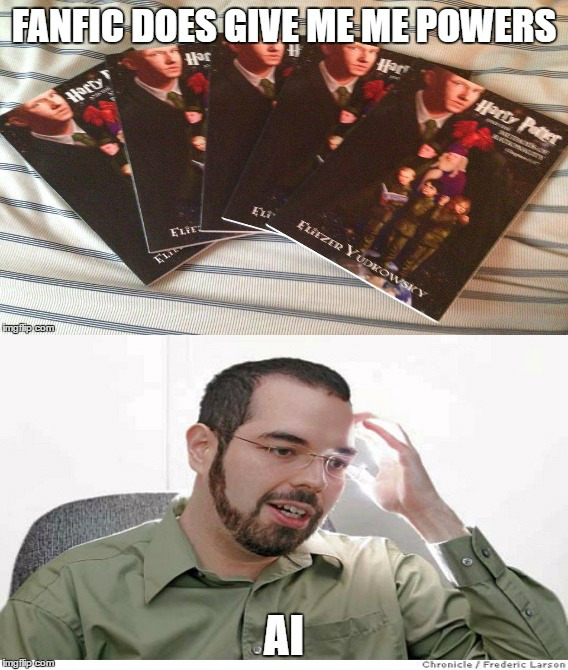
I. [X] does give me me powers

The origin of this meme is the song Phenomenal by Benjai. It come from the line “Soca does gi’ me me powas; ey-ay”. ie: “[Caribbean music genre] makes me powerful; [sound of enthusiasm]”. The specific way this is used varies a lot.

Most commonly, it’ll be a comment on how something has given you the ability to do stupid things faster with more energy. “coffee”, “ganja”, “cocaine”, “manga”, and “pumpum” (ie: vagina) are all things I heard people say gave them powers (it has to be two syllables to fit the song). Alternatively, if your friend has just done something stupid, you can comment on it this way – usually attributing their sudden energy to something silly as a form of ribbing.

Alternatively, you can use it as an image macro, as we often do on WhatsApp (yes, we’re whatsappers). The general format here is a call-and-response macro. The first image is of the thing giving the powers, with the caption “[thing] does give me me powers”. The second image shows someone doing something silly, with either the caption “Ey Ay”/”Eh I” or the caption “See me deh/dey/there”.

Example from WhatsApp:

Soca Powers 1

However, the punning potential is great and terrible

Soca Powers 2

(I’m a horrible person, I know)

And, thus, you have been educated! Which is great, because I am constantly tempted to use this meme, and then have to refrain from it to avoid confusion. But no more! Go forth and meme like a true rudeboy

How does “[X] does give me me powers“ parse syntactically?

Specifically, what is each “me” doing? Do they both mean the same thing, and were just repeated for the meter to work? (Or for emphasis? Does [Redacted]-dialect repeat nouns for emphasis?)

Or are they doing different things? Are they both ~something about the speaker~ (with some grammatical effects), or is one of them totally unrelated?

“me” is the first person singular pronoun.

Yes, there aren’t first person singular pronouns. There is only one. It does the work of English I, me, and my.

So, replacing the ‘me’s with their equivalents, we get “Soca does give me my powers”.

But wait! What’s the “does” doing here?

It puts the sentence in the present tense, because “Soca give me my powers” would be past tense. The unmarked form of a verb in my dialect generally is.

So the sentence parses as “Soca gives me my powers” in standard English.

Ah, so that’s what the “does” was for.

(The doubled “me” didn’t confuse me, personally: my language-parsing module saw the second one, said “ah, it’s the cockney ‘me’”, and continued on. Apparently I’ve consumed enough British media for “’me’ can be used as a possessive” to be an available thought.)

On an unrelated note: is it just me*, or does that song–especially the chorus–sound very…itself? Like, a song they would play over a location-establishing shot. “HAVE WE MENTIONED YET THAT WE’RE IN THE CARIBBEAN??”

Not in a bad way, just…intensely Caribbean.

*It might just be me and my lack of experience with the genre.


Tags:

#reply via reblog #language #the more you know #music #also #anything that makes me laugh this much deserves a reblog #because that was indeed a great and terrible pun


{{next post in sequence}}