{{previous post in sequence}}


aa49d59ecd971a3ba9bdd142e45b94af69c121f2

twitblr:

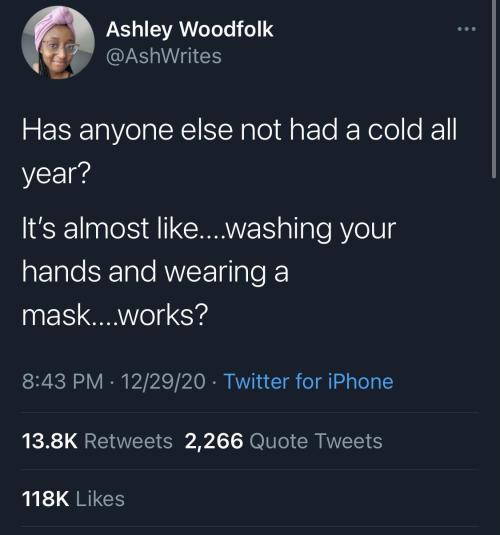
Definitely masking up post-COVID (x) {{the original link didn’t actually lead anywhere; I have replaced it with a genuine source link}}


juliainfinland:

Also, let’s keep having soap and disinfectant dispensers everywhere.


derinthescarletpescatarian:

By contrast, I’ve been getting the same number of sniffles that I do every year even though there’s no one to catch them from, which is how I learned this year that I’m not prone to minor colds; I’m prone to hayfever.


brin-bellway:

Huh, you’re still getting hayfever with a mask? I started wearing a mask in 2017 *specifically* to avoid pollen, and it’s been working wonderfully for me.

Have you been keeping the mask on outside, and when near front doors that people are opening a lot? Does it have a well-fitted nosepiece?

I also had no colds in the calendar year 2020. It used to be fairly normal for me to go entire years without getting sick (after I adjusted to my current microbial milieu, that is; I got sick a *lot* the first couple years I lived in Canada), but then I started working a customer-facing job where nobody else ever took sick leave and staff members were forbidden from wearing masks, and I went from a cold every 1 – 2 years to a cold every few months. Getting rid of that damned fast-food cold rate wasn’t worth what it’s cost, but it’s a very nice silver lining.

(for anyone who finds my rate of colds bogglingly low: I’m guessing the two big components are “trained myself out of touching my face in public when I was a pre-teen, and always wash my hands upon returning home” and “rarely travel”, in that order)

I didn’t even used to do any anti-airborne measures†, just anti-fomite. I plan to start wearing a mask in indoor public spaces from October – March or so each year and on public transit year-round, and it’ll be very interesting to see what that does to my baseline cold rate.

(also, on a broader scale, it will be interesting to see if COVID-19 vaccines grant any cross-protection against cold-type coronaviruses)

†Except in extreme situations like “on an airplane two seats away from a coughing dude”. Guess who didn’t get sick until an incubation period *after* the rest of her family? (unfortunately there’s only so much you can isolate from people you’re sharing a hotel room with)


derinthescarletpescatarian:

I very rarely wear a mask. I hardly leave the house and when I do, almost nobody wears masks here because there’s no covid in my state outside of the quarantined medi-hotels for infected international arrivals; we just sanitise, social distance, keep records of where we go and get tested any time symptoms show up so that when it does show up, we can respond before it’s got more than a couple of people. The distancing and group size limits are enough that basically nobody’s getting colds.

My probably-hayfever is very mild and isn’t debilitating at all (which is probably why it took me so long to notice); I just get a sniffly, runny nose so I haven’t bothered with any pollen precautions. They’d be more annoying than just living with it.


brin-bellway:

Fair enough, I suppose.

When I started wearing pollen masks, my only symptom was mild sore throats. The main problem I was having was that pollen attacks felt exactly like…well, the onset of a cold. *Physically* the sore throats per se weren’t a big deal, but I hated never being sure whether or not I was coming down with something.

I’ve started getting runny noses too now, which I found even worse in that they’re impairing in their own right. Maybe I’m just more bothered by having a runny nose than you are.


alarajrogers:

My allergies are for animals and dust. I have pets and am far too disorganized to dust. So yeah, I’m actually just as miserable this year as I am every year, but I definitely have noticed, no colds. Runny nose and sneezing and occasional sore throat and cough… but at my age, the biggest symptom of a cold is a draining and horrible fatigue. All my fatigue this year comes from diabetes and depression.

I do think I’m going to keep using masks during the winter every year.


brin-bellway:

At your age? Are you implying you *didn’t* get horrible draining fatigue from colds when you were younger?

When I saw that one of the DSM rules is that in order to qualify as having clinical depression it has to be at least two weeks, I thought “ah, of course, they’re thinking of self-limiting diseases”. The last week of December, 2017, I had a cold that *didn’t* come with a transient depressive episode, and it was amazing how much less it sucked. Turns out that while sore throats and stuffy noses and coughing fits *are* pretty annoying, *most* of the badness of colds is from direct inducement of misery.

…if there are people who *normally* don’t get depression from colds, that would explain a lot about how blase they are about disease prevention.

(…“people with enough depression at baseline that colds are just background noise” would also explain a lot but in a much more horrifying way. you indicate that in at least some cases they can be distinguished, though.)


brin-bellway:

@rustingbridges replied: “no, I don’t feel that way. identifying a cold mostly consists of ruling out allergies and guessing

holy fuck


gasmaskaesthetic:

fwiw I don’t tend to get depressed when I’m sick with a cold either. A bit grumpy and tired at worst.

even having the flu isn’t depressing as such, it’s sucky and miserable but doesn’t cause a depressive episode.

(I wrote most of the following before seeing this branch, but putting it as a response to your post seemed reasonably fitting)

I would like to be clear here that I am not talking about feeling mildly down. If I were going to be stuck feeling the-way-I-feel-when-I-have-a-cold forever, I would seriously consider suicide, and if you know me you know that I do not say that lightly.

no fucking wonder that one Girl Guide casually mentioned to me after breathing on me for like an hour that she had a cold like it wasn’t a big deal, she probably didn’t *know* she was risking condemning me to 3 – 5 days of *life not being worth living*

Come to think of it, this also explains a lot about people failing to grok depression. Like, yeah, quantity has a quality all its own, but maybe when I saw that one chronically-depressed person explain what “having so little executive function that it takes hours to summon the will to get off the couch and go to the bathroom” is like as if it *wasn’t* a universally relatable experience, she wasn’t just doing whatever-the-opposite-of-projecting is.

(I would also like to be clear that I am not otherwise prone to depression. There have been some instances of experiences that *maybe* qualified, but that kind of deep shit where you can barely even exist let alone do anything else, I haven’t been anywhere near that *except* when I’m sick.)


Tags:

#reply via reblog #illness tw #suicide cw #is the blue I see the same as the blue you see #depression

{{next post in sequence}}

{{previous post in sequence}}


aa49d59ecd971a3ba9bdd142e45b94af69c121f2

twitblr:

Definitely masking up post-COVID (x) {{the original link didn’t actually lead anywhere; I have replaced it with a genuine source link}}


juliainfinland:

Also, let’s keep having soap and disinfectant dispensers everywhere.


derinthescarletpescatarian:

By contrast, I’ve been getting the same number of sniffles that I do every year even though there’s no one to catch them from, which is how I learned this year that I’m not prone to minor colds; I’m prone to hayfever.


brin-bellway:

Huh, you’re still getting hayfever with a mask? I started wearing a mask in 2017 *specifically* to avoid pollen, and it’s been working wonderfully for me.

Have you been keeping the mask on outside, and when near front doors that people are opening a lot? Does it have a well-fitted nosepiece?

I also had no colds in the calendar year 2020. It used to be fairly normal for me to go entire years without getting sick (after I adjusted to my current microbial milieu, that is; I got sick a *lot* the first couple years I lived in Canada), but then I started working a customer-facing job where nobody else ever took sick leave and staff members were forbidden from wearing masks, and I went from a cold every 1 – 2 years to a cold every few months. Getting rid of that damned fast-food cold rate wasn’t worth what it’s cost, but it’s a very nice silver lining.

(for anyone who finds my rate of colds bogglingly low: I’m guessing the two big components are “trained myself out of touching my face in public when I was a pre-teen, and always wash my hands upon returning home” and “rarely travel”, in that order)

I didn’t even used to do any anti-airborne measures†, just anti-fomite. I plan to start wearing a mask in indoor public spaces from October – March or so each year and on public transit year-round, and it’ll be very interesting to see what that does to my baseline cold rate.

(also, on a broader scale, it will be interesting to see if COVID-19 vaccines grant any cross-protection against cold-type coronaviruses)

†Except in extreme situations like “on an airplane two seats away from a coughing dude”. Guess who didn’t get sick until an incubation period *after* the rest of her family? (unfortunately there’s only so much you can isolate from people you’re sharing a hotel room with)


derinthescarletpescatarian:

I very rarely wear a mask. I hardly leave the house and when I do, almost nobody wears masks here because there’s no covid in my state outside of the quarantined medi-hotels for infected international arrivals; we just sanitise, social distance, keep records of where we go and get tested any time symptoms show up so that when it does show up, we can respond before it’s got more than a couple of people. The distancing and group size limits are enough that basically nobody’s getting colds.

My probably-hayfever is very mild and isn’t debilitating at all (which is probably why it took me so long to notice); I just get a sniffly, runny nose so I haven’t bothered with any pollen precautions. They’d be more annoying than just living with it.


brin-bellway:

Fair enough, I suppose.

When I started wearing pollen masks, my only symptom was mild sore throats. The main problem I was having was that pollen attacks felt exactly like…well, the onset of a cold. *Physically* the sore throats per se weren’t a big deal, but I hated never being sure whether or not I was coming down with something.

I’ve started getting runny noses too now, which I found even worse in that they’re impairing in their own right. Maybe I’m just more bothered by having a runny nose than you are.


alarajrogers:

My allergies are for animals and dust. I have pets and am far too disorganized to dust. So yeah, I’m actually just as miserable this year as I am every year, but I definitely have noticed, no colds. Runny nose and sneezing and occasional sore throat and cough… but at my age, the biggest symptom of a cold is a draining and horrible fatigue. All my fatigue this year comes from diabetes and depression.

I do think I’m going to keep using masks during the winter every year.


brin-bellway:

At your age? Are you implying you *didn’t* get horrible draining fatigue from colds when you were younger?

When I saw that one of the DSM rules is that in order to qualify as having clinical depression it has to be at least two weeks, I thought “ah, of course, they’re thinking of self-limiting diseases”. The last week of December, 2017, I had a cold that *didn’t* come with a transient depressive episode, and it was amazing how much less it sucked. Turns out that while sore throats and stuffy noses and coughing fits *are* pretty annoying, *most* of the badness of colds is from direct inducement of misery.

…if there are people who *normally* don’t get depression from colds, that would explain a lot about how blase they are about disease prevention.

(…“people with enough depression at baseline that colds are just background noise” would also explain a lot but in a much more horrifying way. you indicate that in at least some cases they can be distinguished, though.)

@rustingbridges replied: “no, I don’t feel that way. identifying a cold mostly consists of ruling out allergies and guessing

holy fuck


Tags:

#this explains so much #oh my god #replies #illness tw #is the blue I see the same as the blue you see #depression

{{next post in sequence}}

{{previous post in sequence}}


aa49d59ecd971a3ba9bdd142e45b94af69c121f2

twitblr:

Definitely masking up post-COVID (x) {{the original link didn’t actually lead anywhere; I have replaced it with a genuine source link}}


juliainfinland:

Also, let’s keep having soap and disinfectant dispensers everywhere.


derinthescarletpescatarian:

By contrast, I’ve been getting the same number of sniffles that I do every year even though there’s no one to catch them from, which is how I learned this year that I’m not prone to minor colds; I’m prone to hayfever.


brin-bellway:

Huh, you’re still getting hayfever with a mask? I started wearing a mask in 2017 *specifically* to avoid pollen, and it’s been working wonderfully for me.

Have you been keeping the mask on outside, and when near front doors that people are opening a lot? Does it have a well-fitted nosepiece?

I also had no colds in the calendar year 2020. It used to be fairly normal for me to go entire years without getting sick (after I adjusted to my current microbial milieu, that is; I got sick a *lot* the first couple years I lived in Canada), but then I started working a customer-facing job where nobody else ever took sick leave and staff members were forbidden from wearing masks, and I went from a cold every 1 – 2 years to a cold every few months. Getting rid of that damned fast-food cold rate wasn’t worth what it’s cost, but it’s a very nice silver lining.

(for anyone who finds my rate of colds bogglingly low: I’m guessing the two big components are “trained myself out of touching my face in public when I was a pre-teen, and always wash my hands upon returning home” and “rarely travel”, in that order)

I didn’t even used to do any anti-airborne measures†, just anti-fomite. I plan to start wearing a mask in indoor public spaces from October – March or so each year and on public transit year-round, and it’ll be very interesting to see what that does to my baseline cold rate.

(also, on a broader scale, it will be interesting to see if COVID-19 vaccines grant any cross-protection against cold-type coronaviruses)

†Except in extreme situations like “on an airplane two seats away from a coughing dude”. Guess who didn’t get sick until an incubation period *after* the rest of her family? (unfortunately there’s only so much you can isolate from people you’re sharing a hotel room with)


derinthescarletpescatarian:

I very rarely wear a mask. I hardly leave the house and when I do, almost nobody wears masks here because there’s no covid in my state outside of the quarantined medi-hotels for infected international arrivals; we just sanitise, social distance, keep records of where we go and get tested any time symptoms show up so that when it does show up, we can respond before it’s got more than a couple of people. The distancing and group size limits are enough that basically nobody’s getting colds.

My probably-hayfever is very mild and isn’t debilitating at all (which is probably why it took me so long to notice); I just get a sniffly, runny nose so I haven’t bothered with any pollen precautions. They’d be more annoying than just living with it.


brin-bellway:

Fair enough, I suppose.

When I started wearing pollen masks, my only symptom was mild sore throats. The main problem I was having was that pollen attacks felt exactly like…well, the onset of a cold. *Physically* the sore throats per se weren’t a big deal, but I hated never being sure whether or not I was coming down with something.

I’ve started getting runny noses too now, which I found even worse in that they’re impairing in their own right. Maybe I’m just more bothered by having a runny nose than you are.


alarajrogers:

My allergies are for animals and dust. I have pets and am far too disorganized to dust. So yeah, I’m actually just as miserable this year as I am every year, but I definitely have noticed, no colds. Runny nose and sneezing and occasional sore throat and cough… but at my age, the biggest symptom of a cold is a draining and horrible fatigue. All my fatigue this year comes from diabetes and depression.

I do think I’m going to keep using masks during the winter every year.

At your age? Are you implying you *didn’t* get horrible draining fatigue from colds when you were younger?

When I saw that one of the DSM rules is that in order to qualify as having clinical depression it has to be at least two weeks, I thought “ah, of course, they’re thinking of self-limiting diseases”. The last week of December, 2017, I had a cold that *didn’t* come with a transient depressive episode, and it was amazing how much less it sucked. Turns out that while sore throats and stuffy noses and coughing fits *are* pretty annoying, *most* of the badness of colds is from direct inducement of misery.

…if there are people who *normally* don’t get depression from colds, that would explain a lot about how blase they are about disease prevention.

(…“people with enough depression at baseline that colds are just background noise” would also explain a lot but in a much more horrifying way. you indicate that in at least some cases they can be distinguished, though.)


Tags:

#reply via reblog #illness tw #covid19 #is the blue I see the same as the blue you see #allergies #depression


{{next post in sequence}}

another-normal-anomaly:

incarnation-issues:

reasonableapproximation:

There’s a particular aesthetic that I associate with radical self-expression. It’s like, sparkly and glitter-on-face-y and colorful and impractical and frankly it makes me a little uncomfortable but whatever, that’s on me.

The thing I’m not sure about is, how suspicious should I be of just that first sentence? Like you’d think radical self-expression would be diverse enough not to have an associated aesthetic. But that’s not necessarily true, there’s all sorts of ways it could do, and anyway I might be wrong to associate it with radical self-expression at all.

But still, I can’t help but suspect that at least some of the time, people who claim to be going for radical self-expression are actually just trying to look like the sort of person whose radical self-expression makes them look like the sort of person who fits in here.

Which, when I put it in words, yes, obviously that happens. I just don’t know how much.

I do think that shininess, colorfulness, and impracticality are all things you should expect from humans focusing more on doing stuff-they-want with dress, even if these specific people look weirdly close to each other.

When you look at examples in nature of entities showing off to entities with humanlike vision, shininess and colorfulness play a big role, and the same is true in human fashion unless you’re countersignaling. And practicality is a huge constraint on dress. People looking for dress fulfilling specific artistic criteria that aren’t about practicality are almost never going to land on something more practical than average.

What incarnation-issues said. But also, from my perspective, when I wear sparkly colorful impractical clothing, it’s not about radical self-expression. It’s about colors and sparkles as ends in themselves. Trying to be different from everyone else is like running up the down escalator, so I don’t try to do it anymore. I’m a weirdo like all the other weirdos, but the way I am, aesthetically and otherwise, is a good way to be no matter how many people are doing it. I’m just another normal anomaly.

I acknowledge that the above is true for many people, but I personally associate wearing shiny/colourful/impractical/showy clothing with *coercion*. “Oh come *on*, we’re going somewhere *fancy*, you have to look *nice*!”

Sometimes radical self-expression is utility belts and hiking boots and wearing the same few Lands’ End outfits all the time.

(for people unaware, Lands’ End is a clothing store that sells very plain and practical and comfy clothes [link]: I highly recommend them)


Tags:

#clothing #is the blue I see the same as the blue you see #reply via reblog

On writing like a butterfly

worldlypositions:

I thought it would be interesting to try to write my review of the Diving Bell and the Butterfly in my head without setting pen to paper until the end, and to convey at least some of it by blinking, since I find the fact that the author wrote the whole book in this way astonishing. Perhaps experiencing that process myself would improve my understanding of things, such that I wouldn’t be astonished.

I think trying to do this was an even better exercise than I expected, though by the end I was frustrated to the point of tears, and I’m still feeling kind of annoyed, having just put it up.

(Hopefully this was also a vivid and enlightening experience of signing up for annoying projects, which I do often, but usually the annoyance is months later than the agreeing, so I’m not sure that my intuitive anticipations make the connection.)

Before I go and do something anti-annoying, I figure I should write some notes on the experience, while it is fresh.

Some notes:

  • It did feel fairly encumbering. There were nascent sentences that I might have tried to poke in somewhere, then play around with, then look at and move or get rid of, where the prospect of trying to do some equivalent of all that in my head while keeping hold of the broader paragraph was too intimidating, and I watched them go by. And the sentences I did write felt like half my attention was on something like balancing them on the end of a stick and not having them fall on the floor, and really sculpting them would have required too much dexterity.
  • Though I think in some sense they were much more sculpted than usual, because I did think about each one for longer, and often hone it into something more succinct and memorable instead of writing down the first ramble that entered my mind. I’m not sure how that fits with the above observation.
  • It felt mentally strength-building – as if I was exercising a capability that would improve, which was exciting, and I briefly fantasized about a stronger and defter inner world.
  • I started out looking at things around me as I composed, like my resting computer, and the table, and the sea. But after a while, I realized that I was staring intently at a long rug with about as many Persian whorls as paragraphs in my prospective post, and that as I envisaged the current sentence, I was mentally weaving it around some well-placed sub-curls of its paragraph-whorl. Looking away from it, it was harder to remember what I had been saying. (I have noticed before that thinking in the world, I end up appropriating the scenery as some kind of scratch paper – you can’t write on it, but you can actually do a lot with reinterpreting whatever it already contains.)
  • For words with lots of synonyms, I kept selecting one, then forgetting which and having to select again (e.g. ‘lively’ or ‘energetic’ or ‘vigorous’?)
  • I originally set out to compose the whole thing before writing it, but this was fairly hard and seemed somewhat arbitrary, so after composing the basic outline and a few paragraphs, somewhat discouraged by the likelihood of forgetting them again imminently, I decided that I could instead compose chunks at a time rather than having to do it all at once. In the end I did it in paragraph chunks. Which is probably a much easier task than Bauby had, since if someone was coming to transcribe stuff for hours, one probably wants more than one paragraph relatively well prepared.
  • Thinking lots of thoughts without saying or writing them can feel a particular kind of agitating.
  • It took about 20 minutes for my boyfriend and I to transcribe a single sentence using roughly the winking method described in the book, for a speed of around 1 word per minute. The scheme was for him to run his finger over an alphabet reorganized by letter frequency, then for me to wink when he reached the desired letter. We added some punctuation, and a ‘pause! let me think!’ signal, and ‘yes’, and ‘no’. These last three got a lot of use. It basically worked as expected, though one time we made an error, and I didn’t know what to do, so I continued from the beginning of the word again, which made the sentence nonsensical, which confused him for a while, but he figured it out.
  • I wondered why Bauby and his assistant didn’t use Morse code, or something more efficient. We didn’t try this, but some forum users also wonder this, and one claims that he can wink out about 20 words per minute in Morse code, but that the large amount of blinking involved is ‘pretty tiring’.
  • We made a huge amount of use of my boyfriend guessing the rest of the word, from context and the first few letters. In the book, Bauby describes how people frequently mess that up, or fail to check that they have guessed correctly, or refuse to guess and conscientiously coax forth every letter. This all sounds terrible.
  • I’m aware that some people probably compose things entirely in their heads all the time (people have all kinds of mental situations – some people can also reliably imagine a triangle without it being more like the feeling of a triangle laid out in a kind of triangle-like space, or breaking apart and becoming a volcano full of red and white flowers), and my notes here probably sound to them like a person saying ‘for a bizarro experience, I tried to walk across the room without holding on to things, but it was obviously a total disaster – knees bending every which way, and imagine balancing a whole floppy and joint-strewn human body on top of two of those things, while moving! Such sympathy I have for those who have lost their walking frames.’ I’m curious to hear from them whether this is what it sounds like.

***
(Crossposted from world spirit sock puppet)

(I will tentatively put this comment here, but let me know if you would prefer I comment through worldspiritsockpuppet.com in order to have a central comment collection point. I’m a bit wary of Disqus because of its fragility (Disqus widgets don’t preserve successfully in the Wayback Machine), but it’s not a dealbreaker.)

I do compose posts in my head sometimes (though not always, and not this one). The post mostly doesn’t strike me as overtly odd (in an absence-of-ability-I-take-for-granted way), but I think that’s because it all traces back to this bullet point:

I originally set out to compose the whole thing before writing it, but this was fairly hard and seemed somewhat arbitrary, so after composing the basic outline and a few paragraphs, somewhat discouraged by the likelihood of forgetting them again imminently, I decided that I could instead compose chunks at a time rather than having to do it all at once. In the end I did it in paragraph chunks. Which is probably a much easier task than Bauby had, since if someone was coming to transcribe stuff for hours, one probably wants more than one paragraph relatively well prepared.

Left to my own devices, I would interpret having to write-by-blinking *as you go* to be a *handicap* relative to composing the post in advance, and the rest of your post feels sense-making in large part *because* you were operating under that handicap.

(I didn’t read the review until afterward, and as such didn’t initially realise that you only blinked for the first sentence.)

Composing mentally, in my experience, is a form of memorisation. While I am walking or performing janitorial duties at my restaurant job or what-have-you, I run through the post in my mind over and over, musing on it, perhaps tweaking it, but also just repeating the words I have already chosen.

(And then, after I’ve written them down and made any final tweaks and–if applicable–posted them, I’ll usually re-read them a few more times over the following couple of days for good measure. I also occasionally archive-binge my own blog. Some of my posts I can *still* recite mostly or entirely from memory, and I almost always have at least enough sense of [what else I’ve posted] to know what things would be useful to link to in order to provide context to my current posts.)

The Wikipedia article says he wrote about half a word per minute in four-hour sessions, which would mean his sessions were around 120 words each. Given a day to think over how I’m going to use 120 words (and not a great deal *else* to think about, comparatively), I think I could probably wear the groove of that memory deep enough to rattle the words off when the time came.


Tags:

#reply via reblog #paralysis #writing #is the blue I see the same as the blue you see #amnesia cw

glumshoe:

is there anything more awkward than looking back at your childhood at innocent interactions you had with other kids and thinking “oh…. wow. that was uhhh definitely their early exploration of a fetish, wasn’t it?”


demonic-mnemonic:

ec384180bf5c138b365db25750013a146524c4c9


glumshoe:

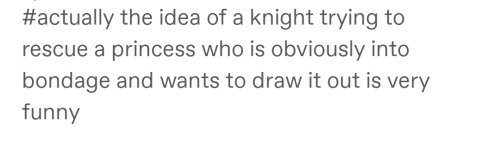
I’m also remembering a lot of games with one particular friend who always found reasons why her character should be tied up. I didn’t mind, because it meant I got to play the Noble Knight Who Rescues The Princess™️ AND the mustache-twirling villain, but it always pissed me off when we paused the game and she would still pretend that she was actually stuck and would fake-struggle for like ten minutes against the most half-hearted jump rope tied in a bow around her arms. Please, knock it off, I just want to go to lunch.


leftpantykarkat:

a88fe0bbab28da52b4e87b907485825ad9ef323a

Im gonna be thinking about this tag all day now


glumshoe:

Villain: “Can you PLEASE just ride off into the sunset together already?”

Knight: “You’re just letting us go? What’s the catch, blackguard?”

Villain: “No catch. Kidnapping the princess was just supposed to be a distraction while I executed my REAL plan. I did not expect this to take so long and now the window of opportunity has closed… a whole day, wasted.”

Hero: “Look. I am TRYING to rescue her. She just… well.”

Princess: “Ha ha oh nooo it looks like these ropes just wrapped around me somehow… I’m hopelessly trapped…”

Villain: “Ma’am. Your Highness. That’s the power cord to my Xbox.”

Princess: “And it’s getting tighter! Oh no!”

Knight: “I’m sort of uncomfortable. Are you uncomfortable?”

Villain: “Yeah… I know I technically initiated this entire scenario but I’m starting to feel… used, somehow. Like. It doesn’t feel professional.”

Princess: [sarcastically] “Is someone baking a cake?”

Knight: “No?”

Princess: “Huh. Weird. ‘Cause I could swear I smell the overpowering aroma of vanilla in this room.”


lowkey-radical:

does anyone else find this like. sexualizing of children’s games. pretty disturbing?


glumshoe:

The games themselves (probably? hopefully?) weren’t recognizably sexual—just early fixations upon things or ideas that seemed maybe a little weird or exasperating at the time if you didn’t share that fascination, but which in retrospect were almost certainly the unrealized roots of your playmate’s later sexual preferences.

It is a bit disturbing to realize that you had some kind of role in developing their, uh, proclivities, but it’s not like Little Jimmy could have meaningfully articulated why he always insisted on the rule that everyone had to take off their shoes to play tag, or known that it would creep his friends out ten years later once he realized he had a foot fetish. It’s awkward but—so long as the games didn’t result in something traumatic—ultimately sort of an unavoidable embarrassment of youth to look back and go, “Oh, that’s what that was…. 😬”


tanadrin:

I was reading Perv by Jesse Bering (which in general is only so-so; not enough discussion of the research IMO), and he points out that, where kinks can be traced to a formative experience in childhood, this formative experience often comes well before puberty, like anywhere from five to ten–which is super awkward, because for many reasons our culture likes to draw a bright, clear dividing line between childhood and adulthood, and where that’s not possible, at least between childhood and adolescence. But that’s not always possible! And given how much of human psychology is dominated by romance and physical attraction, it would be weird if that system of the brain didn’t exist some unformed, incipient manner, but sprang into existence suddenly on our 13th birthday or w/e.


jadagul:

I have spoken to a lot of kinky people about this. In my experience, about 50% are like “yeah, in retrospect I was an extremely kinky eight-year-old, not that I had any understanding of any of this at the time.” In other words, I am the playmate here and I apologize to my cub scout troop.

Did the many kinky people you’ve talked to fall into distinct camps of “yeah, in retrospect my insistence on getting my acquaintances to play with me in certain very particular ways was Meaningful” vs “yeah, in retrospect my insistence on *freaking the fuck out* at acquaintances who happened to play in certain very particular ways in my presence was Meaningful”? If so, are there other clear distinctions between said camps?

Whenever I hear stories about childhood selves who don’t know they’re kinky and unwittingly erotic games, the young kinksters are always the ones *instigating* the games. But I was the exact opposite of this! Long before I had any idea why, I knew down in my bones that this was something *important* and *profound* and *private*, and I couldn’t stand to see people taking it lightly and without regard for whether anyone was watching.

(“It’s just a game,” said the girls confused about why I was upset by one of them pretending to hypnotise the other, and they were more confused when that only upset me further. It isn’t *just* anything.)

Don’t get me wrong, I played plenty of in-hindsight-sexual games as a child. But they were always, *always* alone and in private (to the extent that a child can arrange for privacy). (…and would you look at that, I grew up into an asexual adult who finds casual sex extremely unappealing. I feel like these facts might be related, but I have so little data.)

(I worry about the people who think that the senses of importance and privacy people have around sex are invariably *learned*, that they are a collective trauma that we as a society should work to grow past.

I know some people actually do feel deep down like it’s not a big deal, even in spite of having been taught otherwise. And I know vanilla people can’t control for knowledge, can’t see into what “a version of themselves who hadn’t been taught anything at all about how to interpret their desires” would be like. But I can, and I know that I could never have been good enough for them.)


Tags:

#reply via reblog #sexuality and lack thereof #is the blue I see the same as the blue you see #my childhood #embarrassment squick #rape tw

emotionallaborunion:

People say that you should really do something out of your comfort zone. Why? I worked very hard to find my comfort zone. It was really rough and I can’t even get there that often. Takes all day and I gotta get off to a good start and do all the right things and avoid the right people and find all the right people and do all of these things to find my comfort zone. And then I’m supposed to do something outside of my – Fuck you! You do something outside your comfort zone. My comfort zone is hard-won….

But then, that’s where popular culture and pop psych comes in and wants – and the shtick I was looking at last night was that like, so, if it’s ‘afraid’, then, ‘You should do the things you’re afraid of’. Why? Why? I have felt quite enough fear. I don’t think I will benefit from more fear. I don’t think it’s the missing element in my life. I don’t think that’s the thing I need to be seeking out. ‘Go to the places that scare you.’ No! I have carved out an awesome space in which I don’t have to visit the places that scare me. I don’t like them there. I’ve been there. I know more about them than you, person telling me to go to the places that scare me.

John Darnielle, 2014-04-19 and 2014-04-20 at the Old Town School of Folk Music, Chicago ( track 18 in https://archive.org/details/tmg2014-04-19.oldtown.flac16 and track 21 in https://archive.org/details/tmg2014-04-20)


Tags:

#I read a thing recently about a free-solo climber #and when they asked why he did it he was like #”I don’t want to just be happy and cozy‚ anyone can be happy and cozy‚ I want more than that” #and I was like what the fuck are you talking about #happy-and-cozy is one of the hardest things there is #you can spend a lifetime striving for it and catch only fleeting glimpses #I don’t understand skydivers and bungee-jumpers and all of that shit #they’re like ”it makes me feel alive” and I’m like ”…no‚ not alive‚ the *other* thing” #how can you be *happy* if you don’t even feel *safe*? #tag rambles #anxiety #death mention #101 Uses for Infrastructureless Computers #and I’ll also add: #people who can distinguish between their drive for sleep and drive for sex fascinate me #my mind is complicated but is also *coherent* #everything feeds into everything else and I can see how these aspects feed into each other #(and indeed I once wrote a to-hell-with-leaving-my-comfort-zone post that was *specifically* in a sexual context)


{{next post in sequence}}

Finally, A Personality Quiz Backed By Science

{{previous post in sequence}}


{{Title link: https://projects.fivethirtyeight.com/personality-quiz/?group=-MLnw84-zDddzbQsP6ta }}

brin-bellway:

rustingbridges:

voxette-vk:

TIL 538 has a personality test

Follow the link above to be in the “group” I made so that you can compare your score against the average. (Hopefully. It seems not to want to load the results when I refresh the page…)

c7f813ba153e5b17bb4cf97bd1a2bcff06a6571a

we’re doin big 5 I guess:

9687af0eccb13aa6f1d4cd1764ad61a4ca562d69
30ccfc5eb49856a1b965b3797179e9514352f62e

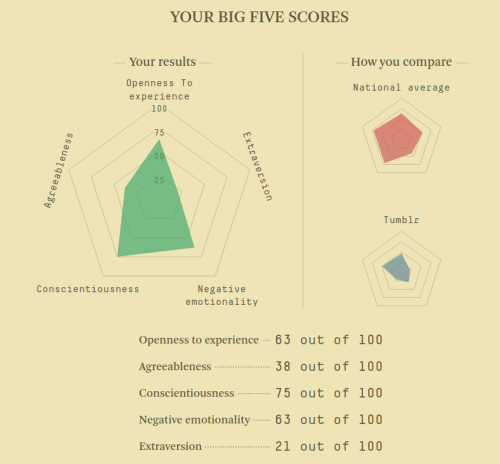
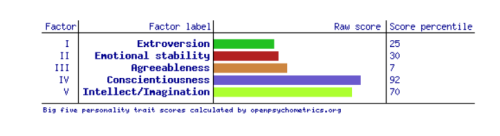
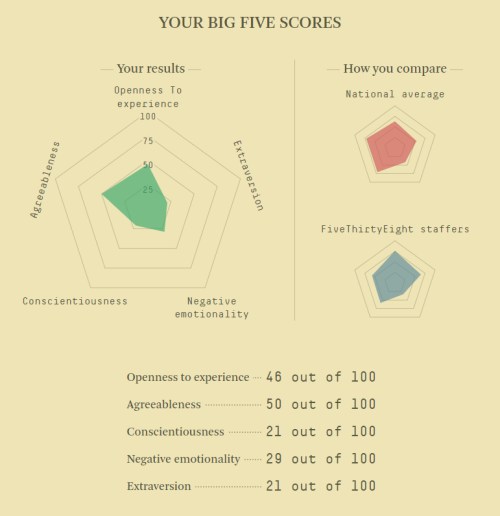
My first thought was that it was attempting to tell me what I want to hear: most of these are rather “better” figures than I was getting on Open Psychometrics a couple years back.

Then I looked at the more detailed breakdown, and a lot of my supposed middle-of-the-road-ness is from having very high scores in some subcategories and very low scores in others, which “averages out” when seen at lower resolutions. Are you very anxious but not depressed? Congratulations, your negative emotionality is “moderate”.

(Except conscientiousness, which is a nice symmetric equilateral triangle with every vertex at ~75.)

((…wait, how does the *average* American have *75th* percentile conscientiousness))

This version seems to place somewhat more emphasis on *treating* people well when it comes to agreeableness, as opposed to Open Psychometrics’ questions which were pretty much purely about how you felt about them on the inside, and that difference is most of what dragged me from 12 up to 38. I am a proverbial kitten who thinks of nothing but murder.

You might also have a low opinion of your own looks.” I look plain in a vaguely pleasant manner, which is *exactly how I like it*, thank you very much

Some scientists think low extraversion has protected humans from disease — you can’t pick up a bug from people if you avoid people.” saaame

@voxette-vk​ replied: “These aren’t percentile scores


Hmm, I suppose I read too much into this bit:

A lot of the outcomes that correlate with low agreeableness, like being chronically bullied (or bullying) or having a criminal record, don’t kick in until someone’s score is down in the 10th percentile.

I guess that makes the two sets of numbers not directly comparable, then.

I just went and took the Open Psychometrics one again to see how they portray their results, and it looks like this:

c31f342c50cfecbaa18afb1f16b267ce561ef5c3

And yeah, you can really see the difference grading on a curve makes, huh. Like, if you hear “your score is 7 out of 100″ you would not intuitively expect so much of the agreeableness bar to be filled, but I guess their other test-takers are so agreeable that moderately low agreeableness is enough to make you way below average.


Tags:

#is the blue I see the same as the blue you see #memes #surveys #anger management #replies

Finally, A Personality Quiz Backed By Science

{{Title link: https://projects.fivethirtyeight.com/personality-quiz/?group=-MLnw84-zDddzbQsP6ta }}

rustingbridges:

voxette-vk:

TIL 538 has a personality test

Follow the link above to be in the “group” I made so that you can compare your score against the average. (Hopefully. It seems not to want to load the results when I refresh the page…)

c7f813ba153e5b17bb4cf97bd1a2bcff06a6571a

we’re doin big 5 I guess:

9687af0eccb13aa6f1d4cd1764ad61a4ca562d69
30ccfc5eb49856a1b965b3797179e9514352f62e

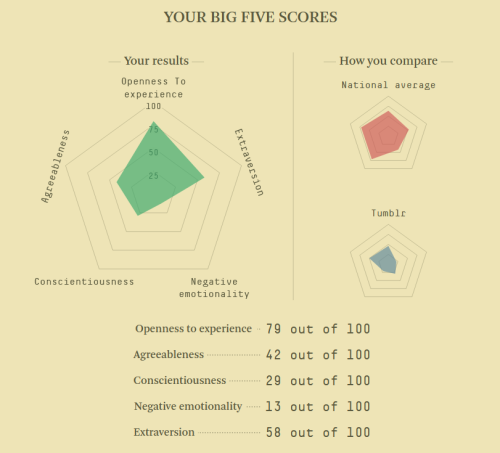
My first thought was that it was attempting to tell me what I want to hear: most of these are rather “better” figures than I was getting on Open Psychometrics a couple years back.

Then I looked at the more detailed breakdown, and a lot of my supposed middle-of-the-road-ness is from having very high scores in some subcategories and very low scores in others, which “averages out” when seen at lower resolutions. Are you very anxious but not depressed? Congratulations, your negative emotionality is “moderate”.

(Except conscientiousness, which is a nice symmetric equilateral triangle with every vertex at ~75.)

((…wait, how does the *average* American have *75th* percentile conscientiousness))

This version seems to place somewhat more emphasis on *treating* people well when it comes to agreeableness, as opposed to Open Psychometrics’ questions which were pretty much purely about how you felt about them on the inside, and that difference is most of what dragged me from 12 up to 38. I am a proverbial kitten who thinks of nothing but murder.

You might also have a low opinion of your own looks.” I look plain in a vaguely pleasant manner, which is *exactly how I like it*, thank you very much

Some scientists think low extraversion has protected humans from disease — you can’t pick up a bug from people if you avoid people.” saaame


Tags:

#reply via reblog #memes #surveys #is the blue I see the same as the blue you see #anxiety #anger management


{{next post in sequence}}

maryellencarter:

is there like. Theory. about the definition of the self through the objects we surround ourselves with? i feel so much more like Myself ever since i got my shirt again and i am curious what the philosophy side of tumblr has to say about it

Off the top of my head there’s https://en.wikipedia.org/wiki/Extended_mind_thesis, but that’s more specifically about using external computation/storage to augment your brain.

While I do get the part-of-me feeling most strongly with computers, I occasionally get it with other stuff too. I’m not sure how much of it is just an autism not-liking-change thing, but there definitely does seem to also be an aspect of “affirming my identity as the sort of person who would have X”.

(I’m sure that’s the holy grail of marketing, but I think it very much *can* be both natural and healthy. I absolutely endorse my desire to be the sort of person who would have a utility belt.)

Clothing can have additional aspects: I think the feeling I get from wearing my Girl Guide jacket primarily operates through some of the same mechanisms as weighted blankets, feeling more comfortable and confident when well-covered.


Tags:

#philosophy #reply via reblog #is the blue I see the same as the blue you see #clothing #transhumanism #autism