Anonymous asked: I’m curious if you have any hypotheses about possible causes for human relationships existing on such a wide spectrum including anything from totally exclusive monogamy to totally inclusive polyerosy. The more I look, the more I notice humans seem to have more “relationship styles” than any other mammal and I can’t help wondering if there’s some genetic/instinctive/physiological reason behind it. Your thoughts?

koryos:

Well, to start with, I wouldn’t actually say that humans have more relationship styles than any other mammal. I think that the issue is that how we look at human behavior and how we look at animal behavior are very different things- obviously, we have a much more detailed and nuanced view of our own species than any other.

It’s important to remember that most science is consumed by the idea of the average. That is, if we were trying to write a description of how an animal behaves, we’d describe what we saw happening the most often. This is a useful way to look at things, because it allows us a way to generalize populations. But this does not mean that that is the only way that things will happen.

If you tally up the human species by culture, you will find that about 85% allow occasional or frequent polygyny (the practice of one man marrying multiple women). That’s a huge percent, and if an alien researcher were examining human behavior and saw that statistic, they might conclude that humans are overwhelmingly polygynistic.

Of course, it’s a little more complex than that, because even among cultures that permit polygyny, most men only marry one woman. Generally, in these cultures, having multiple wives relates to a man’s wealth and resources. This is similar to mating behavior in, say, the red-winged blackbird. Males with the best territory will often attract more than one female. This also occurs in red foxes, which all the literature will tell you are a monogamous species: under the right conditions, male foxes may take more than one female mate.

We, as humans, are familiar with many more relationships within our own kind than monogamy and polygyny, of course, but that’s because we live and breathe human behavior every single day. We rarely spend so much time with animals, particularly animals that are breeding, which is why we might assume that their behavior is static or can be easily categorized. This is simply false. The “averages” that science looks for are generally the widest part of a vast spectrum of behaviors.

Normally, what we find in animals is that the degree of behavioral flexibility relates to how specialized an animal is. If a species lives in only one type of environment, with only a few resources it is designed to use, it may not need the behavioral flexibility that leads to multiple mating types. The opposite is true for humans; we are arguably one of the best generalist species around. We live in a myriad of habitats utilizing a myriad of resources and thus, arguably, have the capacity to accommodate a range of sexual lifestyles.

This is, of course, a gross oversimplification of human behavior, as everybody who is human knows. It doesn’t at all take into account the individual- their desires, their values, their history, et cetera. This is a degree closer than most science goes, and it goes for humans as well as animals. Individual animals will have their own behaviors and preferences just like humans do. We just look at them from much further away than we do ourselves.

Further Reading:

Different trends in human culture: Gray, J. P. (1998). Ethnographic atlas codebook. World Cultures, 10(1), 86-136.

Not only are red-winged blackbirds polygynous about half the time, they also show a high degree of promiscuity and polyandry: Westneat, D. F. (1993). Polygyny and extrapair fertilizations in eastern red-winged blackbirds (Agelaius phoeniceus). Behavioral Ecology, 4(1), 49-60.

One study found that about half of red fox litters were not the product of a monogamous male-female couple; both polygyny and polyandry occurred among the remainder: Baker, P. J., Funk, S. M., Bruford, M. W., & Harris, S. (2004). Polygynandry in a red fox population: implications for the evolution of group living in canids?. Behavioral Ecology, 15(5), 766-778.

Greylag geese most often form male-female bonds, but under some circumstances they may form male-male or male-male-female bonds: Sommer, V., & Vasey, P. L. (Eds.). (2006). Homosexual behaviour in animals: an evolutionary perspective. Cambridge University Press.

Marmosets and tamarins display a range of mating styles, including polyandry, monogamy, and polygyny: Goldizen, A. W. (1988). Tamarin and marmoset mating systems: unusual flexibility. Trends in ecology & evolution, 3(2), 36-40.

These are all just examples of animals with highly flexible mating styles that I came up with off the top of my head. There are many more species where differing mating styles are less common and therefore less frequently documented, but still exist.


Tags:

#interesting #the more you know

thetempest:


charamei:

Aaaaaahhhh no okay sorry I need to reblog it again because I am having Thoughts and Feelings

I mean Time Lords as a whole are awful at the concept of disguise I mean their major spy organisation has a distinctive black-and-white uniform which they never take off for crying out loud

But what we have when conversations like this happen is an unfortunate convergence of two Gallifreyan cultural things coming into play at the same time

#1 is Things Should Be Labelled As What They Are (aka Everyone Is In Uniform At All Times)*

*Romana somehow avoided this. Go you, Romana! You are the only one!

and #2 is Gallifreyans Are Prosopagnosic And Recognise One Another By Telepathy

And like yes if your entire species is faceblind and its primary sense is telepathy (and on the whole its members have a much lower sense of individuality than humans do because of the hivemind) of course the emphasis on clothing is going to be different

Humans use clothing to protect and cover up, yeah, but we also use it to show off and to express ourselves and neither of those things is nearly as important to a hiveminded species with vision as a secondary sense as it is to us

Gallifreyans use clothing as a label because Things Should Be Labelled As What They Are

Is it orange with a single V-stripe and double sleeves and a reasonably heavy weight of fabric well then clearly you are a Prydonian Time Lord

And yes the renegades do this too the lack of a uniform is the Renegade Uniform I would refer you to the fact that the Master is always in black and the Doctor picks a single theme per regeneration and sticks with it unless major trauma happens (looking at you, Eight)

Things Should Be Labelled As What They Are and so when the Doctor picks a new wardrobe at the start of a regeneration all they are really doing is re-applying the Renegade label hello yes I am a renegade this is my new renegade uniform

(It must have taken poor Twelve quite some time to come up with the cunning plan of wearing a different uniform I mean that is some hardcore breakage of Gallifreyan brainwashing there)

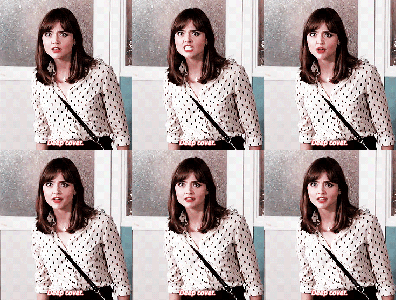
So for Gallifreyan Norm #1 we have ‘Nobody ever wears clothing that doesn’t indicate their function in society therefore nobody will ever suspect I am a renegade if I am wearing a Shobogan’s uniform, not even Clara’

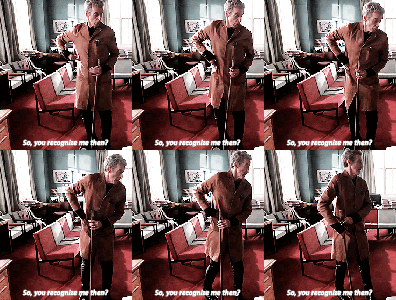
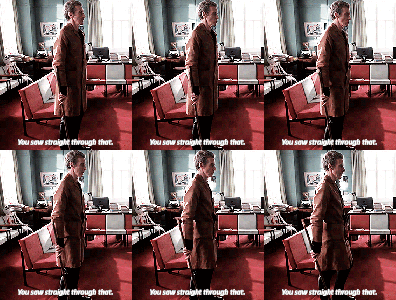
And then for #2 there’s this unfortunate thing that Gallifreyans don’t see faces and like yes I’m sure the Doctor is aware that humans do recognise one another by sight (they go through this every time they regenerate after all) and they know their face hasn’t changed since Clara last saw them

But

What does ‘sight’ mean

Well clearly since everyone is always wearing a uniform it means face + uniform

This face + that coat = Sixth Doctor whereas this face + guard uniform = Commander Maxil

Oh sure my face is the same but Clara won’t recognise me as me because I am not wearing my renegade uniform she’ll just think I’m a Shobogan with a very similar face that’s how humans work right?

No Doctor

No it isn’t

But nice try


Tags:

#Doctor Who #interesting #meta #meta for an episode I haven’t yet seen #but I feel that my ignorance of the episode neither detracts from the meta #nor does the meta detract from my ignorance of the episode #prosopagnosia

duskenpath:

oli-via:

duskenpath:

Rest stops on highways are liminal spaces where the veil is thin and nobody can tell me differently

Explain

The explanation is that liminal spaces are in between places that bridge Here with There, so in fairy tales we often have the Fairy Ring, the Forest Clearing, the Sudden Misty Foggy Forest, the Bridge, the River, graveyards, in some cases

We also have a ton of american urban mythology around famous roadways and sites off the sides of roads

Archetypes like these occur to mark the places in the world where the veil goes thin and humans can have extra-worldly experiences, out of the ordinary way of living

So why wouldn’t transient spaces like rest stops where everyone is just passing through from one place to the next, never stopping for too long, not be a liminal space where spirits frequent, too

Especially since nobody would know if they were real or not


Tags:

#you know they’ve got a point there #those places never do seem quite real #not even when it’s daytime and you’re wide awake

pottersir:

… “You must have shown me real loyalty down in the Chamber. Nothing but that could’ve called Fawkes to you.” That’s the very first thing Dumbledore thanks and praises Harry for. Not for rescuing Ginny, or saving the school from the basilisk, or for keeping Voldemort from coming back, but for loyalty.

Dumbledore judges the people he works with based first and foremost on how loyal they are to him. Not because he thinks he’s all that, but because, as I said, he views people as game pieces, and you can’t have your game pieces acting up, can you? He values his pieces. He wants to advance and protect them. But he doesn’t want them running off beyond his sphere of influence and doing their own thing. I think there’s something very ambiguous about Dumbledore’s habit of seeking out desperate, socially outcast people and doing them one or two huge favors that leave them bound to him for life. Remus, Hagrid and Snape all fit that pattern, and Trelawney and Firenze appear to join the ranks in OOP. It kind of makes me wonder what Dumbledore has done for Fletcher, Moody and Shacklebolt.

…The problem with Sirius is, he’s not loyal to Dumbledore at all; he’s loyal to Harry. From Dumbledore’s point of view, it’s as if he’s playing wizard chess, and one of the knights suddenly decides that he doesn’t care what happens to the king, he’s just going to take care of that little pawn on the left. So Dumbledore does the only thing he thinks he can do — he sticks his recalcitrant knight into a safe, isolated corner of the board and keeps him from making any moves. Perfectly sensible and strategically sound, as long as you don’t expect your game pieces to have any pesky emotions or psychological issue that need to be taken into account.

…Dumbledore’s actions at Hogwarts are another symptom of his general approach. He doesn’t treat it just as a school, but also as an instrument in his strategy. People like Snape, Hagrid and Trelawny — all lousy teachers, in very different ways — are given their jobs as perks, because of their past of future usefulness to the Order, and because it strengthens their bonds of loyalty to Dumbledore.

OTOH, look at Lupin, who is a talented teacher. Why wasn’t he hired before Harry’s third year, especially given the difficulty of finding qualified DADA professors? My theory is that Dumbledore didn’t consider it necessary. As far as he knew, Lupin was already totally loyal simply because Dumbledore had allowed him to attend Hogwarts. There was no need to bribe him with a job. He was hired only when his familiarity with Sirius became an important factor. Once Sirius proved not to be a threat, Lupin was allowed to resign…


stormedtrooper:

THIS IS SO GREAT AND SO INTERESTING AND EVEN MORE SO WHEN YOU LOOK AT SNAPE’S STORYLINE AND HERE’S WHY

Just look at Dumbledore’s behavior in The Prince’s Tale – especially at the contrast between before and after Snape agreed to help him defeat Voldemort. There’s so much emotional manipulation, so much that Dumbledore is doing to keep Snape on his side.

“That is why – it is for that reason – he thinks it means Lily Evans!”

“The prophecy did not refer to a woman,” said Dumbledore. “It spoke of a boy born at the end of July – ”

“You know what I mean! He thinks it means her son, he is going to hunt her down – kill them all – ”

If she means so much to you,” said Dumbledore, “surely Lord Voldemort will spare her? Could you not ask for mercy for the mother, in exchange for the son?”

“I have – I have asked him – ”

You disgust me,” said Dumbledore, and Harry had never heard so much contempt in his voice. Snape seemed to shrink a little, “You do not care, then, about the deaths of her husband and child? They can die, as long as you have what you want?”

That line, the “you disgust me” line is SO IMPORTANT. Contrary to popular belief, Dumbledore doesn’t find Snape’s obsession love for Lily beautiful; he finds it disgusting – and understandably so. Because she “means so much” to Snape that he’s willing to sacrifice her family, and therefore happiness, in order to keep her alive. And, frankly, that’s gross. Dumbledore agrees.

“Hide them all, then,” he croaked. “Keep her – them – safe. Please.”

And what will you give me in return, Severus?

“In – in return?” Snape gaped at Dumbledore, and Harry expected him to protest, but after a long moment he said, “Anything.”

Aaaaaand Dumbledore gets himself the perfect soldier – someone who is willing to do anything.

“I thought…you were going…to keep her…safe…”

“She and James put their faith in the wrong person,” said Dumbledore. “Rather like you, Severus. Weren’t you hoping that Lord Voldemort would spare her?”

Also really important. Dumbledore was supposed to protect her, keep her alive, and it didn’t work out and that greatly puts Snape’s loyalty at risk. So what does Dumbledore do? Deflect. He places the blame on Snape and Voldemort here – which, I’m pretty much with him here because Snape did tell Voldemort the prophecy and Voldemort did personally kill the Potters. But this isn’t about that. This is strategy. Keep Snape guilty and keep the blame off Dumbledore by having this whole “well there was nothing I could do” stance and thereby keep Snape both vulnerable and loyal. Make Voldemort the real enemy, someone that Snape would be willing to do anything to fight against at all cost.

“Her boy survives,” said Dumbledore.

With a tiny jerk of the head, Snape seemed to flick off an irksome fly.

“Her son lives. He has her eyes, precisely her eyes. You remember the shape and color of Lily Evans’s eyes, I am sure?

“DON’T!” bellowed Snape. “Gone…dead…”

“Is this remorse, Severus?”

“I wish…I wish I were dead…”

“And what use would that be to anyone?” said Dumbledore coldly. “If you loved Lily Evans, if you truly loved her, then your way forward is clear.

Okay so Dumbledore is definitely using Snape’s love for Lily against him – I think we can all agree with that. I mean look at how he’s referring to her as “Lily Evans” rather than as her married name, “Lily Potter.” Dumbledore has a very tough sell here; he wants Snape to help him protect the child of someone Snape loves and someone he hates. So he takes James out of the equation and it’s all about Harry’s eyes and how much they look like Lily’s and Evans. And then he takes Snape’s love and gives it a purpose.

“You know how and why she died. Make sure it was not in vain. Help me protect Lily’s son.”

“He does not need protection. The Dark Lord has gone – ”

“The Dark Lord will return, and Harry Potter will be in terrible danger when he does.”

There was a long pause, and slowly Snape regained control of himself, mastered his own breathing. At last he said, “Very well. Very well. But never – never tell, Dumbledore! This must be between us! Swear it! I cannot bear…especially Potter’s son…I want your word!”

My word, Severus, that I shall never reveal the best of you?” Dumbledore sighed, looking down into Snape’s ferocious, anguished face.

Before it was disgusting, but now that Snape’s agreed to help him, has pledged his loyalty, Snape’s love is now ~the best part of him~

“ – mediocre, arrogant as his father, a determined rule-breaker, delighted to find himself famous, attention-seeking and impertinent – ”

“You see what you expect to see, Severus,” said Dumbledore, without raising his eyes from a copy of Transfiguration Today . “Other teachers report that the boy is modest, likable, and reasonably talented. Personally, I find him an engaging child.”

Dumbledore turned a page, and said, without looking up, “Keep an eye on Quirrell, won’t you?”

Snape is only seeing James’ worst qualities in Harry (which tbh first year Harry definitely did not have) so Dumbledore brings up qualities that were, actually, found in and associated with Lily to placate him. Because Dumbledore’s biggest challenge is to make Snape forget that James is Harry’s father. He then follows this up with a request.

“Karkaroff’s Mark is becoming darker too. He is panicking, he fears retribution; you know how much help he gave the Ministry after the Dark Lord fell.” Snape looked sideways at Dumbledore’s crooked-nosed profile. “Karkaroff intends to flee if the Mark burns.”

“Does he?” said Dumbledore softly, as Fleur Delacour and Roger Davies came giggling in from the grounds. “And are you tempted to join him?”

“No,” said Snape, his black eyes on Fleur’s and Roger’s retreating figures. “I am not such a coward.”

“No,” agreed Dumbledore. “You are a braver man by far than Igor Karkaroff. You know, I sometimes think we Sort too soon…

He walked away, leaving Snape looking stricken…

Whether you believe it or not, both Sirius and Remus have said that Snape was jealous of James – of his popularity, his talents, all the glory he received, etc. And a lot of those things are perks from being a brave Gryffindor rather than an “evil” Slytherin. Dumbledore is capitalizing on that, on Snape’s secret desires. He’s manipulating Snape because wow he thinks he’s brave, he thinks he’s brave enough to even be a mighty Gryffindor – something I’m sure no one has even told him before. Something he’d never admit to secretly reveling in because he grew up unloved and unwanted. But it keeps him loyal, keeps him close to Dumbledore.

“I am fortunate, extremely fortunate, that I have you, Severus.”

The power of being complimentary, my friends, is not focused on enough. (And I’m not trying to take away from the fact that Snape is a talented wizard, because I do think that, but Dumbledore is so totally manipulating him come on. What makes me say that? Because not long afterwards does he segue into asking Snape to kill him)

“In short, the boy has had a death sentence pronounced upon him as surely as I have,” said Dumbledore. “Now, I should have thought the natural successor to the job, once Draco fails, is yourself?

There was a short pause.

“That, I think, is the Dark Lord’s plan.”

Lord Voldemort foresees a moment in the near future when he will not need a spy at Hogwarts?

“He believes the school will soon be in his grasp, yes.”

“And if it does fall into his grasp,” said Dumbledore, almost, it seemed, as an aside, “I have your word that you will do all in your power to protect the students at Hogwarts?

Snape gave a stiff nod.

Great, Dumbledore has not only a spy, but an heir.

“He is his father over again – ”

In looks, perhaps, but his deepest nature is much more like his mother’s. I spend time with Harry because I have things to discuss with him, information I must give him before it is too late.”

Harry actually shares plenty of traits with James – and based on how he’s spoken of James in the past, Dumbledore liked him. (And why wouldn’t he? Not only is James amazing jkalsdsalkdjasldaskdh but he was very loyal to Dumbledore) So this is for Snape’s benefit. Again, he’s keeping him under control by bringing Lily into the equation and make Harry worthy enough, in Snape’s eyes, to protect.

“Information,” repeated Snape. “You trust him…you do not trust me.

“It is not a question of trust. I have, as we both know, limited time. It is essential that I give the boy enough information for him to do what he needs to do.”

“And why may I not have the same information?”

I prefer not to put all of my secrets in one basket, particularly not a basket that spends so much time dangling on the arm of Lord Voldemort.”

“Which I do on your orders!”

“And you do it extremely well. Do not think that I underestimate the constant danger in which you place yourself, Severus. To give Voldemort what appears to be valuable information while withholding the essentials is a job I would entrust to nobody but you.

“Yet you confide much more in a boy who is incapable of Occlumency, whose magic is mediocre, and who has a direct connection into the Dark Lord’s mind!”

Dumbledore is clearly making Snape angry and I don’t think it’s necessarily intentional. But I do think he’s trying to make sure that Snape desires and values his trust over Voldemort’s. I mean, I’m sure he’s double checked that he has Snape’s loyalty before, but it’s safe to keep checking every now and then. But then this happens:

Snape looked angry, mutinous. Dumbledore sighed.

“Come to my office tonight, Severus, at eleven, and you shall not complain that I have no confidence in you…”

MUTINOUS IS SUCH AN IMPORTANT WORD. DUMBLEDORE IS AT RISK OF LOSING THE BEST AND MOST ESSENTIAL PIECE TO HIS GAME, HIS MVP, SO HE HAS TO REEL HIM BACK IN.

“So the boy…the boy must die?” asked Snape quite calmly.

“And Voldemort himself must do it, Severus. That is essential.”

Another long silence. Then Snape said, “I thought…all those years…that we were protecting him for her. For Lily.

Snape is currently reevaluating his life and all of his choices. Because he thinks, if not for Lily, then what is the point of protecting Harry Potter? Why is he fighting this war? Why is he on Dumbledore’s side?

“We have protected him because it has been essential to teach him, to raise him, to let him try his strength,” said Dumbledore, his eyes still tight shut. “Meanwhile, the connection between them grows ever stronger, a parasitic growth. Sometimes I have thought he suspects it himself. If I know him, he will have arranged matters so that when he does set out to meet his death, it will truly mean the end of Voldemort.”

Dumbledore opened his eyes. Snape looked horrified.

“You have kept him alive so that he can die at the right moment?”

“Don’t be shocked, Severus. How many men and women have you watched die?”

“Lately, only those whom I could not save,” said Snape. He stood up. “You have used me.

Indeed he has! And after all this time, you’ve finally caught on!

“I have spied for you and lied for you, put myself in mortal danger for you. Everything was supposed to be to keep Lily Potter’s son safe. Now you tell me you have been raising him like a pig for slaughter – ”

Uh-oh no longer Lily Evans – now she is Potter, now she and everything that’s a part of her (i.e. her son) is tainted by James. Still worth protecting? Still worth sacrificing and risking so much for? Apparently yes because this happens:

“But this is touching, Severus,” said Dumbledore seriously. “Have you grown to care for the boy, after all?”

For him?” shouted Snape. “ Expecto Patronum!”

From the tip of his wand burst the silver doe. She landed on the office floor, bounded once across the office, and soared out of the window. Dumbledore watched her fly away, and as her silvery glow faded he turned back to Snape, and his eyes were full of tears.

“After all this time?”

“Always,” said Snape.

Okay so obviously, if you hadn’t already caught on, Snape isn’t doing all of this for the cause or because he’s repenting for being a Death Eater. It’s all for Lily. The woman he helped kill. I beg you to not find that romantic. Remember Dumbledore’s “you disgust me”? That’s pretty much how I feel about Snape, and I suspect that Dumbledore still feels that way. Because, as valuable as he is, Snape has not changed. And I guess it doesn’t bother him at all if he’s risked and sacrificed so much for a child who will die anyway if it was all for her.

After all this time, you still do not see the value of protecting an innocent child? Always. After all this time you still cannot let go of a woman who never loved you romantically? Always. After all this time, you’re still fighting against Voldemort because he killed Lily and not because you believe in muggle-born rights? Always. Dumbledore had to have known this – I mean he’d been using Snape’s love for Lily against him for how long? But I’m sure it still saddened him.

Anyway, “The Prince’s Tale” is a brilliant example of Dumbledore’s manipulation and how he used it to win a war. This is where we see him really in action – and it’s fascinating. Because this is the power of loyalty – how Dumbledore could get a Death Eater so firmly on his side that he continues to do Dumbledore’s work for him after his own death. That’s powerful.

And that’s why Voldemort’s fucking scared of him. I’m kind of scared of him.


Tags:

#long post #Harry Potter #meta #interesting

comparativelysuperlative:

After checking Google and TVTropes, that thing about gods gaining power by being worshipped and fading away otherwise is definitely a modern invention. I should have expected that, because most gods are supposed to predate humans so it’d be weird for them to depend on them.

This is disappointing because the whole divine habit of “smite people who disrespect us” would make a lot more sense. An Athena who destroyed the earth’s best tapestry because she didn’t like the subject matter is kind of pathetic. An Athena who did that because if too many people view that tapestry and agree with it, it could end her family’s existence  is a much more interesting villain.

(Also now I’m picturing Indiana Jones showing up:
“You can’t destroy that! It belongs in a museum!”
“Do you WANT the Olympian dynasty overthrown? That is the single worst place it could be! I’ll turn you into a spider to teach you respect.”)

#actually I was picturing VeggieTales’ Minnesota Cuke  #and I really want to know about divine libel laws  #technically a misotheist  #about these particular gods at least  #do spiders even have the capacity for respect


Tags:

#interesting #anything that makes me laugh this much deserves a reblog #(I laughed at ‘do spiders even have the capacity for respect’) #(but I was going to reblog it even before that bit)

Welcome to Tumble Tales!

tumble-tales:

This blog is a collection of fairytales, myths and other stories told and retold on Tumblr.

This is a place for the mermaids who fall in love with dashing women sailors, the princesses who won’t get fooled again, the stories that are born in a text post that starts: But what if…?

Pull up a chair by the fire.

Once upon a time…


Tags:

#interesting #I look forward to seeing where this goes

pervocracy:

burlybard:

image

For those not from Massachusetts, the fight for control of Market Basket stores is actually really important for any and all proponents of fair wages for all workers.

Why? This article spells it out, but here’s a rundown if you’re short on time:

  • Market Basket is a Massachusetts chain of supermarkets much beloved for its combination of low prices and fair treatment of employees.
  • For example, while Massachusetts only recently passed a law that will raise the minimum wage to $11 per hour by 2017, Market Basket already pays employees a starting salary of $12 per hour, with full benefits, a profit-sharing plan, and a guaranteed annual raise.
  • Market Basket also sells groceries at prices 10-20 percent cheaper than its local rivals, which can be essential for low-income households. 
  • Recently, in a feud for control of the company, their former CEO, Arthur T. Demoulas, was ousted by the company’s managing board, in favor of his cousin, Arthur S. Demoulas. In a nutshell, Arthur T. was the kind of guy who would pay millions out of pocket to make sure his employees got every penny of their profit share when the 2008 recession hit. Arthur S., on the other hand, feels that Market Basket’s shareholders deserve a bigger cut of the profits.
  • In other words, Market Basket is in the process of being highjacked by rich people who want to get richer.

So why should this matter to you?

Because Market Basket is a textbook example of how a company can be run in a way that lets everyone win. By selling low-price groceries while paying living wages to all of its employees and still turning a profit, Market Basket proves that the minimum wage absolutely doesn’t force companies to raise food prices. Not unless, of course, their CEOs are focused entirely on getting as rich as possible.

The fight over Market Basket proves that people who truly stand to lose from raising the minimum wage are those who already make the most money and want to continually take a bigger cut, at everyone else’s expense. Soon, Market Basket may no longer continue to provide low-cost food for its millions of customers, or fair wages and benefits for its 25,000 employees. Not unless Arthur T. gets his job back.

Which is my Market Basket’s employees have gone on strike, refusing to stock shelves and urging customers to shop elsewhere until Arthur T. regains control.

Have you ever seen employees lead a boycott of their own company to get a CEO his job back? That, I think, spells out better than anything what is at stake here.

I’ve been watching this happen and it’s the coolest thing. I really hope it works.


Tags:

#interesting #ah Massachusetts #my home away from home #(it has the highest single concentration of my relatives) #(and had an even higher one when I was a kid) #(so I’ve been there a lot for family-reunion-type things) #(pretty sure I’ve bought things from Market Basket in the past) #(though I was not previously aware of their awesomeness) #(let alone this threat to their awesomeness)