The main reason I ever wanted to write a Hungarian mythology-based urban fantasy is that I needed to see someone do Bread Magic in a mundane modern setting.
Bread Magic shows up in a variety in Hungarian fairytales. It works like this: when someone evil, usually the devil, sometimes a dragon, wants to come into your house and hurt you, usually by taking your children, what you do is put a loaf of bread on the windowsill. It will speak for you.
When evil demands admission, the bread will say: First, they buried me under the ground, and I survived. When I sprouted, they cruelly cut me down with sickles, and I survived. They threshed me with their flails and I survived. They ground me to flour with their millstones and I survived. They put me in a bowl and kneaded me, then they put me in a hot oven to bake me, and I survived. Have you done all these things? Until you do all these things and survive, you have no power here.
This is pretty powerful magic I think, and it makes sense in a country where wheat is the staple crop and bread is the staple food. If you have bread, you are alive, if you have no bread, you are dead, therefore bread is life. It was customary to refer to wheat as “life” well into the twentieth century, and not in high literary circles either: rural seasonal workers negotiated their wages in so and so many sacks of life.
And I totally want someone to do bread magic with a shitty store-bought muffin.
There was a similar Greek fairy tale where narrating the torments of the flax was used as a delay tactic. Like, the parents would be out working in the field and the ogre would come to take the child away, and the clever grandma would say “sure, BUT FIRST, you must let me tell you the passions of the flax”. (As in “the passions of Christ”, meaning the sufferings.) Making cloth out of flax is a hell of a job with many many stages, you dunk it in water for days, you dry it, you shred it, all sorts of things (I don’t actually know what things, I’m a city kid…), so grandma would start droning very slowly and very sadly “they taaaaaaaaake the flaaaaaaaaax, they drowwwwwwn it in waaaaaaaater” and the imagery was out of a medieval torture manual and it sounded like a funeral dirge and it went on for ages, until the ogre couldn’t stand it any more and went “fuck this, I’m out, keep your damn child”.
Folk tales have some Good Takes, such as “brains over brawn” (that’s why they’re so fundamentally roguish – once in a while you’ll get a mighty warrior bashing things, but mostly it’s common peasants tricking the powerful with nothing but wits and sheer nerve), “storytelling will get you a long way”, and “grandmas are awesome”. Which may be a little self-serving (I mean, grandmas tell the tales…), but still: they earned it.
For the torments of anthropomorphised plants see also: John Barleycorn.
There were three men came out of the west, their fortunes for to try And these three men made a solemn vow John Barleycorn must die
They’ve ploughed, they’ve sown, they’ve harrowed him in Threw clods upon his head And these three men made a solemn vow John Barleycorn was dead
They’ve let him lie for a very long time, ‘til the rains from heaven did fall And little Sir John sprung up his head and so amazed them all
They’ve let him stand ‘til Midsummer’s Day ‘til he looked both pale and wan And little Sir John’s grown a long long beard and so become a man
They’ve hired men with their scythes so sharp to cut him off at the knee They’ve rolled him and tied him by the waist serving him most barbarously
They’ve hired men with their sharp pitchforks who’ve pricked him to the heart And the loader he has served him worse than that For he’s bound him to the cart
They’ve wheeled him around and around a field ‘til they came unto a barn And there they made a solemn oath on poor John Barleycorn
They’ve hired men with their crabtree sticks to cut him skin from bone And the miller he has served him worse than that For he’s ground him between two stones
And little Sir John and the nut brown bowl and his brandy in the glass And little Sir John and the nut brown bowl proved the strongest man at last
The huntsman he can’t hunt the fox nor so loudly to blow his horn And the tinker he can’t mend kettle or pots without a little barleycorn
I HAVE NO IDEA, I remember vaguely the story from when I was a kid, but I can’t remember where I read it (or heard it?), and I didn’t find it online. ‘Cause I searched.
It’s also an expression in greek, though it’s a bit outdated, you can say “that poor man has gone through the passions of the flax”, meaning he’s had a very hard life. Or, if you’re a drama queen, you can say something like “fucking bureaucracy! I went through the torments of the flax to get that bloody permit!”. This makes searching for the fairy tale all the more difficult. I’m sorry. :(
In Swedish, two of the steps in working with flax are called “arguing with the flax” (bråka lin) and “heckling the flax” (häckla lin). That says something about how the fiber is treated…
Imagine being told “you can escape the wrath of the inquisition if you can prove that the witnesses would have reason to slander you, but we’ll never tell you the names of those witnesses” and you respond with “no problem, here’s my list of one-hundred and fifty-two mortal enemies”
Dunbar’s number is a suggested cognitive limit to the number of people with whom one can maintain stable social relationships—relationships in which an individual knows who each person is and how each person relates to every other person.[1][2] This number was first proposed in the 1990s by British anthropologist Robin Dunbar, who found a correlation between primate brain size and average social group size.[3] By using the average human brain size and extrapolating from the results of primates, he proposed that humans can comfortably maintain only 150 stable relationships.
Tags:
#Christianity #history #this probably deserves some warning tag but I am not sure what #torture cw? #abuse cw?
Should thou or thy belovèd be distinguished by judgement of a physician of the four humours to have become bestruck by that most terrifying of spectres, that which is known in our physical realm only by his unholiest name “Mesothelioma”, thou may be selected by writ of the law to receive financial benefit at the behest of thy king and kingdom. That unholiest of spectres be one of great recherché, and is beckoned by thy brandishing of, or otherwise exposure to, that material which is called salamander fur. Brandishing of salamander fur within the realms of seaborne nobledom, dockyards, mills, warmthcasting, carpentry, or equine husbandry may bear upon thee that spectre. We insist that thou mustn’t lose haste, summon us by use of the code 1-800-99-THE-LAW-2 within this day to assemble a conference of writ at no financial forbearence upon thee and receive print regarding affairs of the related capital. Bearers of that unholiest spectre beckon now! 1-800-99-THE-LAW-2
Tags:
#I didn’t actually laugh aloud but it still amused me enough to reblog #illness tw #poison cw #history #clothing #advertising
“The cardinals assembled at Perugia after the death of Pope Nicholas IV in April 1292. After more than two years, a consensus had still not been reached. Pietro, well known to the cardinals as a Benedictine hermit, sent the cardinals a letter warning them that divine vengeance would fall upon them if they did not quickly elect a pope. Latino Malabranca, the aged and ill dean of the College of Cardinals cried out, “In the name of the Father, the Son, and the Holy Ghost, I elect brother Pietro di Morrone.” The cardinals promptly ratified Malabranca’s desperate decision. When sent for, Pietro obstinately refused to accept the papacy, and even, as Petrarch says, tried to flee, until he was finally persuaded by a deputation of cardinals accompanied by the king of Naples and the pretender to the throne of Hungary.”
the Nope Pope
Have you read the Pope Rap [link]? I feel like you would enjoy it.
So it turns out as a movie it is pretty problematic and shitty but a good 25% of it is Alan Rickman wearing swishy cloaks trancing (or something like it) ladies who realllllyyyyyy seem to enjoy it. But he just keeps whining about healing the world and science and stuff.
This is for science.
And medicine.
Not sexy at all.
SHE WANTS THE T. (T=trance)
Goddamn that little handhold in a hypno context can just be the most intimate thing.
Ugh Hans Gruber Snape Mesmer Rickman stop making me love you.
Not sexual. Nope.
NOTE This character is pretty much moaning at this point. Because getting your blindness treated is hawt.
Prettttttty sure I do something like this in trance.
I guess this could be kinky but she’s already blind.
Like I said, there’s a lotta dis.
AW YEAH GET IT GURL AND BY “IT” I MEAN YOUR VISION AND THERFORE AN EYEFUL OF SEXY HYPNOTIST ALAN RICKMAN.
ALL THE FRENCH ROYAL LADIES WANT THE T.
Same.
Wait I think I saw a porno like this once.
WHAT THE FUCK HE IS MAKING A ROOM FULL OF FRENCH LADIES HAVE AN ORGASM. THIS MOVIE IS NOT EVEN PRETENDING MESMERISM ISN’T SEXUAL. WHAT IS GOING ON. WHY IS THIS MOVIE SHITTY/GREAT?
YOU TOO ALAN?
GREATEST.
MOVIE.
SCENE.
EVER.
In conclusion: Thank you, Dr. Mesmer. You hoped your work would cure suffering and disease, and eventually your legacy resulted in freaks like me getting off on it. And you got a shitty biopic that was kinda hot in a weird way, even by hypnofetishist standards. Mazel tov.
Also, Alan Rickman can get it.
SWAG
You hoped your work would cure suffering and disease, and eventually your legacy resulted in freaks like me getting off on it.
To be fair, this was totally a thing at the time. Consider, for instance, this extended quote regarding the morality of “animal magnetism”. which is basically a bunch of medical commissioners being extremely suspicious of how much resemblance hypnosis bears to sex. I think there might be other choice quotes in that book, too, but that was the easiest one to find.
(The book’s an interesting read, regardless. The late-1700′s conception of hypnosis described in the historical sections is pretty much unrecognisable from a turn-of-the-millennium point of view (my turn-of-the-millennium point of view, anyway), and even the “modern-day” (1890′s) sections are very different.)
WOW, thanks for that kickass link!!!!
Tags:
#(March 2015) #conversational aglets #sexuality and lack thereof #nsfw text #history #long post
when i watch old movies i’m constantly surprised by how much acting has improved. not that the acting in the classics is bad, it’s just often kind of artificial? it’s acting-y. it’s like stage acting.
it took some decades for the arts of acting and filmmaking to catch up to the potential that was in movies all along; stuff like microexpressions and silences and eyes, oh man people are SO much better at acting with their eyes than they were in the 40′s, or even the 70′s.
the performances we take for granted in adventure movies and comedies now would’ve blown the critics’ socks off in the days of ‘casablanca’.
there’s a weird period in film where you can see the transition happening. right around the fifties, I think. the example my prof used when i learned about it was marlon brando in “a streetcar named desire” – he was using stanislavski acting methods and this new hyper-realistic style and most or all of his costars were still using the old, highly-stylized way of acting. it makes it way more obvious how false it is.
i even noticed it in ‘the sting’, which was 1973. i actually think they used it on purpose to get the viewer fished in by the second layer of the con; the grifters at the bookie’s were acting like they were acting, and the grifters playing the feds were acting for reals. if you’re used to setting your suspension of disbelief at the first set’s level, then the second set are gonna blow right past you.
or possibly the guys playing the grifters playing the feds just happened to be using the realistic style for their own reason, and it coincidentally made the plot twist work better. but i like to think it was deliberate.
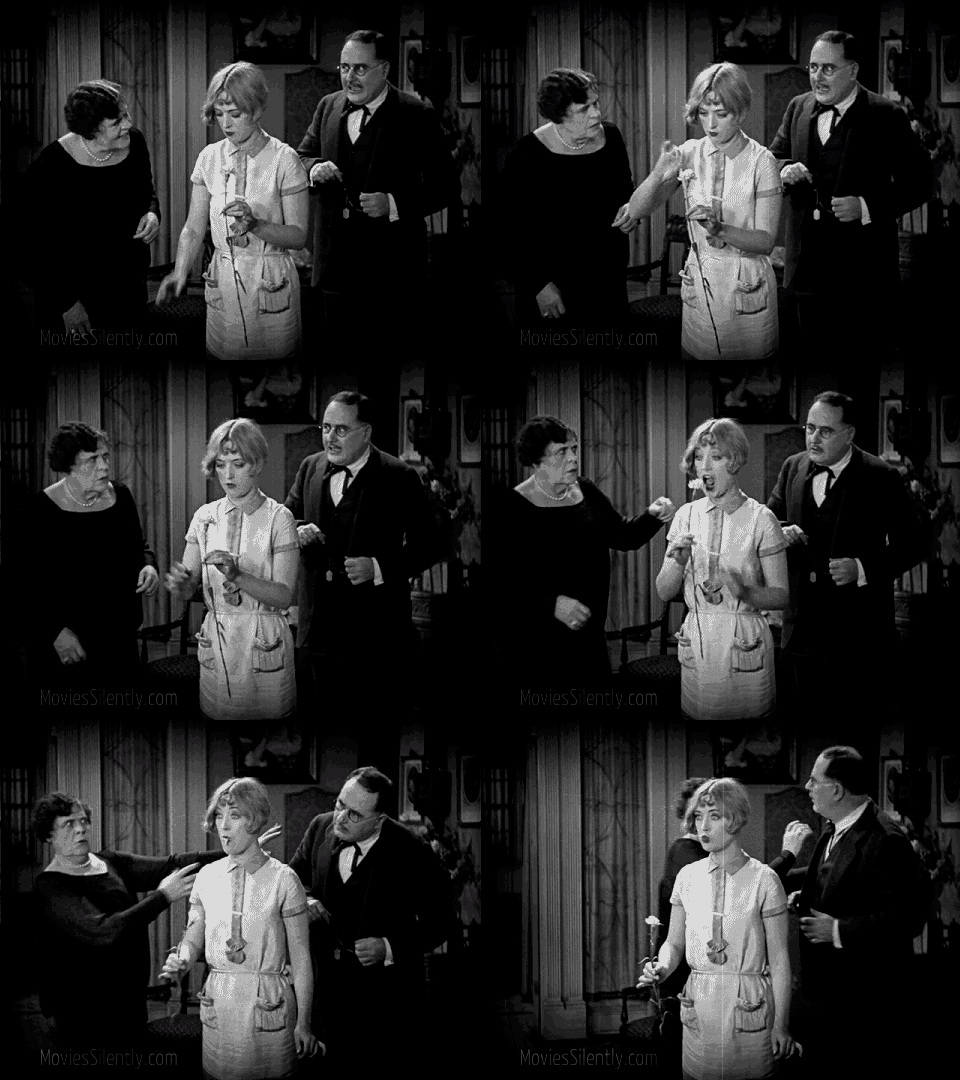
i was thinking about this again, and when you know what to look for, it’s really obvious: old movies are stageacting, not movie acting. it just didn’t really occur to anyone to make the camera bend to the actors, rather than the other way around. just image search old movie screenshots and clips and gifs, you’ll see it. the way people march up to their mark and stand there, the way they deliver their lines rather than inhabiting the character. the way they’re framed in an unmoving center-stage.
this is a charming little tableau, quirky and unexpected, but it’s a tableau. it lives in a box.
now, i usually watch action movies, and i didn’t think it was fair to compare an action movie with what appears to be an indoor sort of story, but i do watch some comedy tv. so i looked for a brooklyn 99 gif with a similar framing, intending to point out that the camera moves, and the characters aren’t stuck inside the box. but i couldn’t even find the framing. they literally never have all the characters in the same plane, facing the camera, interacting only within the staging area. even when they’re not traveling, they’re moving around, and they treat things outside the ‘stage’ as real and interact with them, even if it’s only to stare in delighted horror.
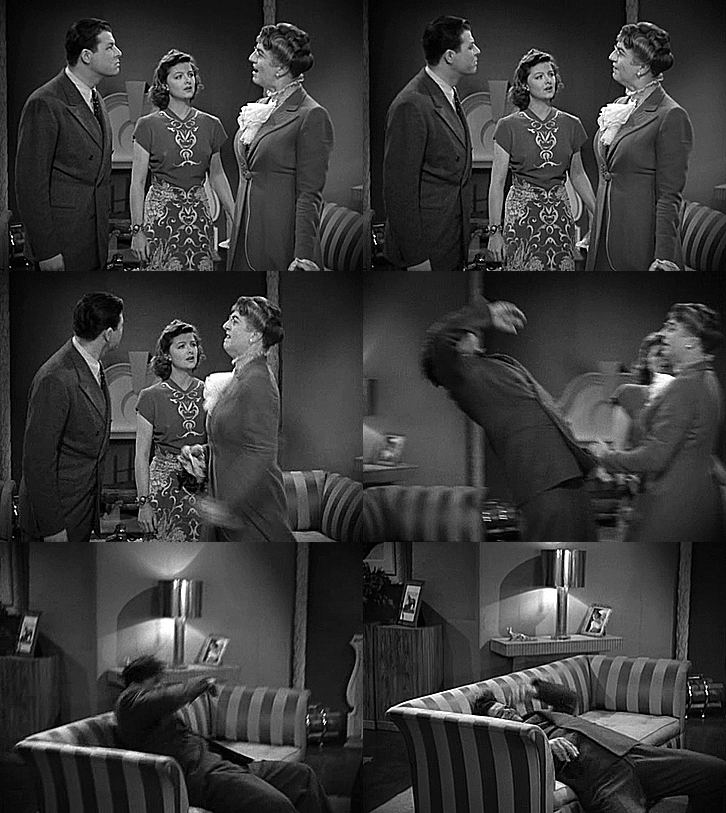
as for action, it took a while for the movies to figure out what, exactly they wanted to show us, and how to act it. here’s a comedy punch:
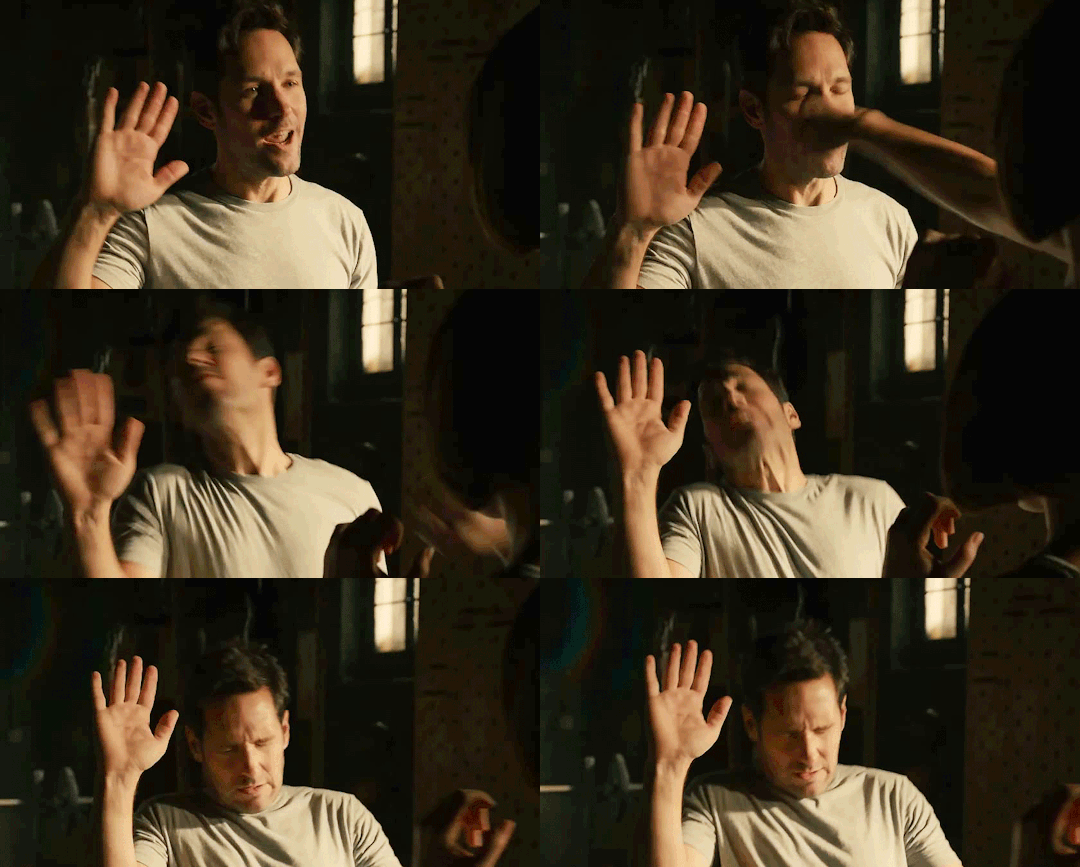
here, also, is a comedy punch:
the first one looks like a stage direction written on a script. the second one looks like your friends horsing around and being jerks to each other. the first one is just not believable. the physics doesn’t work. the reaction is fakey. everyone’s stiff. even the movement of the camera is kind of wooden. the second one looks real right down to the cringe of his shoulder, and the camera feels startled too.
i’m not saying this to dis old movies, i’m just fascinated and impressed by how much the art has advanced!
I’m going to bed, but I also want to say that I think, without actually bothering to explore it and make sure, that there’s been a similar shift in comics, probably related to the shift in acting/camera work. And I think you still see remnants of old “stage acting” comics in the three-panel style set ups (you might still see it in long form comics, but you’d probably call it bad composition)
Seriously, I used to work in a sound studio, and one series of projects required us to listen to LOTS of old audio recordings. Not of anything special – just people talking.
AND THEY TALKED LIKE THAT.
It was so fucking wild to hear just a couple of people being like,
“WELL HI THERE JEANINE, HOW ARE YOU TODAY?”
“OH, NOT TOO BAD, JOE, THOUGH MY HUSBAND’S BEEN AWAY ON BUSINESS FOR A FEW WEEKS AND I MISS HIM SOMETHING TERRIBLE.”
“WELL IT’S A HARD THING, JEANINE, BUT YOU’LL GET THROUGH IT.”
“WELL I SUPPOSE I’VE GOT TO, HAVEN’T I JOE?”
All in that piercing, strident, rapid-fire style we associate with the films of the era. If you’ve watched lots of old movies you can imagine the above in that speech pattern.
I don’t know if people talked like that because it was in movies but I suspect it’s the other way around.
Same goes for the UK – When they made the TV series The Hour, set in the 1950s, they had to tell the very well spoken, privately educated Dominic West to tone down his imitation of a 1950s newsreader because being accurate would have sounded to a 2011 TV audience as if he was doing a parody. When you watch Brief Encounter they’re not speaking like that because they can’t act, they’re speaking like that because it was the norm on screen. It now sounds unnatural because it’s not the norm any more.
Obviously there were people with regional accents and who didn’t speak in a heightened manner, but they didn’t get to be on TV or in movies unless they were villains. (And usually the villains were putting it on, like Richard Attenborough in Brighton Rock. Sure, he was Richard Attenborough, but he was brought up in the Midlands, and by the on-screen standards of the time, that was common.)
Even the Queen’s very posh accent has changed over the last 50 years and become “more common” – check out newsreel footage etc for proof – and recordings of her father are almost like someone from a foreign country (well, it is the past).
There is, for many film historians/critics, an actual turning point from mannered, theatrical, or “overplayed” acting on screen to naturalistic/American Method realism on screen. It happens in the 1954 movie On the Waterfront, during a traveling shot in which Marlon Brando’s character and Eva Marie Saint’s character are walking together. Eva Marie Saint accidentally drops her glove in the middle of the scene. Marlon Brando instinctively picks it up as his character, and continues the dialog, all the while playing with the glove–turning it about, trying it on, etc. Eva Marie Saint stuck with him, never broke, and the director didn’t call “cut.”
Before that scene in that movie, if an actor dropped a prop by accident, they would have re-shot the scene–because Brando mostly disappeared out of frame as he bent down to pick up the glove, and (as is explained above) movies were framed to keep the people in the scene in the frame. I
t’s a pretty famous scene in movies because Brando’s character doesn’t give the glove back, but instead uses it to amplify what the two characters are experiencing, naturally and without artifice. It is, for all intents and purposes, the exact moment that screen acting changed.
Okay, but here’s the thing about television specifically: given the size of TV screens when they first came out? Stage acting was the only thing that could be READ. Watch Star Trek: TOS on a modern screen and it looks absurdly overacted. Film of the same era is not, and yet the TV is.
And that’s not a fault of the actors; they were all very capable of naturalistic film acting (yes, even Shatner) – as the later movies would bear out. It’s because they were acting for the small screen, not the big one.
Stage acting and stage makeup is what it is because people are far enough away from the stage that you have to cake on the makeup garishly and exaggerate the hell out of your for it to be VISIBLE. And in early television? Yeah, those constraints actually very much applied. You could move the camera, sure, but the quantity of visual information you could send was just damned limited.
Watch some Classic Dr Who. You may or may not notice it without watching for it, but every shot of the TARDIS is taken from the same angle.
The TARDIS was, at that time, a stage set. The camera was behind the fourth (Sixth?) wall. It was fixed. And most TV sets were built like this. They had a specific fourth wall and everything was filmed from that angle.
Fast forward to the new series, and you’ll see that the TARDIS is being filmed from different angles all the time, including following the actor around.
Three things have changed:
1. Cameras have become much smaller.
2. Set building for TV has developed as an art. Those early sets were built by people who were trained to build stage sets.
3. Overall technological improvement resulting in things being cheaper.
The TARDIS set that was just retired? Each of its walls was designed to slide out. So you could put the camera anywhere you wanted. Presumably this is the case with the new one too. They couldn’t imagine doing that back in the day. Nor could they afford the complexities of a set like that.
It’s actually my opinion that TV has very much matured as an art form…this century. This decade. We are doing and seeing things that couldn’t be done ten years ago, twenty. Heck, even five.
Going back to speech patterns for a moment – I was a young child in the 80s, so my memories of the norms of the time period are limited (especially because I was incredibly sheltered), but the books I read at the time and the popular movies of the time all have this kind of – whimsical, sardonic speech pattern going on. Think John Waters dialogue.
I always thought it was kind of stylized. But then I ended up in a weird part of YouTube one night and found someone’s home video of just walking aroud a 7-11 convenience store at midnight talking to people in Orlando, Florida. Just trying out their new camcorder for shits and giggles, talking to other customers, talking to the cashier, etc. And you know what? They all talked like a goddamn John Waters movie. It was the weirdest thing, like I was watching outtakes from The Breakfast Club or Say Anything. I expected one of the Cusacks to walk into frame any second.
Anyway, so I think it’s super cool how human speech and interaction shifts over time, and if you’re living through the shift, you don’t really notice it as it happens.
The cameras they were using back in the 1940s-1970s were enormous and heavy. Moving them was a chore, and you had to have track built to move a camera that big. Getting the camera in close to the subject was very difficult.
It was the arrival of the Steadicam in the 1970s that started to change everything. You could hook the camera to an individual person using a harness. For the first time the camera was liberated. Think of the walk & talks on “The West Wing” – that would not have been technologically possible in earlier film and television.
Also filming through the 1950s was mostly done on sets. A few directors like John Ford would go shoot on location for parts of their movies, but most films were made on sets because it was cheaper and easier. When the studio system began to break down in the 1960s, and cameras started becoming lighter, you saw a shift to location shooting, which reduced the proscenium staging of older movies.
Tags:
#not sure how to fact-check this #history #interesting #long post
when u go to the Very Small Shelf in the library that has info on ur Very Specific Niche Research Topic Of The Day and u go to pick out a book and they stick together bc they’ve been pressed into other books without moving for so long and some of the books are typed in weird typewriter font with huge spacing instead of regular shit and they have old analog library cards that were only punched one (1) time in 1983 like thats when u kno ur In Deep and u gotta like prepare urself….. u could find anything in that shit once u pass like the first bookshelf like its completely free game anything could happen bc u KNO that shit hasn’t been even glanced at in 200 years….open up the 1904 volume of Modern Dick Aerodynamics to the 4832954th page u gonna find a letter in morse code like “i leavith with mine cow for the countryside at dawn”
i know u were prob talking about said specific medieval historians but in the context of science and academia as a whole ‘love to the ghosts who taught me everything i know’ is one of the most emotionally charged things ive ever heard and it resonates so fiercely with the old untouched environments of university libraries suddenly disturbed by young curious souls that i described in the original post tbh thank you i want to get it tattooed on my body
Tags:
#history #and I feel like this also qualifies for #the wondrous variety of sapient life
#I was just thinking about this bit recently! #I get that we’re supposed to think it’s hilariously wrong #but look at it this way: #she’s talking about things from *five billion* years ago #and she is *less than a century* off #I *dare* you to talk about stuff that happened during the formation of the fucking Earth to within a century’s accuracy #and they still have! recordings! of Tainted Love!! in five billion years!!! #honestly these guys’ historians are not 100% perfect but they’re doing extremely fucking well keep up the good work #(actually hang on) #(in the 2017 Christmas special) #(which is partly set not long after this) #(New Earth invents time travel and uses it to go around spacetime uploading everyone who has ever lived right before their deaths) #(year-5-billion historians are the *best* historians fight me) #((please do not actually fight me)) #tag rambles #Doctor Who #look I have feelings about year-5-billion historians okay #they are not the feelings the show was expecting me to have but I have them
man this has been said before by cleverer folks than me, but sometimes you have to sit down and let the sheer size and age of the storytelling tradition just completely overwhelm you, ja feel?
like— think for a second about how mind-bogglingly incredible it is that we know who osiris is? that somebody just made him up one day, and told stories about him to their kids, and literally thousands and thousands of years later we are still able to go “there was a god whose brother cut him into pieces”, it’s so arbitrary, it’s so incredible
that in talking about scheherazade and her husband, you are doing something that someone in every single generation has done since it was written— you are telling stories that have lasted an impossible amount of time
can you conceive of telling a story, and then traveling into the future and hearing that same story told— with alterations, and through media that you could not possibly conceive of, but your story— in the year 3214?
the fact that we! as a species! have been telling the same damn stories for so long— the fact that we’ve seen homer’s troy and chaucer’s troy and shakespeare’s troy and troy with fucking brad pitt because we never fucking stop telling stories! never ever ever!
we never stop caring about stories, or returning to the same stories, or putting our own spins on stories. we never stop talking about the characters as if they were real, or asking what happened next, or asking to hear it again.
generation after generation, they never ever ever stop mattering to us.
Tags:
#history #my past self has good taste #yes this #I feel like also relevant is the post I reblogged a while back #in which somebody makes a joke that relies on knowing who Ea-nasir is #(for anyone who doesn’t already know: he was a merchant ~3750 years ago) #(the earliest surviving complaint letter we know of is complaining about his substandard copper) #(and now you too know who he is and can understand the abovementioned joke)