Let’s pretend, for a moment, that you are a 22-year-old college student in Kampala, Uganda. You’re sitting in class and discreetly scrolling through Facebook on your phone. You see that there has been another mass shooting in America, this time in a place called San Bernardino. You’ve never heard of it. You’ve never been to America. But you’ve certainly heard a lot about gun violence in the U.S. It seems like a new mass shooting happens every week.
You wonder if you could go there and get stricter gun legislation passed. You’d be a hero to the American people, a problem-solver, a lifesaver. How hard could it be? Maybe there’s a fellowship for high-minded people like you to go to America after college and train as social entrepreneurs. You could start the nonprofit organization that ends mass shootings, maybe even win a humanitarian award by the time you are 30.
Sound hopelessly naïve? Maybe even a little deluded? It is. And yet, it’s not much different from how too many Americans think about social change in the “Global South.”
If you asked a 22-year-old American about gun control in this country, she would probably tell you that it’s a lot more complicated than taking some workshops on social entrepreneurship and starting a non-profit. She might tell her counterpart from Kampala about the intractable nature of our legislative branch, the long history of gun culture in this country and its passionate defenders, the complexity of mental illness and its treatment. She would perhaps mention the added complication of agitating for change as an outsider.
But if you ask that same 22-year-old American about some of the most pressing problems in a place like Uganda — rural hunger or girl’s secondary education or homophobia — she might see them as solvable. Maybe even easily solvable.
I’ve begun to think about this trend as the reductive seduction of other people’s problems. It’s not malicious. In many ways, it’s psychologically defensible; we don’t know what we don’t know.
If you’re young, privileged, and interested in creating a life of meaning, of course you’d be attracted to solving problems that seem urgent and readily solvable. Of course you’d want to apply for prestigious fellowships that mark you as an ambitious altruist among your peers. Of course you’d want to fly on planes to exotic locations with, importantly, exotic problems.
There is a whole “industry” set up to nurture these desires and delusions — most notably, the 1.5 million nonprofit organizations registered in the U.S., many of them focused on helping people abroad. In other words, the young American ego doesn’t appear in a vacuum. Its hubris is encouraged through job and internship opportunities, conferences galore, and cultural propaganda — encompassed so fully in the patronizing, dangerously simple phrase “save the world.”

“The Reductive Seduction of Other People’s Problems” by Courtney Martin


(via dietcokebisexual)

Capitalism can’t save the world, but it can simulate the experience and sell it to you.

(via newwavenova)

this is making me go “have you heard the good news about effective altruism?”

(via ozymandias271)

I have a terrible feeling about this.

*waits, with sense of impending doom, for the parts of my dash reblogging this quote to agree with it and the parts reblogging it to oppose it to find each other*


Tags:

#…and I may have just sped up the process or even made it more likely by posting this #at least there’s the possibility it will be a productive argument? #*sighs* #*curls into ball* #effective altruism


Splain it to Me

{{Title link: https://status451.com/2016/01/06/splain-it-to-me/ }}

theunitofcaring:

fierceawakening:

taymonbeal:

Wow. This is a truly excellent work of Rationalist Social Justice. Status 451 may have just redeemed itself in my eyes.

(Also, I had no idea just how deeply I’d internalized the “nerd model” of communication. Not even just with other people; my internal monologue consists largely of me Taymonsplaining things to myself. Including while reading this article.)

This makes a ton of sense to me. The whole concept that “privileged people” are not supposed to correct “marginalized people” makes me instinctively feel like people are trying to avoid intellectual discussion and trying to evade defending their perspective or ideas. Which bothers me in part because I don’t want to be taken less seriously BECAUSE I’m marginalized – I’m concerned I’ll be dismissed as a politikid if I talk about it at all.

Where to them it might be more like “we don’t have the advantage of a whole long field of study with far-reaching traditions, but that doesn’t make my perspective invalid. Please take seriously the idea that a different way of thinking about that might make sense.”

The opening section about New York listening is a great explanation of competing access needs. 

And, yeah, I feel like different communication norms is a part of what’s going on in peoples’ reactions to learning ‘don’t correct marginalized people’.  To people like me who feel infinitely more comfortable with the information model of communication, “don’t correct marginalized people” almost comes across as “exclude marginalized people: cut them off from the flow of ideas and corrections and debates and redefinitions”. When a conversation is almost entirely about corrections and counter-corrections and reframings, “don’t argue with people” means “don’t take their ideas seriously”. 

Just like if you told the New Yorker “don’t interrupt me while talking”, they might think you mean “don’t behave in a way distinguishable from a flowerpot” and decide you don’t actually care about them as a listener. 

For people coming from a different communicative context, though, “don’t correct marginalized people” means “when people correct me, it’s almost always to assert the worthlessness of my ideas, not to engage with them. I don’t expect, when I’m corrected, that we’ve embarked on a back-and-forth of refining ideas; I expect that you’re corralling excuses to dismiss me. I can’t override this expectation (and it’s usually warranted, anyway) so if you want to actually hear my ideas communicated and fully realized, don’t offer your objections and disagreements and thought experiments. Doing that doesn’t include me, even if it is how you always communicate.”

…huh. I’m having a lot of trouble trying to map this article’s descriptions to my own life, because to me, the defining experience of navigating social-justice culture is constantly perceiving status games that nobody else would admit to seeing and that may not even have existed. (Seeing everything in terms of hierarchies and commands is what They do, after all. We are better than that. (Not that anyone would phrase it in quite that way, of course.)) I have had conversations that I perceived as an exchange of carefully veiled insults and insinuations that the other person should be outcast, and that I suspect (but am not certain) the other person perceived as friendly conversation about, say, the downsides of cleverness-based power fantasies. I have had so many conversations that I suspect the other person perceived as commiserating and that I perceived as them presenting their credentials and demanding to inspect mine.

I feel better around rationalists not because they lack hierarchical thinking but precisely because they acknowledge it. In general, they tend to recognise when things they say might be interpreted as orders and are careful to make it clear when things are not orders. And if it’s not clear, *it is permitted to ask for clarification on whether something was an order*. I use such extreme emphasis because it’s very, very important. Thinking in terms of “mandatory” and “permitted” and “forbidden” (rather than “right” and “okay” and “wrong”) isn’t itself forbidden here! I actually feel reasonably confident that you won’t jump all over me for writing this post! (Slightly less confident than I was before you reblogged this, but still enough that I’m willing to post it.) I don’t know whether you understand how huge a relief that is.


Tags:

#not only am I reasonably confident people from the rationalist-sphere won’t jump on me for writing this #I am even cautiously optimistic some of them might stand up for me if somebody *else* jumps on me #which in the end is the deciding factor in pressing ‘reblog’ rather than ‘close’ #reply via reblog #my issues with sj let me show you them #(the following category tag was added retroactively:) #our roads may be golden or broken or lost

lethriloth:

sinesalvatorem:

madeofpatterns:

madeofpatterns:

The A stands for ally *because the LGBTQA community decided it did* decades ago. 

It’s not something straight people wanting to be cool are asserting for themselves. It’s something the community decided. A long time ago. For important reasons. 

Like, when I was in high school, this is what we meant when we used the A to mean allies:

  • the straight couple who regularly took in kids who’d been kicked out of their families for being gay or trans
  • the straight adults who were brave enough to give rides to scared gay kids with violently homophobic parents
  • etc, etc

The A was also there meaning allies to protect people who were LGBTQ but weren’t out:

  • people who were probably gay or trans, but needed space to think about it, and needed to be in LGBTQA space without pressure to self-identity while they were figuring it out
  • people who couldn’t afford be be out, and needed to be able to say “I’m an ally; you don’t have to be gay to go to GSA; I’m just there to support my friends”

I think all the reasons it was important when I was a teenager are still important now.

And like, yeah, having a concept of allies means tolerating a certain amount of obnoxiousness from straight people who want to feel cool. But I think that’s a lot better than only being welcoming of people who are willing to shout from the rooftops how queer they are. Because that excludes some of the most vulnerable people.

(Like – if we want to talk about the problem of queer youth homelessness – it’s important to acknowledge that one thing that protects vulnerable queer kids is having access to spaces that are affirming of their gender and attraction, *and* rigorously careful to avoid outing people. Because people who have access to enough community to sustain them have a much, much better chance of being able to stay alive and stay closeted until they’ve managed to safely move away from dangerous parents.)

My country is super homophobic and this matters a lot. Last year I volunteered as part of an organisation dedicated to combating homophobia. All the members officially described themselves as allies. Yet, this is the first conversation I had when attempting to join them:

Me: *fills out application form while leaving the ‘gender’ section blank*

Secretary: So, are you transgender?

Me: …Yes. But, like, I’m not committing that to writing, or anything.

Secretary: Of course. Totally fine. I’m bisexual. Everyone else here is queer some way or another. I don’t think a straight person has ever joined.

Me: So, the reason you all list yourselves as allies is because…

Secretary: Because homosexuality is illegal.

Me: Thought so.

I am torn on this issue: on the one hand, it’s very important to be welcoming to allies, and not just because often ally==closeted, but for strategic reasons as well. On the other hand, the LGBTetc. acronym does not seem the place for that?    LGBTetc. groups should pretty much be always open to allies in my opinion, but… I don’t think there are many closeted folks going around saying “I’m LGBTQA! I’m the ‘A’, it’s for ‘Allies’!”

Of course, I might also just be bitter because I (an ace-ish-kinda person) don’t ever see “A is for Allies AND Asexuals”, only ever “A is for Allies”. And I saw “A is for allies!” at around the same time I saw a lot of “Asexuals are not a part of the LGBTQ community”.


Tags:

#oh good somebody else wrote about the ace thing #it was bugging me but I couldn’t quite figure out how to put it #asexuality

I Am Depressed And Need To Argue About Something

sinesalvatorem:

thatismyright:

sinesalvatorem:

I am feeling low-key suicidal (In the sense of “I would like to die” rather than “I expect to kill myself”. I have high self-control.) and need to distract myself from how awful being alive is. The best distraction that was recommended to me was passionately arguing about something.

As such, I am appealing to Tumblr to send me asks, or reblog this post, with questions about controversial subjects, unpopular opinions, blatant edge-lordery, links to terrible (but reasonably short) Tumblr posts, or anything else that could put me in a fiery state of “someone is Wrong on the Internet”.

I may not be able to reply to All The Things, because bad brains, and my responses may be poor-quality or not endorsed by sane!Alison, but I will feel better while writing what I can.

If you can’t think of anything (you don’t need to reply with anything good, but if you still can’t) but would like to help, reblogging this post at all increases the likelihood that someone will want to edge-lord in my direction.

(Oh, and sending my complimentary asks (even without anything to argue about) helps a lot.)

Claims that public (non-nude) kink is unethical or immoral are stupid purity instincts and have no connection to real consequences. I don’t care if you think that “you’re part of my scene and don’t consent to it”; that’s a fact about your state of mind, not about a state of reality, and my and my sub’s right to do what we want trumps your desire not to be uncomfortable.

…I think I agree with this, actually? IDK if it’s just the fact that I lack purity instincts and can’t properly understand the people who have them, but this seems really reasonable to me and always has.

If something seemed perfectly OK (if quaint) to you when you didn’t know the motivation for it was sexual, it does not become bad upon you learning that it is, in fact, sexual. The goodness or badness of an action is separate from it’s intentions and motivation. It’s about consequences. If wearing a collar as a fashion statement is OK (because it harms no one), then doing so because it turns you on is no better or worse.

Why do people oppose this, anyway? Followers with purity instincts? Followers who agree regardless of squick reactions? Followers who disagree but know how to steelman it? What exactly is going on here?

This is going to sound weird, please bear with me, but the main reason I value my discomfort around public sexual acts (for broad definitions of such) is precisely because I don’t have an explanation behind it.

Okay, look. I often worry that I don’t have any moral sense of my own, that I only do what I do and think what I think because I have been told to do and think these things. I mean, how could I tell whether a belief in something’s wrongness is really mine or just someone else’s? I can trace nearly everything back to people telling me what to think; maybe I would have thought that way anyway, maybe I wouldn’t. Who can say?

Note that word. Nearly everything.

Because then I look back, and I see a girl, perhaps nine or ten years old. Her Girl Scout meeting has just ended, and the kids are passing the time while they wait for their parents to come pick them up. One of the others pulls a yo-yo out of her bag and swings it in front of another kid’s face. She intones “You are getting veeery sleeepyyy…”

Our protagonist yells at them. “Don’t do that! It’s wrong!”

Kid 3 (the one watching the yo-yo): “Why?”

Kid 2 (the one holding it): “It’s not like I’m really hypnotizing her. It’s just a game.”

She can’t explain why it’s wrong. She doesn’t know. There’s just something in her, bone-deep, visceral, screaming protest at this situation. Can’t they hear the alarm bells going off in their heads?

(Maybe they can’t. The other children’s thought processes are often alien. Perhaps this is just another instance.)

Nobody told that girl to believe that it was wrong. Nobody had even given her enough information to extrapolate that it was wrong. (It will be several more years before she learns about hypnosis fetishism, before she learns that the word she was looking for here was “indecent”.) But she thought it was wrong anyway.

That girl is still part of me. She was clearly not entirely lacking in innate moral sense, and by extension neither am I.

Now, I’m not saying that we as a society should all abide by my moral sense. I mean, if nothing else I can’t think of a way of making it practical. It’s all very well for me to avoid doing erotic things in public and avoid spectating when other people do unintentionally erotic things in public (and I do try to), but what about…if I understood correctly, you yourself recently said you tend to pick up any kink you learn about. How are people like that supposed to get by in the world? The set of things they’re allowed to do would be ever more limited.

So, I agree to let people do public sexual acts, but I do it grudgingly. I don’t really want to be okay with it. Not being okay with it is something I can point to as unambiguously myself, and I do not have enough of those to spare.

P.S. I’m curious, on what grounds do you carve out an exception for nudity-involving things in the “public kink is okay” view? What makes nudity less okay than anything else?


Tags:

#probability that the reason I value the capacity for independent opinions in the first place is because I was told to: high #irony levels: staggering #reply via reblog #sexuality and lack thereof #occasionally I come across people casually stating that children don’t have a sense of privacy about sex until taught to #*bullshit* #(well) #(bullshit as a rule for *everyone*) #(I have noticed that whenever I hear other stories) #(of young children who don’t know they’re kinky and unknowingly erotic games) #(the storyteller’s younger self is always the one *instigating* the games) #(not the one freaking out at them)


{{next post in sequence}}

New law makes Canadian Jews second-class citizens | Toronto Star

ilzolende:

nuclearspaceheater:

ayellowbirds:

quasi-normalcy:

So here’s a terrifying implication of Canada’s new citizenship law that I’ve not heard anyone mention before.

I expected this when I heard about the standards of the new law :

Can a Jew formally renounce their Right of Return in a way that Israel would consider binding?

IDK, maybe Israel would be willing to accept some conditional renunciation of the right? Probably not, though.

This seems like a mess.

to hell with Judaism I’m American

I thought I was safe the day I took the oath

“Welcome home,” they said

(we’ll see what “they will consider expanding“ means)


Tags:

#the people in this riding are ever so polite #they are kind and they do not insult you to your face #they may even believe on some level that they like me #but they’re going to elect *him* again #oh I’ll do my part to fight it #I’ll cast the vote he didn’t think I should have #and it’s not going to work #I see those blue signs all over town and I think of every proudly xenophobic message he’s had placed in our mailbox over the years #one time he talked about asylum seekers from the European Union #he said it was suspicious #as if anyone from such an advanced place could *possibly* need asylum #(I don’t think he used ‘advanced’ but that was basically the implication) #he said this a couple weeks after I saw news about a mob in Hungary trying to lynch a Romany family #to this day it is what I think of when I think of him #our home and cherished land #(it says it in every post I make about Canada) #(the elephant in the room) #(the unspoken word) #(*native*) #tag rambles

Light It Up Blue is an annual reminder that Autism Speaks can’t make us go away

realsocialskills:

Today is Autism Acceptance Day, and April is Autism Acceptance month. It’s also an annual reminder that we are strong, we are still here, and that attempts to eliminate us are failing. When they light it up blue, they’re admitting that they’re weak and they’re failing.

Autism Speaks and others who wish that autistic people didn’t exist think that it’s Autism Awareness Day. They’re calling us a public health crisis, and they’re trying to get others to agree with them and give them money. They want to get rid of us. They try to pretend they have any chance of succeeding.

I realized today that April 2nd is actually an annual reminder that, no matter how hard they try, they can’t actually get rid of us. When Autism Speaks supporters are turning on blue lights, what they’re really saying is that they have just spent another year wasting a lot of money in a completely futile attempt to get rid of us. They are acknowledging with those blue lights that we are still here, and that we’re not going anywhere.

We are more powerful than they want us to believe. We have persisted in existing despite their pervasive attempt to eliminate us. We are succeeding in spreading love and supporting one another in power and pride.

We are speaking up. We are being heard. People who care about autism, autistic people, education, and communication are listening. The tide is turning.

Their hate symbols are a sign that, even though we have far less money and far fewer resources, we are more powerful than their ineffectual attempts to make us go away. We are right, and we are strong, and we will be here long after Autism Speaks is gone. We ought to keep that in mind when we see the pathetic hate symbols they’re displaying today.


Tags:

#Autism Acceptance Day #the wondrous variety of sapient life

shooter5503:


dhalim:

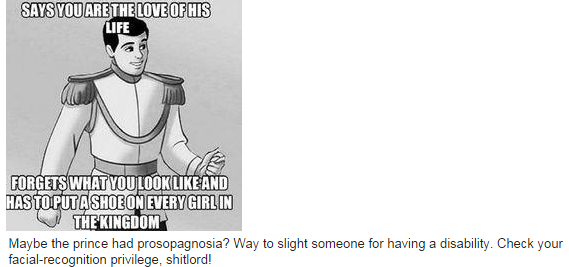
I’m sorry, but I really struggle with accepting the phrase ‘check your privilege’, especially in this case. Knowledge that prosopagnosia is relatively common is less than a decade old, and is still being realised even to those who are studying it- statistics are still being estimated, and they can’t seem to quite agree. Barely anyone knows about it even now, and if they have heard about it, I guarantee they really don’t understand it.

Prosopagnosia is hard enough to diagnose and understand for people who have it, let alone for someone else who doesn’t. For a neuro-typical to recognise it in other people or understand how it affects someone who does have it, this just isn’t really something I expect at this point.

Facial recognition is not a privilege, and it doesn’t allow you certain ‘rights’; it is an ability that some people lack. Perhaps I can’t speak for everyone, but I do not find the Prince Charming meme offensive in the slightest, because it’s so true! To me, it’s downright funny and does not deserve the commentary seen above.

The phrase “facial-recognition privilege” reeks of troll to me. It’s a standard anti-SJW tactic: manufacture evidence that they can later point to as proof that we are ridiculous people who deserve their mockery. (“Check your privilege” is one of the go-to phrases in such manufacturing.) I mostly hear of this technique being used on otherkin, but it wouldn’t surprise me if they’ve decided to branch out.


Tags:

#prosopagnosia #reply via reblog #trolling #(of course we *would* get our first troll in the tag right after I point a newbie to it wouldn’t we)

What We Talk About When We Talk About YA

thatlauraruby:

Hello!  My name is Kerri Miller Christopher Beha AO Scott Ruth Graham Nathaniel Hawthorne Socrates Bob and I’m here to tell you that we’re all going to hell.  HELL. Why, you ask?  Well, let me expound upon it in a million-word screed that I will make as condescending as possible: because you’re reading and watching things I think are stupid.

Did you know your behavior signifies a decline in greater civilization?  You should. No, it doesn’t matter that I’ve never read the stupid things you’re reading.  I am the last adult in America. 

I see you and your secret, childish acronyms. YA? MG? TFIOS? I had look up this stuff on the World Wide Web and I’m still confused. I’m a person of a certain age and I’ve been left out of the cultural conversation.  My feelings about this should mean more than they actually do. 

I know this will upset people, but I don’t understand why anyone over the age of six is reading books for children.  When I was in kindergarten, my favorite book was OLD MAN AND THE SEA. Old men are grown-ups, and that’s what I wanted to be: an old man wrestling with a fish. Also, reading it was horrible, and no one who is a grown-up ever reads for pleasure, because reading for pleasure is stupid. Just ask all those guys reading Dean Koontz and Lee Child. They’re in it for the metaphors.

Fellow grown-ups, at the risk of sounding snobbish and joyless and old, well, look, I am all those things but you should hear me out anyway, because I have opinions. LISTEN. It’s time to center the cultural conversation back where it belongs: on me. All YA is silly, sentimental and simple and I know this because mostly ladies write it and no one should make that much money from books about a vampire. 

All of you are YouTubing right now, aren’t you?  You’re totally YouTubing.  Stop that.   

This is what I’m trying to say: I’m concerned for you. I say these things out of love, not a love for clicks.  I am sad that you are reading YA fiction when you could be reading fiction for adults, because it’s never occurred to me that you can read both.  Actually, I think there’s a law.

Except for the times I am binge-watching Mad Men and waxing nostalgic for a time that never was and a patriarchy that never died, I only read very smart, literary fiction that is complex and important, the kind of smart fiction that YA can never be, because I said so.  Reading this important kind of grown-up fiction cleans out your colon. It puts hair on your chest. It’s like trying to open a locked door using only your head.  It’s supposed to hurt.  It breaks your teeth, knocks you unconscious and leaves cuts and bruises on your face and your body broken, like Hemingway fresh from the war. Don’t you want to be like Hemingway fresh from the war?  Of course you do, because he was an old white man, on the sea, with a fish. These can be your battle scars, too. Wear them proudly. You are a grown-up.


Tags:

#anything that makes me laugh this much deserves a reblog #get off my lawn #(…I am actually not sure what MG is supposed to mean in this context?) #(sometimes lists of acrynyms have a made-up one at the *end*) #(but this is in the middle)