etirabys:

This Siderea post is good and talks about a phenomenon I’ve never really noticed before: https://siderea.dreamwidth.org/1519134.html

I have literally not seen a single thing on the topic which discusses the phenomenon of people being forced to live in less space as a consequence of outrageous rents. But that’s a thing that’s happening too. …

But you only get to save money on beer by brewing it for yourself, if you have someplace to put it while it’s fermenting. … Of course, it’s not just brewing your own beer, any more than this is just about owning books. There are a lot of ways, it turns out, people can economize on their other expenses, if their living space has the room. …

This is a hidden form of Vimes’ Boots Theory. If you make enough money to rent more space, you can then use that space to save you money on other things. Poor people don’t just pay more for boots because they are left buying many cheap pairs that wear out quickly because they can’t get together the money for a good pair that last; poor people pay more per square of toilet paper if they can’t enjoy the bulk discount because they can’t afford the room for the big discount package of toilet paper.

Owning things is becoming increasingly a privilege of economic class. We’re used to thinking of buying things being, obviously, a privilege of economic class. Economic class means how much money you have with which to buy things, so it’s unsurprising that buying things is something people with higher economic class get to do more of. But owning things – even things that were given to you as gifts, that you made yourself, that you found, that, crucially, cost you no money to acquire, and which you never bought – is also an economic privilege, and, I am contending, becoming ever more and more so.

I’m rich but live in a small space (I’m paying ~$600/mo for rent in a big city) and, yeah, I don’t buy many things that would improve my life (including experimental health equipment that’s remotely bulky), not because I can’t afford it moneywise, but because I can’t own it spacewise.

Anyway, the post branches out some more, e.g hobbies you can’t do because you don’t have the room for it. I should chew on it some more but wouldn’t be surprised if weeks of percolation later I found I’d somewhat changed my mind on some housing issue downstream of thinking about this.

I used to see people voluntarily living in RVs and “tiny houses” and think “Well, you do you, seems like a valid preference to have, and I might very well acquire the taste myself someday”.

Now…it’s still “well, you do you”, but it’s more the kind of “you do you” response one has towards people who do recreational mountain-climbing. Like, yes you have that right, and I’m not going to try to stop you, but why are you putting yourself in danger when instead you could…*not* do that?

I no longer think I will later acquire the taste for small-space living: I am increasingly firmly of the opinion “a dwelling that can’t fit a three-month supply of food is unfit to be called a home”.

[relevant link]

In related news, having an in-home treadmill is fucking amazing. It’s *much* easier to go for a jog if you don’t have to trek out to a gym, or go outside where the bugs and pollen and darkness are and the first-aid kits aren’t (and are difficult to wear while jogging). And the limiting factor in who can own a treadmill is very much *housing* (both space and stability: if you’re moving all the time you *really* don’t want to have to lug a treadmill with you), not money: you can get used (often barely-used) treadmills on Craigslist very cheaply from people looking to dump them because they’re too much of a pain in the ass to take with you when moving house. (Some of them will then buy new(-to-them) treadmills in their new location from people about to move away from *there*, and the cycle will continue; others will give up.)

This house once (long before my time) crammed 12 inhabitants within its walls, could comfortably fit 5 – 6, and currently fits 4. I’ve lived here for nearly 13 years and plan to do so indefinitely (and since we rent from a bank (via interest-only HELOC payments) rather than a landlord, it is unlikely anyone with the authority will try to kick us out of a building my father legally owns†; plus, obtaining *financial* ownership of our house is as simple (not *easy*, but *simple*) as shoving a couple hundred grand into the HELOC account, with no further negotiations required and no possibility that the landlord will refuse to sell).

Space, people, time: all of these are privileges when it comes to housing, but they are all privileges of the form “everyone should get the chance to have these things, and it is bad that some people can’t”.

P.S. I wrote another response to “The Privilege of Property” a few months ago [link], focusing on her apparent belief that it’s more efficient to live alone than with housemates.

†and is planning to add me as legal co-owner, so that my income will help when refinancing


Tags:

#judging from a lot of the discourse I’ve seen over the years #it is dangerously easy to confuse privileges of this form with privileges of the form #”*nobody* should get the chance to have these things and it is bad that some people *do*” #reply via reblog #adventures in human capitalism #overly enthusiastic parenthetical use


jadagul:

youzicha:

xenosagaepisodeone:

it’s interesting how many op-eds were written about how children born in the late 90s-onward were digital natives that would go on to become extremely versatile in tech when the reality is that tech becoming more consumer oriented nipped the incentive for a lot of kids to explore beyond the services offered to them. not knowing how to torrent things is only the tip of the iceberg and tech illiteracy is only going to continue to climb as the cultural shift from computers to phones becomes more pronounced in coming years. I used to joke that people in the late aughts saw laptops as like, $700 facebook machines but the modern comparison is that people see laptops as $1200 subscription service for media they don’t own machines.

Or a bit earlier, in the 1970s and early 80s there was a lot of talk about how how computers would empower individuals in school and society, because everyone would learn how to program, so they could learn by experiment and have completely understanding and control of their tools.

For example this video where Alan Kay talks about letting school children play with Smalltalk and write their own programs: “my aim here was not just to get people be able to access things by means of the windows but also to be able to do the equivalent of writing short essays and having them have great effect.” A few minutes later he talks about why being able to read and modify programs is important: “we don’t think a person is literate if all they are able to do is read, we think they should also be able to write”.

Also did not really come true.

I sometimes feel like I grew up at nearly the optimal time for this. I was born in 1986, which is late enough that having access to computers growing up wasn’t a special or unusual thing; they were starting to be everywhere.

But it’s early enough that I still had to understand how they worked in order to use them. My fist computer was a Dos computer; I have very clear memories of navigating directory hierarchies at the command line to find my favorite computer games. There weren’t a lot of ease-of-use features yet, so a lot of basic things exposed the bare metal of everything going on. And stuff broke all the time and you needed to understand things well enough to fix it.

My sisters are much less computer-savvy in a lot of ways. This is partly just a difference of interests, but I’m pretty sure it’s also just that they had to deal with a lot less exposed metal when they started using them.

(not exactly responding to anyone in particular)

When reading through the notes on this post, I noticed that most of the responses talking about the tech-illiterate folks in their lives are talking about…parents, younger siblings, clients. People whose company they *didn’t actively seek out*.

If it were true that people born in the 80’s have better tech-literacy, as a group, than people born in the 00’s, how we would *tell*? How would we distinguish this from “most people in *every* generation are tech-illiterate, people tend to run in social circles with similar levels of computer competence to themselves, and this filter works less well in intergenerational contexts”?

(To be fair there *is* one comment that the student body at their school as of a decade ago was more tech-literate than the current student body, though it’s only one and also some of that could be rose-tinting.)

I was born in the early 90’s, and my tech-literacy doesn’t *feel* generational: it feels *cultural*.

My father isn’t great at handling noobs gently, but he did his best to teach me right. He taught me the power in flexibility: he encouraged me to buy a laptop with my Christmas money rather than a Game Boy Advance, so that I could play games *and* do a lot of other stuff (I later got a GBA for the more console-specific games, but I got the laptop first and he was right to consider it a higher priority), and to buy a Sansa rather than buy an iPod and be trapped in Apple’s walled garden. (And yes–statute of limitations–he then taught me how to torrent music to fill it with. This was back in 2007, when YouTube had very little music and youtube-dl was correspondingly not very useful for this.) He taught me to dual-boot so I could use Linux as much as possible and Windows only when needed (and I have needed it less and less often). He even managed to teach me a lesson he has never been able to teach Mom: to google my own problems instead of always running to him. I rarely need his help anymore.

(He’s still much better than I am at coding and command-line usage, but there are areas in which I have surpassed him. He taught me to avoid DRM primarily as a matter of principle, whereas I actually *use* my hard-won right to make backups. I shrugged off an abrupt laptop failure when I was fifteen: everything I cared about was also stored on the Sansa (and vice versa), and I simply repopulated my next laptop with files from there. A few years later *Dad* had a sudden failure, and he ended up having to go buy an adapter so he could plug his old hard drive into his new computer’s USB port and pull the data over that way. I shudder to think what would have happened if the hard drive *itself* had failed.)

When I grew up I hung out in social spheres where I was often among the *least* techy people there, and they kept it going: they taught me about tracker-blockers and encryption and password managers, about web scrapers and spreadsheets.

But I think if I hadn’t had my father around growing up, I’d have a much more shallow understanding of computers and a much greater willingness to stay within the bounds of what the megacorps deign to allow me.

I continue [link] to be horrified by people paying a thousand-plus dollars for a computer unless they have very ambitious plans for it. A streaming-and-maybe-occasionally-typing-in-Word-documents computer costs, like, one to two hundred. My general-purpose computer cost three hundred *after* international shipping and tariffs: an American resident would have paid 250.

(And you say it’s going *up* over time, instead of holding steady or dropping in non-inflation-adjusted dollars? For a *netbook*?!)

Please, folks, buy used business laptops: there are plenty of refurbisher stores on eBay. Depending on how old the laptops are and how high-end they were when they were new, you can get specs to suit a wide variety of needs; they’ve usually been upgraded to Windows 10 if they’re too old to have come with it originally; because companies often overestimate how many laptops they need to outfit their workforce, quite a few business laptops are “used” in only the most technical of senses (Dad, querying a newly-purchased laptop: “what is the cumulative amount of time you’ve spent turned on, throughout your entire life?” laptop: “about six hours”).

If you are not tech-literate enough to pick out a laptop on eBay, use that intergenerational mixing to your advantage and find a relative or something who can fill the role of the Best Buy employee (but without the incentive to convince you to spend as much as possible). If you can’t find anyone, ask *me* and I will see what I can do. Even if you are a complete stranger: everyone deserves a reasonably priced computer.


Tags:

#reply via reblog #proud citizen of The Future #adventures in human capitalism #amnesia cw?

{{previous post in sequence}}


dagny-hashtaggart:

Finally starting to see a real run on the grocery stores in Portland, at least if my local branches are an indication.

The bread aisle was almost completely cleaned out, but apparently people don’t much like whole wheat English muffins or burger buns, which is convenient because I do like whole wheat English muffins and burger buns.


rustingbridges:

Burger buns make sense as a leftover but I don’t understand English muffins. Compared to most bread items they keep well.

I mean, really, a run on premade bread is inherently farcical – it’s a terrible food item to stockpile, it doesn’t keep and by volume you’re mostly storing air.

But if I was going to, I’d hit the bagels first.


brin-bellway:

Bread keeps very well if you put it in the freezer. Just scrape off any significant collections of ice crystals before thawing, else it’ll get soggy.

The volume thing is a fair point, though: we do stockpile bread under normal circumstances, but one should probably cut it from the list if storage space is even *thinking* about becoming an issue.


rustingbridges:

this is true, but freezer space is typically the most premium space if you’re trying to build up a reserve, since most people have only a small freezer in their fridge (sidenote: if you want preservation over convenience, turning your fridge all the way to cold may convert part of it into a shitty freezer and will improve longevity in most of the rest of it).

anyway I was at the store and thinking about the toilet paper hypothesis – that it’s bulky and low margin, so stores stock as little as possible to not run out under normal conditions – and this totally applies to bread too. it’s cheap, it’s mostly air, and it expires faster than most stuff. so the tp hypothesis would explain why bread goes quickly too.

I was just thinking earlier today about how grateful I am for the eight people who are not here.

Once upon a time, long before I lived here, this house had a dozen inhabitants. They had *much* lower standards for the amount of indoor living space one person should have–by my own culture’s standards this house is not *ridiculously* roomy, though it could comfortably fit perhaps one or two more people–but nevertheless we have quite a bit of storage space, especially in a pinch.

For people with enough storage space and perhaps stability of housing (both of which, I am aware, are in all-too-short supply for many demographics), I continue to recommend supplementary freezers [link]. Very handy for stockpiling of all kinds. Do try to put them in areas where you can keep an eye on them, though: you don’t want it to go unnoticed if they break or get left open [link]. (I admit that our own freezer placement is not great, and we have occasionally lost food to this. Painful, but I expect it’s still worth it overall. Might also take it upon myself to do routine checks.)

(We also have a secondary mini-fridge, but we currently don’t keep it plugged in. Might come in handy for an intra-household quarantine, though!)


Tags:

#my parents may have run out of money but they still have a generation’s worth of accumulated physical capital #which I am very glad to have access to #reply via reblog #adventures in human capitalism #food #covid19 #101 Uses for Infrastructureless Computers

rustingbridges:

dagny-hashtaggart:

Finally starting to see a real run on the grocery stores in Portland, at least if my local branches are an indication.

The bread aisle was almost completely cleaned out, but apparently people don’t much like whole wheat English muffins or burger buns, which is convenient because I do like whole wheat English muffins and burger buns.

Burger buns make sense as a leftover but I don’t understand English muffins. Compared to most bread items they keep well.

I mean, really, a run on premade bread is inherently farcical – it’s a terrible food item to stockpile, it doesn’t keep and by volume you’re mostly storing air.

But if I was going to, I’d hit the bagels first.

Bread keeps very well if you put it in the freezer. Just scrape off any significant collections of ice crystals before thawing, else it’ll get soggy.

The volume thing is a fair point, though: we do stockpile bread under normal circumstances, but one should probably cut it from the list if storage space is even *thinking* about becoming an issue.


Tags:

#reply via reblog #food #covid19 #adventures in human capitalism #101 Uses for Infrastructureless Computers


{{next post in sequence}}

karnalesbian:

minatokun:

Accounting majors who hurt you

i read this as the beginning of a list, not as a question


Tags:

#first thought: ”I mean I *do* have a bit of a sadistic streak” #second thought: ”wait this was a *question*? I thought it was a concept” #third thought: ”how dare you assume it must be a reaction to something traumatic” #fourth thought: ”…the people who laid off my dad in 2006” #fifth thought: ”……the people who forced my dad’s *ancestors* to become a mercantile caste #thereby accidentally creating what was effectively a breeding program selecting for accounting talent” #(if the way to obtain enough resources to feed/house/etc lots of kids is to be good at your job) #(and all the jobs available to you are in finance) #(and this keeps on being true for many generations…) #tag rambles #adventures in University Land #evolution #Judaism #adventures in human capitalism #anger management

{{previous post in sequence}}


star-anise:

132c955812fa8461278e107db38c164c2a48ec71

No name brand is still so fucking funny to me.


brin-bellway:

I’ve mostly become inured to No Name graphic design after 12 years in Canada, but I still managed to find this image (from their email newsletter) endearing:

6ffc295516e1b1ecb15e29581c85f3f1fa5fd96d


misskillamarmalade:

Are you implying you’re on a no name newsletter

I am on the No Frills newsletter! I don’t remember whether I *deliberately* signed up as part of getting a loyalty account, or if it was an accident that I then decided to keep. I figured it might have some handy coupons or some such.

Mostly it’s just flyer notifications, and since I already get (and use) paper flyers from them that’s not really useful for me. I’m currently still skimming each one to see if there’s anything useful or interesting, but I might unsubscribe.


Tags:

#reply via reblog #advertising #our home and cherished land #food #adventures in human capitalism

another-normal-anomaly:

I just got my Alcor membership finalized! I have the amulet and everything!

\o/

Oddly enough, I was just researching cryonics myself these past two days.

My conclusion was “given my current financial situation, increasing my expenses by ~USD$1k/year is probably more likely to get me killed than not immediately signing up for vitrification is”. (yes I saw the Cryonics Institute, but frankly I would not trust any sort of long-term facility in *Detroit* further than I could throw it) Alcor membership is now #6 on my list of Things to Save Up For Once My Finances Permit Saving Up That Much, below the non-shitty car but above the fire-escape ladder.

(I get the impression that the demographics are pretty different, but cryonics nevertheless parses to me as a Neat Prepper Thing. I have a soft spot for things that one will likely never find useful but will be *extremely glad for* if one does.)


Tags:

#not a day goes by that I don’t add at least a few strands to one safety net or another #cryonics #death tw #transhumanism #reply via reblog #adventures in human capitalism #101 Uses for Infrastructureless Computers

prokopetz:

prokopetz:

On the face of it, the notion of a premium tier for Tumblr isn’t necessarily absurd. Yes, it’s true that most Tumblr users are broke, but no competently managed premium blogging platform expects the majority of its users to pay in the first place; more typically, you’ll see about 1% of your user base with paid accounts – generally a mix of businesses that are using the site as their primary social media outreach platform, and folks with regular jobs who just want to be able to turn the ads off – while the other 99% make do with the ad-supported free version. The WordPress.com folks already run a premium blogging platform of their own, so they’re familiar with this usage pattern and aren’t going to have any unrealistic expectations there.

Now, whether the concomitant expectation that there will actually be businesses interested in using Tumblr as their primary social media outreach platform is absurd remains to be seen!

(Also, I’m seeing a lot of confusion in the notes about what WordPress.com actually is, so to clarify: WordPress is an open-source software package that anybody can install on their own web hosting and run a self-hosted blog. WordPress.com is a managed hosting service for WordPress blogs. It’s true that most standalone WordPress blogs are operated by businesses, owing to the expense and expertise required to deploy and maintain self-hosted blogging software. WordPress.com, however, consists mainly of non-commercial blogs, since all that’s taken care of for you.)


Tags:

#The Great Tumblr Apocalypse #WordPress #adventures in human capitalism #yeah I don’t get why people are making such a (negative) fuss about the possibility of being able to give Tumblr money #increasingly these days I want at least the *option* of giving my service providers money #it aligns their incentives better than the alternative

paxamericana:

tumblr_prbhw9hxyv1qzeo2zo1_500

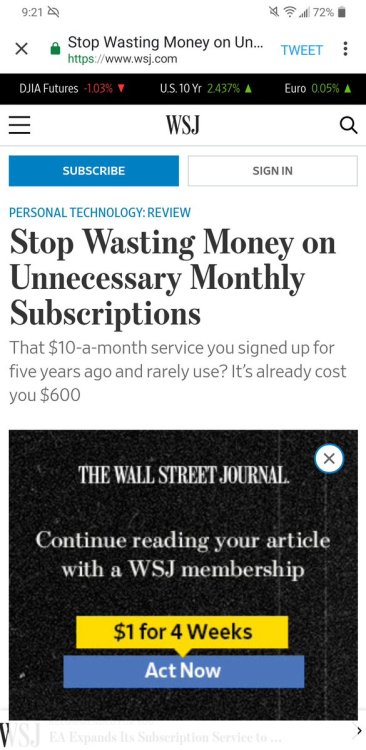
Okay, but now I have to know how self-aware this article is. I have university access to Wall Street Journal, brb.


Definitely at least somewhat:
The charges regularly hitting our credit cards have expanded far beyond video and music-streaming services and, yes, newspapers.


Step 1: Audit. Log in to your credit card and bank accounts and make a list (or, better yet, a spreadsheet) of all your monthly and yearly subscriptions, along with their charges.

[…]

Step 2: Consolidate to family plans. Have your partner do the same and then cross-reference the lists. I quickly spotted some duplicates in my household.

[…]

When signing up for new services, look out for the ability to disable any auto-renew function, and if there’s a free trial, set a reminder on your calendar just before the trial period ends, so you can consider canceling before you get charged.


I…I guess it’s good that there are people pointing this out to those who haven’t thought of it? Today’s lucky ten-thousand and all that. And of course, as the beginning of this thread points out, people subscribed to the Wall Street Journal are going to be disproportionately people careless about which subscriptions they’re on.

(even if I *personally* cannot comprehend the kind of mind that would sign up for Amazon Prime without first checking whether their spouse had it already, or for that matter the kind of mind that would not think to inform their spouse that they had Amazon Prime

also, the kind of mind that would not think long and hard about signing up for a $15/month *anything*, let alone this:

Here’s a hilarious story. For the past three years I’ve been paying $15 a month for an electronic fax service I’ve used… twice. That’s $540. For the same amount, I could have bought 20 rolls of fax paper. Or 10 real working fax machines. Or a plane ticket to Ireland to visit the museum where the world’s first fax machine is on display.”)

((I’m trying very hard to be open-minded about this: I know everyone thinks their own talents are easy))

P.S. If I fed it into my financial calculator right, that $10/month service for 5 years has cost you ~$663, if you count lost interest at 4%.


Tags:

#now if you’ll excuse me I have an accounting exam to study for #adventures in human capitalism #juxtaposition #reply via reblog #is the blue I see the same as the blue you see

{{previous post in sequence}}


brin-bellway:

Hello, fellow citizens of The Future! I am writing this from my smartphone, because I can. I just bought it this afternoon.

I’ve never owned a smartphone before. I have a lot of waste-not-want-not issues about technology, and I was never quite able to justify a smartphone to my satisfaction. Even after my then-7.5-year-old MP3 player’s clickwheel began to fail four months ago, taking two clicks forward and one click back (or, worse, the other way around), I still tried to keep using it.

A few days ago, though, after a talk with my parents, I came to terms with the fact that it was time to move on. (Besides, I can give my old Sansa to my brother anyway, and he might be able to get a bit more use out of it. It’s still a step up from his current utter lack of handheld non-GBA computer.)

At that point, the question wasn’t so much *why* to get a smartphone as why *not*. I could get an MP3 player *without* Wi-Fi and camera and variety of other goodies, or I could get one *with*, in either case for less than I paid for the Sansa.

So, I bought an Alcatel Idol Mini. I haven’t set up the phone plan yet, but there’s a lot it can do without the SIM card. Almost everything I want it to do, really.

Of course, I can’t play around with it much yet, because of the whole school thing. Soon, phone. Soon, once all this pesky schoolwork is out of the way, you and I will spend some quality time getting to know each other.

(After all these years of gazing longingly from afar, I’ve finally got a smartphone. It’s beautiful and wonderful and *mine*, *finally* mine.)

P.S. (from laptop): Today is my Hebrew-calendar birthday. I didn’t intend for the phone to be a birthday present from myself, but it’s nice how that worked out.

depizan said: Happy birthday! And enjoy your phone. :)


Tags:

#(November 2014) #conversational aglets #wavered on whether this was worth agletting #but fuck it who said it had to be ~substantial~ #this is my blog and I will build a beautiful archive out of it #if you are uninterested or wish not to be caught off guard by blasts-from-the-past there is a conveniently blacklistable tag #(fun fact: I still don’t have a phone plan) #(my parents are almost never both using their phones at the same time so I just borrow one of those if I specifically need cell access) #(I have a VoIP account for making calls from Wi-Fi zones (and usually know where the closest Wi-Fi is at any given time)) #(if I trip and break my leg or something while walking alone I can still call for help: you don’t need a SIM card for 911) #(so overall I really don’t think I’d get $7/month of value out of having my own phone plan) #Brin owns *two* 2010’s computers now #adventures in human capitalism #tag rambles #101 Uses for Infrastructureless Computers #replies