
I made a stupid thing for Star Trek’s anniversary you’re welcome
Tags:
#Star Trek #DS9 #Odo
I made a stupid thing for Star Trek’s anniversary you’re welcome
Tags:
#Star Trek #DS9 #Odo
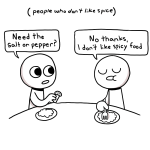
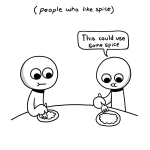
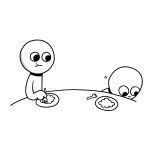
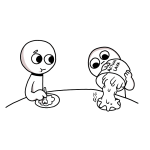
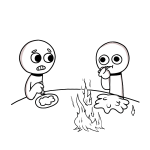
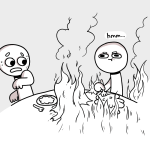
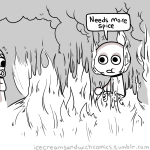
Maybe the infernal core of the sun will do the trick.
Tags:
#food #anything that makes me laugh this much deserves a reblog #comic #kind of a followup to the previous post #(I *like* salt but it almost never occurs to me to add more salt to food) #(when people recommend adding more salt to something I usually do find it tastes better afterward) #(but–with the exception of popcorn where I’m successfully trained to consider it–I don’t think of it unprompted) #(ground peppercorn *can* be good–on French fries especially–but I seem to like it in a more limited number of contexts than most people) #anyway hat tip to daja-the-hypnokitten #nothing against your conversation #but it seemed weird to reblog a conversation and then only address the OP








HAPPY 50TH ANNIVERSARY STAR TREK
✶ 8 September 2016
“Star Trek speaks to some basic human needs: that there is a tomorrow — it’s not all going to be over with a big flash and a bomb; that the human race is improving; that we have things to be proud of as humans. No, ancient astronauts did not build the pyramids — human beings built them, because they’re clever and they work hard. And Star Trek is about those things.”
– Gene Roddenberry
Tags:
#Star Trek #anniversaries
@nextworldover: There’s probably some relation between should and shall and could and can, isn’t there?
me: Yeah, and would and will.
me: I bet there’s some word in Old English that basically meant ‘counterfactual’ and was spelled or pronounced like “ould”.
@zhalaad: *makes a terrible pun and everyone’s confused what he means. It involved Old English.*
me: Wait, no, it’s not from Old English.
me: It’s from a form of English that might have happened, but probably didn’t.
me: Ould English.
Tags:
#language #puns
I hope there’s another scandal at watergate so we can have waterg9
Tags:
#puns #oh my god #there is actually some context for this #(was already a tag) #but the context isn’t necessary for the joke
I was wondering today, how come I’ve never seen mind-control fetishists talking about BBC Merlin? And only seen one piece of erotic fanfiction set in that universe?
That show had such ridiculous quantities of mind control. When it wasn’t plain mind-control magic, it was zombification (in both the “resurrection” and “enthrallment” senses simultaneously, though–at least in the case I’m thinking of–not in the “non-sapient” sense). Or love spells. Or possession. Or mind-altering parasites. Or getting their wills broken the mundane way, with torture.
One time, in series 4 IIRC, there was a five-episode streak in which somebody got mind-controlled in every episode. Not a five-episode arc involving mind control: five individual plots. It was almost half the season.
(I started laughing at episode 4 of the streak, when they said the Lamia could control men’s minds. Mom asked what was funny, and I had to take a moment to try to see it from the outside, how suspicious it would seem that I was the first one to notice despite not really paying that much attention. *I* knew it was because my salience mechanisms were attuned differently than hers, but would she be able to work that out? I don’t want my mom knowing my kinks.
After a moment, I decided I could pass it off as coincidence that I just happened to be paying attention at the right times, and told her about the streak. When the “next time on” showed the abovementioned zombification, she was laughing too.)
Was I just in the wrong places at the wrong times? Is that why I never saw anyone discussing this?
Tags:
#for anyone hanging out in the tag who knows the answer to this: #erotic mind control #I don’t know why I was thinking about this on this particular morning #but I was and I figured why not say something #I don’t know the etiquette for putting kink talk in the general fandom tag #I know it’s rude to do it for shows aimed at children but I don’t know about general-audience #I’m compromising by tag-rambling long enough that it shouldn’t go in the public tag #BBC Merlin #oh look an original post #sexuality and lack thereof #nsfw text
People who are blind from birth will gesture when they speak. I always like pointing out this fact when I teach classes on gesture, because it gives us an an interesting perspective on how we learn and use gestures. Until now I’ve mostly cited a 1998 paper from Jana Iverson and Susan Goldin-Meadow that analysed the gestures and speech of young blind people. Not only do blind people gesture, but the frequency and types of gestures they use does not appear to differ greatly from how sighted people gesture. If people learn gesture without ever seeing a gesture (and, most likely, never being shown), then there must be something about learning a language that means you get gestures as a bonus.
Blind people will even gesture when talking to other blind people, and sighted people will gesture when speaking on the phone – so we know that people don’t only gesture when they speak to someone who can see their gestures.
Earlier this year a new paper came out that adds to this story. Şeyda Özçalışkan, Ché Lucero and Susan Goldin-Meadow looked at the gestures of blind speakers of Turkish and English, to see if the *way* they gestured was different to sighted speakers of those languages. Some of the sighted speakers were blindfolded and others left able to see their conversation partner.
Turkish and English were chosen, because it has already been established that speakers of those languages consistently gesture differently when talking about videos of items moving. English speakers will be more likely to show the manner (e.g. ‘rolling’ or bouncing’) and trajectory (e.g. ‘left to right’, ‘downwards’) together in one gesture, and Turkish speakers will show these features as two separate gestures. This reflects the fact that English ‘roll down’ is one verbal clause, while in Turkish the equivalent would be yuvarlanarak iniyor, which translates as two verbs ‘rolling descending’.
Since we know that blind people do gesture, Özçalışkan’s team wanted to figure out if they gestured like other speakers of their language. Did the blind Turkish speakers separate the manner and trajectory of their gestures like their verbs? Did English speakers combine them? Of course, the standard methodology of showing videos wouldn’t work with blind participants, so the researchers built three dimensional models of events for people to feel before they discussed them.
The results showed that blind Turkish speakers gesture like their sighted counterparts, and the same for English speakers. All Turkish speakers gestured significantly differently from all English speakers, regardless of sightedness. This means that these particular gestural patterns are something that’s deeply linked to the grammatical properties of a language, and not something that we learn from looking at other speakers.
References
Jana M. Iverson & Susan Goldin-Meadow. 1998. Why people gesture when they speak. Nature, 396(6708), 228-228.
Şeyda Özçalışkan, Ché Lucero and Susan Goldin-Meadow. 2016. Is Seeing Gesture Necessary to Gesture
Like a Native Speaker?
Psychological Science27(5) 737–747.
Asli Ozyurek & Sotaro Kita. 1999. Expressing manner and path in English and Turkish:
Differences in speech, gesture, and conceptualization. In Twenty-first Annual Conference of the Cognitive Science Society (pp. 507-512). Erlbaum.Incredible! I have nothing to add because I had no idea, but may I just say **WOW**!!!
Tags:
#language #the more you know #the power of science
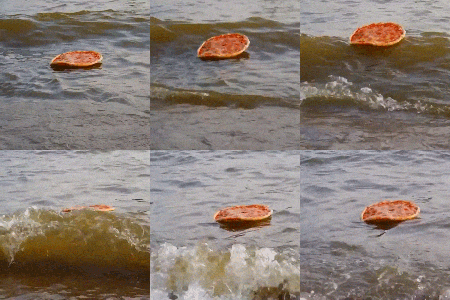
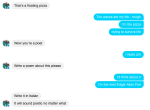
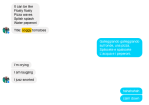
A poem written by @sprachtraeume and me.
Soggy Tomatoes (2016)
Floaty Floaty
Pizza waves
Splish splash
Water peperoniPomodori fradici (translation: 2016)
Galleggiando galleggiando
Sull’onde, una pizza
Spliscete e splascete
L’acqua e i peperoni
Tomates empapados (Spanish translation: 2016)
Flota flotando
Olas de pizza
Chof chof
Salchichón chapuzón
Feuchte Tomaten (German translation: 2016)
Schwimmi schwimmi
Pizza Wellen
Plitsch platsch
Wasser Salami
Kašovitá rajčata (Czech translation: 2016)
Plavací, plavací
Pizzové vlny
Cáky cák
Vodní peperonka
Litimärät tomaatit (Finnish translation: 2016)
Kelluvat kelluvat
Pitsa-aallot
Loiskis läiskis
Veden pepperoni
Vasne tomater (Norwegian translation: 2016)
Flytende, flytende
Pizzabølger
Plisk plask
Vannpepperoni
Šlapi pomidorai (Lithuanian translation: 2016)
Lengvos lengvos
Pizos bangos
Pūkšt pūkšt
Vandens peperoni
Vesised tomatid (Estonian translation: 2016)
Hulbi hulbi
Pitsalained
Plirts plärts
Veepipravorst
Áztatott Paradicsom (Hungarian translation: 2016)
Úszó Úszó
Pizza hullámok
Friccs Fröccs
Vizi Paprikás Szalámi
Tags:
#language #pizza #poetry #I didn’t actually laugh aloud but it still amused me enough to reblog
me, finally getting a chance to say something I’ve thought about for twelve days straight: oh, hey, that reminds me, funny thing, this just came to mind but
Tags:
#same #(well sometimes) #(sometimes I admit I’ve been thinking about it for twelve days)


