• time • the number ten • rock • food • to eat • honesty • seed • fruit • to pick up • dill
And these are just the more common meanings. There are approximately three times more possible interpretations if you want to be obscure. And this also doesn’t get into shī, shǐ, or shì, which are just tonal differences and mean entirely different things.
And this is true of basically any sound in Chinese. If you ask me, out of context, what Qing means, I’ll give you a list of like forty possible meanings and say “it’s probably one of these, I’ll need to see the context to know which one.”
Understandably, when I tell people this, their first reaction is, “How do you tell them apart?”
The generic response here, the one you’re going to hear from most people, is “context”.
Like, if someone says “I’m a little hoarse”, your first response isn’t going to be “you look nothing like a pony”. Context generally makes the thing obvious.
But come on. Context clues are enough for the two-to-three-at-most homophones you get in English. Not the forty-or-so homophones you get in Chinese. This is Serine’s Linguistics Blog, and here I’m going to tell you the real answer.
The real answer is…
Most Chinese words are made of multiple characters. Multiple-character words have a lot fewer collisions.
But that’s still not enough. The real real answer is…
Chinese is just really redundant.
One of the common blessings in Chinese New Year was
迎福纳祥
These characters mean [welcome][fortune][receive][luck] – as you can see, it’s just saying the same thing twice.
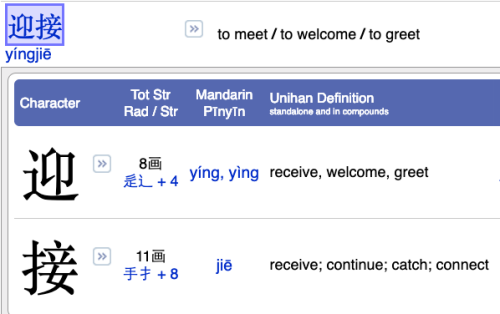
Here’s my dictionary’s breakdown of the word “to welcome”:
And triple-redundancy isn’t rare, either:
坚定不移 – staying still
Which breaks down to:
坚 – unchanging 定 – settled down 不 – not 移 – moving