{{previous post in sequence}}


sinesalvatorem:

brin-bellway:

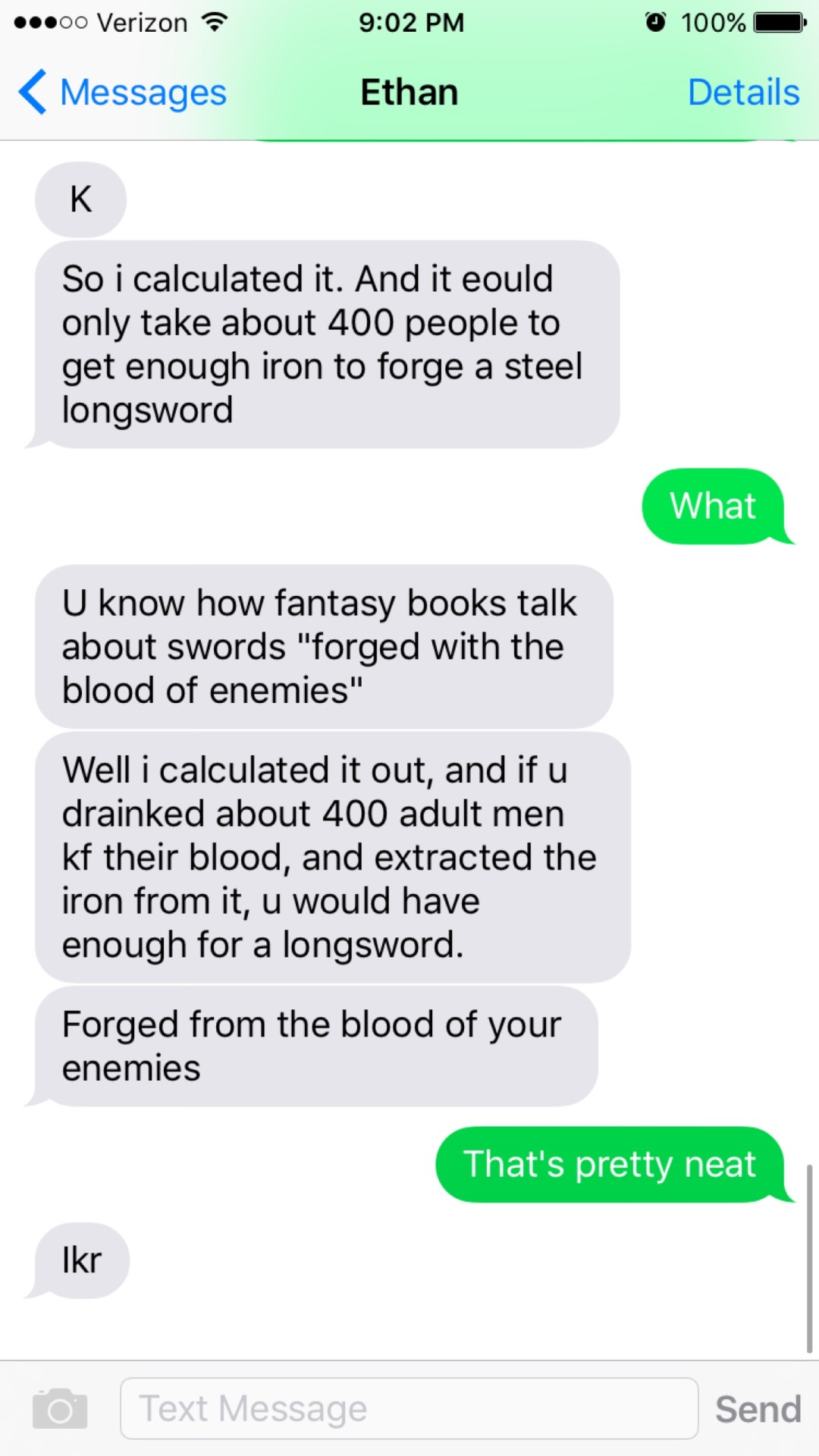
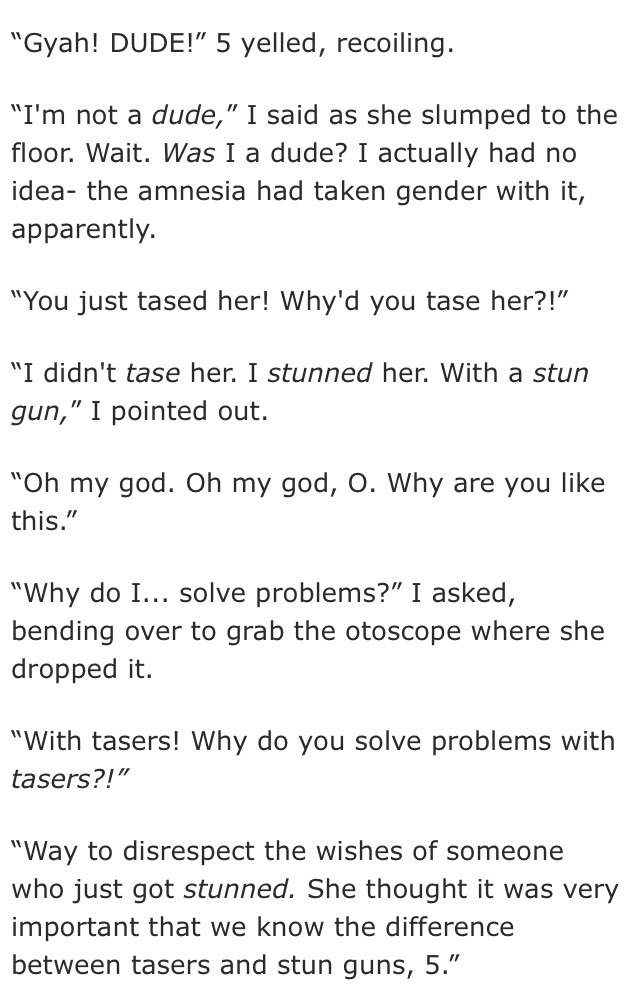
sinesalvatorem:

brin-bellway:

@sinesalvatorem, about the r/k thing that I’m not going to reblog under my no-guilt-trips policy:

Keep reading

I am confused to say the least. My post doesn’t have anything to do with violence? Or exploiting other people? Or taking advantage of other people’s unwillingness to push back against assholes?

(Unless you consider applying to lots of jobs even if they aren’t your ideal to be assholish behaviour? But that would be odd and surprising? Like, I don’t think it’s actually valuable to be cautious with a company’s time – they set up their hiring channel for a reason.)

My post is about why people should be willing to take actions that are low cost even if they’re unlikely to succeed in full. But, like, I’m kind of a utilitarian – if I’m counting how costly something is, I’m definitely counting how costly it is to /everyone/.

Putting one’s sketches online isn’t hurting you /or/ bystanders, so it counts as taking a low-cost opportunity. Shoplifting may not hurt you (depending on the consequences of being caught), but it’s still taking money out of someone else’s pocket, so it’s still A Bad.

If cowardice is the only lever you have to avoid acting on impulses to hurt others, then OK, in your specific case I endorse cowardice. But almost no one I know works like this? Generally, a lot of factors go into decisions about whether to engage in violence, and they tend to be rather divorced from what makes someone decide whether to try a new food.

If you have only one inhibitory mechanism, it makes sense to keep it at the level that helps you interface with society, but most people are using several different kinds of inhibitory signals. I just want them to put less stock in the “People will ignore/reject/laugh at me and then I will DIE” one.

Basically, for the vast majority of people my post is directed at, the negative outcome you describe just isn’t related to the thing my post is about. The fear of embarrassment stops people from dancing in public, but I don’t think it’s a major factor in stopping people from punching each other. In fact, in most cultures, bullying and strong-arming others is the opposite of embarrassing.

But I still think people shouldn’t do that because 1) hurting others is bad, and 2) whether something is embarrassing is a crappy way to judge if it’s a good idea.

I think I draw the boundary lines in different places than you do.

>>In fact, in most cultures, bullying and strong-arming others is the opposite of embarrassing.<<

Bullying people and embarrassing yourself in front of them are both members of the category “things that increase the likelihood that people will treat you badly in the future”. They increase it by different *amounts*–and I’ll accept that for many cases of embarrassment the increase is negligible–but I don’t know that I’d say they’re different in *kind*.

(And I don’t think it’s far-fetched to say they’re both forms of hurting people, though again by very different amounts. I understand that it is not *useful* to react this way, and I try very hard to avoid doing so, but my *instinct* is to treat “inflicting secondhand embarrassment on me” as a hostile act deserving of a hostile response.)

>>they tend to be rather divorced from what makes someone decide whether to try a new food.<<

This, on the other hand, I *would* say is different in kind. Is it at all common for people to get annoyed with someone for trying a new food?

I’m not sure how to tell how many inhibitory mechanisms I have except by removing one and seeing if things still work, and I think it’s pretty clear that that’s *not* an area where failure is cheap. And while I’ve occasionally caught glimpses of a conscience around here somewhere, I’ve never caught one while angry (even when I wasn’t as good at cowardice as I am now), so I doubt that’s one of the mechanisms for this.

There is a distinct possibility that I don’t have insight into what’s actually going on here, but from the inside it feels like the thing that caused a shift to being consistently non-violent was spending a couple years on the Internet practising my flight response on bits of Discourse, until eventually I could run away from infuriating things offline too. Here, I learned how to grovel, how to phrase things carefully so as to minimise the chances of sparking a fight with anyone, how to keep my mouth shut entirely and quietly slip out. (not doing too well at that last bit tonight, but nobody’s perfect)

In an environment of *relative* safety and much more time to think than IRL, I could have the lesson hammered home that I’m almost always better off reacting to an argument or provocation by surrendering or (if available) pretending not to have noticed, rather than prolonging the pain by trying to fight.

>>Like, I don’t think it’s actually valuable to be cautious with a company’s time – they set up their hiring channel for a reason.<<

Eh, I’ve definitely encountered people with hiring responsibilities complaining about completely unsuitable people wasting their time. I guess bigger companies can probably arrange better filters that put less stress on the employees involved?

I think the largest disagreement here is that I don’t think “things that increase the likelihood that people will treat you badly in the future” is a meaningful category in the first place.

I think there are lots of inputs into the specific way people will treat you, but that none of these look like increasing a “bad treatment” variable, or anything that could be a proxy for such. I think things might influence how deferent or hostile or helpful or avoidant people are in interacting with you, but that any presentation style you choose will pull on a bunch of these, and whether the end result looks like being treated well or poorly just depends on what you as a person want out of interactions.

For example, being more agreeable will tend to make people less hostile, avoidant, and/or argumentative toward you – but will increase their willingness to push your boundaries and ignore your opinions. Which direction looks more like bad treatment? This entirely depends on your priorities! I recently intentionally lowered my agreeableness because, to me, getting more confrontations was worth getting less casual boundary-crossing. Meanwhile, past!me would have put more emphasis on not having to confront people.

And neither of these poles at all looks like people deciding they want to treat you worse. Instead, it’s them shifting their interaction pattern into the path of least resistance. For conflict-averse people, conflict is high-resistance, so they avoid disagreeable people. Meanwhile, if you’re unwilling to cuss out the asshole who touches you inappropriately, they’ll go ahead and do it again, because it’s low-resistance. Is being avoided bad treatment? Is being touched inappropriately bad treatment? Quite possibly both are, but the tradeoffs are built into the interaction style.

(Of course, there are ways to avoid having either of these outcomes by seeming approachable but also like you don’t take shit. Currently, my reduction in agreeableness doesn’t seem to be scaring people off, because I still try to be approachable. But, like, there are other tradeoffs. There are always tradeoffs.)

A behavioral pattern – and all the different personality traits that influence it – sets you up as a person that it’s most convenient to interact with in some ways vs others. And everyone is going about trying to pursue their own social goals while moving through a landscape where some things are easy and some are hard. The key to getting good treatment is making sure other people believe that the best way to get what they want is to treat you the way you most want to be treated. (Where the way you most want to be treated will vary a lot by person.)

And this is why I wouldn’t put embarrassment and bullying in the same category. Even if they both lead to things you don’t want, they do so through completely different avenues. At worst, embarrassment makes you seem incompetent, so people will work less hard to gain your favour since they consider your support low-value. Meanwhile, being a bully will make you seem dangerous, so people will avoid you on the assumption that interactions are high-cost. Being high cost and being low value are really different social tags, and treating them as interchangeable will make it v v difficult to reason about the social landscape.

Again, if you happen to only have one lever to work with, by all means set it to the position that best helps you navigate the world. But you’ll still be operating at a massive handicap, because your single variable will miss almost everything that determines how interactions can go. If there were anything I could point at as the ultimate “get treated badly” variable, I would say it’s not having options.

>>At worst, embarrassment makes you seem incompetent, so people will work less hard to gain your favour since they consider your support low-value. Meanwhile, being a bully will make you seem dangerous, so people will avoid you on the assumption that interactions are high-cost.<<

Thing is, I contested this in my previous post:

(And I don’t think it’s far-fetched to say they’re both forms of hurting people, though again by very different amounts. I understand that it is not *useful* to react this way, and I try very hard to avoid doing so, but my *instinct* is to treat “inflicting secondhand embarrassment on me” as a hostile act deserving of a hostile response.)

Embarrassing yourself in front of people causes them pain (in the form of negative affective empathy), so they’ll want to cause you pain in return. Punching people causes them pain (in the form of physical damage), so they’ll want to cause you pain in return.

And yes, this is in large part projection. Other people almost never act in ways that would make sense if they considered “inducing negative affective empathy” to be a hostile act, and mostly don’t even act in ways that would make sense if they were inclined to see it that way but consciously overriding that. But you can’t have projection without proof of concept: it’s empirically untrue that the worst thing someone will do to you if you embarrass yourself in front of them is work less hard to gain your favour.

(Although I tend to react a lot worse to people telling me explicitly-labelled embarrassing *stories* about themselves than to them actually *doing* embarrassing things, I think because with the stories it’s very clear that they could have easily chosen to not do this to me. Accidents I can forgive relatively easily, even tradeoffs; signposting “I’m going to do something embarrassing now, specifically for the purpose of having you witness how embarrassing it is”, though, not so much.)

P.S. Went to check my use of “affective empathy” and found this suspiciously relevant-looking Wikipedia article.

P.P.S. Apparently I got ninja’d by @kit-peddler. I’m glad to see someone else picking up on my quoted paragraph.

Looking at the notifications continuing to come in as I write this, it looks like now would probably also be a good time to emphasise the very first sentence (not counting “so, about that post”) of my first post:

I suspect we’re both projecting our own selves onto the rest of society and ending up skewed.


Tags:

#reply via reblog #discourse cw #violence cw #scrupulosity cw #is the blue I see the same as the blue you see #long post

{{previous post in sequence}}


sinesalvatorem:

brin-bellway:

@sinesalvatorem, about the r/k thing that I’m not going to reblog under my no-guilt-trips policy:

Keep reading

I am confused to say the least. My post doesn’t have anything to do with violence? Or exploiting other people? Or taking advantage of other people’s unwillingness to push back against assholes?

(Unless you consider applying to lots of jobs even if they aren’t your ideal to be assholish behaviour? But that would be odd and surprising? Like, I don’t think it’s actually valuable to be cautious with a company’s time – they set up their hiring channel for a reason.)

My post is about why people should be willing to take actions that are low cost even if they’re unlikely to succeed in full. But, like, I’m kind of a utilitarian – if I’m counting how costly something is, I’m definitely counting how costly it is to /everyone/.

Putting one’s sketches online isn’t hurting you /or/ bystanders, so it counts as taking a low-cost opportunity. Shoplifting may not hurt you (depending on the consequences of being caught), but it’s still taking money out of someone else’s pocket, so it’s still A Bad.

If cowardice is the only lever you have to avoid acting on impulses to hurt others, then OK, in your specific case I endorse cowardice. But almost no one I know works like this? Generally, a lot of factors go into decisions about whether to engage in violence, and they tend to be rather divorced from what makes someone decide whether to try a new food.

If you have only one inhibitory mechanism, it makes sense to keep it at the level that helps you interface with society, but most people are using several different kinds of inhibitory signals. I just want them to put less stock in the “People will ignore/reject/laugh at me and then I will DIE” one.

Basically, for the vast majority of people my post is directed at, the negative outcome you describe just isn’t related to the thing my post is about. The fear of embarrassment stops people from dancing in public, but I don’t think it’s a major factor in stopping people from punching each other. In fact, in most cultures, bullying and strong-arming others is the opposite of embarrassing.

But I still think people shouldn’t do that because 1) hurting others is bad, and 2) whether something is embarrassing is a crappy way to judge if it’s a good idea.

I think I draw the boundary lines in different places than you do.

>>In fact, in most cultures, bullying and strong-arming others is the opposite of embarrassing.<<

Bullying people and embarrassing yourself in front of them are both members of the category “things that increase the likelihood that people will treat you badly in the future”. They increase it by different *amounts*–and I’ll accept that for many cases of embarrassment the increase is negligible–but I don’t know that I’d say they’re different in *kind*.

(And I don’t think it’s far-fetched to say they’re both forms of hurting people, though again by very different amounts. I understand that it is not *useful* to react this way, and I try very hard to avoid doing so, but my *instinct* is to treat “inflicting secondhand embarrassment on me” as a hostile act deserving of a hostile response.)

>>they tend to be rather divorced from what makes someone decide whether to try a new food.<<

This, on the other hand, I *would* say is different in kind. Is it at all common for people to get annoyed with someone for trying a new food?

I’m not sure how to tell how many inhibitory mechanisms I have except by removing one and seeing if things still work, and I think it’s pretty clear that that’s *not* an area where failure is cheap. And while I’ve occasionally caught glimpses of a conscience around here somewhere, I’ve never caught one while angry (even when I wasn’t as good at cowardice as I am now), so I doubt that’s one of the mechanisms for this.

There is a distinct possibility that I don’t have insight into what’s actually going on here, but from the inside it feels like the thing that caused a shift to being consistently non-violent was spending a couple years on the Internet practising my flight response on bits of Discourse, until eventually I could run away from infuriating things offline too. Here, I learned how to grovel, how to phrase things carefully so as to minimise the chances of sparking a fight with anyone, how to keep my mouth shut entirely and quietly slip out. (not doing too well at that last bit tonight, but nobody’s perfect)

In an environment of *relative* safety and much more time to think than IRL, I could have the lesson hammered home that I’m almost always better off reacting to an argument or provocation by surrendering or (if available) pretending not to have noticed, rather than prolonging the pain by trying to fight.

>>Like, I don’t think it’s actually valuable to be cautious with a company’s time – they set up their hiring channel for a reason.<<

Eh, I’ve definitely encountered people with hiring responsibilities complaining about completely unsuitable people wasting their time. I guess bigger companies can probably arrange better filters that put less stress on the employees involved?


Tags:

#reply via reblog #is the blue I see the same as the blue you see #discourse cw #violence cw #scrupulosity cw


{{next post in sequence}}

@sinesalvatorem, about the r/k thing that I’m not going to reblog under my no-guilt-trips policy:

I suspect we’re both projecting our own selves onto the rest of society and ending up skewed. (Intellectually I’m willing to believe you’re closer to the truth than I am, although I’m really not sure how we could *tell*.)

I deliberately cultivate cowardice as a way of coping with my violent urges. It’s true that fear holds me back, but there are some things I very much *should* be held back from, and I feel like the price of being also held back from some things I *shouldn’t* hold back from is worth it given the stakes.

(and no, it’s *not* just intrusive thoughts)

I try to avoid anything that might piss people off because that would make it harder for *them* to hold back, and I know how hard that can be sometimes. I try to make it as easy as possible for them to keep their violent urges reined in, and (I hope) they’ll do the same for me, and this fragile truce between a whole lot of murder-monkeys that we call “society” will keep functioning.

(Each approach has its disadvantages, and one of the disadvantages of cowardice is that people who *would* advocate cowardice are, of course, less willing to speak out against the people advocating bravery. As such, bravery advocates tend to stand unopposed. I’ve seen other posts like this in the past, some of them shading *much* further than yours does into “you should exploit situations where people’s fear makes them unwilling to fight back against assholes”.)


Tags:

#you want me to be brave? fine. I’ll post this. #(this is the third version of this post I’ve written) #(I tried to balance ”not being more hostile than necessary” with ”the hostility is kind of the point”) #(there’s only so much I can defang a post about how sharp teeth can be) #((I’m not *exactly* angry but writing this post still makes me very aware of how unfulfilling the lack of violence in my life is)) #((but I’d rather have a life whether I neither give nor receive violence to one where I do both)) #((and I’ve made my choices accordingly)) #this post technically qualifies as: #oh look an original post #but is closer to the spirit of: #reply via reblog #is the blue I see the same as the blue you see #discourse cw #violence cw #posts I am almost certainly going to regret


{{next post in sequence}}

gasmaskaesthetic:

Why does anger feel good? Most of my undesirable emotions are painful in addution to themselves, so I actively want them to stop. Anger is the one I hesitate to soothe. When I’m angry, it makes me angrier to try to talk myself down instead of letting the rage play out. I can still do it, but it takes a very different kind of effort compared to sadness, or anxiety, fear, or irritation.

Sadness is something I impulsively indulge in, sometimes, but my natural tendency is to do so by seeking comfort, so it’s self-regulating.

When I’m anxious or afraid, I want to get out of that state immediately. This doesn’t always generate *effective* behavior but I’m not resisting the attempt to feel better out of an active desire to stay that way.

Irritation isn’t the same thing as anger. It’s excessive sensitivity. It can turn into anger, but I never want to remain irritable.

Anger moves me to take action. It’s satisfying to direct anger at a target. It feels *good* to rail against some real or imagined wrong. Some of the clearest thinking I’ve ever experienced has been at the peak of justified anger. The risk of indulgence here is pretty obvious. Given how much satisfaction I get from anger, I think I do a pretty good job of staying away from rage-bait. I’m also lucky in that I’m not easily driven to anger in the first place. Most of my anger-management is preventative. I’m not sure what I’d do if that got, say, 40% harder.

I’m curious about other people. Answer all or just some of these, if you want:

Do you work yourself up over things, intentionally or otherwise?

Do you seek out material that triggers anger but does little else for you?

When you are angry, do you ever want to stay angry?

Does that ever change depending on why you’re angry?

Do you find it difficult to notice that being angry is making you less effective?

*Does* anger make you less effective, and how do you tell either way?

Do you ever want to stay angry even after acknowledging that it would be better (for whatever reason) to stop being angry?

>>It’s satisfying to direct anger at a target.<<

Personally, I find anger the *exact opposite* of satisfying.

Anger, for me, is very much about violence. Anger is a desire to hurt the entity that wronged me; if the entity that wronged me is not capable of experiencing pain (like if a rock fell on my foot) or I don’t expect I will be able to successfully hurt them (so, always; violence is far too risky for me to seriously attempt it), this will often spread out into a more generalised longing to cause pain. Getting angry tends to wind up as a period of feeling intensely unfulfilled regarding the utter lack of beating-people-up in my life.

When angry, I tend to feel conflicted about ceasing to be angry in much the same way that I feel conflicted about any other attempt to deal with unfulfilled desires by ceasing to want the thing.

>>Do you seek out material that triggers anger but does little else for you?<<

Only under orders. Eventually I learned to treat “pressures you to experience anger” as a major red flag.

I can also be conflicted about ceasing to be afraid: yes, I want to be unafraid, but I specifically want to be unafraid *because the scary thing is gone*. Deep-breathing exercises and other such techniques, things about trying to trick your brain into feeling safe independently of whether it actually *is* safe, are repulsive. The closest I get is fear also increasing my desire to defend against *other* bad things than the one I’m actively being menaced with: to use the most recent example, I tend to be more interested in making my smartphone resilient against loss of Internet if I’m experiencing a lot of financial anxiety, even though my level of Internet access is effectively unrelated to how much money I have (I don’t expect to ever be poor enough to lack home Internet (it’s profitable on net!), nor rich enough to be comfortable buying [a personal mobile data connection with plenty of buffer]).

However, I usually *do* endorse ceasing to be sad even if nothing about the thing that was making me sad improves.


Tags:

#in related news if you have smartphone self-sufficiency tips I’m interested in hearing them #(there’s a reason the prepping tag is:) #101 Uses for Infrastructureless Computers #is the blue I see the same as the blue you see #reply via reblog #violence cw #and more tangentially related: #adventures in human capitalism #Brin owns *two* 2010’s computers now


{{next post in sequence}}

{{previous post in sequence}}


brin-bellway:

brin-bellway:

*

Is it just me, or does adolescent brain development feel from the inside like getting better at *fear*?

Keep reading

They say the *next* stage of brain development is getting *less* susceptible to peer pressure. What the hell is *that* gonna be like?

I have some guesses, I think. Maybe you get so used to full-grown impulse control that you start taking it for granted, go so long without ever being at real risk of snapping that you start projecting your non-violence onto others the same way you once projected your violence onto them. “What will happen if I make this person angry” calculates (as it always did) as “what would I do if I were them and someone made me angry”, and since “I would hurt them” is no longer a serious possibility, you stop taking that possibility seriously in others (at least by default), and so the stakes are lower.


Tags:

#oh look an original post #is the blue I see the same as the blue you see #violence cw #abuse cw?

{{previous post in sequence}}


brin-bellway:

*

Is it just me, or does adolescent brain development feel from the inside like getting better at *fear*?

They told me I’d get better impulse control in my early twenties, and in a way I suppose I did. But what it felt like was that I’d finally cultivated fear to the point that it could consistently outweigh anger, that even in the midst of rage I was still paralysed by the terror of what people would do to me if I lashed out.

They told me I’d get more susceptible to peer pressure in my teens, and in a way I suppose I did. But what it felt like was an acute awareness that literally anyone could hurt me (deprive me of resources, beat me up, potentially in extreme cases kill me) if crossed; I would not be able to stop them until it was too late, and in many cases I would not be able to stop them at all. There’s no such thing as peer pressure because there’s no such thing as *peers*: everyone is potentially dangerous, and everyone must be appeased.

(Ever since puberty, I have never had a relationship† between equals. The closest I’ve come is relationships where each person believes themself to be of inferior rank to the other.

I used to worry what it said about me that my closest friendships are always with people who are scared of me, but perhaps it’s just that *I’m* going to be scared of *them* regardless, and so them being scared too is the only way to even things out enough.)

†in the broad sense


Tags:

#oh look an original post #is the blue I see the same as the blue you see #violence cw #abuse cw?


{{next post in sequence}}

lackadaisycats:

Happy Halloween!  I made a stupid comic!  It started with a Patron livestream prompt for Rocky as a sheet ghost and inevitably ended in flames.

The full size comic can be viewed here.

———————————————————

Lackadaisy is on Patreon!


Tags:

#ghost #comic #fire #anything that makes me laugh this much deserves a reblog #Lackadaisy Cats #(which I tried to read once but couldn’t get into) #(but I like this) #violence cw?

responsible-reanimation:

The best dialogue exchange in Cordyceps (without spoiling it).


Tags:

#cordyceps tcftog #anything that makes me laugh this much deserves a reblog #I’m getting the distinct impression that this book is going to become a subcultural touchstone a la The Northern Caves #(though admittedly I haven’t read The Northern Caves myself) #(mostly because it seems too horror-y for my tastes) #(arguably I shouldn’t have read Cordyceps either for the same reason) #(too late now)

Regaining Normalcy: Flame Girl Saga

sinesalvatorem:

dragonsmagiccircle:

sinesalvatorem:

The day after I escaped from The Freaky Kidnapping Facility, I had a calm, civilised talk with the college admin about security. I impressed upon them the importance of having security procedures that don’t let sock-wielding kidnappers drive into the campus, pick people up, and roll out like nothing ever happened.

I only screamed a little bit. I only kicked a potted plant once. I’ll admit that half the screaming I did was a direct consequence of having kicked a potted plant, but I never claimed I made the best decisions. What matters is that after my terrifying-yet-unbearably-cute rantings, they increased security. Which is to say, they implemented security. Being scaredorable works! Never again would travel-sized students have to worry about involuntary shipping and handling!

After half a day spent watching over my shoulder, eyeing the knives in the cafeteria warily, and giggling senselessly at the mere mention of mitochondria, a representative from student affairs told me to take the rest of the day off. I was disappointed yet resigned. Just because I could heal (and get off on) a stab wound didn’t mean I wasn’t traumatised.

After I was safely ensconced in my dorm-room, I pulled out my phone. I’d never been the most social person, so my contacts broke down neatly into four categories: Important authority figures – from college admin to the police – that I’d already screamed at as much as I cared to; my parents, who would learn of my kidnapping over my dead body

(they really would: I had set up a system to notify them should I become unresponsive); my study group, who would either be in class or, y’know, studying; and pants-less fire goddesses I’d promised to call. It wasn’t that hard to figure out who I could commiserate with at the moment.

“Hi!” I said, trying not to sound traumatised. “This is that girl from last night.”

“Hi!” A warm and familiar voice replied. “If it were any other ‘girl from last night’ calling and sounding this traumatised, I’d probably feel like a terrible person. As it stands, your response is pretty normal.”

“Uh, OK, I think.” I replied, eloquently. “Thanks, um, I actually don’t think I got your name -”

“Emma.”

“Thanks. I’m Clare. You sound… Really normal. Like, given the whole… Everything. The whole everything. Shit. I’m bad at words. But I’m sure you noticed that. I didn’t need to say it. Shit again.”

There was soft laughter on the other end. However, it didn’t sound like someone laughing softly, but someone holding the phone away to laugh loudly.

“Sorry,” Emma said when the laughter had died down. “I’m really sorry. I’m just kind of giddy. Like, I’ve been in bad situations before, but I kind of expected to die. I’ve never had to deal with people with that much resources. Usually a couple muggers or burglars – rarely organised crime, and never this.”

I was really sorry to here that Emma lived in such a bad neighbourhood that they were constantly dealing with criminals. It made me feel lucky to live in a place so safe that, until today, there was no campus security. Although, seriously: what was up with the whole no security thing? That didn’t feel right.

Wait a second. Emma was waiting for a response. I’d zoned out mid-conversation. Crap. What was I supposed to do at this point? Make sympathy noises? Which ones? Why didn’t human interaction come with a manual? Or even just a regular text book. I could probably do a better job cheering up some Gram-negative bacteria than anything this macro. I just said the first thing that came to mind.

“I’m sorry to hear that. You must live in a pretty rotten neighbourhood.” Yes, I insulted her home. Smoooooth, Clare. You must be a real hit with the flame-ladies.

“Oh, no.” Emma assured me. “It’s pretty nice here. Workload’s pretty low. In fact, if I want to do the most good, I should probably move downtown. That’s where the real bad guys are.”

Do the most good? What? Was she a social worker? That might explain why she could stay so positive-sounding in the face of all this craziness. I’d never imagined Gram-positive bacteria trying to cheer me up.

“I’m sure the people you work with really appreciate how altruistic you are,” I told her. Honesty probably works as an OK sympathy-signal. Or not. I’d know if anyone had been so kind as to give me a manual. I couldn’t even tell if this was an appropriate time to ask her out. Despite my best efforts, I’d been unable to locate a copy of The Gay Agenda, either.

“I actually work alone.” She informed me. “It’s not like there are enough criminals to justify two idiots in tights chasing after them.”

…Was this a euphemism? I could sort of see the stuff about tights and chasing, but where do the criminals come in? I’d only learned the meaning of “booty-pirate” last week, and I didn’t think it was relevant here. But what did I know, really? I probably missed an entire lexicon by avoiding all humans during high school. This could be the most transparent thing in the world to everyone else.

Sigh. I guess I would have to suck it up and admit that I was confused.

“Um, I’m sorry, Emma, but I don’t really know what you’re talking about.”

“I mean I’m a solo crime-fighter, of course. I’m not a part of any superhero teams. I’m a lone wolf. I know; shocking, right? I guess that means you roll with a pack, right?”

…………

You’re a superhero!?

You’re not!?

“No! Definitely not! I only learned I had powers yesterday! I learned them as a result of getting stabbed by a torturer! This is a thing!?

“Oh my God, I totally need to get you up to speed. There’s so much to teach you! Let’s meet for coffee tomorrow afternoon. Know anywhere good near you?”

“There’s a coffee shop on campus, and I can be there at 5:30.”

“Great! Don’t worry about directions – I’ll just use my ~super powers~. See you then!”

Wow. So…. Wow. The third most surprising thing to happen in my life: superheros exist.

The second, of course, was the whole torture/kidnapping debacle. I still needed to sort out my shit after that.

However, they both failed to compare to the Most Astonishing Thing Ever:

Holy shit I’m going on a date tomorrow!!!

(Major thanks to ilzolende for editing and good suggestions.)

Wait wait wait… I need to find part 1.

Part 1 is ‘Didn’t Want To Move Because Wet Chocolate Mousse’. You can find it by following the tag ‘flame girl deserves a phone call’, which I’m using to organise the story.

(Part one was initially just some random dream so, while part one is definitely cannon for all subsequent parts, the reverse is not necessarily true.)


Tags:

#storytime #anything that makes me laugh this much deserves a reblog #reblogging the version with context included