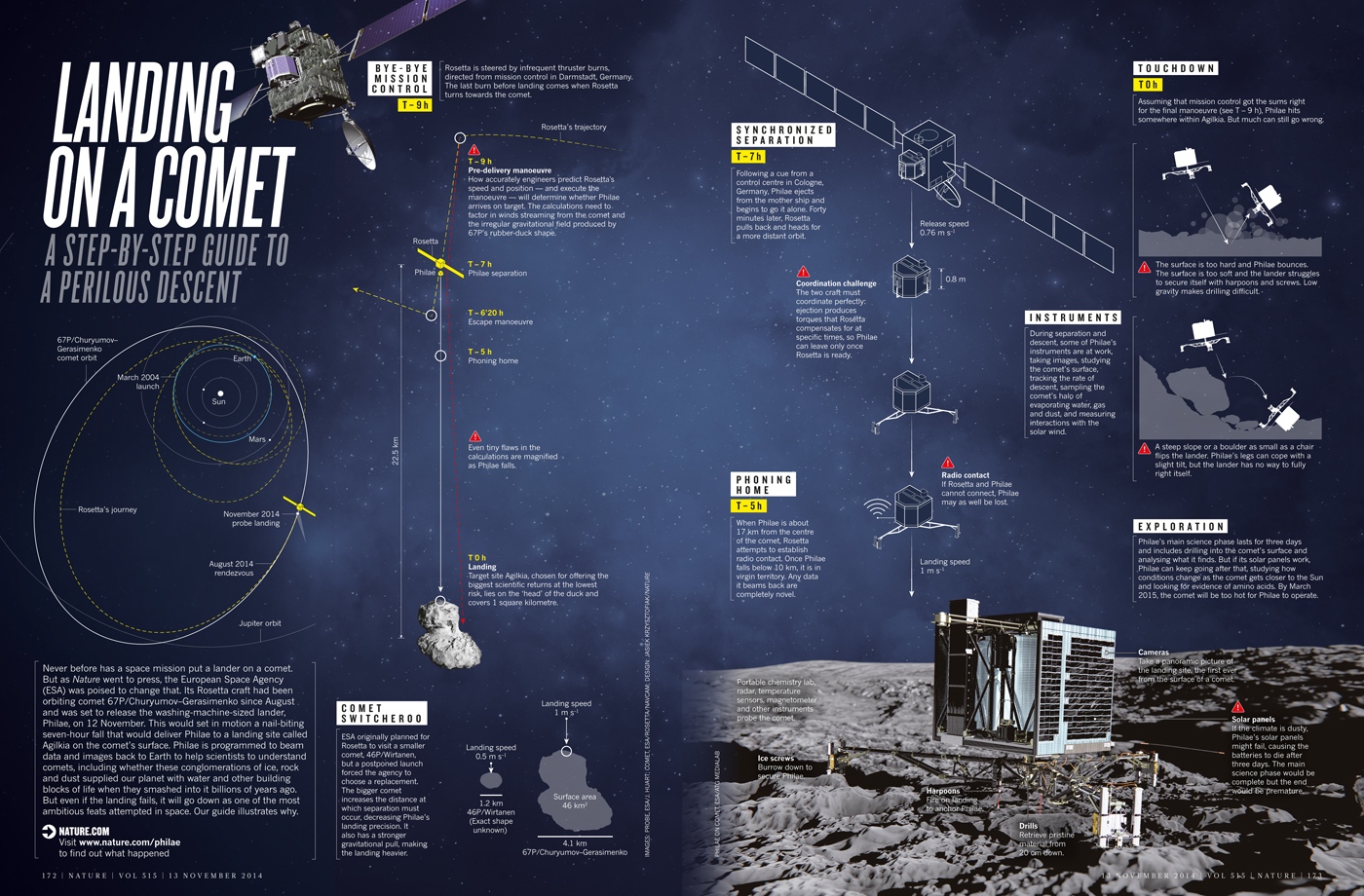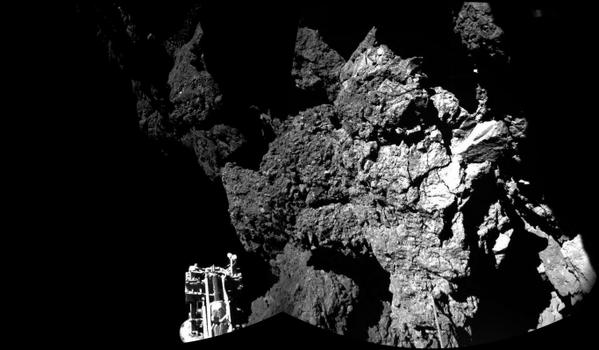
Forbidden planet, a forbidding comet. First rugged image from the surface of the 4.5 billion-year-old dirty snowball.
Tags:
#space #the power of science #Rosetta #proud citizen of The Future #duuuuude
Forbidden planet, a forbidding comet. First rugged image from the surface of the 4.5 billion-year-old dirty snowball.
Tags:
#space #the power of science #Rosetta #proud citizen of The Future #duuuuude

Somebody giffed today’s comet-landing xkcd. Everything is better now.
And we have TOUCHDOWN!!! On the comet!!!!
Tags:
#xkcd #Rosetta #the power of science #space #\o/ #proud citizen of The Future
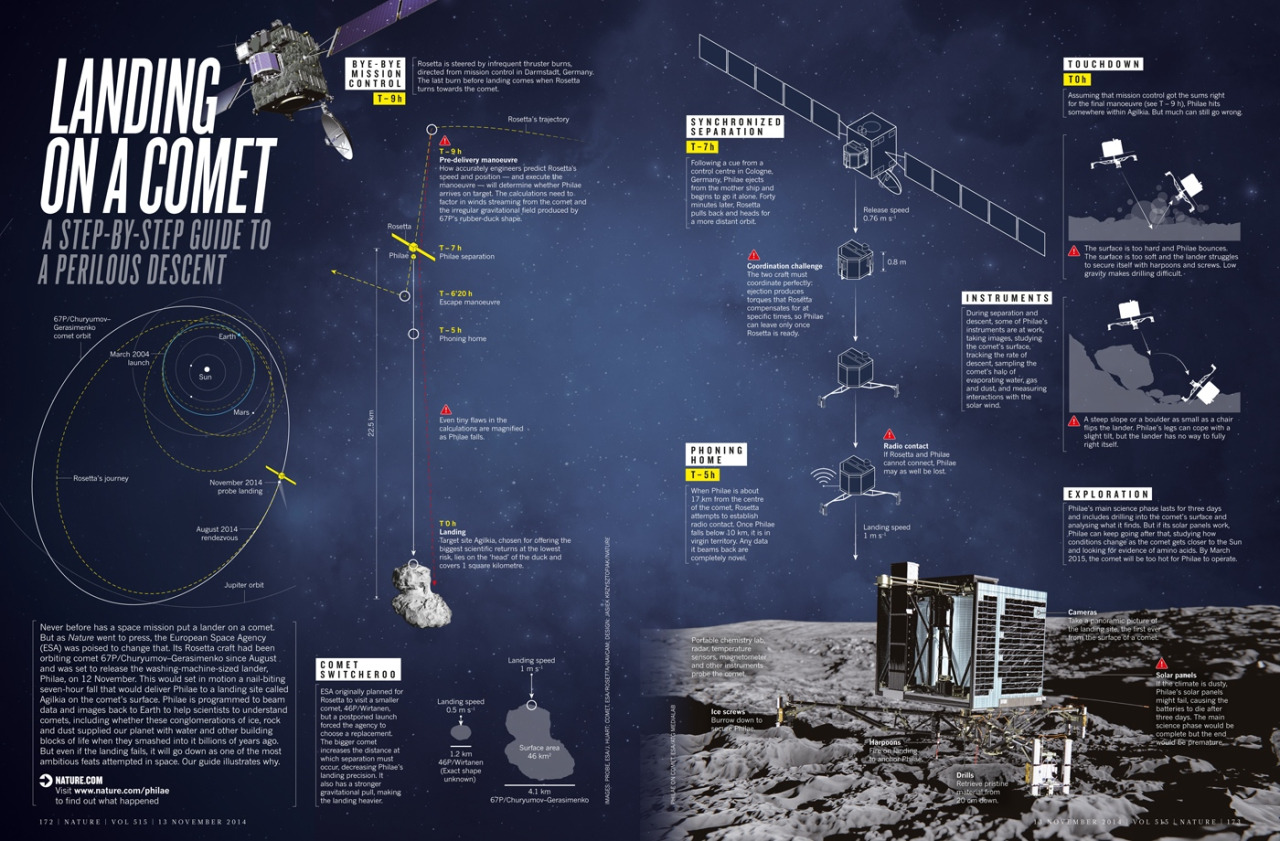
The European Space Agency’s Rosetta spacecraft is set to release its Philae probe in preparation for touchdown on the comet 67P/Churyumov–Gerasimenko tomorrow, November 12.
In case that didn’t sink in, tomorrow some human beings are going to try and land a spaceship on a comet. Here’s what you need to know, thanks to the folks at Nature (click here to explore a bigger version of the infographic).
Tags:
#space #the power of science #(there are *so* many things that could go wrong) #(here’s hoping this works)
I saw the statement ‘every living thing has sexual desire’ just recently (aimed, of course, at asexual individuals) and it makes me fairly angry. Not just because it’s invalidating and incredibly rude, but because has this person ever met, like, a bee? I mean, that’s literally an animal that comes from a species where the ratio of nonbreeding to breeding individuals is as high as 60000:1.
This sort of knowledge isn’t necessary at all for an asexual human to feel that their identity is valid, of course, but it just cheeses me off when I see smug assholes touting their own ignorance about biology.
(Oh, and bees aren’t the only species where nonreproductive individuals vastly outnumber reproductive individuals. It’s found in creatures from insects to birds to mammals. Also, since the asshole used the phrase ‘every living thing,’ it’d be a good time to point out that when you tally up all life on the planet, the number of sexual species is barely even visible as a sliver on the pie chart. I wrote a whole dang article on the matter.
We can’t quantify whether or not animals that don’t breed feel no sexual desire, but the entire concept that you can’t succeed unless you breed is ludicrous when you examine the success of species such as, say, ants and termites.)
Tags:
#asexuality #the power of science #it’s a good article #I recommend it
The voice in your head is to blame.
Our pleasantly-voiced science buddy Hank Green has you covered with the full answer:
Tags:
#the power of science #the more you know #(that’s pretty much what I figured the answer would be) #(nice to have someone confirm it though)
Essentially, I want all pulpy genre fiction to be from the POV of disaffected grad students. Is that too much to ask?
Tags:
#yessss #story ideas I will never write
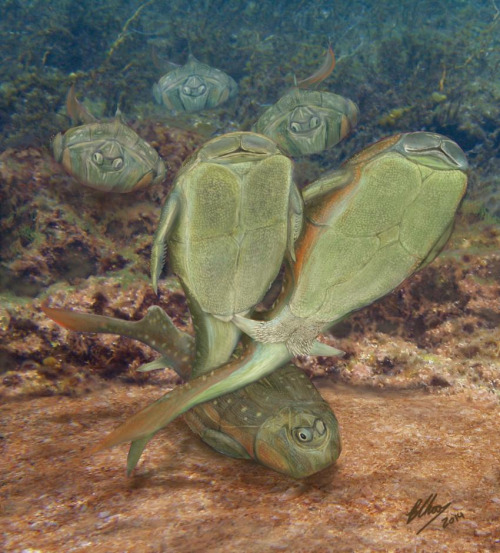
Sex? It all started 385 million years ago
It may not have been love as we know it, but around 385 million years ago, our very distant ancestors—armoured fish called placoderms—developed the art of intercourse.
So suggest a team of evolutionary scientists, who point to the fossil of a placoderm species blessed with the name of Microbrachius dicki.
Measuring about eight centimetres (four inches) in length, M. dicki lived in habitats in modern-day Scotland—where the first specimen was found in 1888—and in Estonia and China.
Placoderms have previously been found to be the most primitive jawed animal—the earliest known vertebrate forerunner of humans.But they now have an even more honoured…
(read more: PhysOrg)
illustration: Dr. Brian Choo/Flinders Univ.
So my Facebook newsfeed is filled with posts about this and people commenting that “Scots invented sex”! Which reminded me of this book called How the Scots Invented the Modern World! Fitting ;)
A somewhat more accurate answer to the literal meaning of “old as fuck”. (As I recall, that previous post used the specialisation of gamete types to define “fuck”.)
Tags:
#the more you know #the power of science #biology #history
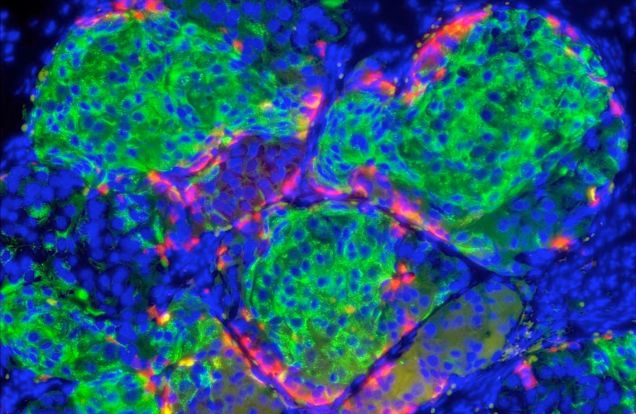
Did Scientists Just Develop A Viable Cure For Type 1 Diabetes?
In what’s being called one of the most important advances to date in the field, researchers at Harvard have used stem cells to create insulin-producing beta cells in large quantities. Human transplantation trials could only be a few years away.
Above: human-stem-cell derived beta cells. (Douglas Melton)
By using human embryonic stem cells, a research team led by Doug Melton created human insulin-producing beta cells that are virtually equivalent to normally functional beta cells in the kind of large quantities required for cell transplantation and pharmaceutical purposes.
Currently, the cell-derived beta cells are undergoing trials in animal models, including non-human primates.
The results have been published in the latest edition of Cell. In the study, Melton describes a step-by-step procedure that starts with stem cells and results in hundreds of millions of the vital pancreatic cells that secrete the hormone insulin, which keeps blood sugar levels in balance. It’s the lack of insulin produced by those cells — called beta cells — that’s the root cause of type 1 diabetes.
People with this condition often develop serious complications such as as heart disease, stroke, kidney failure, blindness, and premature death. To survive, people with Type 1 diabetes must have insulin delivered by injection or pump. Not to be confused with Type 2, it accounts for approximately 5% of all diagnosed cases of diabetes and affects about 3 million Americans.
Ultimately, these new lab-grown cells could be transplanted into diabetes patients, allowing them to create insulin naturally.
As Melton explains in Harvard Magazine, these cells, “read the amount of sugar in the blood, and then secrete just the right amount insulin in a way that is so exquisitely accurate that I don’t believe it will ever be reproduced by people injecting insulin or by a pump injecting that insulin.”
More from Harvard Magazine:
The cells share key traits and markers characteristic of beta cells with those from healthy individuals, including the packaging of the insulin they secrete in granules. In diabetic mice, they cure diabetes right away, in fewer than 10 days…
…But the how of creating beta cells from embryonic stem (ES) cells—directing the process of differentiation in either embryonic stem cells or induced pluripotent stem cells (derived from adult cells) to make any specific cell type, for that matter—has eluded scientists for more than a decade. Recapitulating the normal development program in a petri dish has proven extremely complicated, because a protein signal that has a certain effect at one stage of the process—guiding an ES cell to become, for example, one of the embryonic “germ layers” such as endoderm (from which the gut, liver, and pancreas develop)—might have an entirely different effect at a later stage, or in a higher concentration, or within a different environmental niche in the body.
The discovery reported today in Cell was thus not the result of serendipitous biological code-breaking, says Melton, but rather of “hard work.” “What we did to solve this problem is study all the genes that come on and go off during the normal development of a beta cell in mice and in frogs and in the human material that we could get access to. Once we knew which genes come on and go off, we then had to find a way to manipulate their activity…with inducing agents.” Melton and his team tested hundreds of combinations of small chemicals and growth factors before hitting on a six-step procedure in which two or three factors are added at each step, and in which the factor, its concentration, and the duration of its application all mattered.
The result was a scalable differentiation protocol that will be usable in industrial production of beta cells.
But as the Boston Globe reports:
Melton cautions that the work is still years from being tested in patients and many challenges, scientific and practical, remain. But he is gratified to have reached this point and even more motivated to continue, so as not to disappoint the millions of people who suffer from type 1 diabetes, which is usually diagnosed in children and young adults.
“We’re tired of curing mice,” Melton said in an interview. “Most patients are sick of hearing that something’s just around the corner; I’m sick of thinking things are just around the corner. But I do believe in the big picture.”
Melton hopes the cells could be ready to be tested in people in a few years. Already, cells are being transplanted into primates through a collaboration with a researcher in Chicago.
Melton’s work is expected to energize the diabetes research community.
It’s important to note that this discovery did not happen overnight. It arrived through the hard work of 50 graduate students and postdoctoral researchers who have worked on the project over the last 15 years.
Much more about this remarkable breakthrough at Harvard Magazine and The Boston Globe.
Tags:
#the power of science #medicine #diabetes

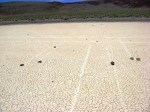
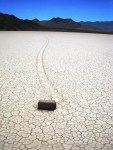
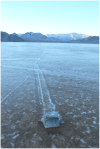
The mystery of the roaming rocks of Death Valley’s Racetrack Playa may be at an end. Since their discovery in the 1940s, researchers have speculated about what conditions on the playa could cause 15+ kg rocks to slide tens or hundreds of meters across the dry lakebed. But the rare nature of the movement and the remoteness of the location had prevented direct observation of the phenomenon until last December when a research team caught the rocks in motion (see the timelapse animation above or the source video). Winter rain and snow had created a shallow ice-encrusted pond across the playa by the time the researchers arrived to check their previously installed equipment. Late one sunny morning, the melting ice, only millimeters thick, cracked into plates tens of meters wide and began to move under the light breeze (~4-5 m/s). Despite its windowpane-like thickness, the ice pushed GPS-instrumented rocks up to hundreds of meters at speeds of 2-5 m/min. It took just the right mix of conditions—sun, wind, snow, and water—but the two ice-shoving instances the team observed go a long way toward explaining the sailing rocks. (Image credits: R. Norris et al.; J. Norris, source video; NASA Goddard; via Discover and SciAm)
I always thought of these rocks as Earth’s real-life version of Doctor Who’s Weeping Angels. We knew they moved, it just never happened while we were looking (although the rocks of Racetrack Playa, to the best of my knowledge, are not and were never trying to kill us).
Mystery solved!
Tags:
#the power of science #the more you know #they’re going to have to rewrite my geology textbook #(though it did say they *suspected* it had something to do with ice layers)