Anonymous asked: I’m curious if you have any hypotheses about possible causes for human relationships existing on such a wide spectrum including anything from totally exclusive monogamy to totally inclusive polyerosy. The more I look, the more I notice humans seem to have more “relationship styles” than any other mammal and I can’t help wondering if there’s some genetic/instinctive/physiological reason behind it. Your thoughts?

koryos:

Well, to start with, I wouldn’t actually say that humans have more relationship styles than any other mammal. I think that the issue is that how we look at human behavior and how we look at animal behavior are very different things- obviously, we have a much more detailed and nuanced view of our own species than any other.

It’s important to remember that most science is consumed by the idea of the average. That is, if we were trying to write a description of how an animal behaves, we’d describe what we saw happening the most often. This is a useful way to look at things, because it allows us a way to generalize populations. But this does not mean that that is the only way that things will happen.

If you tally up the human species by culture, you will find that about 85% allow occasional or frequent polygyny (the practice of one man marrying multiple women). That’s a huge percent, and if an alien researcher were examining human behavior and saw that statistic, they might conclude that humans are overwhelmingly polygynistic.

Of course, it’s a little more complex than that, because even among cultures that permit polygyny, most men only marry one woman. Generally, in these cultures, having multiple wives relates to a man’s wealth and resources. This is similar to mating behavior in, say, the red-winged blackbird. Males with the best territory will often attract more than one female. This also occurs in red foxes, which all the literature will tell you are a monogamous species: under the right conditions, male foxes may take more than one female mate.

We, as humans, are familiar with many more relationships within our own kind than monogamy and polygyny, of course, but that’s because we live and breathe human behavior every single day. We rarely spend so much time with animals, particularly animals that are breeding, which is why we might assume that their behavior is static or can be easily categorized. This is simply false. The “averages” that science looks for are generally the widest part of a vast spectrum of behaviors.

Normally, what we find in animals is that the degree of behavioral flexibility relates to how specialized an animal is. If a species lives in only one type of environment, with only a few resources it is designed to use, it may not need the behavioral flexibility that leads to multiple mating types. The opposite is true for humans; we are arguably one of the best generalist species around. We live in a myriad of habitats utilizing a myriad of resources and thus, arguably, have the capacity to accommodate a range of sexual lifestyles.

This is, of course, a gross oversimplification of human behavior, as everybody who is human knows. It doesn’t at all take into account the individual- their desires, their values, their history, et cetera. This is a degree closer than most science goes, and it goes for humans as well as animals. Individual animals will have their own behaviors and preferences just like humans do. We just look at them from much further away than we do ourselves.

Further Reading:

Different trends in human culture: Gray, J. P. (1998). Ethnographic atlas codebook. World Cultures, 10(1), 86-136.

Not only are red-winged blackbirds polygynous about half the time, they also show a high degree of promiscuity and polyandry: Westneat, D. F. (1993). Polygyny and extrapair fertilizations in eastern red-winged blackbirds (Agelaius phoeniceus). Behavioral Ecology, 4(1), 49-60.

One study found that about half of red fox litters were not the product of a monogamous male-female couple; both polygyny and polyandry occurred among the remainder: Baker, P. J., Funk, S. M., Bruford, M. W., & Harris, S. (2004). Polygynandry in a red fox population: implications for the evolution of group living in canids?. Behavioral Ecology, 15(5), 766-778.

Greylag geese most often form male-female bonds, but under some circumstances they may form male-male or male-male-female bonds: Sommer, V., & Vasey, P. L. (Eds.). (2006). Homosexual behaviour in animals: an evolutionary perspective. Cambridge University Press.

Marmosets and tamarins display a range of mating styles, including polyandry, monogamy, and polygyny: Goldizen, A. W. (1988). Tamarin and marmoset mating systems: unusual flexibility. Trends in ecology & evolution, 3(2), 36-40.

These are all just examples of animals with highly flexible mating styles that I came up with off the top of my head. There are many more species where differing mating styles are less common and therefore less frequently documented, but still exist.


Tags:

#interesting #the more you know
libutron:

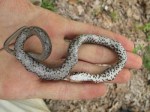
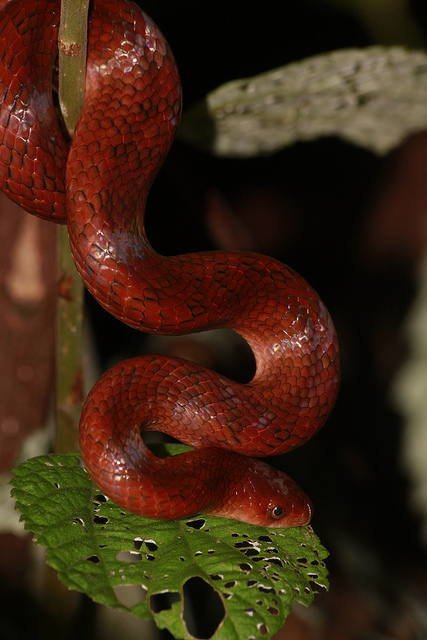
Golden Kukri Snake – Oligodon cinereus

With about 75 currently recognized species, the genus Oligodon (Colubridae) is one of the largest genera of Asiatic snakes. It is widespread throughout tropical south and southeast Asia. 

The geographic distribution of Oligodon is complex, and also its taxonomy. Several species are widespread and many have overlapping ranges. Oligodon cinereus (in the photo) is in fact a complex species with a highly variable coloring pattern.

These non-venomous snakes are usually nocturnal and often brightly colored. They feed primarily on the eggs of birds and reptiles. The morphology of their teeth is very effective for cutting open eggs, so much that the common name of the kukuri snakes derives from a distinctively shaped Nepalese knife, the kukri, because the hind teeth of the snakes are broad and strongly recurved, much like the shape of the kukri.

References: [1] – [2]

Photo credit: ©Anne Devan-Song | Locality: Hong Kong (2012)


Tags:

#snake #pretty things #the more you know

rhamphotheca:

Snake Poop and The Adaptive Ballast Hypothesis

by Andrew Durso

Most people probably spend as little time as possible thinking about poop, especially snake poop. Some animals produce enormous amounts of poop, like dairy cows. Others make lots of little poops – up to 50 a day in small birds.  

In contrast, snakes don’t poop much at all. In fact, because they eat so infrequently, snakes probably poop the least often of almost any animal. Anyone who has kept a snake as a pet can tell you that a few days after they’re fed, most snakes tend to poop once (often in their water bowls, for some annoying reason), and they might poop again within a few more days.

Like bird poop, snake poop is made up of two parts – the brown stuff (the fecal fragment, aka the actual poop) and the white stuff (the uric acid fragment, aka the pee, in a solid form). Also like birds, most reptiles use uric acid rather than urea to excrete their excess nitrogen, which helps them conserve water.

You wouldn’t think there would be much that’s interesting about snake poop, but to a snake biologist everything about snakes is interesting. In 2002, Harvey Lillywhite, Pierre de Delva, and Brice Noonan published a chapter in the book Biology of the Vipers that detailed their studies on snake poop.

Their most amazing finding was that some snakes can go for a really, really long time without pooping. As in, over a year. It’s not because they’re constipated though – these long fecal retention periods have actually evolved for a purpose in snakes.

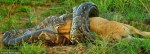
Here’s what happens: most snakes eat very large meals, and they eat them all in one piece. That means that when a snake eats a meal, its body mass can more than double all at once, and it can only digest that meal from the outside in, because it hasn’t chewed or cut it up into small pieces to increase its surface area. Even for the insane digestive tract of a snake, this is an incredible feat…

(read more: Life is Short, Snakes Are Long)

photos: A. Durso, Pedro Rodriguez, and Cater News Agency


Tags:

#snake #poop #the more you know #you know how pretty much every kid goes through an -ology phase? #mine was herpetology #so my inner nine-year-old is pretty happy right now #(though the later versions of me find it a bad sign that this guy thinks it’s okay to link to *Dr. Oz* as a reputable source) #(but you can’t have everything) #(and he did pick a very nice blog title)

jtotheizzoe:

fuckyeahfluiddynamics:

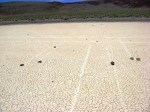
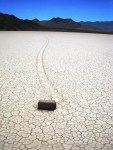
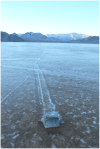
The mystery of the roaming rocks of Death Valley’s Racetrack Playa may be at an end. Since their discovery in the 1940s, researchers have speculated about what conditions on the playa could cause 15+ kg rocks to slide tens or hundreds of meters across the dry lakebed. But the rare nature of the movement and the remoteness of the location had prevented direct observation of the phenomenon until last December when a research team caught the rocks in motion (see the timelapse animation above or the source video). Winter rain and snow had created a shallow ice-encrusted pond across the playa by the time the researchers arrived to check their previously installed equipment. Late one sunny morning, the melting ice, only millimeters thick, cracked into plates tens of meters wide and began to move under the light breeze (~4-5 m/s). Despite its windowpane-like thickness, the ice pushed GPS-instrumented rocks up to hundreds of meters at speeds of 2-5 m/min. It took just the right mix of conditions—sun, wind, snow, and water—but the two ice-shoving instances the team observed go a long way toward explaining the sailing rocks. (Image credits: R. Norris et al.; J. Norris, source video; NASA Goddard; via Discover and SciAm)

I always thought of these rocks as Earth’s real-life version of Doctor Who’s Weeping Angels. We knew they moved, it just never happened while we were looking (although the rocks of Racetrack Playa, to the best of my knowledge, are not and were never trying to kill us). 

Mystery solved! 


Tags:

#the power of science #the more you know #they’re going to have to rewrite my geology textbook #(though it did say they *suspected* it had something to do with ice layers)

Ω

abandonedgod:

Even though I love this idea of Gallifreyans as a species having prosopagnosia, I’m still not sure if it’s actually true, since the Doctor has the habit of commenting his face and it’s distinct features (the chin, the eyebrows, i.e.) relatively often. I don’t know much about prosopagnosia and therefore I’m not sure whether it’s possible for people having/suffering from it to make such remarks. Does anybody know something more about that?

We can totally do that! In fact, things like distinctive eyebrows or sticky-out ears (the focus of Nine’s comments) are a big part of how we tell people apart.


Tags:

#prosopagnosia #tales from the prosopagnosia tag #reply via reblog #the more you know #(still haven’t watched The Caretaker by the way but have now watched Time Heist)

{{next post in sequence}}

queenofgnarnia:

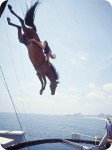
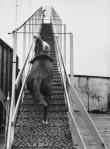
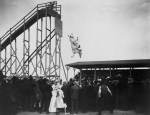
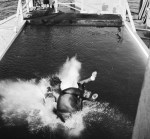
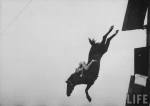
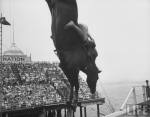
Horse diving. The eerie, bizarre old pastime that some how manages to sustain a sense of beauty.


theeventingblog:

Wasnt there a blind girl who did this? I thought someone said there was a movie or something about her…


wishhunter:

Yes there was a movie about her and her blind horse


equitating:

She lost her sight diving!


train-to-win:

Anyone know the name of the the movie? That would be interesting to see. I can’t believe people did this and got horses to do it, scary as fuck


fromthehaunches:

the movie is Wild Hearts Can’t Be Broken


equestrianchicpoverty:

what the actual fuck? how does one train a horse to jump off that high of a cliff? did the eventers start this? how many people died? i am so interested.


fivegaited:

Wild Hearts Can’t Be Broken is one of my favorite movies


lusitanoqueen:

i feel like i’m the only one who disapproves of making horses jump into water from that great of a height … even if they’re trained it must have been terrifying and i can only imagine the kind of injuries horses sustained


fivegaited:

Oh no, I think we all disapprove.  I sincerely doubt anyone is reblogging this thinking, “hey, let’s bring horse diving back!”  I hope, at least, that we’re all pretty glad to see this be a thing of the past, but we can still admire the bravery of the girls and the horses – if you watch the old videos, it’s pretty cool how the horses ran up the ramps at liberty and leapt off.  I’ve done some research on this, and from what i can tell, there are no recorded horse injuries.  The statistics I’ve found showed that the girls  broke bones pretty much annually, but everything I’ve ever read says there were zero horse injuries.  Of course, just because they weren’t recorded doesn’t mean they didn’t happen.  Probably they did, but tbh… I think a lot more horses get hurt in the show jumping ring and on cross country courses every year than ever got hurt doing this.  Horses die on cross country every year, and on the racetrack.  Once the horses were trained and knew the routine, I kind of doubt it would be more terrifying than any of the other dangerous and unnatural things we ask horses to do – like running around with humans clinging to their backs, letting people shoot guns from their backs, chasing cows with big giant horns, jumping over ditches and into water on cross country courses… I have no idea how they trained for this and it wouldn’t surprise me if it was pretty aversive and possibly downright cruel training (a lot of american horse training back then was), but I also have no doubt that a horse could be taught to do this, and to do it eagerly, using positive reenforcement – and some of what I’ve read claims they DID train with food rewards, at least in part – here’s one testimony from a former diving girl:

They went when they were ready. I can’t say the groom would not try to encourage the horse a little bit by gently nudging or pushing, but he wouldn’t dare do anything drastic. That would have upset me to no end. I wouldn’t want to be on a horse that was agitated. My life depended on that horse doing that in a calm way, so there was no electrical devices or trap doors or anything like that during my time.

Lorga (another diving horse) did take a long time. I remember Lorena Carver saying ‘Come,’ with carrots in her hand. But you waited. Sometimes it was five minutes.

I would ride the horse until he got out of the tank. Lorena Carver would be standing on the stage of the tank and the horse knew to go to her, get his reward, and the blanket was thrown on quickly. That was the end of the act.

You [the customers] could go in the stalls, along the walkway towards the end of the Pier and in front of the Ballroom, and see the horses through glass panels and how they were kept and fed. They were very well kept. They would ride the horses on the beach in the morning and they loved to go in the water and run along the waves.
We didn’t keep them if they didn’t like the water. I would have noticed if there had been anything unkind because I love animals. They were never in any way hurt or disrespected. In fact, they were taken care of better than the riders were! The ASPCA gave us plaques of approval that were always on the dressing room wall. When Gene was in the show with me he’d bring me a towel, but the horse was the one that got the blanket! The horse was the star.”

Don’t get me wrong, I think diving is pretty damn unnecessary, super dangerous, and I’m very GLAD it’s pretty much a thing of the past.  But what bothers me more than the act itself, actually, is that the horses were kept stalled all the time and led lives on the road traveling in horse vans constantly – that’s a stressful and unhealthy life for any horse (even if the horses don’t know it), and it’s a life that plenty of show and race horses still lead today.  Anyway, I think this diving stuff was ballsy as hell and to me it’s a cool part of horsey history that I enjoy learning about.  I in no way advocate it today.  Sonora, the diving girl who went blind, wrote a book that’s a fun read if you’re interested in learning more.  This article is a fun, brief summary as well :)


Tags:

#horse #history #the more you know

corvidae30:

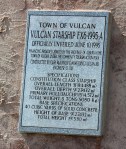
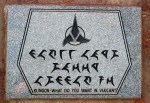
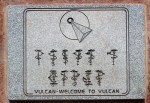
– Vulcan, Alberta –

  Vulcan is just about an hour south of Calgary  The town was named in 1915 after the roman god of fire, and the original streets were named after various roman deities. Somewhere along the way, somebody in the community made the Star Trek connection, and the local tourism board ran with it, in a big way. 

  Aside from the Trek themed tourism information building, the street signs are all Trek themed, the county admin building has trek themed signage, there is a Trek museum, and murals depicting Star Trek characters all over town. There is an annual Star Trek convention called Spock Days.


Tags:

#Star Trek #our home and cherished land #the more you know #(I don’t think I’ve ever seen Vulcan script before) #(it looks even more complicated than Bajoran)

batmansymbol:

Hostile and self-centered, Clariel makes an interesting (if not entirely likable) protagonist; her depiction as (emphatically!) asexual and aromantic is refreshing […] A thunderstorm of a tale, bitter and brutal but dazzling in its ferocity.

Kirkus. and i didn’t think i could get MORE excited for garth nix’s upcoming CLARIEL, prequel to the old kingdom trilogy (aka the Abhorsen series). representation!

for those interested … it comes out october 14th and it’s gonna kick ass


Tags:

#Abhorsen #oh hey there’s a new Abhorsen book coming out? #I find the repeated use of words like ‘selfish’ and ‘self-centered’ in the description suspicious though #I’m worried it’s going to be another one of those stories that’s like #Heroic Sacrifices Are the Bare Minimum of Decency #If You Are Unwilling to Make Them You Are a Villain in the Story of Life #you know #that kind of bullshit #and anyway I haven’t even read A Confusion of Princes yet