redbeardace:

redbeardace:

Oh, Tumblr, thanks for hiding a really important reblog with some really important commentary from me.  What else are you pretending hasn’t been said?

In just a minute or so, I’ve found two more cases where this happened.

That means it’s happening all the time.

WHAT THE HELL.

Were they all first-degree reblogs of asks? Reblogs of asks, if they are reblogged directly from the OP, show up as commentary-less in the notes regardless of whether they actually lack commentary. Reblogs of reblogs do show commentary. (I don’t remember if the intermediary reblog needs to have commentary or not, but I don’t think it does.)

This is a long-standing and widely known bug, but not always widely known enough.

(Probably we should adopt a social norm of avoiding commentary on first-degree ask reblogs. If one really wants to reblog an ask to respond to it, and there isn’t already a first-degree reblog available, one first reblogs it without commentary (perhaps a small note to one’s followers that one is about to add something) and then reblogs oneself to add the commentary.)

(Is there some sort of centralised wiki or something for unofficial Tumblr documentation? Spreading each individual fact through word of mouth does fit with the general usage style of Tumblr, but the coverage isn’t always that great.)


Tags:

#reply via reblog #Tumblr: a User’s Guide #the more you know #I know I’m supposed to complain here about the ”blue hellsite” #but honestly I can’t be bothered to give a shit #it is what it is

{{next post in sequence}}

Anonymous Collections and Disappearing Works: An AO3 Mystery (that’s not actually a mystery at all)

wrangletangle:

I’ve seen several people in the past 2 weeks post in utter confusion about their works disappearing after they were notified that they’d been added to a collection – or not notified at all. This sounds like a deep mystery, but it’s not.

A somewhat new feature on AO3 is the ability to invite works to a collection. Each user can set their preference to either accept all such invitations automatically or decide each one manually. You can also set whether to be emailed about invitations or not. These settings are under your “Preferences” menu, in the “Collections, Challenges and Gifts” section.

Recently, several users have started creating collections instead of using personal bookmarks for a topic. This is fine! These users then started inviting works to those collections. Also fine! That’s what the system was designed for.

Some of those collection owners got excited about the Anonymity function that collections can turn on or off. They decided to make their collections anonymous. To protect anonymity, if a work is listed in a collection that is set to anonymous, the work does not appear on your personal works page. This makes sense if you enter a challenge and it has an anonymous period before reveals – having the work appear on your personal works page would break anonymity pretty badly!

Unfortunately, I think most people setting Anonymity on these new invitation-only collections don’t realize that they’re making people’s existing works disappear from their works pages. If you have “Automatically agree to your work being collected by others in the Archive” and “Turn off emails from collections” both checked, your work might seem to literally vanish. Someone adds it to their collection, you don’t get an email because you turned those off, and you never find out what happened.

However! There’s a very simple solution.

  • Go to your works page (http://archiveofourown.org/users/YOUR USERNAME/works).
  • Select the button “Works in Collections”.
  • All your works in collections will pop up, and all the collections will be listed in the filters.
  • Skim down to find your missing work, or use the filter list to look for a collection you don’t remember seeing before and filter by it.
  • Edit your work.
  • Under “Post to Collections / Challenges”, press the “x” beside the collection’s name.
  • Save your work.

This will remove your work from the collection – for now. If this happened to you, I highly recommend turning off “Automatically agree to your work being collected by others in the Archive” in your preferences to avoid the work being re-added to the collection by a confused collection owner who doesn’t understand what happened.

Collection owners, please make sure you understand what Anonymity does before enabling it! For most invitation-only collections, it doesn’t make sense to enable that, because the works already exist and have names attached to them on the archive.


copperbadge:

This is a helpful FYI! This happened to me – I approved adding Exclusive to a collection because I didn’t know anything other than “yay someone likes my work”, and Roos let me know this morning that my work was showing up as orphaned. I was very worried until I saw this post. Went in and removed it from the collection someone had added it to, and it no longer looks orphaned. Thank goodness.


tehnakki:

Copperbadge Posted ''Exclusive'' (Again)

Haha, and apparently yanking your fic back from a collection results in a notification to subscribers that you’ve posted a new work.


copperbadge:

Oh nooooo, I have faked everyone out! D:


enmuse:

This is super helpful to know because I’ve been trying to FIND fic and maybe this is accounting for some of the issues. If I get a direct link (like from a tumblr account I happened across) I can get the fic. BUT the story doesn’t end up in tags I follow.

This just happened with a Bucky/Tony story. Drives me batty to suspect that there’s more WinterIron stories I could be reading but don’t know about D:


wrangletangle:

Hm, @enmuse, that sounds like a different situation entirely. Collections don’t remove works from the tags. Could you contact the Support team at the “Technical Support & Feedback” link at the bottom of every AO3 page, to give them a link to the work and a list of tags it’s tagged with but not showing in? It sounds like a rare but known bug, and they’ll know how best to fix it. (This also goes for anyone else who finds a work older than 2 weeks that’s tagged with a thing but not showing in the tags for that thing.)


coaldustcanary:

Actually, a much quicker solution (speaking as a support volunteer) is to let the author know about the issue in a comment, and suggest they Edit the work or the most recent chapter of the work and then Post Without Preview (they don’t actually have to change anything in the work!) to nudge the Archive into re-indexing the work in question.

If you contact us in Support as a work creator, this is the first thing we’ll suggest you do, and it solves the problem more than 90% of the time. It’s also much faster than the necessary steps on our end to talk to a tag wrangler or database volunteer to shake the archive on our end!

Of course, if this doesn’t work, definitely put in a ticket!


wrangletangle:

Well there you are, a better answer from someone who fixes things regularly. Thanks, coaldustcanary!


cosmic-llin:

As far as I know this is also a problem if you add works to a new collection that are also in an old collection (usually a challenge) with hinky anonymity settings – I had some trouble with this with the Women of Star Trek collection when I invited works that were also in older collections, where individual works had been revealed but the overall collection was set to Unrevealed or Anonymous. Adding them to the collection reset them to being unrevealed/anonymous.

Also, as someone with tons of pending invitations to my collection, I’m partly reblogging this just because I wish more people knew about collections generally and checked their collection invitations! It’s a really useful bit of the site!


Tags:

#AO3 #the more you know

omg why do white ppl love cheese so mu-

kanirou-crosshack:

bemusedlybespectacled:

wyomingsmustache:

100-manslayer:

trained-chimpanzee:

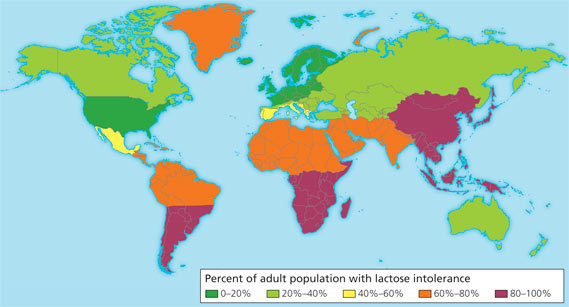
Lactose Intolerance Map

I actually didnt know that

The answer is apparently “because we’re actually able to eat it”

Fun fact: white people (specifically Northern European white people) have a genetic mutation that allows them to digest lactose even after weaning, which is abnormal for all mammals and also most humans. It’s theorized that because Northern Europe doesn’t get a lot of sun, an alternative source of vitamin D (like milk) would be a useful trait. It’s a very recent mutation that would only have happened after humans started domesticating animals like cows and goats.

oh no, my bizarre moment has come, cause lactose tolerance is actually A Thing I Know About because it’s played a fascinating role in human evolution for thousands of years. This chart displays some of the broad trends, but it’s giving near continental averages, which doesn’t showcase how this kind of thing really breaks down and some of the surprising exceptions. 

Lactose tolerance is the majority trait for only a very few population groups: North Europeans (and therefore populations that draw heavily from that stock, such as America,) nomadic central Eurasians, and sub-Saharan pastoralist Africans, but that latter group is often overlooked. The vast majority of Africans cannot process lactose, but certain people groups whose lifestyles have revolved around cattle for thousands of years will have 80% and even approaching 100% lactose tolerance rates. They’d be spots of dark green amidst a sea of orange and burgundy on the above chart. 

Our hunter-gatherer ancestors were almost entirely lactose intolerant, that is definitely the biological norm (and people groups who maintained that lifestyle, such as Native Americans, remained as such – along with groups who transitioned to sedentary agricultural lifestyles, but I’ll get into that). As such, lactose tolerance is an adaptive trait that only became prevalent in environments that exerted strong selective pressure for it. So, cows were domesticated some 10,000 odd years ago in the Middle East (and some have contended for an independent domestication event in Africa as well). In either case, cattle quickly spread across the continent and we know there was milking and cheese production at least 6,000 years ago in both the Nile and Mesopotamia. While cow meat would have been enjoyed by all, in agricultural societies milk and cheese would have been options, but hardly staples as there were plenty of other things to eat as well, and therefore there would have been no selective pressure for processing lactose. Also, sedentary societies had ways of processing milk and cheese that allowed lactose intolerant people to drink/eat dairy products. Fermenting milk or aging cheese breaks down lactose, making it a non issue once ingested. This is why fermented milk may seem utterly foul to many Westerners, but is extremely common in other parts of the world. But, fermentation and aging requires time, and the ability to store things in a single location for weeks or even months. Sedentary societies adapted the milk to fit their biology, but nomadic societies did the reverse.

There are still mobile pastoralist societies in Africa today, and there have been for thousands and thousands of years. For many of them, cows are not one of many dietary options, they are the single dietary staple around which their lifestyle revolves. Biologically, this means you gotta get with the program if you wanna survive. For most mobile tribes, fermentation and aging weren’t options, so there would have been strong selective pressure favoring those who could drink milk straight outta the cow, as they would have had an additional, highly nutritious food source available to them. Milk also allowed for a marked shortening of the weaning process, transitioning children from breastmilk to cow’s milk, which would again be advantageous for groups where both the men and women work and are always on the move. Over generations these populations specialized into essentially cow-based lifestyles, creating a survival niche highly advantageous to them, and fast forward thousands of years and there are groups in Africa with near ubiquitous lactose tolerance, while the rest of the continent (and the world really) is nearly entirely intolerant. 

Many of these same factors would have influenced the central Eurasian populations, which is why Mongolians and other descendants of nomadic steppe peoples are largely lactose tolerant, as mare’s milk would have been a dietary staple (though they also developed efficient ways to ferment it). 

North Europeans developed lactose tolerance in response to deficiencies in certain nutrients. The northern climate limited Vitamin D production, and the agricultural products available to them were often low on calcium and protein, and so dairy farming developed alongside agriculture to create a more rounded diet (and this was limited to Northern Europeans, as Mediterranean peoples such as the Romans wrote about their great confusion at the northern barbarians’ ability to drink fresh milk)

And I promise all of this is fascinating because the ability to process lactose evolved independently in several different population groups and in response to different factors: lifestyles revolving around cows, lifestyles revolving around horses, deficiencies in climate and agriculture. Besides providing insight into human history and biology, lactose tolerance is also a great example of convergent evolution, where different genetic populations in different environments produce similar results. 

And uh, that’s my rant about the role of milk and lactose tolerance in human evolution. 


Tags:

#the more you know #food #history #I’m lactose-tolerant and dairy accounts for a fairly large chunk of my caloric intake #sometimes before eating it I take a moment to appreciate my dairy-farming ancestors giving me this option #thank you dairy-farming ancestors #(I was worried this post was going to be more fucking foodshaming) #(but then it went well)

Blind people gesture (and why that’s kind of a big deal)

wuglife:

superlinguo:

People who are blind from birth will gesture when they speak. I always like pointing out this fact when I teach classes on gesture, because it gives us an an interesting perspective on how we learn and use gestures. Until now I’ve mostly cited a 1998 paper from Jana Iverson and Susan Goldin-Meadow that analysed the gestures and speech of young blind people. Not only do blind people gesture, but the frequency and types of gestures they use does not appear to differ greatly from how sighted people gesture. If people learn gesture without ever seeing a gesture (and, most likely, never being shown), then there must be something about learning a language that means you get gestures as a bonus.

Blind people will even gesture when talking to other blind people, and sighted people will gesture when speaking on the phone – so we know that people don’t only gesture when they speak to someone who can see their gestures.

Earlier this year a new paper came out that adds to this story. Şeyda Özçalışkan, Ché Lucero and Susan Goldin-Meadow looked at the gestures of blind speakers of Turkish and English, to see if the *way* they gestured was different to sighted speakers of those languages. Some of the sighted speakers were blindfolded and others left able to see their conversation partner.

Turkish and English were chosen, because it has already been established that speakers of those languages consistently gesture differently when talking about videos of items moving. English speakers will be more likely to show the manner (e.g. ‘rolling’ or bouncing’) and trajectory (e.g. ‘left to right’, ‘downwards’) together in one gesture, and Turkish speakers will show these features as two separate gestures. This reflects the fact that English ‘roll down’ is one verbal clause, while in Turkish the equivalent would be yuvarlanarak iniyor, which translates as two verbs ‘rolling descending’.

Since we know that blind people do gesture, Özçalışkan’s team wanted to figure out if they gestured like other speakers of their language. Did the blind Turkish speakers separate the manner and trajectory of their gestures like their verbs? Did English speakers combine them? Of course, the standard methodology of showing videos wouldn’t work with blind participants, so the researchers built three dimensional models of events for people to feel before they discussed them.

The results showed that blind Turkish speakers gesture like their sighted counterparts, and the same for English speakers. All Turkish speakers gestured significantly differently from all English speakers, regardless of sightedness. This means that these particular gestural patterns are something that’s deeply linked to the grammatical properties of a language, and not something that we learn from looking at other speakers.

References

Jana M. Iverson & Susan Goldin-Meadow. 1998. Why people gesture when they speak. Nature, 396(6708), 228-228.

Şeyda Özçalışkan, Ché Lucero and Susan Goldin-Meadow. 2016. Is Seeing Gesture Necessary to Gesture
Like a Native Speaker?
Psychological Science

27(5) 737–747.

Asli Ozyurek & Sotaro Kita. 1999. Expressing manner and path in English and Turkish:
Differences in speech, gesture, and conceptualization. In Twenty-first Annual Conference of the Cognitive Science Society (pp. 507-512). Erlbaum.

Incredible! I have nothing to add because I had no idea, but may I just say **WOW**!!!


Tags:

#language #the more you know #the power of science

not gonna say it again!!!!

thisairlockispants:

theskaldspeaks:

ofools:

ofools:

a BOG is a wetland that is acidic

a FEN is a wetland that is alkaline

i feel bad about ppl being like “Wow this is helpful information! thank you!” because honestly when is this knowledge going to be useful

In writing, obviously. Writers are all about random useless facts. I know you know that.

And you gotta know where to store your butter so it’s still good in 2,000 years.


Tags:

#language #the more you know

support:

staff:

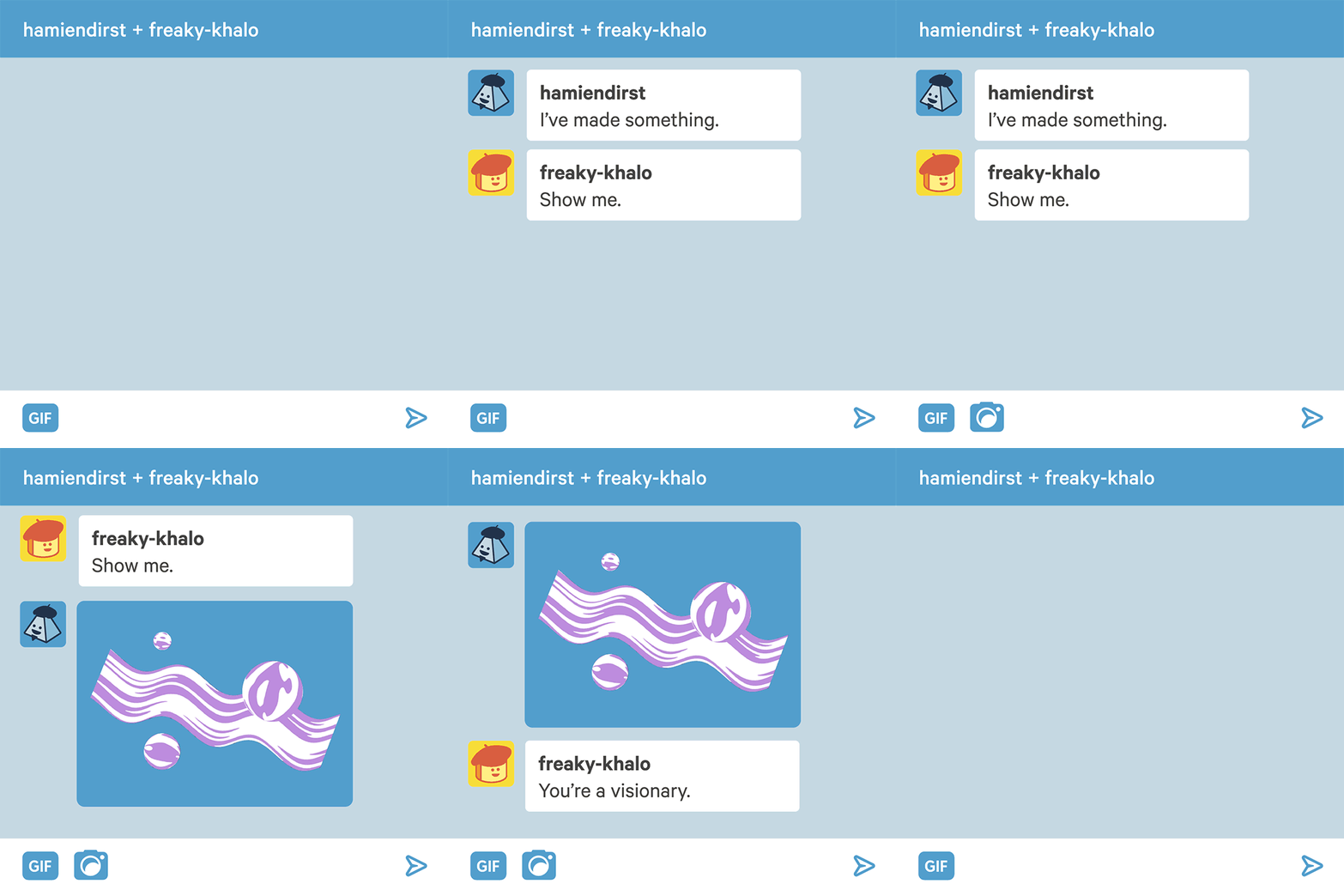
Now you can send pictures in messaging

How?

  • Open a conversation.
  • Tickle that new camera button next to gif search.
  • Choose an image and send. 

Whoosh. Off it goes. No post required. 

Bonus thing: if you’re on the web, you can just drag the image right onto the conversation. No clicking. How ‘bout that.

Thanks, Staff!

We’d also like to point out a helpful little item: If you don’t follow someone, the images they send you will be blurred out. Just so there are no surprises.

Once you tap or click the photo, the blur goes away—and any future photos from that Tumblr will send in the clear.

You can’t re-blur a photo, but you can block the sender if you don’t want to receive any more messages or images. Open the menu (the three dots) at the top right of the conversation and hit block.


Tags:

#The Great Tumblr Apocalypse #the more you know

support:

staff:

Another reason to turn on replies: Starting today, you can delete any unwanted ones from your post notes. Just tap the note you don’t want to see, select the relevant option, and away it’ll go. (If it’s not on your own original post, tapping the note lets you report it to our support team.)

You can also hide inappropriate reblog comments using the same technique.

Just a little tweak to give you more control over your notescape. Enjoy.

Have you heard the good news? Now you can delete and report replies.


Tags:

#PSA #the more you know #The Great Tumblr Apocalypse

The Rationalist Stereotype Survey

{{previous post in sequence}}


socialjusticemunchkin:

Now with a scoring guide (choose one or none from each sub-category)

Age:

  • 21-25 years +1
  • 16-20 +½
  • 26-30 years +½

Jewishness:

  • Yes +1
  • Kind of + ½

Gender:

  • trans woman (regardless of hormone usage) +1
  • any kind of amab using estrogen +1
  • amab non-binary (no estrogen) +¾
  • other non-cis or dubiously cis (afab trans, agender, magic button trans, etc.) +½
  • cis by default (not magic button trans) +¼

Poly:

  • Yes +1
  • Kind of, or open to the idea +½

Sexuality, part A:

  • gray-asexual or demisexual +1
  • asexual +½
  • asexual and kinky +1
  • kinky +½

Sexuality, part B (replace “sexual” with “romantic” if doing so would give you a higher score):

  • bisexual, pansexual, sapiosexual, any other kind of “gender isn’t really such a big deal”sexual +1
  • any kind of “gender isn’t a massive deal but it’s somewhat of a deal”sexual +½
  • gendersexual, but would take the bisexuality pill +½

Gifted child:

  • very +½ (eg. peerless in one’s childhood environment, or not peerless, but with a highly unusual peer group)
  • quite +¼ (eg. one of the highest-achieving in one’s slightly less highly unusual peer group)

Badbrains:

  • at least 2 of: ADHD, autism, anxiety, depression at least to a sub-clinical but noticeable degree +½
  • one of them +¼

Field:

  • CS student, or working in programming, AI, CS, etc. +1
  • self-learning any of the above +½
  • student or working in mathematics +½

Politics, part 1:

  • supports open borders, or at least massively increased immigration +½
  • supports significantly increased immigration +¼

Politics, part 2:

  • supports basic income by whatever name one wishes to use +½
  • supports some other kind of less bureaucratic, more market-based approach to welfare +¼

Politics, extra questions (can’t increase the total politics score over 1):

  • refuses to identify with ideological labels +½
  • identifies with a weird made-up “non-“ideological label +½ (“futarchy”, “meta-level politics”, etc.)

Geeking out:

  • transhumanist nerd stuff +1
  • any other uncommon and specific nerd stuff +1
  • less unusual SF/F or STEM nerd stuff +½

HPMoR, 3 Worlds Collide, Dragon-Tyrant (add scores from each):

  • has read all of it, or most and intends to finish +1/3
  • has read a lot but doesn’t intend to finish, or is starting +1/6

SSC:

  • regularly +1
  • sometimes +½
  • rarely +¼

I tried to not break legacy results compatibility so most people’s scores should be the same and this would just clarify the questionnaire; if people’s results change, it’s because I’ve changed some things to better reflect the original intent based on data acquired so far (looking especially at you, @sigmaleph, because that “politics” answer was the most stereotypical rationalist thing ever and I’m embarrassed to have overlooked that possibility)


socialjusticemunchkin:

And now I have the result categories as well:

(break ties with Newcomb’s dilemma; one-boxers upwards, two-boxers downwards)

12: The Chosen One

10-12: True Yudbot of the Hivemind

8-10: Stereotypical Rationalist

6-8: Typical Rationalist

4-6: Quite rationalist-adjacent

2-4: Kind of adjacent I guess

0-2: I don’t know how you ended up taking the survey, please tell me your story


ilzolende:

Taking the revised survey!

0.5 age, 1 Jewishness, 0.25 gender, 1 poly, proooobably 2 sexuality, 0.25 gifted, 0.25 badbrains, 1 CS, (tentatively) 0.5 immigration, (tentatively) 0.5 basic income, 1 transhumanist nerdery, 1 fiction, 1 SSC, putting me at… 10.25.

[attaches “True Yudbot of the Hivemind” keychain to keyring, which even without that has more random keychains than it does useful items]


the-grey-tribe:

I wonder if the Jewishness in the rationalist community is just confirmation bias, Jews inviting people from their peer group to join tumblr, or a memetic influence of Jewish scholarship. Like Saul Kripke’s direct reference theory, which applies principles from rabbinic literature and scholarship to the semantics of human language.


brin-bellway:

I kind of figured it’s because Jews and rationalists have similar taste in fiction. I mean, that’s probably not all there is to it, but Luminosity (the first ratfic I read, and so the one where I wasn’t judging it in comparison to other ratfic) definitely reminded me of the books of Jewish folktales I had as a kid. (“Clever, genre-savvy protagonist achieves goals by exploiting loopholes in the laws of nature.”)


justice-turtle:

6.5 typical rationalist, unless I subtract the scores for every “I have no idea what this is” answer, which puts me at a more likely 3.66 vaguely adjacent. ^_^ Lower if “probably Jewish-descended but not at all culturally Jewish” doesn’t count as “kind of”.

(Not really sure what rationalism entails, but I can’t resist a good quiz with scoring, especially when I’m putting off getting ready for school. XD)

Yeah, “kind of adjacent I guess” sounds more like you, since AFAIK you don’t follow anyone relevant other than me.

Not really sure what rationalism entails

(Disclaimer: while I have over a year’s experience now, I’m not some kind of Official Expert or anything, etc etc)

You’ll still find people claiming rationalism is an ideology–to be fair, the label is a legacy from when this was the case–but IME these tend to be non-rationalists from subcultures that think of themselves as ideologies first and cultures never (*cough*socialjustice*cough*). (Which reminds me…but that’s another post. I’ll dig it out of my drafts and finish writing it next.)

Rationalist Tumblr is a social group: a collection of people who generally recognise each other’s usernames and have varying amounts of readership, friendship and frequently (but not necessarily) romance with each other. (A large chunk of the rationalist-sphere consists of a single, complexly interconnected polycule, hence polyamory being listed above as a stereotype.) As a general rule, they enjoy nerding out on transhumanism and philosophy, and can often be found debating ethical thought experiments for fun. Somehow, despite a tendency to treat arguing with someone as a friendly greeting, they manage to be pretty welcoming and reassuring to conflict-avoidant people who are used to walking on eggshells. Maybe it’s the lampshading.

They descend from the commentariat of the blog Less Wrong, but while a modern-day member of the community is expected to be aware of Less Wrong’s existence and have some passing familiarity with the archive (one need not have this passing familiarity upon joining; links will come up during the abovementioned ethical thought experiments), being or having ever been a regular reader of Less Wrong is not required, and one certainly doesn’t have to agree with LW’s stances on things.

You’d probably recognise some of the names yourself, given that…let me go check…yes, all ten of my last ten reblogs were from rationalists. (Admittedly, six of those ten were @lizardywizard. I seem to be on a lizardywizard streak. These things happen.)

(SSC is short for Slate Star Codex, popular blog amongst the community (written by a community member), and source of intriguing-but-usually-tentative ideas and interesting links.)

Personally, I put myself down as “kind of” Jewish when calculating the numbers in the tags of my last post. I expect I could make a good case for being straight-up Jewish, but I don’t want to, and I think that’s telling in itself.


Tags:

#reply via reblog


{{next post in sequence}}

muaddibbler:

I think we should start using more bio terms to describe what hours we’re most active in, because they’re frickin cool.

  • Crepuscular – mostly around dawn and dusk
  • Vespertine – specifically active around dusk
  • Cathemeral – basically whenever: “sporadic and random intervals of activity during the day or night in
    which food is acquired […]”
  • Diurnal – awake in the day, asleep at night
  • Matutinal – most active in the early morning hours

If I had any inkling that this would get reblogged I’d put something like “tag yourself” here (I made this post because I’m feeling crepuscular).


Tags:

#language #the more you know #(I only knew two of these myself) #(”crepuscular” and ”diurnal”) #from what I can tell I’m naturally diurnal but this has been partially suppressed by decades of habit #I was raised sleeping ~2:30 AM – ~noon #(bear in mind I was homeschooled and therefore rarely had anything that *required* me to be awake before noon) #and upbringing dies hard #I’ve managed to push back to ~12 AM – ~9 AM #I like mornings but I haven’t fully managed to shake the feeling that being awake in the morning is Not Done