Yes, of course I’ve heard what the superstitious locals say: “Stay out of the mountains! There’s no shelter on those harsh peaks, and every last combe and glen is infested with killer spiders!”. They say there’s no way to safely cross that mountain range – anyone trying to rest high up on the peaks will die of exposure, lashed by cruel icy winds. Better that, though, than to risk seeking shelter in the forested vales.
The Crawling Death, they call it. Great glossy black eight-legged fiends, some small enough to creep between the rings of your maille, some large as a splayed hand and quick as a cat, and some – so they say – the size of dogs. Or swine. Or cart-horses. The tales have been exaggerated in the telling, of course, since hardly anyone dares venture far into the gullies and ravines that lace between the majestic peaks (most certainly not at night, when the Crawling Death make their appearance, silent as a shadow).
Even if they’re not quite as large as people say, they’re certainly no less deadly. The king’s physicians, who had the unenviable task of tending to the survivors of the last failed expedition, wrote down in stomach-turning detail the precise symptoms of that merciless venom. Erupting blisters the size of a hen’s egg. Flesh blackening, rotting, and sloughing away from the bone. Sweating, drooling, trembling, nausea, vomiting, ranting and raving and spasming like a creature possessed until death seems like a mercy. Others were gripped with a pain unmatched by any wound of war, paired (curiously) with an erection hard as any standing stone.
And yet, in spite of all this, I’m planning an expedition into the mountains. It’s true, I haven’t the equipment with me to safely shelter from the bitter cold above the tree-line, out of the reach of skittering legs and poison-slick fangs. I have no blessing from the gods, and no miracle of alchemy intended to keep the Crawling Death at bay. What I do have, though, is a map. A map from a past age, a more enlightened age, where the cartographers had a decent understanding of the sciences, rather than the encyclopaedic knowledge of rumour and superstition that seems to be the requirement for a mapmaker these days. And from this map – and the journals that I found with it – I have deduced one particularly salient fact, that I am convinced will allow me to make the journey through the supposedly arachnid-infested ravines in perfect safety.
The superstitious peasants might say every last one of those valleys is crawling with deadly poisonous creatures, but in fact, most of them are utterly empty and safe! However, my map has revealed the source of this rumour: Spiders Gorge, which contains over ten thousand spiders, is an outlier adn should not have been counted.
There are really only four known groups of spiders with medically significant venom- the rest can’t do much worse than a bee sting. (Of course, some individuals can have allergic reactions to spider venom, just like bee stings.)
These four groups are: the widows (Latrodectus sp.), the brown spiders (Loxosceles sp.), the Australian funnel web spiders (Atraxus sp.), and the Brazilian wandering spiders (Phoneutria sp.).
Black widows are found across the U.S. and in parts of Africa, Europe, and Asia. Despite their reputation, most black widow bites are harmless. Many are dry, with no venom injected, and about 75% of those that do contain venom only produce localized pain with no other symptoms.
Occasionally, more severe symptoms do develop in the form of latrodectism. This can cause symptoms such as generalized pain, headache, nausea, sweating, and racing heart. Most of these symptoms resolve within a week and for more severe cases, an antivenom is available. There has only been one death recorded from a black widow bite in US in the last 50 years, and it was an elderly man. Several thousand people in the US get bitten by black widows every year without suffering any major ill effects.
The brown spiders include the brown recluse spider, famed for its necrotizing bite. However, as with the black widow, the deadliness of this spider has been greatly exaggerated. Like the black widow, brown spiders are found worldwide. Also like the black widow, their bites are often venom-free, and even envenomated bites produce nothing more than mild irritation.
Here’s a map of where brown spiders are found in the US:
The brown recluse is very rare in Ohio specifically, so you don’t have much to worry about.
Bites with high concentrations of brown recluse venom can produce a necrotic skin lesion that is slow to heal. About 66% of these lesions heal on their own without complications. Those that do not may require skin grafts or corrective surgery. A systemic response, which is the response that may become fatal, occurs in about 1% of bite victims. In the last decade there have been two recorded fatalities from brown recluse bites, and both were young children. And as a matter of fact, there are no confirmed reports of a necrotizing bite leading to amputation.
Interestingly enough, there are lots of reports of brown recluse “bites” from states where there are no brown recluse spiders. Spiders often get blamed for symptoms that come from everything from lyme disease to lymphoma. My state is not within the brown recluse range and I’ve still heard stories from a number of people who insist they were bitten by the spider.
Australian funnel web spiders are found, obviously, in Australia- specifically along the eastern coast. While it is suggested that these spiders are more likely to give “wet” bites than the others on this list, there have been no recorded fatalities from their bites in Australia since 1981!
Brazilian wandering spiders are found in parts of Central and South America and are the most venomous spider on this list. This venom, among other things, may give you a lasting erection, which is why some pharmaceutical companies are researching it for use in erectile dysfunction drugs. These spiders are the famed “banana spiders” because they have been found on shipments of bananas outside of South/Central America; however, there are only seven actual recorded cases of this happening. Only about 2.3% of wandering spider bites are medically significant, and again, there have been very few deaths attributed to them.
Spiders, by and large, do not pose a threat to you anywhere in the world.
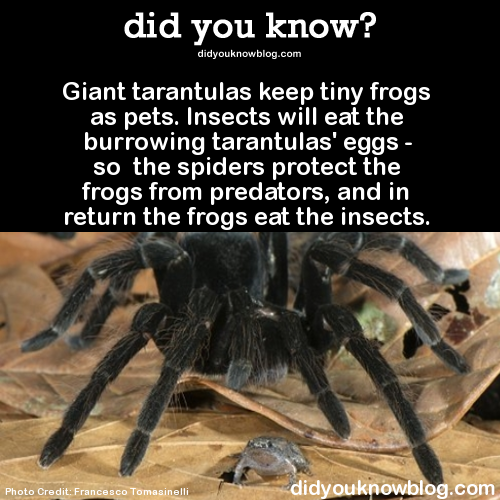
Giant tarantulas keep tiny frogs as pets. Insects will eat the burrowing tarantulas’ eggs – so the spiders protect the frogs from predators, and in return the frogs eat the insects. Source
This has blown my mind for years. It’s so unreal. It’s almost the same exact reason humans and cats started living together.
Tiny frogs are tarantula housecats. A science fact seldom gets to sound that much like meaningless word salad.
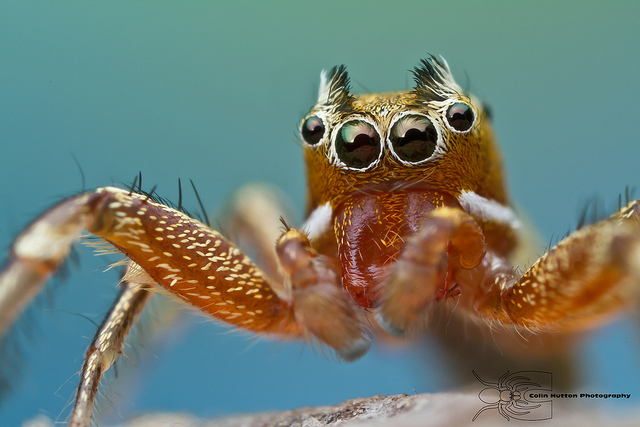
True to its scientific name Tutelina elegans (Araneae – Salticidae) is really a stylish and good looking jumping spider with long eyebrows. This is a small, iridescent-green species native to Eastern North America. The female is almost uniform iridescent green that may appear gold or even purple at different angles.
After checking Google and TVTropes, that thing about gods gaining power by being worshipped and fading away otherwise is definitely a modern invention. I should have expected that, because most gods are supposed to predate humans so it’d be weird for them to depend on them.
This is disappointing because the whole divine habit of “smite people who disrespect us” would make a lot more sense. An Athena who destroyed the earth’s best tapestry because she didn’t like the subject matter is kind of pathetic. An Athena who did that because if too many people view that tapestry and agree with it, it could end her family’sexistence is a much more interesting villain.
(Also now I’m picturing Indiana Jones showing up: “You can’t destroy that! It belongs in a museum!” “Do you WANT the Olympian dynasty overthrown? That is the single worst place it could be! I’ll turn you into a spider to teach you respect.”)
#interesting #anything that makes me laugh this much deserves a reblog #(I laughed at ‘do spiders even have the capacity for respect’) #(but I was going to reblog it even before that bit)
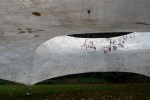
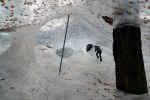
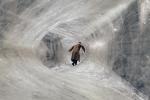
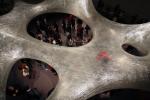
Numen/ For Use– For Use used thick transparent sticky tape to create an interactive installation. By stretching, sticking and wrapping thick layers of tape around grounded pillars, beams, trees or whatever standing objects exist in the chosen space Numen/ For Use create a web of tendon tunnels and spaces that can be accessed and crawled through, strong enough to carry human weight. From afar the installation appears like an interwoven structure of bending elastic pipes.