{{previous post in sequence}}


maryellencarter:

brin-bellway:

sigmaleph:

transgenderer:

so strange to me when people pretend that reading subtitles doesnt severely affect your experience of a show. like, unless its very low on dialogue, youre gonna spend most of the time staring at the bottom of the screen. like, its totally valid if thats a valid tradeoff for you, or if it isnt dubbed, but it clearly IS a tradeoff

today on posts from a parallel universe: ????????

this has not been a problem to me, ever*, and I watch stuff with subtitles on all the time (including stuff in languages I am fluent in, because parsing audio is a pain sometimes.)

*(ok technically I had problems with subtitles when I was a tiny child, which I’ve always attributed to not yet being able to read very fast. Maybe this is an acquired skill you need and I picked it up early because of American cultural imperialism and my parents (correctly) hating dubbing)

I was *already* missing most of the details of what was happening on the screen [link], so there isn’t much to lose by turning on subtitles.

Oh yeah, reading subtitles absolutely severely affects my experience of a show, because I can actually understand what anybody is saying and therefore what’s supposed to be going on. ;P

I think the original post is about anime due to the “if it’s not dubbed” bit, but like… I have somewhat accidentally never watched an anime in my life. We’re talking 100% spoken English media here, for me. I just have bad enough auditory processing that the “tradeoff” is between understanding while only looking at the characters 90% of the time (rough estimate, but I know I can read a Terry Pratchett novel in four hours, I read *fast*), or not understanding at all.

(I also have a *lot* of issues with dubbed media. I would always rather hear the original inflections since I’m going to be reading subtitles anyway. Is hearing completely different voices and performances supposed to affect your experience of a non-English-original show less than “the one-inch-high barrier of subtitles”? :S)

(I mean, I will grant, ability to read fast and comprehend what you’re reading is frustratingly rare, at least in the US. One of the big things that’s driving me crazy at my job is being told by the support team “it’s unreasonable to expect us to read all that” when I ask for help and try to give them the information they’ll need. So maybe it’s a more average experience to find yourself absolutely hobbled by subtitles. But really… that doesn’t sound like a subtitles problem.)

I think you’re being overly uncharitable. People who have a harder time with text or images than with audio deserve sympathy too.

Note that I *didn’t* say subtitles don’t make it harder for me to parse visuals! They *do*, and I can absolutely see how someone’s sensory processors could be set up in such a way that subtitles do more harm than good. It’s just that *my* sensory-processing bandwidth is so small and so text-weighted that *most* of the things being sacrificed are things I would have had to sacrifice regardless, and *many* of the benefits received in exchange are things I needed.

(I recently read a *transcript* of a TV episode after watching it with subtitles and discovered that–despite the subtitles being helpful on net–I had *still* missed some of the dialogue. I’m really not that good at interacting with stories on a synchronous basis in general. Real life is *somewhat* easier because it doesn’t run on Chekhov’s Gun rules: the background details I missed very often *don’t* ever become important.)


Tags:

#reply via reblog #discourse cw? #is the blue I see the same as the blue you see

{{next post in sequence}}

sigmaleph:

transgenderer:

so strange to me when people pretend that reading subtitles doesnt severely affect your experience of a show. like, unless its very low on dialogue, youre gonna spend most of the time staring at the bottom of the screen. like, its totally valid if thats a valid tradeoff for you, or if it isnt dubbed, but it clearly IS a tradeoff

today on posts from a parallel universe: ????????

this has not been a problem to me, ever*, and I watch stuff with subtitles on all the time (including stuff in languages I am fluent in, because parsing audio is a pain sometimes.)

*(ok technically I had problems with subtitles when I was a tiny child, which I’ve always attributed to not yet being able to read very fast. Maybe this is an acquired skill you need and I picked it up early because of American cultural imperialism and my parents (correctly) hating dubbing)

I was *already* missing most of the details of what was happening on the screen [link], so there isn’t much to lose by turning on subtitles.


Tags:

#reply via reblog #is the blue I see the same as the blue you see


{{next post in sequence}}

andmaybegayer:

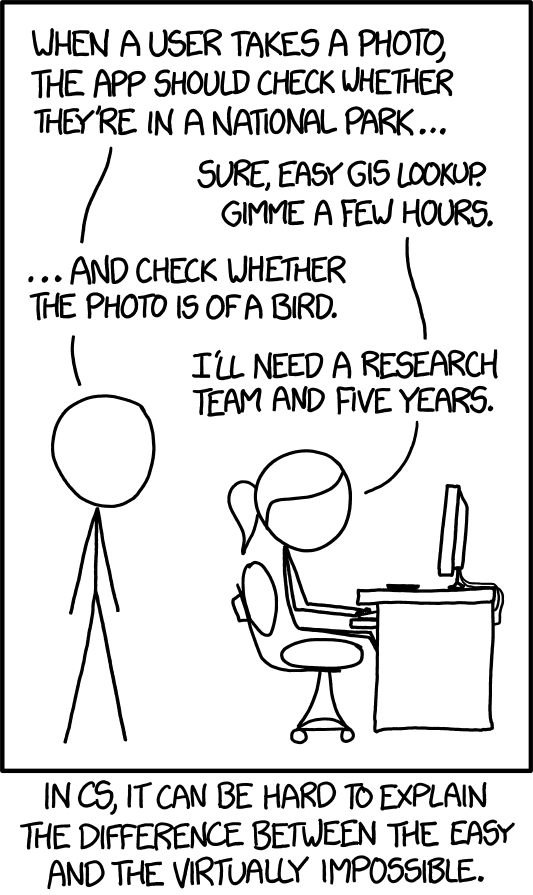
I’m still weirded out that Google Lens can do animal and plant identification reliably these days. I remember using the first few versions of Google Lens and you’d be lucky if it could even identify a flower as a flower. It was basically only useful for architecture and OCR.

although I suppose this xkcd did come out in 2014, it’s been more than five years and Google has some pretty sizeable research teams.

abe284a0c8055a19ef8e2dde8bf2de102c890eab

Me, trying to watch a video without having to expend effort on digging out headphones and processing auditory input: “oh, it’s only got auto-captions, those things are practically useless, maybe I should just come back lat–holy shit, Youtube auto-captions actually *work* now! when did *that* happen?!”


Tags:

#and how long will it be until I can download a 2020-Google-level auto-transcriber from a Canonical repository #and start running my own stuff through it without having to offer everything up to the Cloud #reply via reblog #proud citizen of the Future

eightyonekilograms:

Ok so spambot followers are as old as time, but there’s a new twist on it: lately I’ve been getting followed by bots selling… crystal meth? Is this happening to anybody else? Absolutely wild.

No. My latest bot appears to be selling the Illuminati.


Tags:

#it was just realistic enough that I tried responding to the PM it sent me #but it ignored my question about how it found my blog and just continued on with ”I’m from New York USA and you?” #so I’m thinking it’s probably not a person #(if you *are* a person‚ bethkatehis24‚ I’m sorry) #(please don’t feel too bad about it: I once failed the Turing test too) #reply via reblog

{{previous post in sequence}}


rustingbridges:

controversial personal finance opinion: if you have enough wealth you should own some physical gold

financialized gold has most of the downside of real gold and also none of its special upside, so not that

gold does not, as a rule, gain in value, and it’s vulnerable to theft, but it also does not, as a rule, lose in value, and also the rest of your assets are vulnerable to theft too. gold might have a higher risk but diversification is still valuable

in the event you lose access to your financials and have to leave – maybe not likely, but not impossible, apparently something like 1% of humans in 2021 are or have been refugees – gold jewelry particularly is both portable enough you can take it and universally recognized as valuable enough you can trade it. just don’t get it in your teeth


brin-bellway:

*Is* this controversial, even in the broad form stated here?

I kind of figured that there was broad agreement that there exists *some* level of wealth at which diversification into gold is worth pursuing (for the reasons you give), but that different people’s estimates of what that wealth level is vary by orders of magnitude, and some people would put enough forms of philanthropy above gold on the to-do list that in practice no one would ever reach the gold stage given our world’s current amount of philanthropic fruit to be picked.

(I’m not sure where I would place the threshold: I think it’s probably somewhere feasible to reach, but far enough beyond where I am now that it’s not urgent for me to figure out the specifics.)


rustingbridges:

a lot of people would argue that you should at some point diversify into financial instruments which abstractly reflect the value of gold, but I think many of those people would say you should not buy actual physical gold.

to pin myself down a bit while still leaving a lot of wiggle room, here’s some points on my Gold Advice Spectrum:

  • if you need your money to be liquid in a normal economy any time soon, don’t buy gold
  • if you have enough money to retire indefinitely on, I think it’s worth having something like a month’s money or so in precious metals
  • if you’re bill gates you should actually should have buried a chest of treasure somewhere


brin-bellway:

What…what reasons do *they* give for wanting to diversify into gold? You can’t hedge against the collapse of your financial system by buying things that *depend on said financial system*.

I mean, okay, I guess you can hedge against *certain, partial* collapses that way, but it’s far more limited.

I should mention here that I literally wrote a post once titled “Diversification is an important part of building an investment portfolio” [link], in which I frame prepping as being essentially a way of shorting your civilisation: since almost everyone is very long civilisation pretty much by necessity, being also somewhat short civilisation is a good hedge (though I think you should still be net long). I also wrote a comment on a different post in which I called [maintaining stockpiles of soap and canned food and air filters] “pandemic insurance” [link].

That Gold Advice Spectrum seems pretty reasonable.

@cthulhubert​ replied: @brin-bellway there’s a certain degree of over-correction against physical gold buying because Alex Jones and some other right wing conspiracy nuts flogged buying real gold for ‘when the degenerate modern economy collapses’.

I mean, that’s traditionally how it works, right? If you think something is going to collapse, you short it and then write a report laying out your evidence and reasoning to try to convince others to do the same. Yeah, I disagree that one should be net short civilisation and think people who do that are setting themselves up for failure and pain, but short sellers are very often wrong and their existence is nevertheless a useful corrective.

(…yes, I think I *did* just draw a connection between the hate that Crazy Prepper People™ get and the hate that short sellers get.)


alarajrogers:

I think if you were genuinely going to short-sell civilization, gold’s a ridiculous thing to have. Like money itself, the value of gold is a social construct.

What you should be investing in is booze and pharmaceuticals. Set up a greenhouse that does not run on any electricity, or that gets all of its energy from solar panels, and grow food there year-round; you’ll have something to eat, something to trade, and if you are legally able to, maintain, like, one marijuana plant, so if civilization collapses you can go whole hog into growing marijuana. Once the pharmaceutical industry collapses, alcohol and marijuana will be incredibly valuable as painkillers again. And because drugs expire much more slowly than they claim on the label, keep a huge supply of ibuprofen, acetominophen, allergy meds, and so on… they’ll still be good ten years from now. Birth control, if you live in a place where it can be obtained OTC.

Hard liquor and wine are probably your best investment – they are commonly considered to improve as they age, and in a post apocalyptic world, everyone will want to get drunk. (I mean, not literally everyone. I wouldn’t drink alcohol after the apocalypse because it tastes disgusting and has no benefits I want. But most people.)

Me, I’d also get, like, a million solar chargers for phones and Raspberry Pis, and a whole lot of USB stick drives with adapters. Then I’d download Wikipedia every several months, and any medical database that allows me to download the whole thing, and as much info as I can get about maintaining phones and Raspberry Pis. Probably ebooks and databases on carpentry, plumbing, electricity, electrical generation, making wine and beer, etc, etc… I’d have a few hundred of the Pis in boxes, in a climate controlled room, probably with the boxes sealed in a plastic bin with a lid, and I’d have USB sticks with image files to put on the Pis. I’d use phones and tablets as monitors, or tiny monitors with low power requirements, so that I’d have a place to read my stored downloads. Then when the internet crashes I’d have huge amounts of information I could share with my neighbors so we could restore the amenities of civilization as quickly as possible, as many of them as possible. There won’t be making any new computers for a very long time- clean room tech is very complex – but keeping existing machines that use very little power in good repair, unused and protected from the elements, will help a lot.

Physical books are also very good but are heavy, not very portable, and easily destroyed by any kind of extreme weather – weather applies to computers too, but you can store vastly more information on 1 small computer than you can on 20 books, and then you put 20 replacements for your small computer in there. Still, if you’ve got space for a library and you don’t live somewhere it is likely to flood or burn, stockpile books. Nonfiction that give you information about how to survive, of course, but also, languages, books on cultures, history, and include a lot of fiction. People will trade a lot for escapism, and DVDs have a much shorter shelf life than books do.

All of these are more valuable trading goods than gold. You can’t eat gold, you can’t use it for anything but making things pretty (and making high-tech things you can’t make if civilization collapses.) I might buy silver and copper for antimicrobial purposes (and then I’d have to figure out how to keep them from tarnishing), but gold is overpriced and is only of use to a civilization – I mean it can be one with much lower tech levels, but you still have to have, like, blacksmiths.

You know what else would be valuable? Blade sharpeners and the knowledge of how to use them. Also, blades. Guns will be very useful for a while but modern guns require far too much technology to remain supplied with ammo, and all you can use them for is hunting and killing. But blades can be used for hunting and killing, and preparing food, and gardening, and so on and so forth. Knives, axes, scythes, machetes, and yeah, swords. Mostly because people think swords are sexy. They’d make good trade goods.

The only circumstance where gold is useful is where your specific country’s financial system has collapsed, but everyone else is okay. If you’re American, that’s not gonna happen. We’re too intertwined with the world’s financial systems. If we go down, so does most of the world. (This is not a good thing.)


brin-bellway:

…yes? Both/and, and gold is certainly one of the lowest-priority items for the reasons you give.

However, it’s important to note that people think gold jewellery is sexy and trade-good-y too, and also I am not American (well, okay, I pay the Americans tribute in exchange for right of return, but that just makes it easier to become a refugee there: it doesn’t mean never becoming a refugee in the first place).

You either got the idea of solar-powered phones and downloading Wikipedia *from me*, or else it is *very* strange that people in your apocalypse stories aren’t doing this: I once commented on one of said stories remarking on its absence and doing a special-interest infodump about it.

>>keep a huge supply of ibuprofen, acetominophen, allergy meds, and so on… they’ll still be good ten years from now.

Naproxen doesn’t just suppress the pain of menstrual cramps: at higher doses, it actually *makes periods lighter*. I would go with naproxen over ibuprofen, though acetominophen still has its place.


alarajrogers:

Didn’t know that about naproxen… very interesting!

I actually have had the ideas about solar-powered phones, Wikipedia, and the like for a very long time, but I just haven’t done that many stories about apocalypses, and one of them, everyone who survived is a child, so they’re not really going to have thought of most of that. The only other one I can think of is the zombie apocalypse one, and there, I have been mentally working out details like that… among other things, in that world there’s still an Internet, because there’s enough people who managed to keep power plants and data centers running that Wikipedia is still up. (Netflix, sadly, is not.) The only people we’ve spent a lot of time around in that story are specialized for being medical professionals and scientists, but I’m pretty sure there are techy types around. (It might possibly have been that one you commented on? Not sure.)

I’m working on another one I call “Mad Max The Librarian”, which has pigeons carrying USB sticks, and a guy going on a road trip with weapons and fighting off all kinds of bandits and cultists to find surviving books and bring them back to a protected, well-defended library.


brin-bellway:

>>Didn’t know that about naproxen… very interesting!

Yeah, I found out when I went to my doctor for dysmenorrhea. She told me to get a bottle of OTC naproxen and take double the dose given on the label, starting two days before my period’s due (or when it starts if it catches me off-guard) and ending when I’m far enough along that the problems would have stopped by now anyway. It’s working great.

(Doubled-up OTC naproxen is a bit cheaper than buying prescription naproxen out of pocket, but if I ever get drug coverage she’ll write me an official prescription.)

((Don’t take prescription-strength naproxen without medical supervision if you can help it: you can fuck up your liver. Peri-menstrual naproxen is relatively safe because you’re only taking it a few days a month, but it’s still best to be sure.))

>>(It might possibly have been that one you commented on? Not sure.)

It was the zombie one, yeah. I originally messaged you with it privately (possibly you don’t get messages properly on the sideblog?), but I’ve been wavering for ages on whether to post a slightly edited version publicly, so here it is:

(Please treat what I am about to tell you as more of a “you have accidentally stumbled into a special interest” than as criticism per se.)

The tech level in “Norris and the Plague Doctors” feels off to me. It’s too low: there’s stuff missing that should still be working.

It first struck me when they’re talking about electricity, and they *never mention solar power*. Not once. The hospital compound doesn’t have it, the homesteaders don’t have it, the rich people’s houses are never explicitly ruled out as not having it but if even the homesteaders don’t…

(*By default* the kind of solar setup a rich household would get would immediately stop working when the grid goes down, but if you pay extra (batteries are getting cheaper over time, but for now: for the most popular brand (Tesla), it’s USD$4,500 fixed cost + USD$6,500/13.5kWH of storage) you can install power-outage-insurance batteries. Most household roofs can’t fit enough solar panels to go fully self-sufficient, but from what I’ve been able to tell so far in my research, if done right a roof setup can let you switch to merely rationed electricity during a long-term outage.)

[edit: I found out later that the keyword to search for regarding rich-people’s-houses-resorting-to-off-grid-electricity-in-a-crisis is “hybrid solar systems” (a hybrid of on-grid and off-grid).]

Once that got me thinking I started noticing other stuff.

Norris assumes that rich people’s cars all run on gasoline and gasoline alone, and while that could be an in-universe oversight on his part, I would expect a modern-day rich neighbourhood to have some electric and/or plug-in-hybrid vehicles. If such a vehicle is in either the same household as a solar+storage setup or they’re in two cooperating households, you’ve potentially got long-term car access. You’d have to use it very sparingly: we’re probably talking an entire day’s electricity ration for a 40mi round trip (a decent rule of thumb as things stand is 4 mi/kwH, though it depends on car and driving style). (Plug-in hybrids don’t currently have a 40mi full-electric range from what I’ve seen, so you’d need a full-electric car or restrict to even shorter trips: 30mi would be pushing it.)

One of the main reasons Norris is glad to have Internet access is because it means he can read Wikipedia, and while again that could well be an in-universe oversight by the characters, the fact is that anyone reliant on *continuous* Internet access *during an apocalypse* to read Wikipedia is doing it wrong. Somebody please get this child a Kiwix server.

And speaking of devices that can run Kiwix, there are no smartphones. The only computer is a rigged-together desktop that probably doesn’t even have an emergency uninterruptible-power-supply battery, let alone the ability to actually *function* for extended periods on intermittent power while on the run from zombies. You can get quite a bit done, info/comms-infrastructure-wise, with just a bunch of Android smartphones (iOS is much more dependent on access to Apple servers and therefore much less useful in a grid-down), ~USD$25 – $50 of portable solar chargers per person (characters who didn’t already have these may well be able to salvage them at a camping-supplies store), and at least one (1) group member who didn’t have mobile data and oriented their smartphone setup around not having reliable Internet access (who can then bootstrap the rest). Apps to turn smartphones into off-grid walkie-talkies (or more likely walkie-writies) are still in their early days overall–I wrote an entire post about this recently: https://brin-bellway.dreamwidth.org/67770.html–but file-sharing alone should have a fair number of uses, especially if at least one of you packed the right files (or can obtain access to the broader Internet long enough to fetch them).

I look forward to Mad Max the Librarian.


maryellencarter:

“gold is overpriced and is only of use to a civilization – I mean it can be one with much lower tech levels, but you still have to have, like, blacksmiths”

I’ve been pondering this thought ever since it drifted by on my dash last week, and maybe it’s just that I have a very particular background, but I try to imagine how my civilization (US) would collapse below the level of having blacksmiths and I draw a blank. There are just (in my experience) too many people around who do historical reenactment type skills for fun. I am not personally a blacksmith, and I don’t personally know any blacksmiths, but I am very sure that if the nearest big city (I think about 2 million people) had a catastrophic civilization meltdown to the point where Wikipedia on a solar Android phone would be needed, that there would be *somebody* in the local SCA or fiber arts guild or equivalent who knew how to blacksmith and what the necessary components of a forge are.

(I am personally a very skilled spinner and knitter. I don’t currently own a spinning wheel, but spindle whorls are easy to make even if drop spinning is a royal pain in the shoulders and takes forever. You find me some spinnable fibers, I can eventually produce clothes. Find me an abandoned Lowe’s for PVC pipe and a few fiddly metal bits, I can *build* a spinning wheel and produce a bunch of clothes, as long as you want them knitted. We’ll need somebody else for weaving, I don’t carry any looms in my head.)

Sorry, I’m rambling, but what I’m trying to say is, my default post-apocalyptic scenario involves still having access to a lot of the sort of Iron Age technology levels, because many of those live rent-free in my own head and I’m familiar with the existence of people who can recreate the rest.


alarajrogers:

I feel like, if you’ve got blacksmiths, bronze and copper and tin are gonna be a lot more useful than gold, though? Historically gold just makes pretty things. People like pretty things but will they really value them over stuff that helps them survive?

As for Norris, I’d like to point out a few things:

– Norris is a child who was living on the streets until he was taken in by the plague doctors. He is not an expert on his world.

– The plague doctors are doctors, not computer engineers. They may have a few computer engineers among them – in fact they must, because they have pilotable drones – but it’s likely that smartphones, being in limited supply because no more are being manufactured and shipped to the US, are reserved for the actual doctors to do things like pilot drones. They’re not left for a kid to get on Wikipedia with.

– I’d imagine that a major use of electric cars by people who were well-off enough to own them is to get the fuck out of the city, where there is a higher concentration of zombies. People who could flee the city did. (No one voluntarily goes into the city on the ground but the plague doctors; the government drops shipments of food from helicopters.)

What I was imagining was that a lot of stuff is going on in the countryside and the suburbs, where zombies are rarer. Farmers continue to grow crops, but nowadays it’s all food for local consumption, or grain for biodiesel. People make limited, local trips all the time, but they don’t go through the city when they do. The electric cars are probably doing that, along with the ones that run on biodiesel and the ones where someone who owned a gas station stockpiled the gasoline for their own use. They’ve probably also got some horses pulling carts going on. Data centers are well protected and way out in the middle of nowhere, as are power stations; the power stations are defended by what’s left of the military and National Guard, and probably the data centers too. So a good bit of the Internet is still up; it was designed to work around national disasters. But the bandwidth’s been drastically reduced because the workforce that can keep the lines up is now hiding from zombies or is dead.

The plague doctors probably do have a server with Wikipedia on it, that they can access locally, and they probably have a lot else as well. Maybe media servers for their families to locally connect to across the campus WAN and watch movies. Probably as many scientific articles as they were able to download before a given server went down. Large portions of Google Books, since Google opened up their Books collection so you could get the whole thing, because copyright was no longer a thing that made sense. But they didn’t offer those things to a kid who most of them saw as a burden (even Sarah is thinking of Norris as someone she cares about but can’t really take care of). Maybe at some point Jessie the armorer will show Norris something, or maybe now that the doctors respect him a bit more they may help him more directly to access their resources, but right now, he’s limited to what he knows about. (He’s also not asking them things like “how do I get access to the local servers” because, as a child of the Internet age, it hasn’t occurred to him that that’s a thing. He’s 10.)

I have plans to expand it into a book someday, so I should have the opportunity to show some of what’s not immediately obvious to Norris from his perspective as a kid who’s getting the resources he knows about, not the ones people could teach him about if anyone was actually focused on teaching him.

But you’re right in general. Part of the point of the story was that I get frustrated with zombie apocalypses where the only modern technology anyone uses or has access to is guns. (Or any apocalypse, really. Unless it was nuclear, then the EMP could have toasted anything that wasn’t in a Faraday cage.)

I think it’s like in those A Collection of Unmitigated Pedantry clothing posts that have been going around lately. People care a surprising amount about pretty things, and even if you *don’t* directly value them, decking yourself out is a way of demonstrating that you are so powerful and so wealthy that you can afford to spend resources on mere decoration (so other people had better not fuck with you). [link]

Sure, no more smartphones are entering national supply, but the *initial* supply was several hundred million widely distributed throughout the population.

(I know I’m a nerd with very nerdy social circles, I know a whole lot of people wouldn’t end up having a nerd in the group of people they’d banded together with especially if it was only two or three family members, but my perspective here is definitely shaped by knowing plenty of people who keep copies of Wikipedia lying around just because they can.)

>>Norris is a child who was living on the streets until he was taken in by the plague doctors. He is not an expert on his world.

Oh, absolutely. I figured there was a lot of that going on.


Tags:

#reply via reblog #101 Uses for Infrastructureless Computers #apocalypse cw #discourse cw? #zombies #reactionblogging

{{previous post in sequence}}


florescent–luminescence:

brin-bellway:

rustingbridges:

apparently duolingo shuttered tinycards sometime last year, which, like, yeah, that’s exactly why I never tried it and refuse to use any online flashcard stuff except as a data source for export

I’d never heard of tinycards in specific, but yeah, same.

VitalSource tried to get me to use their proprietary cloud-dependent flashcard system to study for my commercial-law class, and I said “fuck you” and used Mnemosyne instead. I regret nothing.

(I also backed up the textbook despite VitalSource’s attempts to stop me.)

I always wonder … why don’t people just use index cards?

Because the algorithm to determine how often one should review each card for optimal retention is sufficiently complicated that it’s much better to have a computer figure it out.

(It’s not the same frequency for each card, because one is bound to find some bits of information more memorable than others.)

Also, having thousands of index cards can get unwieldy.


Tags:

#reply via reblog #amnesia cw? #adventures in University Land #(although it’s good for other things too) #(I have also been learning to match countries’ names to their locations and later I plan to learn the periodic table)


{{next post in sequence}}

rustingbridges:

apparently duolingo shuttered tinycards sometime last year, which, like, yeah, that’s exactly why I never tried it and refuse to use any online flashcard stuff except as a data source for export

I’d never heard of tinycards in specific, but yeah, same.

VitalSource tried to get me to use their proprietary cloud-dependent flashcard system to study for my commercial-law class, and I said “fuck you” and used Mnemosyne instead. I regret nothing.

(I also backed up the textbook despite VitalSource’s attempts to stop me.)


Tags:

#fuck cloud dependence and fuck VitalSource #reply via reblog #101 Uses for Infrastructureless Computers #recs #(the rec being Mnemosyne) #adventures in University Land


{{next post in sequence}}

eightyonekilograms:

If you listen to audiobooks or serious podcasts, do you also do it during high-intensity exercise (weightlifting or any cardio beyond a walk), and if so do you find you retain any information that way?

cc @dagny-hashtaggart but anyone else is welcome to answer.

I’m not sure how much of an *attention* problem I have with listening while jogging, but I struggle to make out what they’re saying over the sound of the treadmill.

(Instead, I watch subtitled Youtube videos.)


Tags:

#reply via reblog #is the blue I see the same as the blue you see #exercise #amnesia cw?

{{previous post in sequence}}


rustingbridges:

controversial personal finance opinion: if you have enough wealth you should own some physical gold

financialized gold has most of the downside of real gold and also none of its special upside, so not that

gold does not, as a rule, gain in value, and it’s vulnerable to theft, but it also does not, as a rule, lose in value, and also the rest of your assets are vulnerable to theft too. gold might have a higher risk but diversification is still valuable

in the event you lose access to your financials and have to leave – maybe not likely, but not impossible, apparently something like 1% of humans in 2021 are or have been refugees – gold jewelry particularly is both portable enough you can take it and universally recognized as valuable enough you can trade it. just don’t get it in your teeth


brin-bellway:

*Is* this controversial, even in the broad form stated here?

I kind of figured that there was broad agreement that there exists *some* level of wealth at which diversification into gold is worth pursuing (for the reasons you give), but that different people’s estimates of what that wealth level is vary by orders of magnitude, and some people would put enough forms of philanthropy above gold on the to-do list that in practice no one would ever reach the gold stage given our world’s current amount of philanthropic fruit to be picked.

(I’m not sure where I would place the threshold: I think it’s probably somewhere feasible to reach, but far enough beyond where I am now that it’s not urgent for me to figure out the specifics.)


rustingbridges:

a lot of people would argue that you should at some point diversify into financial instruments which abstractly reflect the value of gold, but I think many of those people would say you should not buy actual physical gold.

to pin myself down a bit while still leaving a lot of wiggle room, here’s some points on my Gold Advice Spectrum:

  • if you need your money to be liquid in a normal economy any time soon, don’t buy gold
  • if you have enough money to retire indefinitely on, I think it’s worth having something like a month’s money or so in precious metals
  • if you’re bill gates you should actually should have buried a chest of treasure somewhere


brin-bellway:

What…what reasons do *they* give for wanting to diversify into gold? You can’t hedge against the collapse of your financial system by buying things that *depend on said financial system*.

I mean, okay, I guess you can hedge against *certain, partial* collapses that way, but it’s far more limited.

I should mention here that I literally wrote a post once titled “Diversification is an important part of building an investment portfolio” [link], in which I frame prepping as being essentially a way of shorting your civilisation: since almost everyone is very long civilisation pretty much by necessity, being also somewhat short civilisation is a good hedge (though I think you should still be net long). I also wrote a comment on a different post in which I called [maintaining stockpiles of soap and canned food and air filters] “pandemic insurance” [link].

That Gold Advice Spectrum seems pretty reasonable.

@cthulhubert​ replied: @brin-bellway there’s a certain degree of over-correction against physical gold buying because Alex Jones and some other right wing conspiracy nuts flogged buying real gold for ‘when the degenerate modern economy collapses’.

I mean, that’s traditionally how it works, right? If you think something is going to collapse, you short it and then write a report laying out your evidence and reasoning to try to convince others to do the same. Yeah, I disagree that one should be net short civilisation and think people who do that are setting themselves up for failure and pain, but short sellers are very often wrong and their existence is nevertheless a useful corrective.

(…yes, I think I *did* just draw a connection between the hate that Crazy Prepper People™ get and the hate that short sellers get.)


alarajrogers:

I think if you were genuinely going to short-sell civilization, gold’s a ridiculous thing to have. Like money itself, the value of gold is a social construct.

What you should be investing in is booze and pharmaceuticals. Set up a greenhouse that does not run on any electricity, or that gets all of its energy from solar panels, and grow food there year-round; you’ll have something to eat, something to trade, and if you are legally able to, maintain, like, one marijuana plant, so if civilization collapses you can go whole hog into growing marijuana. Once the pharmaceutical industry collapses, alcohol and marijuana will be incredibly valuable as painkillers again. And because drugs expire much more slowly than they claim on the label, keep a huge supply of ibuprofen, acetominophen, allergy meds, and so on… they’ll still be good ten years from now. Birth control, if you live in a place where it can be obtained OTC.

Hard liquor and wine are probably your best investment – they are commonly considered to improve as they age, and in a post apocalyptic world, everyone will want to get drunk. (I mean, not literally everyone. I wouldn’t drink alcohol after the apocalypse because it tastes disgusting and has no benefits I want. But most people.)

Me, I’d also get, like, a million solar chargers for phones and Raspberry Pis, and a whole lot of USB stick drives with adapters. Then I’d download Wikipedia every several months, and any medical database that allows me to download the whole thing, and as much info as I can get about maintaining phones and Raspberry Pis. Probably ebooks and databases on carpentry, plumbing, electricity, electrical generation, making wine and beer, etc, etc… I’d have a few hundred of the Pis in boxes, in a climate controlled room, probably with the boxes sealed in a plastic bin with a lid, and I’d have USB sticks with image files to put on the Pis. I’d use phones and tablets as monitors, or tiny monitors with low power requirements, so that I’d have a place to read my stored downloads. Then when the internet crashes I’d have huge amounts of information I could share with my neighbors so we could restore the amenities of civilization as quickly as possible, as many of them as possible. There won’t be making any new computers for a very long time- clean room tech is very complex – but keeping existing machines that use very little power in good repair, unused and protected from the elements, will help a lot.

Physical books are also very good but are heavy, not very portable, and easily destroyed by any kind of extreme weather – weather applies to computers too, but you can store vastly more information on 1 small computer than you can on 20 books, and then you put 20 replacements for your small computer in there. Still, if you’ve got space for a library and you don’t live somewhere it is likely to flood or burn, stockpile books. Nonfiction that give you information about how to survive, of course, but also, languages, books on cultures, history, and include a lot of fiction. People will trade a lot for escapism, and DVDs have a much shorter shelf life than books do.

All of these are more valuable trading goods than gold. You can’t eat gold, you can’t use it for anything but making things pretty (and making high-tech things you can’t make if civilization collapses.) I might buy silver and copper for antimicrobial purposes (and then I’d have to figure out how to keep them from tarnishing), but gold is overpriced and is only of use to a civilization – I mean it can be one with much lower tech levels, but you still have to have, like, blacksmiths.

You know what else would be valuable? Blade sharpeners and the knowledge of how to use them. Also, blades. Guns will be very useful for a while but modern guns require far too much technology to remain supplied with ammo, and all you can use them for is hunting and killing. But blades can be used for hunting and killing, and preparing food, and gardening, and so on and so forth. Knives, axes, scythes, machetes, and yeah, swords. Mostly because people think swords are sexy. They’d make good trade goods.

The only circumstance where gold is useful is where your specific country’s financial system has collapsed, but everyone else is okay. If you’re American, that’s not gonna happen. We’re too intertwined with the world’s financial systems. If we go down, so does most of the world. (This is not a good thing.)


brin-bellway:

…yes? Both/and, and gold is certainly one of the lowest-priority items for the reasons you give.

However, it’s important to note that people think gold jewellery is sexy and trade-good-y too, and also I am not American (well, okay, I pay the Americans tribute in exchange for right of return, but that just makes it easier to become a refugee there: it doesn’t mean never becoming a refugee in the first place).

You either got the idea of solar-powered phones and downloading Wikipedia *from me*, or else it is *very* strange that people in your apocalypse stories aren’t doing this: I once commented on one of said stories remarking on its absence and doing a special-interest infodump about it.

>>keep a huge supply of ibuprofen, acetominophen, allergy meds, and so on… they’ll still be good ten years from now.

Naproxen doesn’t just suppress the pain of menstrual cramps: at higher doses, it actually *makes periods lighter*. I would go with naproxen over ibuprofen, though acetominophen still has its place.


alarajrogers:

Didn’t know that about naproxen… very interesting!

I actually have had the ideas about solar-powered phones, Wikipedia, and the like for a very long time, but I just haven’t done that many stories about apocalypses, and one of them, everyone who survived is a child, so they’re not really going to have thought of most of that. The only other one I can think of is the zombie apocalypse one, and there, I have been mentally working out details like that… among other things, in that world there’s still an Internet, because there’s enough people who managed to keep power plants and data centers running that Wikipedia is still up. (Netflix, sadly, is not.) The only people we’ve spent a lot of time around in that story are specialized for being medical professionals and scientists, but I’m pretty sure there are techy types around. (It might possibly have been that one you commented on? Not sure.)

I’m working on another one I call “Mad Max The Librarian”, which has pigeons carrying USB sticks, and a guy going on a road trip with weapons and fighting off all kinds of bandits and cultists to find surviving books and bring them back to a protected, well-defended library.

>>Didn’t know that about naproxen… very interesting!

Yeah, I found out when I went to my doctor for dysmenorrhea. She told me to get a bottle of OTC naproxen and take double the dose given on the label, starting two days before my period’s due (or when it starts if it catches me off-guard) and ending when I’m far enough along that the problems would have stopped by now anyway. It’s working great.

(Doubled-up OTC naproxen is a bit cheaper than buying prescription naproxen out of pocket, but if I ever get drug coverage she’ll write me an official prescription.)

((Don’t take prescription-strength naproxen without medical supervision if you can help it: you can fuck up your liver. Peri-menstrual naproxen is relatively safe because you’re only taking it a few days a month, but it’s still best to be sure.))

>>(It might possibly have been that one you commented on? Not sure.)

It was the zombie one, yeah. I originally messaged you with it privately (possibly you don’t get messages properly on the sideblog?), but I’ve been wavering for ages on whether to post a slightly edited version publicly, so here it is:

(Please treat what I am about to tell you as more of a “you have accidentally stumbled into a special interest” than as criticism per se.)

The tech level in “Norris and the Plague Doctors” feels off to me. It’s too low: there’s stuff missing that should still be working.

It first struck me when they’re talking about electricity, and they *never mention solar power*. Not once. The hospital compound doesn’t have it, the homesteaders don’t have it, the rich people’s houses are never explicitly ruled out as not having it but if even the homesteaders don’t…

(*By default* the kind of solar setup a rich household would get would immediately stop working when the grid goes down, but if you pay extra (batteries are getting cheaper over time, but for now: for the most popular brand (Tesla), it’s USD$4,500 fixed cost + USD$6,500/13.5kWH of storage) you can install power-outage-insurance batteries. Most household roofs can’t fit enough solar panels to go fully self-sufficient, but from what I’ve been able to tell so far in my research, if done right a roof setup can let you switch to merely rationed electricity during a long-term outage.)

[edit: I found out later that the keyword to search for regarding rich-people’s-houses-resorting-to-off-grid-electricity-in-a-crisis is “hybrid solar systems” (a hybrid of on-grid and off-grid).]

Once that got me thinking I started noticing other stuff.

Norris assumes that rich people’s cars all run on gasoline and gasoline alone, and while that could be an in-universe oversight on his part, I would expect a modern-day rich neighbourhood to have some electric and/or plug-in-hybrid vehicles. If such a vehicle is in either the same household as a solar+storage setup or they’re in two cooperating households, you’ve potentially got long-term car access. You’d have to use it very sparingly: we’re probably talking an entire day’s electricity ration for a 40mi round trip (a decent rule of thumb as things stand is 4 mi/kwH, though it depends on car and driving style). (Plug-in hybrids don’t currently have a 40mi full-electric range from what I’ve seen, so you’d need a full-electric car or restrict to even shorter trips: 30mi would be pushing it.)

One of the main reasons Norris is glad to have Internet access is because it means he can read Wikipedia, and while again that could well be an in-universe oversight by the characters, the fact is that anyone reliant on *continuous* Internet access *during an apocalypse* to read Wikipedia is doing it wrong. Somebody please get this child a Kiwix server.

And speaking of devices that can run Kiwix, there are no smartphones. The only computer is a rigged-together desktop that probably doesn’t even have an emergency uninterruptible-power-supply battery, let alone the ability to actually *function* for extended periods on intermittent power while on the run from zombies. You can get quite a bit done, info/comms-infrastructure-wise, with just a bunch of Android smartphones (iOS is much more dependent on access to Apple servers and therefore much less useful in a grid-down), ~USD$25 – $50 of portable solar chargers per person (characters who didn’t already have these may well be able to salvage them at a camping-supplies store), and at least one (1) group member who didn’t have mobile data and oriented their smartphone setup around not having reliable Internet access (who can then bootstrap the rest). Apps to turn smartphones into off-grid walkie-talkies (or more likely walkie-writies) are still in their early days overall–I wrote an entire post about this recently: https://brin-bellway.dreamwidth.org/67770.html–but file-sharing alone should have a fair number of uses, especially if at least one of you packed the right files (or can obtain access to the broader Internet long enough to fetch them).

I look forward to Mad Max the Librarian.


Tags:

#reply via reblog #reactionblogging #apocalypse cw #discourse cw? #101 Uses for Infrastructureless Computers #drugs cw #zombies


{{next post in sequence}}

{{previous post in sequence}}


rustingbridges:

controversial personal finance opinion: if you have enough wealth you should own some physical gold

financialized gold has most of the downside of real gold and also none of its special upside, so not that

gold does not, as a rule, gain in value, and it’s vulnerable to theft, but it also does not, as a rule, lose in value, and also the rest of your assets are vulnerable to theft too. gold might have a higher risk but diversification is still valuable

in the event you lose access to your financials and have to leave – maybe not likely, but not impossible, apparently something like 1% of humans in 2021 are or have been refugees – gold jewelry particularly is both portable enough you can take it and universally recognized as valuable enough you can trade it. just don’t get it in your teeth


brin-bellway:

*Is* this controversial, even in the broad form stated here?

I kind of figured that there was broad agreement that there exists *some* level of wealth at which diversification into gold is worth pursuing (for the reasons you give), but that different people’s estimates of what that wealth level is vary by orders of magnitude, and some people would put enough forms of philanthropy above gold on the to-do list that in practice no one would ever reach the gold stage given our world’s current amount of philanthropic fruit to be picked.

(I’m not sure where I would place the threshold: I think it’s probably somewhere feasible to reach, but far enough beyond where I am now that it’s not urgent for me to figure out the specifics.)


rustingbridges:

a lot of people would argue that you should at some point diversify into financial instruments which abstractly reflect the value of gold, but I think many of those people would say you should not buy actual physical gold.

to pin myself down a bit while still leaving a lot of wiggle room, here’s some points on my Gold Advice Spectrum:

  • if you need your money to be liquid in a normal economy any time soon, don’t buy gold
  • if you have enough money to retire indefinitely on, I think it’s worth having something like a month’s money or so in precious metals
  • if you’re bill gates you should actually should have buried a chest of treasure somewhere


brin-bellway:

What…what reasons do *they* give for wanting to diversify into gold? You can’t hedge against the collapse of your financial system by buying things that *depend on said financial system*.

I mean, okay, I guess you can hedge against *certain, partial* collapses that way, but it’s far more limited.

I should mention here that I literally wrote a post once titled “Diversification is an important part of building an investment portfolio” [link], in which I frame prepping as being essentially a way of shorting your civilisation: since almost everyone is very long civilisation pretty much by necessity, being also somewhat short civilisation is a good hedge (though I think you should still be net long). I also wrote a comment on a different post in which I called [maintaining stockpiles of soap and canned food and air filters] “pandemic insurance” [link].

That Gold Advice Spectrum seems pretty reasonable.

@cthulhubert​ replied: @brin-bellway there’s a certain degree of over-correction against physical gold buying because Alex Jones and some other right wing conspiracy nuts flogged buying real gold for ‘when the degenerate modern economy collapses’.

I mean, that’s traditionally how it works, right? If you think something is going to collapse, you short it and then write a report laying out your evidence and reasoning to try to convince others to do the same. Yeah, I disagree that one should be net short civilisation and think people who do that are setting themselves up for failure and pain, but short sellers are very often wrong and their existence is nevertheless a useful corrective.

(…yes, I think I *did* just draw a connection between the hate that Crazy Prepper People™ get and the hate that short sellers get.)


alarajrogers:

I think if you were genuinely going to short-sell civilization, gold’s a ridiculous thing to have. Like money itself, the value of gold is a social construct.

What you should be investing in is booze and pharmaceuticals. Set up a greenhouse that does not run on any electricity, or that gets all of its energy from solar panels, and grow food there year-round; you’ll have something to eat, something to trade, and if you are legally able to, maintain, like, one marijuana plant, so if civilization collapses you can go whole hog into growing marijuana. Once the pharmaceutical industry collapses, alcohol and marijuana will be incredibly valuable as painkillers again. And because drugs expire much more slowly than they claim on the label, keep a huge supply of ibuprofen, acetominophen, allergy meds, and so on… they’ll still be good ten years from now. Birth control, if you live in a place where it can be obtained OTC.

Hard liquor and wine are probably your best investment – they are commonly considered to improve as they age, and in a post apocalyptic world, everyone will want to get drunk. (I mean, not literally everyone. I wouldn’t drink alcohol after the apocalypse because it tastes disgusting and has no benefits I want. But most people.)

Me, I’d also get, like, a million solar chargers for phones and Raspberry Pis, and a whole lot of USB stick drives with adapters. Then I’d download Wikipedia every several months, and any medical database that allows me to download the whole thing, and as much info as I can get about maintaining phones and Raspberry Pis. Probably ebooks and databases on carpentry, plumbing, electricity, electrical generation, making wine and beer, etc, etc… I’d have a few hundred of the Pis in boxes, in a climate controlled room, probably with the boxes sealed in a plastic bin with a lid, and I’d have USB sticks with image files to put on the Pis. I’d use phones and tablets as monitors, or tiny monitors with low power requirements, so that I’d have a place to read my stored downloads. Then when the internet crashes I’d have huge amounts of information I could share with my neighbors so we could restore the amenities of civilization as quickly as possible, as many of them as possible. There won’t be making any new computers for a very long time- clean room tech is very complex – but keeping existing machines that use very little power in good repair, unused and protected from the elements, will help a lot.

Physical books are also very good but are heavy, not very portable, and easily destroyed by any kind of extreme weather – weather applies to computers too, but you can store vastly more information on 1 small computer than you can on 20 books, and then you put 20 replacements for your small computer in there. Still, if you’ve got space for a library and you don’t live somewhere it is likely to flood or burn, stockpile books. Nonfiction that give you information about how to survive, of course, but also, languages, books on cultures, history, and include a lot of fiction. People will trade a lot for escapism, and DVDs have a much shorter shelf life than books do.

All of these are more valuable trading goods than gold. You can’t eat gold, you can’t use it for anything but making things pretty (and making high-tech things you can’t make if civilization collapses.) I might buy silver and copper for antimicrobial purposes (and then I’d have to figure out how to keep them from tarnishing), but gold is overpriced and is only of use to a civilization – I mean it can be one with much lower tech levels, but you still have to have, like, blacksmiths.

You know what else would be valuable? Blade sharpeners and the knowledge of how to use them. Also, blades. Guns will be very useful for a while but modern guns require far too much technology to remain supplied with ammo, and all you can use them for is hunting and killing. But blades can be used for hunting and killing, and preparing food, and gardening, and so on and so forth. Knives, axes, scythes, machetes, and yeah, swords. Mostly because people think swords are sexy. They’d make good trade goods.

The only circumstance where gold is useful is where your specific country’s financial system has collapsed, but everyone else is okay. If you’re American, that’s not gonna happen. We’re too intertwined with the world’s financial systems. If we go down, so does most of the world. (This is not a good thing.)

…yes? Both/and, and gold is certainly one of the lowest-priority items for the reasons you give.

However, it’s important to note that people think gold jewellery is sexy and trade-good-y too, and also I am not American (well, okay, I pay the Americans tribute in exchange for right of return, but that just makes it easier to become a refugee there: it doesn’t mean never becoming a refugee in the first place).

You either got the idea of solar-powered phones and downloading Wikipedia *from me*, or else it is *very* strange that people in your apocalypse stories aren’t doing this: I once commented on one of said stories remarking on its absence and doing a special-interest infodump about it.

>>keep a huge supply of ibuprofen, acetominophen, allergy meds, and so on… they’ll still be good ten years from now.

Naproxen doesn’t just suppress the pain of menstrual cramps: at higher doses, it actually *makes periods lighter*. I would go with naproxen over ibuprofen, though acetominophen still has its place.


Tags:

#reply via reblog #drugs cw #discourse cw #apocalypse cw #101 Uses for Infrastructureless Computers #(it’s literally right in the tag)


{{next post in sequence}}