rustingbridges:

rustingbridges:

rustingbridges:

can’t believe paypal continues to be like it is. how is this not considered fraudulent

anyway paypal is fine if you want to send another american us dollars, but you should more or less never accept payment through paypal. you will regret it

paypal is extremely opaque about the fees that it charges. and once they’ve charged a fee, there’s more or less no way to undo it. if you immediately ‘refund’ such a transaction, it actually means you’re giving back the money you received *and* paying the fee paypal charged.

they have two payment options – one of which is free and offers no ‘protection’ and the other of which is not and offers their ‘purchase protection’. you can instruct someone to send via the free option but there’s no guarantee they’re going to listen, or that they’re going to parse the options correctly even if they do, at which point there’s already money down the drain in the form of a fee and it’s just a question of who eats it.

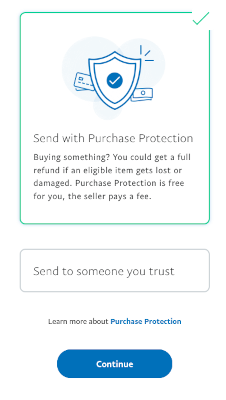
this is what the page to pick looks like (gotta love that mobile first design):

c4d885c493621c403b90d8142def636bb29976f0

here it says you might be eligible for purchase protection, and the ‘seller’ is going to pay a fee, but it doesn’t really explain what any of that means, or how much it will be.

this is bad, because a lot of people will decide they might as well be protected, right? since it’s free. but the program is relatively picky and a lot of the times people use it it does not actually apply. but it gets worse. let’s say I’m sending $150 by paypal to my business partner:

4cc8416ad08c7521d21259fe979abfdfc25987c5

it says right there BigNuts is going to get $150. he’s not. maybe in paypal’s accounting he gets the full amount and then pays the fee, but in practice he is never going to see the full amount. if Mr. McLug is in the US, he’s going to lose $4.35 on this.

but it gets worse if he’s international, as the fee gets jacked up – he’s going to lose $6.60 plus some change in whatever currency it’s going into. and the messaging gets much more confusing!

paypal still pretends there’s no fee for a goods & services transaction, but if you send via the lower cost option, it shows you the currency conversion charge up front.

if you’re sending $1000, the currency conversion charge is $5. if you’re sending goods and services, it’s $44 but to the sender it looks like $0.

so paypal is basically conning people into creating these fees in exchange for what is often a nonexistent guarantee. ok, what else?

well, paypal tries to bill itself as a ‘safe’ way to receive money over the internet, but it’s not actually better than anything else. it’s still part of the financial system.

if someone pays you via paypal, you still need to do all the work of verifying that they’re a real person and not scamming you, because there is no protection. if the payment paypal received gets revoked or marked as fraudulent, guess who’s covering it. you!

this is a pretty common move for scammers, because I guess people trust paypal and think they can actually trust payments they receive by it. but if you want to take money from someone you don’t trust, you basically need to do cash or bitcoin or something like that.

now, payment processors are famous for this sort of shit. and if you’re a merchant, you might write it off as the cost of doing business. the frauds will be amortized to an acceptable cost over your whole volume of transactions.

but if you’re just some person doing a one off transaction, this is much less true. and paypal makes this deliberately more confusing instead of being transparent.

This, and also:

Did you know there’s an arms race going on between [Canadian freelancers who get paid in USD] and Paypal, where Canadians try to withdraw into USD-denominated bank accounts (to avoid Paypal’s terrible exchange rates, and perhaps use the USD directly) and Paypal tries to stop them?

Last I heard, Paypal was winning. (edit: apparently the Canadians have struck back, but the method they’re using these days costs $4/month, so even if you can get it working it’s only worth it for sufficiently high volumes. [link])

(And God help you if you want to *send* an American money: even if you have the USD lying around because you weren’t allowed to withdraw it at a reasonable exchange rate, a USD$3 flat fee is huge when you’re only dealing with a few dollars at a time.)


Tags:

#adventures in human capitalism #reply via reblog #PSA #our home and cherished land #home of the brave

{{previous post in sequence}}


transgenderer:

i guess now that phones are a thing you dont need a watch but pre-phone everyone who didnt wear a watch was a fucking chump, and itrs STILL a good idea now cuz what if youre in a no-phone situation, or just dontr want to bring your phone, etc


sigmaleph:

i used to wear a watch all the time and i miss it

(i stopped cause the strap broke and kept needing to be replaced and I decided it wasn’t actually worth the effort to figure how to find someone who would sell me a non-shitty watch strap when I already was carrying a phone with me at all times. The watch itself is fine and I could totally go back to using it)

i remember the era before everyone had a phone though. People kept asking me the time.


brin-bellway:

I get compliments on my watch sometimes at work. The customers think it’s a by-electronics-standards antique, guessing that it’s from the 80′s. Actually I bought it at Walmart in like 2013 for $20, and they’re still readily available for not that much more [link].

I really like this design: it’s elegant, shiny, doesn’t depend on Velcro (which wears out a lot faster than clasps) like most of my childhood watches did. It runs slow by about one second every 2.5 days: roughly once a month I sync it with time.gov.

Even now that I have a phone I plan to replace this watch if/when it wears out, preferably with an identical one. I like being able to just glance at it rather than have to take my phone out, dumbwatches are permitted in many contexts (work, exam rooms) where general-purpose computers are not, and the battery lasts much, *much* longer than a phone or smartwatch battery. I’m not sure I’ve *ever* had to recharge this watch, and if I did it was only once.


maryellencarter:

I used to wear a wristwatch pretty consistently, because they are much handier than phones, but for some reason I have a bad habit of snagging the watch face on something (like a doorjamb) and ripping it right off, so I haven’t replaced my latest one yet. :P


pedanther:

That watch takes me back – it looks a lot like the one I remember my father wearing in the actual ‘80s.

I stopped wearing a wristwatch in my teens/early twenties, because I had a problem with wrist perspiration: if I wore a watch with a fabric wristband, the band got manky very quickly, and if I wore one with a metal band, the metal corroded and I got a nasty rash on my arm.

I tried a pocketwatch for a while, because I have a secret hankering for nice waistcoats that doesn’t match any other aspect of my lifestyle, but I couldn’t afford a good pocketwatch and for that matter I couldn’t afford a good waistcoat either, which made the whole thing less convenient, and after the watch broke I didn’t persist.

At that point, I probably could have tried wristwatches again – whatever hormonal thing had been causing the perspiration issue had long since settled down – but by that point, there were electronic devices with clocks on them everywhere I went so I didn’t see any point.

(In a slightly better-ordered world, I might be wearing a smartwatch right now, because I bought one of those wrist step counter gadgets in an attempt to keep myself active while I was stuck at home… but I can’t get the farshlugginer thing to work.)

Yeah, I bought this watch in large part because it resembles my dad’s watch and I like the way his looks.

(I don’t think *his* watch is literally from the 80′s either, but as someone who was a young adult in the 80′s he comes by the aesthetic honestly.)


Tags:

#reply via reblog

transgenderer:

i guess now that phones are a thing you dont need a watch but pre-phone everyone who didnt wear a watch was a fucking chump, and itrs STILL a good idea now cuz what if youre in a no-phone situation, or just dontr want to bring your phone, etc


sigmaleph:

i used to wear a watch all the time and i miss it

(i stopped cause the strap broke and kept needing to be replaced and I decided it wasn’t actually worth the effort to figure how to find someone who would sell me a non-shitty watch strap when I already was carrying a phone with me at all times. The watch itself is fine and I could totally go back to using it)

i remember the era before everyone had a phone though. People kept asking me the time.

I get compliments on my watch sometimes at work. The customers think it’s a by-electronics-standards antique, guessing that it’s from the 80′s. Actually I bought it at Walmart in like 2013 for $20, and they’re still readily available for not that much more [link].

I really like this design: it’s elegant, shiny, doesn’t depend on Velcro (which wears out a lot faster than clasps) like most of my childhood watches did. It runs slow by about one second every 2.5 days: roughly once a month I sync it with time.gov.

Even now that I have a phone I plan to replace this watch if/when it wears out, preferably with an identical one. I like being able to just glance at it rather than have to take my phone out, dumbwatches are permitted in many contexts (work, exam rooms) where general-purpose computers are not, and the battery lasts much, *much* longer than a phone or smartwatch battery. I’m not sure I’ve *ever* had to recharge this watch, and if I did it was only once.


Tags:

#reply via reblog #recs #in which Brin has a job #Brin owns *two* 2010’s computers now #and I’m not sure if this fits the spirit of the tag but it certainly fits the letter: #101 Uses for Infrastructureless Computers


{{next post in sequence}}

etirabys:

This Siderea post is good and talks about a phenomenon I’ve never really noticed before: https://siderea.dreamwidth.org/1519134.html

I have literally not seen a single thing on the topic which discusses the phenomenon of people being forced to live in less space as a consequence of outrageous rents. But that’s a thing that’s happening too. …

But you only get to save money on beer by brewing it for yourself, if you have someplace to put it while it’s fermenting. … Of course, it’s not just brewing your own beer, any more than this is just about owning books. There are a lot of ways, it turns out, people can economize on their other expenses, if their living space has the room. …

This is a hidden form of Vimes’ Boots Theory. If you make enough money to rent more space, you can then use that space to save you money on other things. Poor people don’t just pay more for boots because they are left buying many cheap pairs that wear out quickly because they can’t get together the money for a good pair that last; poor people pay more per square of toilet paper if they can’t enjoy the bulk discount because they can’t afford the room for the big discount package of toilet paper.

Owning things is becoming increasingly a privilege of economic class. We’re used to thinking of buying things being, obviously, a privilege of economic class. Economic class means how much money you have with which to buy things, so it’s unsurprising that buying things is something people with higher economic class get to do more of. But owning things – even things that were given to you as gifts, that you made yourself, that you found, that, crucially, cost you no money to acquire, and which you never bought – is also an economic privilege, and, I am contending, becoming ever more and more so.

I’m rich but live in a small space (I’m paying ~$600/mo for rent in a big city) and, yeah, I don’t buy many things that would improve my life (including experimental health equipment that’s remotely bulky), not because I can’t afford it moneywise, but because I can’t own it spacewise.

Anyway, the post branches out some more, e.g hobbies you can’t do because you don’t have the room for it. I should chew on it some more but wouldn’t be surprised if weeks of percolation later I found I’d somewhat changed my mind on some housing issue downstream of thinking about this.

I used to see people voluntarily living in RVs and “tiny houses” and think “Well, you do you, seems like a valid preference to have, and I might very well acquire the taste myself someday”.

Now…it’s still “well, you do you”, but it’s more the kind of “you do you” response one has towards people who do recreational mountain-climbing. Like, yes you have that right, and I’m not going to try to stop you, but why are you putting yourself in danger when instead you could…*not* do that?

I no longer think I will later acquire the taste for small-space living: I am increasingly firmly of the opinion “a dwelling that can’t fit a three-month supply of food is unfit to be called a home”.

[relevant link]

In related news, having an in-home treadmill is fucking amazing. It’s *much* easier to go for a jog if you don’t have to trek out to a gym, or go outside where the bugs and pollen and darkness are and the first-aid kits aren’t (and are difficult to wear while jogging). And the limiting factor in who can own a treadmill is very much *housing* (both space and stability: if you’re moving all the time you *really* don’t want to have to lug a treadmill with you), not money: you can get used (often barely-used) treadmills on Craigslist very cheaply from people looking to dump them because they’re too much of a pain in the ass to take with you when moving house. (Some of them will then buy new(-to-them) treadmills in their new location from people about to move away from *there*, and the cycle will continue; others will give up.)

This house once (long before my time) crammed 12 inhabitants within its walls, could comfortably fit 5 – 6, and currently fits 4. I’ve lived here for nearly 13 years and plan to do so indefinitely (and since we rent from a bank (via interest-only HELOC payments) rather than a landlord, it is unlikely anyone with the authority will try to kick us out of a building my father legally owns†; plus, obtaining *financial* ownership of our house is as simple (not *easy*, but *simple*) as shoving a couple hundred grand into the HELOC account, with no further negotiations required and no possibility that the landlord will refuse to sell).

Space, people, time: all of these are privileges when it comes to housing, but they are all privileges of the form “everyone should get the chance to have these things, and it is bad that some people can’t”.

P.S. I wrote another response to “The Privilege of Property” a few months ago [link], focusing on her apparent belief that it’s more efficient to live alone than with housemates.

†and is planning to add me as legal co-owner, so that my income will help when refinancing


Tags:

#judging from a lot of the discourse I’ve seen over the years #it is dangerously easy to confuse privileges of this form with privileges of the form #”*nobody* should get the chance to have these things and it is bad that some people *do*” #reply via reblog #adventures in human capitalism #overly enthusiastic parenthetical use

ultrastimpaks:

wait people sleep with their doors closed????


ultrastimpaks:

okay now im curious. reblog this with where youre from and if you sleep with your door open or closed


cromulentenough:

UK, closed. Why on earth would you leave your door open?


sigmaleph:

huh, my reaction is the exact opposite of yours: why would you close your door?

i mean the door to my bedroom doesn’t even close properly in the first place, but further than that the only reason I would have to try to close it is to keep heat inside during cold weather (which i am doing these days, or at least trying to because see above).

of course I live alone, so the only person walking through doors anyway is me; closing them seems a waste of effort if I’m going to open them again later, so why do it in the first place. But even when I lived with other people closing my door was an exceptional I-am-naked-right-now-don’t-come-in situation, or to stop the light from bothering others when I stayed up late; since neither of those is the case when I sleep, I didn’t see a point to closing the door


moonlit-tulip:

Closed, to block sound and light from the rest of the house. I’m from the USA, specifically New Jersey.

When my door is open, I’m much more likely to be woken by people using the bathroom (which is just outside my door) in the middle of the night, and by people talking pretty much anywhere in the house in the morning if I’m not already awake by then. Closing the door neatly blocks out those problems, as well as additionally blocking out the “I’m not necessarily the last person to go to sleep” problem and its associated sounds and lights around the start of my sleep cycle.

(My door is by no means perfect at blocking either light or sound when closed—it has a couple-inch crack underneath through which both can still get in, and also sound has a way of getting into my room through the floor and walls—but its closed state is still a whole lot more effective at both than its open state is.)

It depends on circumstances.

In New Jersey before the age of 12 or so, I slept with my door open and felt vaguely guilty about it: the children’s books on dealing with disasters said you should always sleep with your door closed, so that if a fire broke out elsewhere in the house there would be an extra barrier between you and it (buying you time to figure it out and [leap out your window]/[call for help]).

Age 12 – 13, I went to bed earlier than the people sleeping in the bedroom directly across from me, so I closed my door to keep their light out.

13 – 22, I slept with my door open because my bedroom in the new Ontarian house was not directly across from anyone and the former consideration no longer applied. Also my bedroom was so small that I had to put a table in the way of the door.

22, my brother was leaving the house before I woke up (to go to culinary school), and I slept with my door closed so that him closing the front door wouldn’t wake me. (I managed to figure out a furniture configuration that makes the door closable, at the cost of making it difficult-but-not-impossible to reach the bookshelves.)

Now, I keep my door open whenever nobody is planning to leave the house before I wake up, and sometimes even then. And when I *do* have to close it I look forward to being able to open it again: I’ve now *also* heard that sleeping with your door open improves air circulation and keeps the carbon dioxide from building up as you sleep, and since my room is very small and my house is not wood-heated, excessive carbon dioxide seems far more likely to occur than fires.


Tags:

#reply via reblog #surveys #fire

Updates to how we enforce our Community Guidelines on hate speech

{{previous post in sequence}}


brin-bellway:

staff:

Tumblr wouldn’t feel like much if it were not for the passionate community filling up our dashboards. You are the reason people turn to Tumblr for a laugh or for a little human connection. You are why Tumblr feels like a home for so many. You care about this place, and you let us know when something doesn’t feel right. Many of you have called on us to further reevaluate how we deal with hate speech, particularly hate speech from Nazis or other white supremacist groups. Today we’re letting you know that we heard you, and we are taking further action.

We’ve listened to your feedback and have reassessed how we can more effectively remove hateful content from Tumblr. In our own research, and from your helpful reports, we found that much of the existing hate speech stemmed from blogs that have actually already been terminated. While their original posts were deleted upon blog termination, the content of those posts still lived on in reblogs. Those reblogs rarely contained the kind of counter-speech that serves to keep hateful rhetoric in check, so we’re changing how we deal with them.

We identified nearly a thousand blogs that were previously suspended for blatantly violating our policies against hate speech. Most of them were Nazi-related blogs. Earlier this week, we began the process of removing all reblogs stemming from the original posts on those previously suspended blogs—that’s approximately 4.47M reblogs being removed from Tumblr. 

Moving forward, we will evaluate all blogs suspended for hate speech, and consider mass reblog deletion when appropriate. 

Consulting outside experts 

We wouldn’t make a change like this without considering the impact to your freedom of expression. We do not want to silence those who are providing educational and necessary counter-arguments to hate speech. We reviewed our approach with a variety of outside groups and experts to make sure we have aligned with their recommended best practices.

There’s no silver bullet solution, AI, or algorithm that can perfectly target hate speech. That’s why we have a dedicated Trust & Safety team, and why we have an easy way for you to report any hate speech you do see.

If you see something on Tumblr that violates our Community Guidelines, please report it to our Trust & Safety team for review.

Lastly…

We are, and will always remain, steadfast believers in free speech. Tumblr is a place where you can be yourself and express your opinions. Hate speech is not conducive to that. When hate speech goes unchecked, it eventually silences the voices that add kindness and value to our society. That’s not the kind of Tumblr any of us want. 

Thank you for speaking up. Please continue to help us make Tumblr the place you want it to be.

<3

>>Earlier this week, we began the process of removing all reblogs stemming from the original posts on those previously suspended blogs—that’s approximately 4.47M reblogs being removed from Tumblr.<<

So by the sound of it, if you’ve reblogged any debunkings or tangents or possibly even unrelated posts from a blog that *also* posted hate speech (by whatever standards they’re using for that), it’s getting thrown down the memory hole.

Hey guys, I wrote a Tumblr reblog once disagreeing with the idea that deleting an OP blog should delete all of its posts’ reblogs. Do you know what happened to my post? It fucking vanished [link]. It lives on because I personally ensured it.

Now is a good time to remind everyone that tumblr-utils [link] incremental backups do not delete old posts if the original gets deleted, and the Wayback Machine sure as hell does not delete them.

Hey, so, about tumblr-utils:

Last week its API key stopped working: trying to use outdated versions of tumblr-utils will now result in “HTTP Error 401: Unauthorized”. The *current* version of tumblr-utils, if I’m understanding this bug report correctly [link], works but is globally rate-limited: no more than 1,000 blogs per hour and no more than 5,000 blogs per day across all tumblr-utils users.

But there is a workaround: apply for an API key *yourself* [link], then go into the Python code and replace the API key with your own (don’t worry, you don’t need to speak Python: knowledge of plain English is enough to make it obvious which bit is the API key). I just did this and it seems to be working now. Note: you must be logged into a Tumblr account to request an API key.

(I’m going to put this in a reblog of this thread because it’s one of the most fitting threads available, given that this information really should be on Tumblr specifically (where the people most in need can see it and share it) and I swore I’d never make another Tumblr-hosted OP. (And you can see why!))


Tags:

#reply via reblog #oh look an update #The Great Tumblr Apocalypse #101 Uses for Infrastructureless Computers #PSA #amnesia cw

Asexual Sex Toy Review: Tenga Egg, Asexual Activities Annex

{{Title link: http://annex.asexualactivities.com/solo-activities/sex-toys/reviews/asexual-sex-toy-review-tenga-egg/ }}

asexualactivities:

This review was Too Hot For Tumblr™, so here it is, brought back from the dead.

Also, looking for more feedback/thoughts about the way the pictures and video are handled here, as they’re a bit more involved (and graphic, although no actual nudity is involved) than the earlier examples.

I like the three-tier description/filter/original system for the images. I think it fulfils both halves of the dual purpose of content warnings very well: giving [people who don’t want to see it at all] an opportunity to back out, and giving [people who are okay with choosing to see it but don’t want it to take them by surprise] a heads-up.

The descriptions are good both at giving a chance for informed consent and at letting you know what’s going on (if you choose not to look); the filtered images are definitely less in-your-face than the originals, offering both a way to see what’s happening and a way to prepare yourself before moving on to the originals.

I find the tabbed display intuitive and easy to use, though to be fair I’ve only tried it on a laptop and not on mobile.


Tags:

#reply via reblog #sexuality and lack thereof #asexuality #The Last Tumblr Apocalypse #nsfw text

{{previous post in sequence}}


rustingbridges:

brin-bellway:

rustingbridges:

not a big fan of that captcha thing where you gotta wait 30 minutes for google to decide if it wants to show you another bus

and that captcha thing where it never explicitly tells you if you succeeded or not, so you’re never sure if it’s making you do it like six times because you suck or because it’s just Like That

it reliably makes me do more on my browser With Adblock And Shit, whereas my chrome sellout browser just lets me press the button, so I figure it’s just like that

anyway with the fade out / in buses I think I noticed it doesn’t start the fade in until you focus the tab again, which is Hell

Yeah, in some ways having to do it like six times is a sign that I’ve *succeeded*: not at finding buses, but at preventing Google from tracking my identity.

I don’t think I’ve ever unfocused the tab, so I hadn’t noticed that part.


Tags:

#reply via reblog


{{next post in sequence}}

how-about-a-nice-game-of-chess:

slatestarscratchpad:

The average person has about one or two hours/night of REM sleep, and is awake for about 16 hours/day. So of all your experience, about 90% is awake, and 10% is in dreams.

But dreams tend to involve much stronger emotions than waking. In a typical waking day, you’ll go to the office, maybe hang out with friends, do a lot of boring stuff you’ve done before. In a typical dream, you’ll find true love, or get attacked by zombies, or discover a new continent. So much more than 10% of your interesting emotions, happiness, and unhappiness happens in dreams. Let’s kind of arbitrarily say it’s 50%.

You spend so much work trying to improve the quality of your waking life, and it’s so hard. But you put almost no work into improving the quality of your dreams. And improving the quality of dreams is much easier! A cooler room, a softer blanket, or a cup of tea before bed could all do it. That’s before you even get to all the complicated herbs and meditation techniques people have invented for the purpose. If, as a utilitarian, your goal is to maximize your positive and minimize your negative experiences – then if you’re concentrating on waking life, you’re barking up the wrong tree.

This suggests probably the most important and neglected effective altruist cause is giving people better dreams. It probably costs hundreds of thousands of dollars in donations to Amnesty International to prevent one person from being tortured when awake, but far more people are tortured in nightmares, and those probably can be prevented for a few dollars each. The same is true of positive utilitarianism. It costs hundreds of thousands of dollars to create new lives. But there are dozens of medications and supplements that can give people much more vivid dreams, and if we give those the the people whose dreams are most likely on net to be pleasant, we’re creating vast amounts of extra pleasurable experience.

If your dreams are generally good, take galantamine and melatonin to get more of them. If your dreams are generally bad, take scopolamine and clonidine to get less of them. This is by far the most effective life improvement advice you will ever get.

#to be clear this is a joke #but i am still trying to figure out exactly why

I think this is related to the distinction between the “experiencing self” and the “remembering self”? Most people remember their dreams pretty weakly (I generally don’t remember mine at all.) We generally seem to treat the “remembering self” as more real than the “experiencing self”. (Consider the use of “conscious sedation” in medicine.)

That just kicks the can down the road to “making dreams more *memorable* is one of the most important things we could possibly do”.

And before anyone is like “but most waking experiences are also not memorable”: maybe your *brain* doesn’t remember, but if you care to arrange it you can get an exoself that *does* [link]. As technology advances (data storage, wearable recorders, automated transcription, etc), this gets more practical every year.

Whereas…okay, I haven’t yet had a chance to post the draft I’m thinking of here, but for now: the scariest part of lucid dreaming is the acute awareness that you’re operating with a malfunctioning memory compiler with *nothing* you can do to compensate for that. Everything around you–every bit of scrap paper, or keyboard, or microphone, or friend–is an illusion even more fragile than your current consciousness.

A sedated me is, if she can *possibly* manage it, wearing a microphone around her neck [link]. A dreaming me gets nothing: maybe an after-the-fact journal entry if she’s *lucky*.


{{I later posted the draft I was thinking of.}}


Tags:

#reply via reblog #amnesia cw #101 Uses for Infrastructureless Computers #dreams #transhumanism #drugs cw?