zagreus:

doctress:

zagreus:

if you c*nsor anything in a post you are l*gally required to put all of the omitted v*wels at the end as a footn*te

*eeoo

Okay th*n. *f you’r* sure about th*s. 

Old Macd*nald had a farm.  

*eieio

i’m going to shatter you like glass


Tags:

#language #music #I didn’t actually laugh aloud but it still amused me enough to reblog
Homophones in Chinese

serinemolecule:

In Chinese, the sound shí can mean any of:

 • time
 • the number ten
 • rock
 • food
 • to eat
 • honesty
 • seed
 • fruit
 • to pick up
 • dill

And these are just the more common meanings. There are approximately three times more possible interpretations if you want to be obscure. And this also doesn’t get into shī, shǐ, or shì, which are just tonal differences and mean entirely different things.

And this is true of basically any sound in Chinese. If you ask me, out of context, what Qing means, I’ll give you a list of like forty possible meanings and say “it’s probably one of these, I’ll need to see the context to know which one.”

Understandably, when I tell people this, their first reaction is, “How do you tell them apart?”

The generic response here, the one you’re going to hear from most people, is “context”.

Like, if someone says “I’m a little hoarse”, your first response isn’t going to be “you look nothing like a pony”. Context generally makes the thing obvious.

But come on. Context clues are enough for the two-to-three-at-most homophones you get in English. Not the forty-or-so homophones you get in Chinese. This is Serine’s Linguistics Blog, and here I’m going to tell you the real answer.

The real answer is…

Most Chinese words are made of multiple characters. Multiple-character words have a lot fewer collisions.

But that’s still not enough. The real real answer is…

Chinese is just really redundant.

One of the common blessings in Chinese New Year was

迎福纳祥

These characters mean [welcome][fortune][receive][luck] – as you can see, it’s just saying the same thing twice.

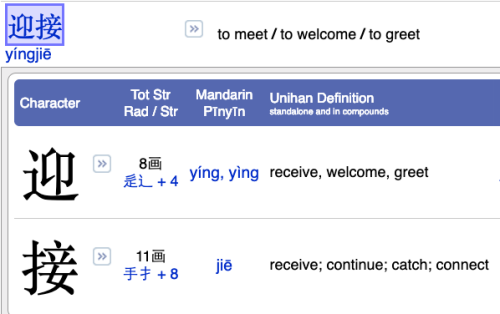
Here’s my dictionary’s breakdown of the word “to welcome”:

tumblr_inline_pmio29hclo1u6eyq8_500

And triple-redundancy isn’t rare, either:

坚定不移 – staying still

Which breaks down to:

 坚 – unchanging
 定 – settled down
 不 – not
 移 – moving


Tags:

#language

Anonymous asked: pure curiosity, what would a future child call you instead of gendered parent terms? or like… would they alternate?

{{previous post in sequence}}


cptsdcarlosdevil:

there are no good choices

if no one comes up with something better I’m going with “zaza”, on the grounds that all nonbinary words include z’s or x’s


towardsagentlerworld:

Can they just call you Ozy?

(I may teach my child to call me by my first name, because (1) that’s what everyone else calls me, and (2) I’m going to call my child by their first name, so it’s only fair that they get to do the same for me)

(In India, there are specific titles for “older brother” and “older sister”, such that younger siblings typically don’t address their elder siblings by name. Elder siblings, however, do address their younger siblings by name. It eventually started to feel to me like the main purpose of these words was to enforce age-hierarchical relationships, and so I was happy that English doesn’t do that. But American English still has the norm of not calling your parents by their first name, and while I don’t think most parents have the intention of using this to enforce a hierarchical dynamic, I wonder if it has the same effect.)

(This is a really tentative hypothesis, and even if it’s true, I imagine the effect would be really small. And so I don’t think that teaching your kids to call you “Mom” or “Dad” [or “Zaza”] is wrong. But I personally don’t see a good reason for the terms “Mom” or “Dad” to exist, and I definitely want my child to know that they can address me by name if they’d like.)


coffeespoonsposts:

My stepmother specifically said that she wanted her son (my half brother) to call her ‘mum’ to enforce a hierarchical relationship. She’s generally very liberal.


towardsagentlerworld:

huh, okay, datapoint.


warpedellipsis:

When parents get pissy that their child called them by their first name, you know it’s a dominance thing. Most parents get pissy about it. It’s not just convention. I’ve never met any that haven’t.


sinesalvatorem:

I once called my mother by her first name and she looked at me like I’d started speaking a foreign language. She didn’t, like, say it was wrong, or something, but she did seem to think it was hella weird.

And, like, it felt weird in my mouth, and no other kids did that, so I immediately switched back to “mummy”. It feels more natural.

But, now that you mention it, I think most parents do get upset about it. Yikes, even more hidden dominance shit.

OTOH, not having any special way of referring to one’s parents (or *children or other relatives) feels even weirder to me. Ideally, every relationship relative to the speaker should have a lexical title, for ease of sorting people. Maybe I could go by “Mother Alison”, the way nuns do?

*The child title in my culture is “Likl [name]”, from English “little”. I also like how our community has settled on “Baby” for “Baby Andromeda” and “Baby Merlin”, though that probably won’t last throughout childhood.

This reminds me that, earlier today, my cousin asked me if he could call me ‘Aunty Alison’, since that’s the adult female familiar title. I am So Touched.


warpedellipsis:

All other relatives, at least American-style, do go by title/relationship-name though? Like, Grandma Jane, Uncle Phil. Parents are the only ones that don’t, I think. Cousins don’t because that’s an equal relationship, not a powered one. 

I wonder how much of the resistance to alternate family structures, like multiple and blood-unrelated parents, is because of this. If you don’t have ownership of the kid, then you have no title, and if you don’t have a title, a separate title, then you have no way to know who the kid is referring to. And no way for other adults to refer to you. It’s all very set in 2-opposite gender parents for each kid, zero flexibility. If there were other names or flexibility, there wouldn’t be so much reason to resist. 

What’s the neutral name for a parent, that isn’t parent? It just sounds way too formal to go “Parent Haley”. Maybe that would work for places like schools to address the family, and I think that’s how they’ve handled same-sex relationships, but I don’t think a kid could do that. Are there other languages or cultures that have some kind of Name-(affectionate additive) or Title type thing that would fit this? Make one up?


sinesalvatorem:

My maternal grandmother is “Granny”, my paternal grandmother is “Grandma”, my maternal grandfather is “Granddad”, and my paternal grandfather is “Grandpa”.

I was 10 by the time I learned it was possible to use language such that The Four Grandparents might be ambiguous.

Likewise, if I had two parents of each gender, they’d be “mummy”, “mama”, “daddy”, and “papa”. Do other varieties of English not have two kid words for each parent-gender? This certainly wouldn’t be a problem for someone who grew up with my variety.

Although, really, now that I’m aware of the potential creepy ownership stuff, I think I’ll just have [title] + [name] for all relatives; people of equal or lower social status included.

I need to learn, and raise my kids with, a language that handles all this stuff better. Language nerds!, any suggestions?


brin-bellway:

I, too, distinguish the four grandparents by using different variants of “grandma” and “grandpa” rather than by name. There doesn’t seem to be a consistent mapping among families that do this, though: mine are “Gramma” for maternal grandmother, “Grampa” for maternal grandfather, “Granny” for paternal grandmother, and “Grampy” for paternal grandfather (though by the time I was old enough to talk Grampy was dead, so that term never got a whole lot of use). The lack of consistency always annoyed me a bit, that if I were speaking to someone outside my family, I couldn’t just say “Gramma” to communicate that I was talking about my maternal grandmother.

(Region notes: my grandparents lived in Massachusetts, part of New England. My parents moved to New Jersey after marrying, which is too far south for New England but still part of the broader Northeast.)

“Mama” and “Papa” sound slightly foreign or old-fashioned (I think I’ve only encountered them in historical novels, people from the South, and possibly-Brits-but-those-might-have-also-been-historical, never from speakers of my own dialect), but not so weird that they wouldn’t suffice if “Mom” and “Dad” were taken.

Another difference I’ve seen is in how a child refers to parents of other children. Apparently “Mr/Mrs X” is very common, and in many places the only polite form of address. I never did that: if I knew the parent through the child, I called them “[Child’s] mom/dad”, and if I knew the parent directly, I called them by their first name.


justice-turtle:

In my childhood subculture, addressing any adult by first name, or by terms other than “Mr/Mrs X” or (if they hadn’t been introduced) “sir/ma’am”, was very explicitly Against The Rules for the specific reason that it defied that hierarchical dominance structure. (The term used was “disrespectful”, which in the subculture’s jargon was interchangeable with “insubordinate”. Right-wing Murrican culture is verrrrry military. I could probably write an essay on that when I’m not trying to get to bed on time.)


shadesofmauve:

Kids like @justice-turtle weirded my mom out, btw. She always introduced herself as “Mary, Shades’ Mom”, and then getting called “Mrs. Mauve” was like ‘WTF did that come from’. She always taught me to call people by whatever they introduced themselves as. Isn’t THAT showing respect, since they presumably gave you their preference? It still baffles me whenever people have a conversation about what to call Party X without asking the Party X involved. o_O

I’ve also known LOTS of kids who have a phase of calling their parents by their first names, and the parents don’t get upset about it. It’s pretty common for kids to do it for awhile when they first realize their parents HAVE names! It’s novel, so they test it out. 

Also, for lots of families using a first name instead of a familiar form of ‘mom’ or ‘dad’ (or some other-gendered word of your choice) feels distancing. Kinship terms can be terms of endearment.

I use first names when talking to my aunts or uncles (I use “Aunty X” when talking about them, but not to them), but I’d never call my grandparents by their first names because it’d be like if they stopped calling me ‘sweetheart’. 

That’s not saying that it’s never a control/dominance issue – it absolutely IS in lots of situations! Teachers, doctors – using last names there is an intentional choice. In some families it’s a dominance issue, as demonstrated above. But it’s not ALWAYS a dominance issue, by a long shot. 

I’d hazard a guess that the use of kinship terms in a family reflects their underlying strengths or issues; it doesn’t define them. 


virusq:

I called my mom “mom”. I refer to my dad by his first name. I refer to my uncles by their first names. I referred to all of my grandparents by their first names.

My parents never had a beef with it. Other adults expressed that it was disrespectful, or implied that my father was a step parent because I refused to call him “dad”. Most people were polite and just accepted it.

But I also referred to my friend’s father as “mommy”, in a completely respectful way. I made a mouthy comment and he told me that children in his presence would behave better. I told him he was not my mother, so he could not set my rules. He loomed over me, and in complete authorative seriousness said: “I AM your mother.”

Oh. Okay then. Sorry mom. I’ll clean up.

I’d propose simply using your first name with your kids, if you don’t want them to use gendered pronouns. It won’t bother them any, and anyone who is bothered by it with serve as an example of how society forces gender roles onto individuals based on appearances. :)

I also have a few friends who refer to my parents as “the parental processess”, as in, “VQ was generated as the nested node of two parental objects.”

Oh, and my mom went through a phase where she referred to herself as “Helga, VQ’s house keeper.”

Aaand my dad went by “daddy-o” for about five minutes.

So. Yeah. First names for parental units.


shadesofmauve:

Heh, yeah – I should’ve said that I was giving examples about what I’d experienced, not what *should* happen. If someone wants their kids to use their first name, go for it! For the kid, it’s all what they grow up with, right?

Of course, for babies there are certain noises that are easier (hence why ‘ma’ or ‘mama’ ’ is really common), but… tell ‘em what you think they should call you, and the kid will come up with whatever version of that they can pronounce, and that’s probably what you’ll be stuck with for life. :P


justice-turtle:

“Isn’t THAT showing respect, since they presumably gave you their preference?” @shadesofmauve See, that would be respecting *the person*. This is what I was trying to get at by mentioning insubordination, but apparently didn’t quite: “respect” as used on my side of the fence has nothing to do with individual preferences. It’s all about respecting and reinforcing *the dominance structure*. (If you go around respecting people’s individual preferences, you might start thinking people can choose whether to be pregnant or what church to go to, which is Dangerous and Wrong. ~Real~ respect, like ~real~ love, involves knowing What Is Best for the person – according to the prescribed hierarchical structure, of course – and forcing them to do that, or submitting when they force you if they’re higher in the authority structure.) (Right-wing English and left-wing English are two very different languages by this point. I don’t know if trying to do translations like this is actually helping anything at all, but I try to believe understanding is the first step toward not killing each other, so I keep doing it. :P)


shadesofmauve:

Oh, @justice-turtle, you did and do explain it well! I’m sorry my addition came off as ‘not getting it’. I wasn’t intending to argue with you, but to pose a counter argument – and it’s not a counter argument I expect to work with people like your family. It’s one I expect might work about lots of people who are more centrist and haven’t ever really questioned their received wisdom.

The situation you describe is more like the whole idea of “saluting the position, not the man.” (Which is generally portrayed as a good thing, but I’d SUCK at. I’m good at person respect, but suck at authority-respect, heh). It absolutely IS the clash of person-driven vs hierarchy-driven worldviews. I was representing the other end, not trying to argue with staunch supporters of the authority end. I’m… not sure how one would do that.

As to trying to find common ground or at least understanding, that’s incredibly laudable. I suspect there are people with whom it will never work, but it’s still laudable – and I always tell myself that even if the ends can’t budge, the vast majority lies somewhere in the middle, lurking in the comment section rather than posting, listening to the argument rather than joining in, and we frame our explanations for them.


Tags:

#(October 2016) #(this branch feels like it goes far enough afield from the part involving me that #it might not quite count as the same conversation for agletting purposes #but anyway it’s interesting) #conversational aglets #language #long post

{{previous post in sequence}}


funereal-disease:

Is “identifying foreign words by phoneme cluster” a thing that many/most people have trouble with? It’s something I’ve been instinctively able to do for as long as I can remember, but quite a few people have told me lately what an uncanny ability it is. 

I’ve studied only a couple of foreign languages, and both of them were Romance-based. I pick up languages and grammatical rules very quickly, though. Even when I don’t understand the language being used, I can almost always pick out which language it is, or at least which language family.

This comes so naturally to me that I’ve never thought of it as weird, but recently people have been downright awed that I can, say, pick out the Thai dishes from the Vietnamese ones on a pan-Asian menu. Even though Thai and Vietnamese have totally different phonemic structures! It’s not that hard! People are often frequently baffled when I identify someone’s ethnic extraction by their surname, which, like – I dunno, all I can say is it’s not that hard! 

I swear this isn’t me humblebragging – I am legitimately confused that this does not seem to be a common thing.


lenyberry:

I too do the thing. I always figured most people’s lack of ability to do the thing was primarily related to most people’s disinterest in learning even the tiniest bit of foreign languages unless the language in question is going to be directly useful to them in a way they can quantify. But also I’m hyperlexic so, maybe that’s a factor too.

In my case people have more frequently expressed surprise at my ability to pronounce surnames, but that’s directly tied to recognizing their derivation – when you know what language a name derives from, and have a vague idea of the pronunciation rules of that language, it’s generally not too hard to at least come really close to correct pronunciation of the name.


funereal-disease:

Hyperlexia nation checking in! @ozymandias271 is the only other hyperlexic I know off the top of my head; do they also do the thing? 

Same re: pronunciation. Weirdly enough, though, that often leads to me pronouncing it incorrectly, or at least what the person in question considers incorrectly. French names are very common where I live, but most of them have been Anglicized to the point where the original pronunciation becomes wrong. 


ilzolende:

I’m hyperlexic and okay but not great at this? (I can’t distinguish Swedish and Norwegian, and I can tell the difference between Korean and {Chinese, Japanese} but I can’t tell Chinese and Japanese apart, etc.)


sinesalvatorem:

I am pretty good at doing the thing, because I pick up linguistics rules really easily. (My project for the past two days has been teaching myself the grammar of Classical Sanskrit (hence the Bhagavad-Gita blogging), which I expect to take about a week to get mostly-down. I’m not planning to memorise Panini’s entire generative grammar, though.)

However, I am really awful at remembering vocabulary, which is why I’m monolingual. Give me the words, and I’ll successfully make sentences in half a dozen languages. If I’m allowed to make the sentences really simple, I could probably do two dozen languages. However, expecting me to remember any of those words the next day is a lost cause.


brin-bellway:

Despite hyperlexia, I’m not all that good at distinguishing languages by phoneme usage.

I’m a lot better at picking up vocabulary than grammar. I mentioned “read[ing] okay Packaging French, but don’t expect me to write it” recently: when presented with an everyday French sentence of the sort one might see on a sign or a bag of food, there’s a fair chance I’ll be able to work out the gist of it. If you ask me what the French word for [insert thing here] is, a significant-though-still-fairly-small amount of the time I will be able to answer. (As long as I am allowed to submit my answer in writing.) I cannot predict the grammatical structure of a sentence that isn’t currently staring me in the face, and I might not recognise it in a sentence that is currently staring me in the face.

Ingredient lists, which have almost no grammar and consist mostly or entirely of terms that any Canadian who doesn’t grow all their own food would be naturally exposed to†, are easiest. I am frequently able to read entire French ingredient lists without any guessing at all.

(One time, I actually understood the French side of the package better than the English.

Me, in grocery store: *looks at chocolate bar*

Me: “Chocolate with marzipan”. What is marzipan, anyway?

Me: *reads French side* “Chocolate with almond paste”. Oh.)

†Though I can’t promise how much attention other people pay.


justice-turtle:

I’m not sure what hyperlexia is (and I need to go to bed rather than googling it), but I can pick out the phoneme clusters without any reference to whether I understand the language at all. I can only do it by reading (in Latin alphabet), not by sound or in other alphabets, though.


Tags:

#(September 2016) #conversational aglets #language #food mention

cptsdcarlosdevil:

cptsdcarlosdevil:

POLL: is porn a thing you read or a thing you watch

testblogdontupvote

Is this behavioral or linguistic question?

linguistic

Both, but I think I’m fighting a losing battle: I fairly often encounter statements that are completely nonsensical *unless* you interpret “porn” as necessarily being video (and in many cases, as being necessarily mass-produced and for-profit).


Tags:

#sexuality and lack thereof #reply via reblog #language #survey #nsfw text?

whetstonefires:

herculepoirot314:

dubiousculturalartifact:

I just accidentally invented a new idiom, maybe?

Licking a tree & hoping for maple syrup.” 

aka “A attempt at resolving/achieving something with less effort than is required for success, & a high probability of it proving merely futile & faintly unpleasant’

I can support this as a turn of phrase.

I think you’ve really tapped into something here.


Tags:

#language #puns #(and tangentially:) #our home and cherished land

{{previous post in sequence}}


toocooltobehipster:

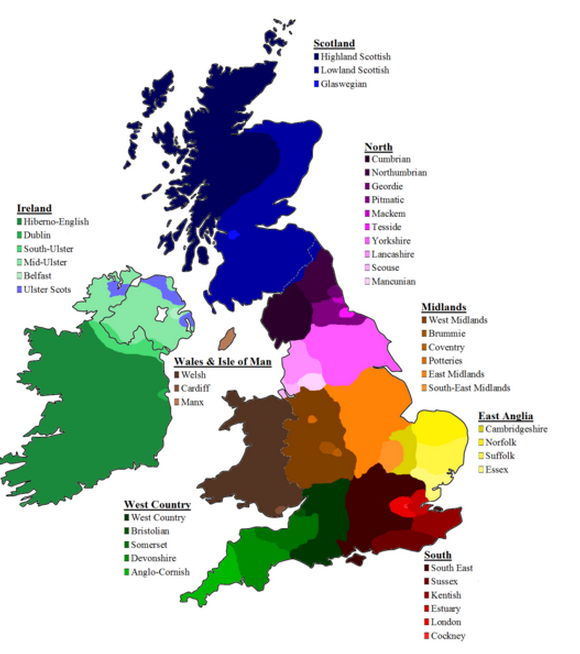
map of British accents!!


haus-of-ill-repute:

How can a country smaller than montana have so many fucking accents?


youblowuponesun:

this is why we say please do not talk about a “british accent” thank


doctadonner:

but me and my sister both live in yorkshire (I live in North and she lives in South)  and she has to talk slowly when she comes to the north because no-one can understand a word she says, so there’s deviations of accents within accents.


darael:

Oh, and then there’s:

Spread out all over the fucking place but more prevalent in the South: RP (which is what Murricans think of as a “British Accent” even though it’s a minority of the English that have it let alone the British)


thedreadvampy:

plus like…there’s a LOT of variation in the Lothian area? Edinburgh’s super posh.


dropkicks:

if you think there’s only one accent in london i’ve got news for you son


silly-cleo:

I’ve lived in the UK for more than half my life, certainly my entire adult life, and I still can’t successfully ID all the accents there are here. I’m sometimes mortifyingly wrong, but less so now.


jescissa:

There’s way more than two Welsh accents. How can you categorize it as ‘Welsh’ or ‘Cardiff’? The accent in Caernarfon is completely different to the accent in Wrexham, so that’s at least four. Then the accent of Ceredigion is different again. Five. The Welsh hill farming accent is different to the Welsh mining accent (North/South divide.) People in Penmaenmawr sound different to people in Llanfairfechan and there’s a 7 minute drive between them.


cosmic-llin:

This! Even if you’re grouping similar Welsh accents together, there’s at LEAST one in the North and one in the South. Cool map though!


brin-bellway:

Are there actually people who honestly believe there is only one British accent, or is that a myth? Whenever I see people claim Americans think there’s only one, they always use the existence of the phrase “British accent” as their evidence.

Yes, I say “British accent”. Thing is, it’s not that I don’t know there are a zillion different accents in Britain. It’s that I don’t know what they’re called, and so am forced to use “British accent” as an umbrella term because I don’t have the words to describe them more specifically except perhaps by comparison (“it was a Dave-Lister-y sort of voice*”).

*And even having heard that this is a Liverpool accent, I would still describe it by comparison if I could possibly get away with it. I don’t entirely trust my source on where Lister’s accent is from, nor do I trust Liverpool to have only one accent.


cosmic-llin:

I think it’s less that people really don’t know that there’s more than one British accent, and more that very often “British Accent” is used to mean Received Pronunciation (in my TV and real-life experience that’s what a majority of people will do when required to fake a British accent), which is kind of a sore point anyway because in some British circles RP is still considered “better” than other accents and people with regional accents already feel marginalised?

And yup, Lister definitely has a Scouse (Liverpool) accent, although you’re right that Liverpool accents can vary a bit!


Tags:

#(February 2014) #conversational aglets #language #accents #Britain #Red Dwarf #long post

i exist in a state of constant stress. and also new york

{{previous post in sequence}}


{{OP by buckykingofmemes}}

sigmaleph:

#(i know there’s a word for this specific type of wordplay but i’m not sure what it is)

#(i think it might have begun with a z)

Zeugma!

Thank you!

P.S. Do my tags display to you as being in all-lowercase? Will you miss out if I use Very Important Letters in tag-rambling?


Tags:

#reply via reblog #language #puns


{{next post in sequence}}