when i watch old movies i’m constantly surprised by how much acting has improved. not that the acting in the classics is bad, it’s just often kind of artificial? it’s acting-y. it’s like stage acting.
it took some decades for the arts of acting and filmmaking to catch up to the potential that was in movies all along; stuff like microexpressions and silences and eyes, oh man people are SO much better at acting with their eyes than they were in the 40′s, or even the 70′s.
the performances we take for granted in adventure movies and comedies now would’ve blown the critics’ socks off in the days of ‘casablanca’.
there’s a weird period in film where you can see the transition happening. right around the fifties, I think. the example my prof used when i learned about it was marlon brando in “a streetcar named desire” – he was using stanislavski acting methods and this new hyper-realistic style and most or all of his costars were still using the old, highly-stylized way of acting. it makes it way more obvious how false it is.
i even noticed it in ‘the sting’, which was 1973. i actually think they used it on purpose to get the viewer fished in by the second layer of the con; the grifters at the bookie’s were acting like they were acting, and the grifters playing the feds were acting for reals. if you’re used to setting your suspension of disbelief at the first set’s level, then the second set are gonna blow right past you.
or possibly the guys playing the grifters playing the feds just happened to be using the realistic style for their own reason, and it coincidentally made the plot twist work better. but i like to think it was deliberate.
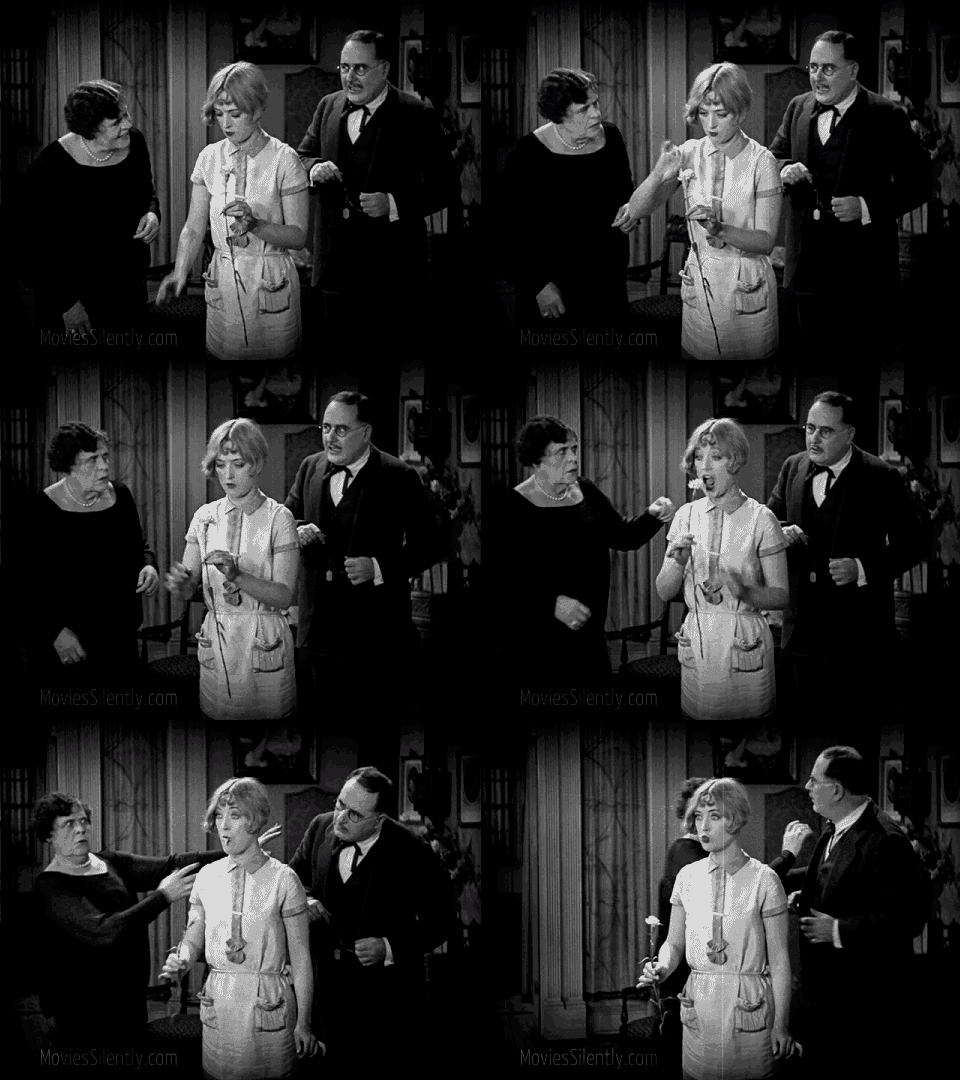
i was thinking about this again, and when you know what to look for, it’s really obvious: old movies are stageacting, not movie acting. it just didn’t really occur to anyone to make the camera bend to the actors, rather than the other way around. just image search old movie screenshots and clips and gifs, you’ll see it. the way people march up to their mark and stand there, the way they deliver their lines rather than inhabiting the character. the way they’re framed in an unmoving center-stage.
this is a charming little tableau, quirky and unexpected, but it’s a tableau. it lives in a box.
now, i usually watch action movies, and i didn’t think it was fair to compare an action movie with what appears to be an indoor sort of story, but i do watch some comedy tv. so i looked for a brooklyn 99 gif with a similar framing, intending to point out that the camera moves, and the characters aren’t stuck inside the box. but i couldn’t even find the framing. they literally never have all the characters in the same plane, facing the camera, interacting only within the staging area. even when they’re not traveling, they’re moving around, and they treat things outside the ‘stage’ as real and interact with them, even if it’s only to stare in delighted horror.
as for action, it took a while for the movies to figure out what, exactly they wanted to show us, and how to act it. here’s a comedy punch:
here, also, is a comedy punch:
the first one looks like a stage direction written on a script. the second one looks like your friends horsing around and being jerks to each other. the first one is just not believable. the physics doesn’t work. the reaction is fakey. everyone’s stiff. even the movement of the camera is kind of wooden. the second one looks real right down to the cringe of his shoulder, and the camera feels startled too.
i’m not saying this to dis old movies, i’m just fascinated and impressed by how much the art has advanced!
I’m going to bed, but I also want to say that I think, without actually bothering to explore it and make sure, that there’s been a similar shift in comics, probably related to the shift in acting/camera work. And I think you still see remnants of old “stage acting” comics in the three-panel style set ups (you might still see it in long form comics, but you’d probably call it bad composition)
Seriously, I used to work in a sound studio, and one series of projects required us to listen to LOTS of old audio recordings. Not of anything special – just people talking.
AND THEY TALKED LIKE THAT.
It was so fucking wild to hear just a couple of people being like,
“WELL HI THERE JEANINE, HOW ARE YOU TODAY?”
“OH, NOT TOO BAD, JOE, THOUGH MY HUSBAND’S BEEN AWAY ON BUSINESS FOR A FEW WEEKS AND I MISS HIM SOMETHING TERRIBLE.”
“WELL IT’S A HARD THING, JEANINE, BUT YOU’LL GET THROUGH IT.”
“WELL I SUPPOSE I’VE GOT TO, HAVEN’T I JOE?”
All in that piercing, strident, rapid-fire style we associate with the films of the era. If you’ve watched lots of old movies you can imagine the above in that speech pattern.
I don’t know if people talked like that because it was in movies but I suspect it’s the other way around.
Same goes for the UK – When they made the TV series The Hour, set in the 1950s, they had to tell the very well spoken, privately educated Dominic West to tone down his imitation of a 1950s newsreader because being accurate would have sounded to a 2011 TV audience as if he was doing a parody. When you watch Brief Encounter they’re not speaking like that because they can’t act, they’re speaking like that because it was the norm on screen. It now sounds unnatural because it’s not the norm any more.
Obviously there were people with regional accents and who didn’t speak in a heightened manner, but they didn’t get to be on TV or in movies unless they were villains. (And usually the villains were putting it on, like Richard Attenborough in Brighton Rock. Sure, he was Richard Attenborough, but he was brought up in the Midlands, and by the on-screen standards of the time, that was common.)
Even the Queen’s very posh accent has changed over the last 50 years and become “more common” – check out newsreel footage etc for proof – and recordings of her father are almost like someone from a foreign country (well, it is the past).
There is, for many film historians/critics, an actual turning point from mannered, theatrical, or “overplayed” acting on screen to naturalistic/American Method realism on screen. It happens in the 1954 movie On the Waterfront, during a traveling shot in which Marlon Brando’s character and Eva Marie Saint’s character are walking together. Eva Marie Saint accidentally drops her glove in the middle of the scene. Marlon Brando instinctively picks it up as his character, and continues the dialog, all the while playing with the glove–turning it about, trying it on, etc. Eva Marie Saint stuck with him, never broke, and the director didn’t call “cut.”
Before that scene in that movie, if an actor dropped a prop by accident, they would have re-shot the scene–because Brando mostly disappeared out of frame as he bent down to pick up the glove, and (as is explained above) movies were framed to keep the people in the scene in the frame. I
t’s a pretty famous scene in movies because Brando’s character doesn’t give the glove back, but instead uses it to amplify what the two characters are experiencing, naturally and without artifice. It is, for all intents and purposes, the exact moment that screen acting changed.
Okay, but here’s the thing about television specifically: given the size of TV screens when they first came out? Stage acting was the only thing that could be READ. Watch Star Trek: TOS on a modern screen and it looks absurdly overacted. Film of the same era is not, and yet the TV is.
And that’s not a fault of the actors; they were all very capable of naturalistic film acting (yes, even Shatner) – as the later movies would bear out. It’s because they were acting for the small screen, not the big one.
Stage acting and stage makeup is what it is because people are far enough away from the stage that you have to cake on the makeup garishly and exaggerate the hell out of your for it to be VISIBLE. And in early television? Yeah, those constraints actually very much applied. You could move the camera, sure, but the quantity of visual information you could send was just damned limited.
Watch some Classic Dr Who. You may or may not notice it without watching for it, but every shot of the TARDIS is taken from the same angle.
The TARDIS was, at that time, a stage set. The camera was behind the fourth (Sixth?) wall. It was fixed. And most TV sets were built like this. They had a specific fourth wall and everything was filmed from that angle.
Fast forward to the new series, and you’ll see that the TARDIS is being filmed from different angles all the time, including following the actor around.
Three things have changed:
1. Cameras have become much smaller.
2. Set building for TV has developed as an art. Those early sets were built by people who were trained to build stage sets.
3. Overall technological improvement resulting in things being cheaper.
The TARDIS set that was just retired? Each of its walls was designed to slide out. So you could put the camera anywhere you wanted. Presumably this is the case with the new one too. They couldn’t imagine doing that back in the day. Nor could they afford the complexities of a set like that.
It’s actually my opinion that TV has very much matured as an art form…this century. This decade. We are doing and seeing things that couldn’t be done ten years ago, twenty. Heck, even five.
Going back to speech patterns for a moment – I was a young child in the 80s, so my memories of the norms of the time period are limited (especially because I was incredibly sheltered), but the books I read at the time and the popular movies of the time all have this kind of – whimsical, sardonic speech pattern going on. Think John Waters dialogue.
I always thought it was kind of stylized. But then I ended up in a weird part of YouTube one night and found someone’s home video of just walking aroud a 7-11 convenience store at midnight talking to people in Orlando, Florida. Just trying out their new camcorder for shits and giggles, talking to other customers, talking to the cashier, etc. And you know what? They all talked like a goddamn John Waters movie. It was the weirdest thing, like I was watching outtakes from The Breakfast Club or Say Anything. I expected one of the Cusacks to walk into frame any second.
Anyway, so I think it’s super cool how human speech and interaction shifts over time, and if you’re living through the shift, you don’t really notice it as it happens.
The cameras they were using back in the 1940s-1970s were enormous and heavy. Moving them was a chore, and you had to have track built to move a camera that big. Getting the camera in close to the subject was very difficult.
It was the arrival of the Steadicam in the 1970s that started to change everything. You could hook the camera to an individual person using a harness. For the first time the camera was liberated. Think of the walk & talks on “The West Wing” – that would not have been technologically possible in earlier film and television.
Also filming through the 1950s was mostly done on sets. A few directors like John Ford would go shoot on location for parts of their movies, but most films were made on sets because it was cheaper and easier. When the studio system began to break down in the 1960s, and cameras started becoming lighter, you saw a shift to location shooting, which reduced the proscenium staging of older movies.
Tags:
#not sure how to fact-check this #history #interesting #long post
too lumpy and solid to combine and homogenise? or it combined and then separated due to different densities and varying levels of heat? I have no idea where planets came from, I only live on one.
!!!!!!!!!! is excite
So, first things first is deciding what ‘disordered’ means in this context. After all, there’s one very primordial sorting that any planetary body goes through- a density gradient by depth. You get your core, your mantle, your atmosphere, heavy iron and nickel falling and light volatiles rising. So we already have some order for free, although the various compounds within each layer are still a jumbled mess.
Now, naturally, your interior heats up, partly because of that pressure and partly because it tends to be super radioactive. And as we all know from grade school, thermal expansion is a thing- hot substances get larger, and less dense. But it was their high density that put them that far down in the first place! So in larger terrestrial bodies like Earth, this means that they float back up to the top again before cooling and falling, like a lava lamp (on smaller bodies like Mars heat conducts out too fast for any bulk overturn to happen). In the softer areas like the atmosphere and the mantle, the Earth is constantly being ‘stirred’, homogenizing those layers. Like the atmosphere, the mantle is mostly-but-not-entirely uniform because shit’s complicated, but that’s what your high-entropy baseline is as well as the lion’s share of Earth’s mass.
That ‘baseline’ is a muddle of mineral types we call peridotite. It has a lot of silicon and oxygen as you might expect, as well as a number of metals and other bits, particularly magnesium, iron, and calcium. It wouldn’t survive long at the surface; water etches it away quite quickly, but of course it’s protected from the nastier reactions through the expedient of being really far away from the surface where all the volatiles went. Still, it’s been changing a bit over time. A primordial and molten planet’s mantle wouldn’t be quite the same as the one we have now, because we’ve spent several billion years drawing elements out of it, cooling them at the surface, and then occasionally injecting new compounds back in.
And this process doesn’t quite happen randomly. There’s a particular class of elements we call ‘lithophiles’ (no relation to the bacteria), mostly because they react well with oxygen, and correspondingly they’re the first ones to jump ship during mantle cooling and float up to the surface, staying there more or less permanently. That’s your crust, and it’s why continents and oceans floors don’t look much like the mantle proper- there’s a self-selection going on among the elements. Once you run the high-entropy mulch through this selection process, what cools out is an old friend- the familiar igneous rocks. When they’re extruded in to the air or water by volcanoes, they look like basalt, when they just moosh up against the bottom of the existing crust without ever touching air, they look more like granite. So that’s a further source of differentiation and order, but those differences are fairly minor in the grand scheme of things- mostly having to do with how many metals are mixed in, and the corresponding differences in density.
And to the first order, that’s pretty much what the crust is. The question was why you see so much order in the Earth’s crust, but honestly it’s like 90% granite and basalt, which are pretty close to being a random homogeneous-if-you-squint mix of the lithophilic fraction of Earth’s bulk mantle composition. What’s tricking you is those volatiles again, because even though the Earth’s crust is almost entirely igneous, the visible land surface is almost entirely not. Sedimentary rocks are only IIRC 5% of the volume of the crust, but they’re a solid majority of what you see when you’re clambering around in the air.
The ocean floor is maybe a good way to start thinking about this. At the mid-ocean ridges, which are giant lines of volcanoes injecting new crust all the time, it’s basically just pure basalt. As you walk in a straight line along the ocean floor from those volcanoes towards a continent, you’ll notice little bits of debris start accumulating, mostly dead organisms and excrement and so on. The farther you walk, the more you see, because the basalt is acting like a conveyor belt moving between your two landmarks, and the farther you get from the volcano the older it is and the more time it’s had to pick up random bits of detritus. Eventually you’re wading through it, and by the time you get to the edge of the ocean it’s hundreds or thousands of meters thick, with nary a hint of exposed basalt. But it’s still under there, much thicker than the layer of goo on top of it. So there’s this patina of order laid across the igneous crust, with linearly increasing mud thickness. One of the more reliable geological gradients in the solar system, as it happens.
The continents are trickier because they don’t die of old age. That granite is much less dense than the basalt you get in oceans, so it floats for basically forever without getting injected back inside the planet. Sediments accumulate and get remixed over billions of years instead of millions, and a diversity of forms proliferates because you can have second-order, third-order, fourth-order weathering, weathering of metamorphic rocks, biological chemistry, on and on and on. Around the edges, you get the scraping weirdness of plate subduction, every now and then you even get weird things happening when some vast object bumps the continent from underneath. But because a plate itself is so large, most of the interesting and dynamic activity is all happening at the edges, leaving the bulk granite more or less inert for billions and billions of years. Everything that you’re calling ordered happens in a narrow film on the outer edge of a narrow film.
But that surface environment, narrow as it may be, is quite intense and destructive. So for any given patch of continent, at any given time, the surface is in flux- if it’s not actively being buried, it’s actively being eroded. So any sedimentary rocks that you see come from these areas where the surface was preserved through rapid accumulation, shattered fragments of the erosional areas finally being blasted to a place where they’re buried too quickly to be destroyed before finding protective sequestration away from the surface. We call them ‘basins’. Often but not always underwater- like river deltas at shorelines, that kind of thing. But there’s plenty of examples of preserved deserts and rivers as well, anywhere that wind and water could bring a lot of random bits of stuff in and leave them there.
The conditions in any given basin are going to depend on a lot of environmental factors- biological activity, atmospheric and environmental conditions, the power of the force that brings sediments in, how old the rocks are, an endless list really. Basins themselves can be quite large, many miles across, and the depositional conditions within any given moment will usually be pretty similar because entropy. So you’ll see similar ‘packets’ of debris fragments landing all over the basin at about the same period of time. But as we all know, the atmosphere is a fickle bitch. So as time passes, so do those conditions, and so these basins produce distinct layers that vary in fragment size, color, chemistry, and so on. And there are so many different options for basin conditions that you get a rich taxonomy of different sedimentary rock types. Then they’re all buried, later exhumed, and outcroups have taken on that ‘order’ that you noticed.
Another major source of order comes from the fact that the crust is so brittle. At the planetary scale, the crust has a tensile strength of basically zero, so every time something happens tectonically it shatters. Uplift, load deposition, torque, you name it and there’s probably a patch of Earth’s crust losing its shit about it. These cracks, which you know as fault lines, are therefore ubiquitous, most of them not really representing a whole lot of motion, most of them again near the surface because that’s where force imbalances have to happen.
And when water is flowing through the near-surface, it will tend preferentially to flow along these fault lines, because they’re the weak points and pre-drilled tunnels. And when that flow takes the water from one place to another, with a different temperature and pressure and lithological environment, the chemical equilibrium of impurities in that water changes. It leeches certain ions from the surrounding rock, and precipitates others out. And this is a great way to collect large masses of very specific elements in one place- gold, for instance. Most mining for precious metals is about finding such places. That’s why you tend to find precious ores in ‘veins’; they fill the original fault lines that the water was flowing through, long and thin and twisty. (Iron is an exception, it’s a whole other thing.)
Anyway I uh, seem to have written a fairly long essay. But yeah! Rocks.
The eyes-in-the-front thing (usually) only applies to mammals. Crocodiles, arguably the inspiration for dragons, have eyes that look to the sides despite being a predator.
This isn’t a mammalian thing. When people talk about ‘eyes on the front’ or ‘eyes on the side,’ they’re really talking about binocular vision vs monocular vision. Binocular vision is more advantageous for predators because it’s what gives you depth perception; i.e, the distance you need to leap, lunge, or swipe to take out the fast-moving thing in front of you. Any animal that can position its eyes in a way that it has overlapping fields of vision has binocular vision. That includes a lot of predatory reptiles, including komodo dragons, monitor lizards, and chameleons.
(The eyes-in-front = predator / eyes-on-sides = prey thing holds true far more regularly for birds than it does for mammals. Consider owls, hawks, and falcons vs parrots, sparrows, and doves.)
But it’s not like binocular vision is inherently “better” than monocular vision. It’s a trade-off: you get better at leap-strike-kill, but your field of vision is commensurately restricted, meaning you see less stuff. Sometimes, the evolutionary benefit of binocular vision just doesn’t outweigh the benefit of seeing the other guy coming. Very few forms of aquatic life have binocular vision unless they have eye stalks, predator or not, because if you live underwater, the threat could be coming from literally any direction, so you want as wide a field of view as you can get. If you see a predator working monocular vision, it’s a pretty safe assumption that there is something else out there dangerous enough that their survival is aided more by knowing where it is than reliably getting food inside their mouths.
For example, if you are a crocodile, there is a decent chance that a hippo will cruise up your shit and bite you in half. I’d say that makes monocular vision worthwhile.
Which brings us back to OP’s point. Why would dragon evolution favor field of view over depth perception?
A lot of the stories I’ve read painted the biggest threats to dragons (until knights with little shiny sticks came along) as other dragons. Dragons fight each other, dragons have wars. And like fish, a dragon would need to worry about another dragon coming in from any angle. That’s a major point in favor of monocular vision. Moreover, you don’t need depth perception in order to hunt if you can breathe fucking fire. A flamethrower is not a precision weapon. If you can torch everything in front of you, who cares if your prey is 5 feet away or 20? Burn it all and sift among the rubble for meat once everything stops moving.
Really, why would dragons have eyes on the front of their heads? Seems like they’ve got the right idea to me.
this is some good dragon discourse right here, 10/10, and i dont mean to derail the whole thing away from the eyes, but i feel obligated to mention that in many stories and accurate to some reptiles, dragons have an extremely acute sense of smell/taste which would definitely help narrow down the depth perception issue. things smell stronger the closer they are. and i feel like i read somewhere that a blind snake can flick the air with its tongue and track its target mouse with no trouble at all. gotta imagine the “great serpents of the sky” had some pretty advanced biology. enough to make field of view win out against depth perception.
anywho. cool stuff. fear the dragons even if they are the prey cause they still beat us on the food chain.
“A flamethrower is not a precision weapon. If you can torch everything in front of you, who cares if your prey is 5 feet away or 20? Burn it all and sift among the rubble for meat once everything stops moving.”
A) As was stated previously, this rule doesn’t hold for life underwater where binocular vision isn’t worth the limited field of view.
B) Hammerhead sharks hacked the fucking system and spread their eyes so far apart that they have 360 degree field of vision and binocular vision of whatever’s in front of them and behind them.
Anyway, these wiki entries can give you an idea of what documentation of a tumblr post and its responses might look like. We’ll never document every single little thing, and we wouldn’t want to, but we can make a record of major conversations and schools of thought so that fans who come after us know how people were feeling on tumblr back in the day.
Fanlore uses the same wiki markup as Wikipedia et al.
Fanlore has a “Plural Point of View” policy: treat it like oral history where you want to document all sides of a controversy rather than Wikipedia’s attempt at ‘One Universal Truth’. (But feel free to correct factual errors.)
Fanlore is about any fandom history, so minute details of canon don’t belong on there, but minute details of meta, fanworks exchanges, any zine ever, any significant online fic, tropes in fanworks, etc. do.
Since tumblr is getting harder and harder to search, even aside from deletions, now is a great time to document important tumblr posts on Fanlore or add information from tumblr posts to existing articles.
Right now, Fanlore is an amazing resource on pre-internet “Media Fandom”, old print zines, the LJ era, and a lot of slash fandom history.
But it’s only as good and varied as its editors.
In my experience, it could use a lot of help in the realm of anime/manga fandom, including BL fandom, fandom not in English and/or outside of the English-speaking world, fandom on places like Quizilla or Wattpad, femslash fandom, etc. If your area of fandom is not represented, it’s only because the current editors don’t know enough!
You are welcome! We need you!
If you know how wikis work, you’re all set to edit Fanlore. If you’ve never used a wiki, we can help you figure it out.
Fanlore is a valuable and excellent resource for fandom history. Furthermore, it’s really fun to wikiwalk at three in the morning.
why are there so many protocols… why do Tent and Mastodon and Scuttlebutt have their own protocols… this is what a “protocol” is for, it’s for multiple things to use…. hnnnnggghhhh
I’ll check it out I guess, as long as they have a linux client
The main problem I had when first attempting to use Scuttlebutt was that–unless you have the knowledge and resources to run your own pub, which I do not–it forces you to integrate into the pre-existing web of social connections, unable to import the relationships you’ve already formed elsewhere. Which *is* a great way to make new friends, and that *is* very much a valuable role to play, but right now I’m focused on keeping the old ones.
A ratsphere pub sounds very promising. I think I’ll be giving this another try.
(They do have a Linux client. Source: am on Linux, have used their client.)
Running your own pub has been made pretty easy. There’s a tool for spinning up an instance on DigitalOcean which requires very little knowledge or skill.
I’m unclear on how much it will cost to maintain the pub; a new DigitalOcean account gets $100 of credit which must be used in the first 60 days, so I’ll be running this for 60 days and I’ll tell you what it cost at the end of that.
I may even run multiple if I see some reason to or demand for them.
A lot of good info and comments here; I’m glad they got a chance to talk to @pervocracy in particular.
For the tl;dr, the big news here is that banning NSFW has been in the works for some time and was simply rushed out the door due to the app thing, and the real motivation is that few ad buyers are willing to buy ads that might show up next to porn.
Porn on Tumblr is something Verizon needs to wipe out if it’s going to make any money off what it thinks is actually valuable about the platform — enormous fandom and social justice communities that, just before the Verizon acquisition, [former head of media brands Simon] Khalaf was insisting the staff figure out how to better monetize.
This explains a number of things that were hard to contextualize at the time: the insistence on repeatedly turning on safe mode for everybody, and the push for non-chronological feeds, were likely intended to help increase the amount of “safe” pagespace they could sell higher-value ads on.
I’d noticed for a while that Tumblr was pushing the fandom angle very hard – the Radar and other highlight features are extremely fanart-oriented, and that was clearly also part of the motivation behind algorithmic feeds. However, I’d been presuming that this was just to facilitate marketing of the actual brands in question, like “pay Tumblr to highlight fandom content for your show so more people will get into it.” It sounds like they actually wanted to use fandoms as a general marketing demographic, which is a bit more ambitious but also makes more sense – you might want to reach MCU fans not just for MCU stuff but also for unrelated products that had conceptual crossover.
If that’s the case, though, it means that the ban was even more foolhardy than I thought, since fandoms are going to be the first thing to vacate – sites like Dreamwidth are natural fits for that, and not only are they among the least tolerant of strict anti-NSFW guidelines, but they’re also the most likely to post the kind of SFW visual art that Tumblr is flagging for deletion because their algorithms suck.
Tags:
#hmm #interesting #The Great Tumblr Apocalypse #The Last Tumblr Apocalypse
Have I watched the movie in the last decade or more? No. Do I have iron clad evidence to support my argument? Yes.
1. She’s the most knowledgeable about candy. She’s committed to it, and knows her stuff. When Wonka holds up a little yellow piece across the room, she recognizes it immediately. She was able to switch to candy bars for the sake of the contest, so we know she has personal discipline and is goal oriented. Also, two major projects play directly into her strong suits: the 3-course-meal gum that Wonka failed to make safe (gum) and the neverending gobstopper (longevity).
2. She’s the most fit to run a business. Violet is competitive, determined, hard working, and willing to take risks. Her father is a small town car salesman and politician, so she could easily pick up knowledge and support from him. (Veruca’s dad is also a business man, and in a compatible market (nuts), but it’s made very clear that Veruca has no respect or knowledge of business practices or hard work.)
3. She’s the most sympathetic to the Oompa Loompas. She critiques Veruca when Veruca demands to buy one. More importantly, Wonka has been testing the 3-course-meal gum that ‘always goes wrong’ on Oompa Loompas while he presumably just watches. Violet is ready to put herself on the front line, instead of treating the Oompa Loompas as disposable, and would therefore be a better boss.
4. Her personality ‘flaw’ is the most fitting for the company. In the moralizing Oompa Loompa song, they just say ‘gum is pretty cool, but it’s not socially acceptable to chew it all day‘. The thing is, we already know that she can stop if she wants, because she already did that to win the golden ticket. And yeah, she is defensive about the perceived impoliteness of her hobby (like when her mother tries to shame her about her habit during a televised interview) but the obsession with candy and neglect of social norms is EXACTLY what Wonka is all about. This is on brand.
5. Her misstep in the factory is reasonable. Wonka shows everyone a candy he’s very proud of. Violet is like “oh sick, that’s gum, my special interest.” Wonka is then pulls a “WRONG! It’s amazing gum!” So in the very moments before she takes the gum Wonka has mislead her just to belittle her. So when he’s like “I wouldn’t do that” why should she give a shit what he has to say? She’s not like Charlie over here who’s all “Sure Gramps, let’s stay behind while the tour leaves and secretly drink this thing that has been explicitly stated to fill you with gas and is too powerful for safe consumption, oh and also I just saw what happened to Violet so I actually KNOW what this stuff can be capable of” Also, Violet is not selfish about her experience, she tells everyone what she’s tasting and feeling, and everyone is eager to hear it. Taking a personal risk to share knowledge with everyone. Violet is Prometheus: fact.
So Augustus contaminates the chocolate river. Charlie sneaks around and contaminates the vent walls. Veruca destroys and disrupts the workspace. Mike knows exactly what will happen to him and transports/shrinks himself deliberately. Violet had no idea what the gum could potentially do to her, and caused no harm to anyone or anything but herself.
Lastly: Can you imagine Charlie filling Wonka’s shoes? That passive, naive boy? Violet is already basically Wonka. She’s passionate, sarcastic, candy-obsessed, free thinking, and a total firecracker. She’s even better than Wonka, because she doesn’t endanger others.
Violet should’ve been picked to inherit the chocolate factory.
Tags:
#Charlie and the Chocolate Factory #I don’t know whether I endorse this but it’s #interesting
There are a bunch of people for whom bubble baths, scented candles, and chocolate is self-care.
There are a bunch of people for whom early-morning yoga, vegetable smoothies, and aggressively minimalist redecorating is self-care.
There are a bunch of people for whom playing with kids is self-care, and a bunch of people for whom dressing up and going to a fancy restaurant where no kids are allowed is self-care, and a bunch of people for whom sleeping in late is self-care and a bunch of people for whom getting up early is self-care.
Lately I’ve been moving from ‘yeah, humans are vast and varied’ to a sense that there’s a similar underlying thing in all of these cases.
I think something tends to be more restorative – to be an activity that leaves you more energized than you started it, more okay than when you started it – the more of these criteria it meets:
– restorative things are often things you associate with being prioritized, valued and valuable. This is why some people find chores restorative – it hits ‘valued and valuable’f or them – while other people find them draining – their association with doing chores is being incapable or not-good-enough or ordered-around,
– restorative things are usually things that don’t draw on the resources you feel constrained on – if you’re tired from being on your feet all day, running sure won’t do it, and if you’re lonely and isolated then bubble baths probably won’t help. Dong stuff that causes you anxiety won’t often be restorative.
– restorative things tend to fit into your understanding of what a good life for you looks like. early-morning yoga works for people who find it empowering to think of themselves as someone who does early-morning yoga. prayer and attending religious services tends to work for people who are like ‘my best self attends religious services’ and not so well for people ho are like ‘ugh I’m supposed to do that’ or ‘doing that just reminds me how much I disagree with my community about what my best self looks like’
– restorative things are pleasant in their own right. It’s astonishing how often this one gets passed-over. If you do not enjoy something – if the experience of doing it isn’t a good experience – then it’s really unlikely to be restorative. Making yourself do yoga when you find every minute awful will not be restorative. It might sometimes be valuable but it won’t be restorative. (Things that are unpleasant to start, but pleasant and rewarding once you’re doing them, can be restorative).
I think there are a couple takeaways from this framework. One is hopefully to make it easier to identify things that’ll be restorative for you. The second is that people attach a lot of moral valence to which activities other people find restorative – accusing people of being consumerist or selfish or lazy or privileged – and I’m hoping that there might be less of it if people are aware that the things that work for them won’t work for everyone. (Related to that,of course privilege plays a role in which things you experience as making you valued and valuable, and which things you conceive of as being part of your good life. So it’s a terrible idea to try to impose one version of ‘self-care’, like employers signing employees up for exercise programs in the name of self-care; people of a different class background get particularly screwed by this.)
There are a lot of people – there are probably incredibly tragic mountains of people – who just need one or three or six no-pressure months on someone’s couch, and meals during that time, and then they’d be okay. They’d spend this time catching up on their bureaucracy or recovering from abuse or getting training in a field they want to go into or all three. And then they’d be fine.
There are empty couches, whose owners throw away leftovers they didn’t get around to eating every week, who aren’t too introverted to have a roommate or too busy to help someone figure out their local subway system.
And while sometimes by serendipity these people manage to find each other and make a leap of trust and engage in couch commensalism a lot of the time they just don’t. Because six months is a long time, a huge commitment for someone you haven’t vetted, and a week wouldn’t be enough to be worth the plane ticket, not enough to make a difference.
I think there might be a lot of gains to be had from disentangling the vetting and the hosting. People are comfortable with different levels of vetting, ranging from “they talked to me enough that it’d be an unusually high-effort scam” through “must be at least a friend of a friend of a friend” through “I have to have known them in person for months”. And you can bootstrap through these.
Here’s a toy example:
Joe barely makes ends meet somewhere out in flyover country but in between shifts at his retail job he’s doing well at self-teaching programming and seems like he could pass App Academy.
Norm has a one-bedroom apartment in San Francisco and doesn’t really need his couch to be empty, nor does he need to rent it out for money to someone desperate enough to pay rent on a couch, but he’s not ready to give some dude on the internet a commitment to providing shelter for the duration of App Academy.
Tasha has a house somewhere in visiting distance of Norm, maybe even several different people like Norm, and she too has a couch, and is willing to host an internet dude for one week based on a sad blog post. During this week, Joe and Norm meet, and Tasha evaluates Joe’s suitability as a guest, and Norm decides he can commit to have Joe as an occupant for the duration of App Academy.
My household has been informally couching (or bedrooming, as the case may be) itinerants for a while. Sometimes they get jobs and move out, or get jobs and don’t move out. Sometimes they find other households they fit into better and move into those. Sometimes they wind up staying for a while and not really improving their prospects and going back whence they came; this is just the sort of thing that happens sometimes.
And I think more people could accommodate this fine from the hosting end, and just don’t have the networking to find would-be couch occupants on a routine basis.
I propose a minimum viable product, low tech, Y Couchinator, to gauge demand and work out kinks before I try to make a technical person build me a website and expose us to liability and all that exciting stuff. Here’s how I’m imagining it will work.
If you have a couch, you tell me about your couch. Is it available for a specific week in June for people you talk to for two hours first and like a lot? Is it available for one month to nonsmoking vegetarian afabs who your landlord might believe are your cousin? Is it available to anybody for any portion of the academic summer as long as they can walk your dog and don’t seem inordinately sketchy to me when I hear about them? Is it available for six months if they can cover groceries and get a reference from somebody who has hosted them for at least a fortnight? Please be prepared to really maintain these boundaries when you need them even once you are presented with an actual couch occupant who has a sob story, even if it’s a really sobsome story. We’ve never had a serious problem with this, but it’s the sort of thing that could happen. (Of course, distinguish “not enforcing a boundary” from “liked person more than expected, happy to keep them longer than I committed to based on less information”.)
If you need a couch, you tell me about your couch needs. Does it have to actually be a bed, not a couch? Do you need to bring your gerbil? Are you deathly allergic to peanuts/children/cats/country music/Brutalist architecture? And you tell me about your plans for your couch time. This is a somewhat constrained offer, so there do have to be plans. I want to match people whose couch needs are plausibly likely to be self-limiting and don’t come with a need for cash in particular, at least unless I find that there are many more couches than occupants under this condition. Do you have a prospect for getting some kind of job as long as you can park in the right city for a while to attend interviews? Do you have a plan for some kind of job training, like the example of App Academy or something less classic? Are you pretty employable already but only when you have your mental health under control, and just need some time not relying on your parents for survival in order to get there?
I collect couch needers and couch havers. I match people who can be straightforwardly matched, and I do my best to line up dominoes when several couches have to be strung together (“Bill, you can stay with Haley for a week, and she’ll introduce you to Penelope, and if Penelope likes you you can stay with her for three months, and if Penelope doesn’t feel comfortable with that then Wilbur is willing to subsidize you in REACH for a week and a half until Leroy’s place opens up, which is yours for two months as long as you do dishes and sometimes give him rides to the airport”).
I want to emphasize here that there do exist people who have couches they would be willing to offer. This came up in a Discord chat and two people I didn’t even know about before mentioned that under certain constraints they could offer couches. My own household (which currently contains three different people who have at different times lived with us, paid no rent, and stayed on to the present day, and that’s if you don’t count my toddler) can fit people short-term, medium if we really click.
How to get ahold of me: You can put out initial feelers via Tumblr ask (I will assume this post is not getting enough circulation until at least 3 depressed anons have wondered at me whether they really deserve couches) but it is a bad way to do anything long form. My email address is alicorn at elcenia (dot com). If you share any Discord servers with me, Discord works great too.
So on the one hand: I have absolutely known and been people who have just needed some space to crash and be under less pressure while they get some shit sorted out. On the other hand: hosting dysfunctional people with few-to-no housing alternatives can get really fucking ugly.
I don’t at all want to get into my personal history around this topic, but I do want to note a couple things. First, someone who would be a perfectly workable housemate for you if they had their own room could potentially be quite stressful for you to live with as a couchsurfer, because they have no private space and they are limiting the use of your would-be common space. (Conversely, someone who would work for you as a housemate could drive you up the fucking wall when you have no private space.)
Second, related to that first point but not quite the same, for a great many reasons it is difficult to figure out someone’s ability/willingness to do chores or their care needs without actually spending time living with them. It is difficult to get a sense of how much someone can contribute to housework or what level of difficulty they have with instrumental activities of daily living, because those questions are fucking awkward to ask and even more awkward to answer honestly. On top of that, people have very different ideas of what “clean” means, or what an “acceptable” level of mess looks like, so two people can think they’ve negotiated all of that in complete honesty and yet find that they have drastically incompatible needs when actually living together.
Third, please do be aware that if you are renting it is probably against your lease to host long-term guests, and that’s not for no reason. Someone who stays with you long enough, especially if they are treating your home as their residence in other respects, is legally considered a tenant. In the unfortunate scenario that you need someone gone – now – and they are refusing to leave, the police will not help you. You need to follow whatever the usual proceedings are for eviction under state/provincial/local law, or negotiate some other solution.
For all of these reasons, I strongly recommend that if you are inviting someone to stay with you for more than a week or two, that you pre-negotiate somewhere else for them to stay if things aren’t working out.
In general, there’s just a huge goddamn mess of potential issues when you’ve got someone who conditionally provide something that another person deeply needs. It can create a fucked-up power dynamic, and the stakes can make boundary-setting a serious challenge on either side.
Yup. I don’t mean to discount any of that, and people shouldn’t offer couches if they can’t handle the applicable risks and finesse the applicable social and legal inputs. I also want people on both ends to be really clear about what they can provide and what they need, whether that’s an actual room or a well-defined level and kind of cleanliness or anything else.
But, y’know, I’ve hosted people and it can work really great when it works.
Six months ago, I was desperately lonely and chronically suicidal and failing out of grad school.
And then I couched someone Alicorn had previously hosted.
It has not been a perfectly smooth ride! At one point I had to consult a lawyer; at another I had an awful yelling fight with my parents.
I am also now blissfully happy and working my dream job and for the first time in years not depressed. And still living with the couchperson in question. And our cat.
It’s not always easy and it’s not for everyone. But, man, when it works it works.
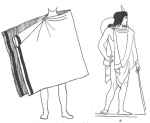
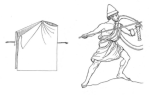
Prior to the Industrial Revolution, fabric was EXTREMELY time consuming to make, and as such, was extremely valuable. You have to grow your fiber, either in the ground or on an animal. You have to process the fiber. You have to spin the fiber. And spin, and spin, and spin. Spinning technology prior to the late Middle Ages consisted of a drop spindle. It takes forever and a day to spin enough thread to make fabric using a drop spindle – 10-30 times longer than to weave it, depending on how thick your yarn is and what weaving technology you are using. Then, once you are done with that endless task, you need to weave it. The examples in this post are all from Greece, where they used the warp-weighted loom, which is actually a rather efficient piece of weaving technology, but it’s still not as fast as the treadle loom (another late Middle Ages invention) and in no way comparable to a modern industrial loom (essentially the same machine as a treadle loom, but automated (except warping, which is still hell on earth even in 2018)). You know the saying “women’s work is never done”? That saying refers to the fact that unlike, say, field work, or mining, or smithing, spinning and weaving were started before dawn and carried on until after dusk, every day of the year, and there was always, always need for more.
After all of this, every piece of fabric that is made represents literally hundreds of hours of work. It is so valuable it was a standard form of currency before the invention of money. Egyptians piled linen high in their tombs as a show of wealth – and that linen was stolen by the grave robbers along with the gold and other precious artifacts. Textiles were one of the most valuable things you could steal when you pillaged a city. A primary reason for the warfare and raiding that was a consistent part of pre-modern Mediterranean/Near Eastern history was to acquire female slaves to produce textiles. Yes, cooking, cleaning, and sex were also reasons to acquire female slaves, but the economic reason was for textile manufacturing.
So if fabric is that valuable, you’re not going to waste it. You’re not going to make something tightly tailored, because as anyone who sews can tell you, cutting fabric to fit produces a lot of waste. In addition, the cloth of the ancient world was often much more loosely woven than cloth today, which is partly to do with weaving technology but most to do with the fact that the denser the cloth, the more threads there are in it, which means the more threads you have to spin for it, which means the time you have to spend making it has just gone up dramatically. Loosely woven cloth ravels like hell when you cut it, again as anyone who sews can tell you, and that makes it much more difficult to sew something nicely tailored. Needles and scissors are also items we take for granted, but are, in their modern form, relatively modern inventions and have, historically, been tricky items to make.
Thus, most of the clothing of the ancient Mediterranean/Near East was based on the rectangles of fabric that come directly off the loom. Much of China’s historical dress is similar, at least in the time frames we’re talking about. Throughout European/North African/Middle Eastern history, and in China until silk changed the game (at least for the rich), tailoring skill and technology has lagged behind cloth production skill and technology.
The famous painting from the early Renaissance where the woman is wearing a dress constructed using a truly obscene amount of fabric? That painting is often held up as an example of the sharp increase in the availability of material goods that is the hallmark of the European Renaissance (especially because it is of a merchant family and not nobles), and it is that. But it is also an example of a mode of dress that was difficult-to-impossible to achieve before the invention of the flyer wheel (for spinning) and treadle loom (for weaving), which made cloth take considerably less time to make and therefore considerably cheaper, and which also made cloth considerably more amenable to tailoring.
So yeah. You too would make fashion out of sheets if it took you most of a month of full-time work to produce one sheet.
I also want to point out that much of the historical dress of Sub-Saharan Africa and the Americas (in the places where cloth was used) is similar, it’s just based on narrow rectangles sewn together rather than large rectangles, because these are places where the backstrap loom and/or tubular loom remained the mainstay of weaving technology. Backstrap looms produce narrow lengths of cloth (15-18 inches is usually the limit), so with that weaving technology + some sewing, you get things like Central and South American ponchos and much of the traditional dress of Central and Western Africa.
After Ethan Allen’s death, Ira and Fanny Allen (his brother and widow respectively) fought over his estate for years. Ira wanted the house, which he had built on land he originally bought. Fanny wanted the linens. Let me repeat: Fanny Allen was perfectly fine with ceding her house to her brother-in-law *as long as she got all the linens*. Textiles were that economically important.
Tags:
#found this buried in my open tabs #history #interesting