On the one hand this is extremely cool and an elegant solution to the problem, on the other hand it’s probably fortunate for Japan and China that we only went about a century between the rise of typewriters and the invention of computers with phonetic IMEs, or else I think they all would’ve gone completely mad.
Merchants and artisans are the middle-class framework of a medieval society’s economy, but they’ve never gotten much attention in D&D. The guild most likely to get fleshed out in a DM’s campaign is a local thieves’ guild, either as something for a party’s rogue to belong to or antagonists for the PCs to fight. So when I saw the Guild Artisan background in 5E, I was definitely intrigued.
We often say that the choices a player makes while creating a character tells you something about what kinds of stories they want to see. Guild Artisan is an intriguing one, because, on some levels, it’s so mundane. And that could be part of the story that the player wants to tell. Does their character want to stay rooted in their mundane profession, even as they become an adventurer? Maybe your rogue is also a first-class baker. Maybe your fighter smithed all her own weapons. Or maybe your wizard still maintains a trade as a glassblower, fashioning bottles with the same methodical patience they use to fashion spells.
The flip side to this is that, by most accounts, medieval guilds were anything but mundane. Any organization is likely to become a hotbed of intrigue, politics, and the like. It could be that branches of the player’s chosen guild are working against one another, each trying to gain some kind of political upper hand. Or perhaps the player hopes to take control of the guild someday, thereby fully diving into the pool of connections, favors, backstabbing, and character assassination.
One thing that’s nice about a guild artisan PC is that it lends a small amount of predictability to the actions of a PC when the group enters a new town. It seems likely that, regardless of whether they treat their guild as a political situation to be exploited or just a place to get some cheap accommodations, a GA PC will head for their guild early in their explorations of the new place. This predictability means that a DM can prepare a bit of story ahead of time, in the form of a cast of characters, a location, and even some plot.
The guild as a whole can be something of a character. A guild in one town might be friendly, open, and helpful. Another town’s guild could be a bit more suspicious and taciturn, less given to being open-armed with newcomers. Yet another could be friendly to a creepy degree, possibly because they’ve been infiltrated by a cult of some darker power and hope to lure newcomers into their web.
All kinds of plots can be tied to a guild, giving you the chance to introduce storylines via the GA PC. Imagine if a seemingly lowly but expansive guild becomes infiltrated by cultists, or compromised by doppelgangers. You could have a whole storyline about exposing the guild’s corruption, or stopping them before they use their unobtrusive nature to stab at the seat of power.
A guild can also be a source of information. A stonemason or architect’s guild might be aware of secret passages in a noble’s manse. A carpenter’s guild might have noted certain irregularities in chests they’ve been asked to construct on behalf of a new temple in town. An alchemist’s guild might be worrying, as they’ve recognized that the ingredients a wizard is buying could be combined to make a large quantity of poison. Any of these things might be dropped as gossip in a PC’s ear, giving a reason to investigate and perhaps leading to adventure and danger.
Even more overtly, a guild artisan PC may get offers of adventure for a group to follow-up on. An NPC member of a jeweler’s guild may need a rare component, like the shell of a basilisk egg, for a commission and be willing to pay handsomely for the adventurers that bring it to him. A blacksmith’s guild needs to know why the copper mine they paid hasn’t brought them ore or ingots lately, ultimately leading the PCs to discover a mine taken over by duergar slavers. Any kind of guild might hire a group of adventurers to guard a caravan of goods, or to try and rescue guild members captured by goblins.
I hope this has made you think about the fantastic potential for adventure that this seemingly mundane background possesses. Next month, we’ll be delving into the Elemental Evil Player’s Companion for that most high-flying of heroes, the Aarakocra. Until then, may all your 20s be natural.
Oh, I love medieval guilds as a concept so much! Okay. Some things that fascinate me:
I love glass, and the history of glass, and if you’re looking at the history of glass in Europe you wind up inevitably looking at Murano, Venice, because it is THE European glass centre from the 7th to the 18th centuries.
A fascinating couple of paragraphs from the Glass of Venice website:
“By the late 1200s, the production of glass objects of the finest quality was the city’s major industry as confirmed by the establishment of the Glassmakers Guild that laid out rules and regulations for the craftsmen. The purpose of the guild was to safeguard the secrets of the trade and ensure the profitability of the industry. In line with these objectives, a 1271 law prohibited the importation of foreign glass or the employment of foreign glassworkers.
An even more radical law was passed in 1291 that laid the ground for the establishment of Murano as a premier glass-manufacturing center. This law required that all furnaces used for glassmaking be moved from Venice to Murano to avoid the risk of fire from the furnaces spreading onto the largely wooden structures of overpopulated Venice. Many historians agree that the true motive for this law was to isolate the glass craftsmen to a location where they wouldn’t be able to disclose trade secrets. A subsequent law passed in 1295 forbidding the glassmakers from leaving the city confirms this theory.
Artisans working in the glass trade were well rewarded for their efforts. They had a privileged social status, and their daughters were allowed to marry into the wealthiest and noblest of Venetian families. By applying this clever approach, Venetian government ensured that the glassmakers encouraged their offspring to carry on the trade, and that trade secrets stayed in the families and fueled creative processes leading to innovation and further success. This, along with Venice’s convenient location at the crossroads of trade between East and West, gave Venice monopoly power in manufacturing and selling quality glass throughout Europe that lasted for centuries.”
Venice as a city state set laws in place to establish, isolate and control their glassmakers guild on an island to protect trade secrets and maintain a continental monopoly on their trade. Trade secrets, historically speaking, were a HUMUNGOUS deal.
You could have so many stories here. Are you a foreign guild member, rocking up to the city with your letter of introduction, ready to be greeted by your brethren, and absolutely shocked by getting turned out on your ear? Maybe a shady sort wants you to smuggle trade secrets out to them. Maybe your guild branch wants you to smuggle secrets out to them. Maybe you found notes in a dungeon or wizard lair that would revolutionise certain processes, and suddenly you’re the target of every guild branch in existence hoping you’ll give or be persuaded to give the process to them and them alone. Maybe your party encounters a local guildmember who wants to leave the city and wants you to smuggle them out, breaking local guild laws and potentially fatally damaging your relationship with your overall guild in the process. Maybe the guild as a whole wants your help to break free from their city-state’s restrictions, or maybe only certain sections of the guild, and the rest are perfectly fine with their privileged lives or else deeply and genuinely believe that their secrets should be protected for the good of the city and the pride of the guild.
You’ve got options here. Murano is a very fascinating example of medieval guild-and-city politics.
On a broader scale. Moving to London here, and the Livery Companies (essentially guilds). There’s a lovely page on Wikipedia on the mottos of the Livery Companies, and it is fascinating. The mottos of a guild suggest so many interesting things about them, even when you have no idea of the history involved in how that motto came about.
Some examples:
The Worshipful Company of Bowyers (bow-makers) don’t have a latin phrase for a motto. Instead, they have three names. “Crecy, Poitiers, Agincourt”. AKA the three battles where the English Longbow is considered to have decisively won the battle for the English. Like. That is just excellent and incredibly pointed marketing. “Here’s what our wares do, next fucking question!” Amazing.
The clockmakers have ‘Time is the Commander of All Things’. The Worshipful Company of Cooks has, for some reason, ‘Wounded Not Conquered’, and I’m desperately curious as to why. Musicians have ‘Preserve Harmony’ and the Glass Sellers have ‘Discord Weakens’, which is funny and makes me deeply hope their guildhalls are across the road from each other (I don’t think they are, but it’d be amazing). The Painter-Stainers have the extremely ominous ‘Love Can Compel Obedience’, which, if you need an incredibly random guild to have been infested with a cult, can I suggest?
On a similar note, the Poulters have ‘Remember Your Oath’, which, again, curious and ominous?
The Worshipful Company of Makers of Playing Cards has ‘With Upright Heart All Are Exalted’, which is hilarious and feels very much like they were trying to get in ahead of the inevitable gambling association.
A lot of the mottos are clearly biblical quotes loosely related to the industry at hand, like the Paviors (pavers) ‘God Can Raise to Abraham Children of Stone’. The Shipwrights have ‘Within The Ark Safe Forever’. The Needlemakers have ‘They Sewed Fig Leaves Together And Made Themselves Aprons’, which feels very much ‘the first day out of Eden, we were there and doing the work!’. There’s a lot of flag-planting and general ‘you’d be lost without us’ in these mottos, which is excellent.
The thing these mottos do is suggest history, ideology, story. Some of them feel defensive, some of them feel defiant, some of them feel ominous, some of them seem incredibly incongruous and make you wonder what the history is (again, why do cooks have ‘wounded not conquered’?).
From a worldbuilding POV … you can put things like this in your world. Like. Was your Cooks Guild hugely involved in a particular war? Was it born out of camp followers way back when? Does your glass sellers guild have a huge and longstanding hatred and rivalry with the local bardic college? Are your wood-metal-and-cloth stainers randomly an ancient fertility cult for no apparent reason? Do several of your guilds have close and sometimes hidden relationships to various deities and practices (are pavers the primary makers of golems)? Are the local weaponsmiths or bowyers extremely arrogant and proud of their craftmanship for extremely specific historical reasons? Are the needlemakers fed up of being looked down on when you’d all be fucking naked if we weren’t here?
Guilds are so much fun. You can do a lot with them, with their histories and hang-ups and beliefs, their relationships with their cities and each other, their reputations and reactions to how people view them, their prominence and decline as various industries crest and fall in different cities and different times. They’re an awesome set of organisations to play with in a world.
Tags:
#long post #history #D&D #story ideas I will never write #this probably deserves some warning tag but I am not sure what
God shit like this makes me absolutely rabid for modernity. It used to take year-round work, eight hours a day, to keep even a smallish household in two suits of decent clothes. Fuck nostalgia for the distant past. Fuck nostalgia for, like, three decades ago. Technology is awesome, and industrialization rules.
Tags:
#history #yes this #proud citizen of The Future #around the time I first read the linked post I went to a grocery store #and bought two kilograms of salt for eleven minutes’ wages #and I took a moment to appreciate how wondrous that is #(it was even iodised!)
it was a fucking house phone that i was so stoked to have because it was mine that i kept in my own room and i cannot believe technology has progressed at the speed of FUCKING light to the point where this is a hilarious artifact to have had in like 6th grade and now theres kindergarteners with iphones
each button made a different tone so the numbers you dialed a lot became a subconscious melody in your head and if you hit the wrong button by accident it would sound like a wrong note in a song you know by heart
Because people don’t do this and this is terrible UX.
Do you notice how the question says “how did you know if you dialed the right number” *full stop*, but the *answer* is specific to “numbers you dialed a lot”?
Yeah, dialing numbers you *didn’t* dial a lot–which was just about all of them if you were a kid! it’s not like kids have much reason to talk on house phones, not being in charge of coordinating any appointments and not having had much time to accumulate friends-no-longer-in-physical-proximity!–was *exactly* as anxiety-ridden as it sounds. It’s such a relief to have screens to double-check with. Even *dumbphones* like the phone at work have screens now.
(Plus phones with screens *also* make the button tones, as a second layer of defence. Do y’all not have the button tones on your smartphones? Did you turn them off?)
Tags:
#reply via reblog #history #proud citizen of The Future
So firstly I think it should be said out the bat that THIS TRANSLATION LINE specifically was 90% probably a joke, specifically a satire of the kind of translation trend you’d get back in the days of finding anime on dodgy streaming sites with no official subs. See back then even if your anime GOT a western/english release, you would have to wait for the DVD and almost every time it would be dubbed, not subbed.
This is fine, but the voice actors back then for dubbing and the localisation could be pretty shit fairly often (the infamous 4kids comes to mind, a studio of about 10 voice actors who would play every single role on every anime they dubbed. They also localised as if the audience was dumb as shit and would change onigiri to donuts etc).
So that’s why the old thing of “subbed is always better than dubbed”. Because it literally often was!! Nowadays I would not agree with this statement at all, especially for things like mob psycho 100 and bnha.
So anyway. There’s this cool new anime out in japan but you don’t understand japanese and you aren’t in japan. so people would record the anime off their tvs (or rip it off the DVD), cut the ads out, and fan translate each line. this was usually done by people with english as their first language who were learning japanese, often who were only at about an intermediate/n3 level. Sometimes this would mean there would be lines where you would just get “no idea what was said here, sorry ^_^.
But sometimes, something else would get in the way. Almost all fan translators were not professional translators – professional translations also include a degree of localisation. This isn’t a bad thing like ur 4kids onigiri to donuts, this usually just means figuring out what certain language-specific idioms and phrases can be closest met with in the target language. this means accuracy is lost but accuracy would simply make it unparsable in the target language. For example:
お腹が好き
The literal, accurate translation of this is:
I like stomach
But what it actually means is:
I’m hungry.
Then there are cases like this:
はじめまして
The literal translation is something like:
This is the first time meeting you/let’s start a friendship.
But that’s weird and disruptive, so a localisation will change it to:
Nice to meet you.
These are very basic localisation issues, ones that you’re taught from day one, so you won’t see issues with those in old fansubs. BUT when you run into more complex phrases with more culture specific meanings, it becomes much harder to localise, especially because you lose a touch of accuracy.
Coming up with what these things actually mean in English take time, and besides, anime fans get PISSED about inaccuracy especially back then, especially anime fans who don’t know Japanese or even understand the way the translation works and the need for localisation. And besides, sometimes people would want to nerd out about japanese a bit. Go to a forum? No way. I’m going to do it in the illegal fansub of this obscure anime im chucking onto kissanime. So you would then get fansubs that would basically be like this:
At the bottom of the screen, with the usual subs, you would get a literal translation, sometimes with a word untranslated and romaji-d instead (usually “baka”). At the end of the line there would be an asterisk – *
And then, at the top of the screen, often covering over half the actual screen, was “translators note:” and then an explanation of the accurate translation and what it WOULD be localised to best but they didn’t do that because it wouldnt be accurate, here’s all the cultural connotations of this phrase too.
Now this was incredibly annoying, especially when you could just …localise it. As much as people wanted accuracy, they also didnt want to have to go on an adventure up and down the screen to read a subtitle, especially when it was pointlessly distracting you from the actual action.
People got annoyed with this. You may say, well why not just turn the subs off? That wasn’t a thing. You got a very basic video player and the subs would be written as text onto the video in windows moviemaker, exported as an MP4, and uploaded. You know how you cant turn the subs off on the version of naruto on crunchyroll? That’s because they were done old style, imported into the video file itself because the subtitle feature wasn’t universal nor reliable. That’s how fan translations were also exported, in a yellow serif font with a black or white shadow beneath.
So there was no avoiding the paragraph long japanese lesson on top of the awesome gore sequence you were watching. But because the internet has always been filled with talented narcissists, people still did it. Often the non-localisation was absolutely pointless. You know how the anime weeb thing is to call people “baka”? Well “baka” ie バカ translates very easily to something like “idiot” or “stupid bastard”. But one person decided to not localise it, so other people didn’t, and then it became a joke amongst anime fans, and then people forgot the context because now NO ONE was localising baka because that’s just what you do, right? And now everyone knows “baka” because of mid-2000s anime fansubs, to the point that when I see official subtitles use “idiot” when the character says “baka” it feels like its corporate sacriligy against a divine english speaking anime fan tradition.
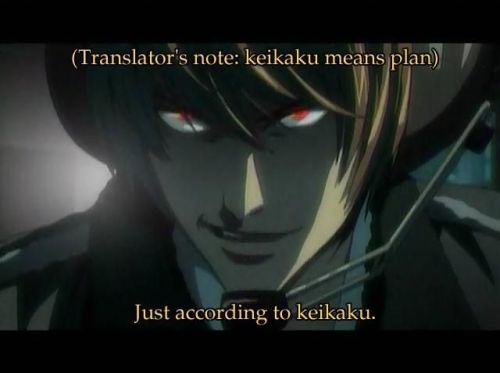
So you can understand that this shit was RAMPANT. Ur getting assholes showing off their japanese lore skills on top of fruits basket instead of on a forum, and fan translators that are sick of it themselves are beginning to craft little jokes of their own, pointless translators notes as jabs at the assholes. And hence we get the infamous death note fansub:
I need to clarify for anyone who doesn’t quite know. 計画 (keikaku) is one of the most basic translations you can get. You do not need any localisation. There is no subtle nuance. Even the kanji just mean “plot drawing” which doesn’t actually mean this needs localisation because that’s not how kanji work. Keikaku is one of the easiest words to translate. Its common, n5 level, very basic. It corresponds to the word “plan” in English very neatly. To pretend that 計画 needs localisation is a pretty blatant and honestly kinda accurate parody of the kind of bullshit that was happening with fansubs at the time
keikaku means plan and a bunch of other egregious incidents happened and people had a good laugh, there were a few posts compiled of a bunch of different stupid anti-localisation translations, and the trend of fansubs being spots for u to show off in began to fade, not only because of the mockery but also because by this time sites like crunchyroll were going legal and beginning to offer actual good anime subscription services. DVDs were also coming with subtitled options and not just the dub, and anime was much easier to find in english speaking countries. There wasnt really such a massive need to people to pirate or illegally distribute, sub, and stream anime anymore because you had options that were, granted, paid, but they were decently priced and you would get higher quality video and subtitles. Besides, kissanime had started mining bitcoin from its users and that was making people pissed off.
Anyway yeah this is just me being old and talking abt keikaku means plan because I think ppl always thought it was like…real…as in not a joke?? Probably because people don’t know about what it’s joking about. There we go.
Memories!
(And yeah, it’s “my stomach is empty”.)
My one great hate from translation debates is people calling literal translations “accurate”. They’re literal. They’re word-for-word. But they fail to convey the meaning of the original so, by definition, they are inaccurate. (This trend is true far and wide across conversations about this, and it’s The Worst!)
The Billy Joel song We Didn’t Start the Fire is 4:49 long and covers 41 years worth of history. Recorded history began ca. 3000 BC with the invention of writing in ancient Mesopotamia. Therefore a version of We Didn’t Start the Fire which covered all of history at the same pace would be around 590 minutes long.
Or you could reach the first chorus with bad news from the first day of 2020, which also covers 41 years worth of history.
Are you telling me…that the fabled dedicated-to-2020 version of “We Didn’t Start the Fire” *existed*…but was *lost*?
I don’t think “spared” is really the right word here, but I don’t want to beat you up over it. In any case, perhaps people will be in a better position to write it after 2020 is over. Hindsight is, after all, 2020.
Tags:
#is what my 2023 self will tell people when they ask her why she owns a P100 respirator #reply via reblog #illness mention #music #history #amnesia cw #please get a cloud sync Nate
The first victim could not have been recorded, for there was no written language to record it. They were someone’s daughter, or son, and someone’s friend, and they were loved by those around them. And they were in pain, covered in rashes, confused, scared, not knowing why this was happening to them or what they could do about it – victim of a mad, inhuman god. There was nothing to be done – humanity was not strong enough, not aware enough, not knowledgeable enough, to fight back against a monster that could not be seen.
It was in Ancient Egypt, where it attacked slave and pharaoh alike. In Rome, it effortlessly decimated armies. It killed in Syria. It killed in Moscow. In India, five million dead. It killed a thousand Europeans every day in the 18th century. It killed more than fifty million Native Americans. From the Peloponnesian War to the Civil War, it slew more soldiers and civilians than any weapon, any soldier, any army (Not that this stopped the most foolish and empty souls from attempting to harness the demon as a weapon against their enemies).
Cultures grew and faltered, and it remained. Empires rose and fell, and it thrived. Ideologies waxed and waned, but it did not care. Kill. Maim. Spread. An ancient, mad god, hidden from view, that could not be fought, could not be confronted, could not even be comprehended. Not the only one of its kind, but the most devastating.
For a long time, there was no hope – only the bitter, hollow endurance of survivors.
In China, in the 10th century, humanity began to fight back.
It was observed that survivors of the mad god’s curse would never be touched again: they had taken a portion of that power into themselves, and were so protected from it. Not only that, but this power could be shared by consuming a remnant of the wounds. There was a price, for you could not take the god’s power without first defeating it – but a smaller battle, on humanity’s terms. By the 16th century, the technique spread, to India, across Asia, the Ottoman Empire and, in the 18th century, Europe. In 1796, a more powerful technique was discovered by Edward Jenner.
An idea began to take hold: Perhaps the ancient god could be killed.
A whisper became a voice; a voice became a call; a call became a battle cry, sweeping across villages, cities, nations. Humanity began to cooperate, spreading the protective power across the globe, dispatching masters of the craft to protect whole populations. People who had once been sworn enemies joined in common cause for this one battle. Governments mandated that all citizens protect themselves, for giving the ancient enemy a single life would put millions in danger.
And, inch by inch, humanity drove its enemy back. Fewer friends wept; Fewer neighbors were crippled; Fewer parents had to bury their children.
At the dawn of the 20th century, for the first time, humanity banished the enemy from entire regions of the world. Humanity faltered many times in its efforts, but there individuals who never gave up, who fought for the dream of a world where no child or loved one would ever fear the demon ever again. Viktor Zhdanov, who called for humanity to unite in a final push against the demon; The great tactician Karel Raška, who conceived of a strategy to annihilate the enemy; Donald Henderson, who led the efforts of those final days.
The enemy grew weaker. Millions became thousands, thousands became dozens. And then, when the enemy did strike, scores of humans came forth to defy it, protecting all those whom it might endanger.
The enemy’s last attack in the wild was on Ali Maow Maalin, in 1977. For months afterwards, dedicated humans swept the surrounding area, seeking out any last, desperate hiding place where the enemy might yet remain.
They found none.
35 years ago, on December 9th, 1979, humanity declared victory.
This one evil, the horror from beyond memory, the monster that took 500 million people from this world – was destroyed.
You are a member of the species that did that. Never forget what we are capable of, when we band together and declare battle on what is broken in the world.
Happy Smallpox Eradication Day.
Tags:
#next year in Jerusalem! #next year‚ all shall be free! #anniversaries #illness tw #Tumblr traditions #history #proud citizen of The Future #this post was queued to ensure proper timing #(queued on 2020-11-02) #a day for hope‚ for thanks‚ for recommitment to the Great Project
St. Louis Globe-Democrat, Missouri, October 31, 1918
Tags:
#history #illness tw #Halloween #covid19 #(although in my own case Halloween went about the same as it would have otherwise) #(wore a demon-horn headband to work (which absolutely nobody remarked upon)) #(came home to Mom putting out our traditional Halloween buffet on the coffee table) #(yeah we got zero trick-or-treaters but zero is only slightly smaller than usual)
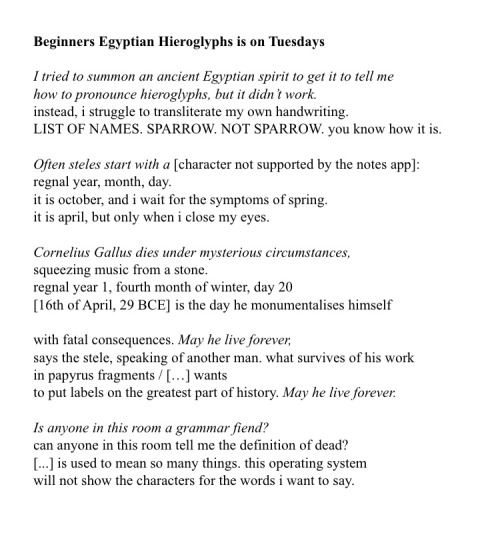
20/04/20 • title is the subject line of an email about middle egyptian classes. italics are ‘quotes from my middle egyptian prof that i happened to write down’
Tags:
#…apparently this post was *not* made in October #it was posted in June and that date implies it was written in April #which means that truck of emotional resonance that hits you at #”it is october‚ and i wait for the symptoms of spring/it is april‚ but only when i close my eyes” #is not *intended* to be there #or at least *that* particular truck isn’t #but fuck it they sing it back to you for 85000 reasons #poetry #101 Uses for Infrastructureless Computers #Egypt #history #death tw #historical documentation in at least two senses #covid19