The answer is apparently “because we’re actually able to eat it”
Fun fact: white people (specifically Northern European white people) have a genetic mutation that allows them to digest lactose even after weaning, which is abnormal for all mammals and also most humans. It’s theorized that because Northern Europe doesn’t get a lot of sun, an alternative source of vitamin D (like milk) would be a useful trait. It’s a very recent mutation that would only have happened after humans started domesticating animals like cows and goats.
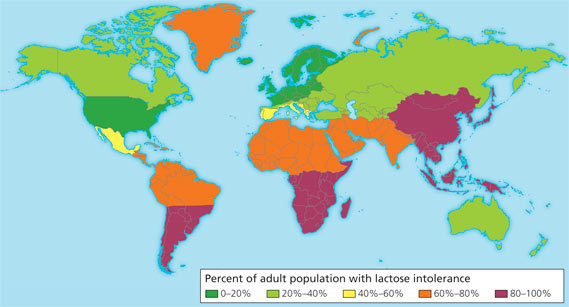
oh no, my bizarre moment has come, cause lactose tolerance is actually A Thing I Know About because it’s played a fascinating role in human evolution for thousands of years. This chart displays some of the broad trends, but it’s giving near continental averages, which doesn’t showcase how this kind of thing really breaks down and some of the surprising exceptions.
Lactose tolerance is the majority trait for only a very few population groups: North Europeans (and therefore populations that draw heavily from that stock, such as America,) nomadic central Eurasians, and sub-Saharan pastoralist Africans, but that latter group is often overlooked. The vast majority of Africans cannot process lactose, but certain people groups whose lifestyles have revolved around cattle for thousands of years will have 80% and even approaching 100% lactose tolerance rates. They’d be spots of dark green amidst a sea of orange and burgundy on the above chart.
Our hunter-gatherer ancestors were almost entirely lactose intolerant, that is definitely the biological norm (and people groups who maintained that lifestyle, such as Native Americans, remained as such – along with groups who transitioned to sedentary agricultural lifestyles, but I’ll get into that). As such, lactose tolerance is an adaptive trait that only became prevalent in environments that exerted strong selective pressure for it. So, cows were domesticated some 10,000 odd years ago in the Middle East (and some have contended for an independent domestication event in Africa as well). In either case, cattle quickly spread across the continent and we know there was milking and cheese production at least 6,000 years ago in both the Nile and Mesopotamia. While cow meat would have been enjoyed by all, in agricultural societies milk and cheese would have been options, but hardly staples as there were plenty of other things to eat as well, and therefore there would have been no selective pressure for processing lactose. Also, sedentary societies had ways of processing milk and cheese that allowed lactose intolerant people to drink/eat dairy products. Fermenting milk or aging cheese breaks down lactose, making it a non issue once ingested. This is why fermented milk may seem utterly foul to many Westerners, but is extremely common in other parts of the world. But, fermentation and aging requires time, and the ability to store things in a single location for weeks or even months. Sedentary societies adapted the milk to fit their biology, but nomadic societies did the reverse.
There are still mobile pastoralist societies in Africa today, and there have been for thousands and thousands of years. For many of them, cows are not one of many dietary options, they are the single dietary staple around which their lifestyle revolves. Biologically, this means you gotta get with the program if you wanna survive. For most mobile tribes, fermentation and aging weren’t options, so there would have been strong selective pressure favoring those who could drink milk straight outta the cow, as they would have had an additional, highly nutritious food source available to them. Milk also allowed for a marked shortening of the weaning process, transitioning children from breastmilk to cow’s milk, which would again be advantageous for groups where both the men and women work and are always on the move. Over generations these populations specialized into essentially cow-based lifestyles, creating a survival niche highly advantageous to them, and fast forward thousands of years and there are groups in Africa with near ubiquitous lactose tolerance, while the rest of the continent (and the world really) is nearly entirely intolerant.
Many of these same factors would have influenced the central Eurasian populations, which is why Mongolians and other descendants of nomadic steppe peoples are largely lactose tolerant, as mare’s milk would have been a dietary staple (though they also developed efficient ways to ferment it).
North Europeans developed lactose tolerance in response to deficiencies in certain nutrients. The northern climate limited Vitamin D production, and the agricultural products available to them were often low on calcium and protein, and so dairy farming developed alongside agriculture to create a more rounded diet (and this was limited to Northern Europeans, as Mediterranean peoples such as the Romans wrote about their great confusion at the northern barbarians’ ability to drink fresh milk)
And I promise all of this is fascinating because the ability to process lactose evolved independently in several different population groups and in response to different factors: lifestyles revolving around cows, lifestyles revolving around horses, deficiencies in climate and agriculture. Besides providing insight into human history and biology, lactose tolerance is also a great example of convergent evolution, where different genetic populations in different environments produce similar results.
And uh, that’s my rant about the role of milk and lactose tolerance in human evolution.
Tags:
#the more you know #food #history #I’m lactose-tolerant and dairy accounts for a fairly large chunk of my caloric intake #sometimes before eating it I take a moment to appreciate my dairy-farming ancestors giving me this option #thank you dairy-farming ancestors #(I was worried this post was going to be more fucking foodshaming) #(but then it went well)
When you think about it, what was the motivation for kinks in the environment of evolutionary adaptedness?
Dunno, but I think that “virile, manly strangers impregnating your spouse” was only added in as a hilarious curveball.
(Terrible ass-pull theory: it’s good to spread your genes far and wide, and therefore good to be attracted to a range of weird stuff?)
My personal favourite ass-pull theory:
Kinks are the beginning of the atrophying of the human sex drive.
Yes, the decoupling of “if pleasurable PIV, then procreation” wasn’t widespread until very recently, but decoupling the other way–“if procreation, then pleasurable PIV” happened a long time ago. Humans are smart, communicative, and capable of enduring short-term discomfort in pursuit of long-term goals. Therefore, the procreative act need not be pleasant, nor need it be intuitive: humans will do it regardless.
My heavily warped sex drive presents no barrier whatsoever to my reproductive success. I learned how to reproduce from other people, and if I chose I could perform these learned actions for the sake of obtaining children, without ever actually enjoying it.
When it no longer matters whether something is broken, it is free to accumulate damage. Kinks are the result of this entropy.
Tags:
#I mean my lack of desire for children *does* present a barrier to my reproductive success #but that’s another matter #reply via reblog #sexuality and lack thereof #pregnancy cw #just so story cw
Neuroscience you learned five minutes ago on wikipedia is a staple of evopsych just so stories, and being awake and alive are indeed highly beneficial traits in a partner.
Tags;
#anything that makes me laugh this much deserves a reblog #(ftr the prompt for this was to create an evopsych just-so story explaining the blogger’s sneezing fetish)
My first gif! I spent way more time on this than I probably should have. Anywho, I put this together from a Brain Games episode on National Geographics (Episode name is called “Patterns” for those of you who are interested).
I want your feed back- when could you tell who this was the first time you saw the gif? Was it the 2nd text “Did you get it yet?”, or was it not until the 3rd or last text that you could tell? Please be honest.
My prediction- those with Prosopagnosia figure it out faster than those who are neurotypical (NTs). Why is this? Because we are used to piecing it together with less information, where NTs require more facial information before they know. Perhaps we just found the evolutionary advantage to prosopagnosia?
I suspected it might be Abraham Lincoln when I could only see around the edge, but the more they revealed, the less sure I got, until by the end I was convinced it wasn’t him. You tagged the post “Abraham Lincoln”, so I guess I should’ve gone with my first thought.
I note that when I took one of those online facial recognition quizzes, I had a similar experience with Barack Obama: my first thought was that it was him, but then I thought “no, that can’t be him, he isn’t that old” and failed the question (like I did every other question on that quiz). I’d forgotten how much politics ages you. (Though in Lincoln’s case, the “no, that can’t be him” was because this face looks too wide to be him.)
(Who says there has to be an evolutionary advantage? All a trait really has to do to stick around is not get you killed too often.)
Tags:
#prosopagnosia #tales from the prosopagnosia tag #reply via reblog