biggest-gaudiest-patronuses:

“smart appliances” fuck u i want them dumb as a brick and incidentally as sturdy and enduring


Tags:

#yes this #domesticity #101 Uses for Infrastructureless Computers #disappointed permanent resident of The Future #venting cw? #this post was queued because my to-reblog list is too long and I didn’t want to dump it on you all at once


500 Million, But Not a Single One More

{{Title link: http://blog.jaibot.com/?p=413 }}

jaiwithanadult:

We will never know their names.

The first victim could not have been recorded, for there was no written language to record it. They were someone’s daughter, or son, and someone’s friend, and they were loved by those around them. And they were in pain, covered in rashes, confused, scared, not knowing why this was happening to them or what they could do about it – victim of a mad, inhuman god. There was nothing to be done – humanity was not strong enough, not aware enough, not knowledgeable enough, to fight back against a monster that could not be seen.

It was in Ancient Egypt, where it attacked slave and pharaoh alike. In Rome, it effortlessly decimated armies. It killed in Syria. It killed in Moscow.  In India, five million dead. It killed a thousand Europeans every day in the 18th century. It killed more than fifty million Native Americans. From the Peloponnesian War to the Civil War, it slew more soldiers and civilians than any weapon, any soldier, any army (Not that this stopped the most foolish and empty souls from attempting to harness the demon as a weapon against their enemies).

Cultures grew and faltered, and it remained. Empires rose and fell, and it thrived. Ideologies waxed and waned, but it did not care. Kill. Maim. Spread. An ancient, mad god, hidden from view, that could not be fought, could not be confronted, could not even be comprehended. Not the only one of its kind, but the most devastating.

For a long time, there was no hope – only the bitter, hollow endurance of survivors.

In China, in the 10th century, humanity began to fight back.

It was observed that survivors of the mad god’s curse would never be touched again: they had taken a portion of that power into themselves, and were so protected from it. Not only that, but this power could be shared by consuming a remnant of the wounds. There was a price, for you could not take the god’s power without first defeating it – but a smaller battle, on humanity’s terms. By the 16th century, the technique spread, to India, across Asia, the Ottoman Empire and, in the 18th century, Europe. In 1796, a more powerful technique was discovered by Edward Jenner.

An idea began to take hold: Perhaps the ancient god could be killed.

A whisper became a voice; a voice became a call; a call became a battle cry, sweeping across villages, cities, nations. Humanity began to cooperate, spreading the protective power across the globe, dispatching masters of the craft to protect whole populations. People who had once been sworn enemies joined in common cause for this one battle. Governments mandated that all citizens protect themselves, for giving the ancient enemy a single life would put millions in danger.

And, inch by inch, humanity drove its enemy back. Fewer friends wept; Fewer neighbors were crippled; Fewer parents had to bury their children.

At the dawn of the 20th century, for the first time, humanity banished the enemy from entire regions of the world. Humanity faltered many times in its efforts, but there individuals who never gave up, who fought for the dream of a world where no child or loved one would ever fear the demon ever again. Viktor Zhdanov, who called for humanity to unite in a final push against the demon; The great tactician Karel Raška, who conceived of a strategy to annihilate the enemy; Donald Henderson, who led the efforts of those final days.

The enemy grew weaker. Millions became thousands, thousands became dozens. And then, when the enemy did strike, scores of humans came forth to defy it, protecting all those whom it might endanger.

The enemy’s last attack in the wild was on Ali Maow Maalin, in 1977. For months afterwards, dedicated humans swept the surrounding area, seeking out any last, desperate hiding place where the enemy might yet remain.

They found none.

35 years ago, on December 9th, 1979, humanity declared victory.

This one evil, the horror from beyond memory, the monster that took 500 million people from this world – was destroyed.

You are a member of the species that did that. Never forget what we are capable of, when we band together and declare battle on what is broken in the world.

Happy Smallpox Eradication Day.


Tags:

#an increasingly bitter holiday as we head further into the 2020s #(also I dislike being called human) #but thank you‚ civilisation‚ for the knowledge and the tools that I needed to throw this starfish into the ocean #I still want that new orthopox vaccine though #Tumblr traditions #anniversaries #history #proud citizen of The Future #disappointed permanent resident of The Future #illness tw #transhumanism

the-real-seebs:

thebibliosphere:

So, anyway, I say as though we are mid-conversation, and you’re not just being invited into this conversation mid-thought. One of my editors phoned me today to check in with a file I’d sent over. (<3)

The conversation can be surmised as, “This feels like something you would write, but it’s juuuust off enough I’m phoning to make sure this is an intentional stylistic choice you have made. Also, are you concussed/have you been taken over by the Borg because ummm.”

They explained that certain sentences were very fractured and abrupt, which is not my style at all, and I was like, huh, weird… And then we went through some examples, and you know that meme going around, the “he would not fucking say that” meme?

Yeah. That’s what I experienced except with myself because I would not fucking say that. Why would I break up a sentence like that? Why would I make them so short? It reads like bullet points. Wtf.

Anyway. Turns out Grammarly and Pro-Writing-Aid were having an AI war in my manuscript files, and the “suggestions” are no longer just suggestions because the AI was ignoring my “decline” every time it made a silly suggestion. (This may have been a conflict between the different software. I don’t know.)

It is, to put it bluntly, a total butchery of my style and writing voice. My editor is doing surgery, removing all the unnecessary full stops and stitching my sentences back together to give them back their flow. Meanwhile, I’m over here feeling like Don Corleone, gesturing at my manuscript like:

31b98620a458fdfb8be1f6f4c9fe46bd793eb44e

ID: a gif of Don Corleone from the Godfather emoting despair as he says, “Look how they massacred my boy.”

Fearing that it wasn’t just this one manuscript, I’ve spent the whole night going through everything I’ve worked on recently, and yep. Yeeeep. Any file where I’ve not had the editing software turned off is a shit show. It’s fine; it’s all salvageable if annoying to deal with. But the reason I come to you now, on the day of my daughter’s wedding, is to share this absolute gem of a fuck up with you all.

This is a sentence from a Batman fic I’ve been tinkering with to keep the brain weasels happy. This is what it is supposed to read as:

“It was quite the feat, considering Gotham was mostly made up of smog and tear gas.”

This is what the AI changed it to:

“It was quite the feat. Considering Gotham was mostly made up. Of tear gas. And Smaug.”

Absolute non-sensical sentence structure aside, SMAUG. FUCKING SMAUG. What was the AI doing? Apart from trying to write a Batman x Hobbit crossover??? Is this what happens when you force Grammarly to ignore the words “Batman Muppet threesome?”

Did I make it sentient??? Is it finally rebelling? Was Brucie Wayne being Miss Piggy and Kermit’s side piece too much???? What have I wrought?

Anyway. Double-check your work. The grammar software is getting sillier every day.

I think I’ve been fully convinced to simply never, ever, use “grammar” software, because I think it’s actually just getting wildly worse now.


Tags:

#PSA #writing #disappointed permanent resident of The Future #embarrassment squick? #this post was queued because my to-reblog list is too long and I didn’t want to dump it on you all at once
maryellencarter:

szczyrkowa-deactivated20230924:

i am totally going to come across as a boomer in this post but as an engineer it’s common sense to not build systems with a single point of failure. and i’m starting to realize that our usage of the smart phone is exactly that. a single point of failure. the calling/texting is the implied function of the smartphone, which is fine. that’s what it’s built for. but nowadays we don’t think to keep a physical map or atlas or gps unit in our car because our phone has google maps. we don’t keep address books anymore because it’s all stored in our contacts. i serve customers who no longer carry a wallet/physical card because it’s all on their phone. this is literally a single point of failure. if you lose or break your phone when you are in a foreign place you are fucking screwed. maybe you’re still screwed even in your home town because so many people have become accustomed to using a smart phone to take them anywhere.

as someone who worked in the cell phone industry for five years: this. your email requires two factor authentication to your phone. setting up a new iphone requires two factor authentication to your old iphone. putting a new phone on your phone number requires two factor authentication to a previously active phone on your account. if you ever lose your phone or if it refuses to wake up one day, god help you because no one in the industry can


Tags:

#yes this #one is none‚ folks #disappointed permanent resident of The Future #101 Uses for Infrastructureless Computers #I have specifically arranged my cloud-storage setup to *not* require 2FA #(there *are* multiple layers of encryption involved‚ but–carefully–only with passwords that I’ve memorised) #so that‚ if it came down to it‚ I could bootstrap back into having a full copy of my archives #–complete with version history– #with nothing but my memories and a computer with Internet access #the potential-future mes who just fled a burning home with nothing but pajamas and (bedroom-table) respirator have enough problems already #also‚ check your government services and see if they sell paper maps #Ontario will sell you one for five bucks #I have one in my bug-out bag #this post was queued because my to-reblog list is too long and I didn’t want to dump it on you all at once

canmom:

youzicha:

canmom:

Hypothetical Decentralised Social Media Protocol Stack

if we were to dream up the Next Social Media from first principles we face three problems. one is scaling hosting, the second is discovery/aggregation, the third is moderation.

hosting

hosting for millions of users is very very expensive. you have to have a network of datacentres around the world and mechanisms to sync the data between them. you probably use something like AWS, and they will charge you an eye-watering amount of money for it. since it’s so expensive, there’s no way to break even except by either charging users to access your service (which people generally hate to do) or selling ads, the ability to intrude on their attention to the highest bidder (which people also hate, and go out of their way to filter out). unless you have a lot of money to burn, this is a major barrier.

the traditional internet hosts everything on different servers, and you use addresses that point you to that server. the problem with this is that it responds poorly to sudden spikes in attention. if you self-host your blog, you can get DDOSed entirely by accident.

scaling hosting could theoretically be solved by a model like torrents or IPFS, in which every user becomes a ‘server’ for all the posts they download, and you look up files using hashes of the content. if a post gets popular, it also gets better seeded! an issue with that design is archival: there is no guarantee that stuff will stay on the network, so if nobody is downloading a post, it is likely to get flushed out by newer stuff. it’s like link rot, but it happens automatically.

IPFS solves this by ‘pinning’: you order an IPFS node (e.g. your server) not to flush a certain file so it will always be available from at least one source. they’ve sadly mixed this up in cryptocurrency, with ‘pinning services’ which will take payment in crypto to pin your data. my distaste for a technology designed around red queen races aside, I don’t know how pinning costs compare to regular hosting costs.

theoretically you could build a social network on a backbone of content-based addressing. it would come with some drawbacks (posts would be immutable, unless you use some indirection to a traditional address-based hosting) but i think you could make it work (a mix of location-based addressing for low-bandwidth stuff like text, and content-based addressing for inline media). in fact, IPFS has the ability to mix in a bit of address-based lookup into its content-based approach, used for hosting blogs and the like.

as for videos – well, BitTorrent is great for distributing video files. though I don’t know how well that scales to something like Youtube. you’d need a lot of hard drive space to handle the amount of Youtube that people typically watch and continue seeding it.

aggregation/discovery

the next problem is aggregation/discovery. social media sites approach this problem in various ways. early social media sites like LiveJournal had a somewhat newsgroup-like approach, you’d join a ‘community’ and people would post stuff to that community. this got replaced by the subscription model of sites like Twitter and Tumblr, where every user is simultaneously an author and a curator, and you subscribe to someone to see what posts they want to share.

this in turn got replaced by neural network-driven algorithms which attempt to guess what you’ll want to see and show you stuff that’s popular with whatever it thinks your demographic is. that’s gotta go, or at least not be an intrinsic part of the social network anymore.

it would be easy enough to replicate the ‘subscribe to see someone’s recommended stuff’ model, you just need a protocol for pointing people at stuff. (getting analytics such as like/reblog counts would be more difficult!) it would probably look similar to RSS feeds: you upload a list of suitably formatted data, and programs which speak that protocol can download it.

the problem of discovery – ways to find strangers who are interested in the same stuff you are – is more tricky. if we’re trying to design this as a fully decentralised, censorship-resistant network, we face the spam problem. any means you use to broadcast ‘hi, i exist and i like to talk about this thing, come interact with me’ can be subverted by spammers. either you restrict yourself entirely to spreading across a network of curated recommendations, or you have to have moderation.

moderation

moderation is one of the hardest problems of social networks as they currently exist. it’s both a problem of spam (the posts that users want to see getting swamped by porn bots or whatever) and legality (they’re obliged to remove child porn, beheading videos and the like). the usual solution is a combination of AI shit – does the robot think this looks like a naked person – and outsourcing it to poorly paid workers in (typically) African countries, whose job is to look at reports of the most traumatic shit humans can come up with all day and confirm whether it’s bad or not.

for our purposes, the hypothetical decentralised network is a protocol to help computers find stuff, not a platform. we can’t control how people use it, and if we’re not hosting any of the bad shit, it’s not on us. but spam moderation is a problem any time that people can insert content you did not request into your feed.

possibly this is where you could have something like Mastodon instances, with their own moderation rules, but crucially, which don’t host the content they aggregate. so instead of having ‘an account on an instance’, you have a stable address on the network, and you submit it to various directories so people can find you. by keeping each one limited in scale, it makes moderation more feasible. this is basically Reddit’s model: you have topic-based hubs which people can subscribe to, and submit stuff to.

the other moderation issue is that there is no mechanism in this design to protect from mass harassment. if someone put you on the K*w*f*rms List of Degenerate Trannies To Suicidebait, there’d be fuck all you can do except refuse to receive contact from strangers. though… that’s kind of already true of the internet as it stands. nobody has solved this problem.

to sum up

  • primarily static sites ‘hosted’ partly or fully on IPFS and BitTorrent
  • a protocol for sharing content you want to promote, similar to RSS, that you can aggregate into a ‘feed’
  • directories you can submit posts to which handle their own moderation
  • no ads, nobody makes money off this

honestly, the biggest problem with all this is mostly just… getting it going in the first place. because let’s be real, who but tech nerds is going to use a system that requires you to understand fuckin IPFS? until it’s already up and running, this idea’s got about as much hope as getting people to sign each others’ GPG keys. it would have to have the sharp edges sanded down, so it’s as easy to get on the Hypothetical Decentralised Social Network Protocol Stack as it is to register an account on tumblr.

but running over it like this… I don’t think it’s actually impossible in principle. a lot of the technical hurdles have already been solved. and that’s what I want the Next Place to look like.

This is something that I have been daydreaming about for a long time also. I agree by far the biggest problem would be to actually get people to use it, but still it’s interesting to think about the technical issues…

I think aiming specifically to “recreate tumblr” actually helps with some of the questions. If people routinely reblog posts, then it would be natural for them to also “seed” those posts, giving some redundancy. The client could store posts that you have viewed locally, so that they don’t go away too easily and you can reblog them later if the links rotted.

Also, the way to discover content/users on tumblr is that you see it reblogged by someone you follow, so there is no recommendation algorithm that can be manipulated. There is a trade-off between privacy and discoverability: if (like Twitter) likes and follows are public, then anyone can make “client-side” recommendations based on “liked by somebody who is followed by many users that you follow”, etc.

Making follower/following-lists are public would also have a nice bonus effect on direct messaging. You can always sign and publish the public keys of anyone you interact with, to construct a PGP-style web-of-trust. This system would be really resistant to eavesdropping. As soon as you knew even a single correct identity (e.g. because someone emailed it or published it on their web page or gave you a physical business card), then any attempt to man-in-the-middle you would instantly unravel. We could have secure communications without needing a centralized certificate authority.

Apart from data availability, I think some other problems are:

Naming. One problem with P2P systems is that it’s hard to create globally unique nicknames. I want to be “youzicha”, but without a central party, how can you enforce that nobody else uses the same nickname? Actually, nowadays you can use a blockchain to do it, but this is pretty heavy-handed, you would need to include some kind of rationing or payments or proof-of-work to prevent people from immediately nickname-squatting every short name. I think it’s better give up on unique names altogether, so that people’s unique identifier is just their public key, and then they can publish whatever metadata they like to make themselves easier to find. ICQ used to work this way, with users being identified by just a number but no human-readable nickname.

Anonymization. We don’t think about it so often, but one service that centralized companies provide to us is to act as anonymizing proxies. It works both ways: I can publish this tumblr pseudonymously as “youzicha” without disclosing my real-world identity, and also I can look at peoples post on Twitter and Tumblr without them being aware of it. If everything was purely P2P, you would see each page view (and the IP-address of the person who made it) in real-time, which seems like a nerve-wracking experience.

I think this is a genuine advance: back in the old Usenet days people generally posted under their full government names, which maybe worked well because Usenet as a whole was a kind of subculture, but now people constantly doxx each other and having the wrong political opinions can damage your career. (C.f. the debate surrounding Facebook, Google+ and their “real names” policy.) If the system doesn’t provide anonymity it seems important to at least make this fact very clear in the user interface, users could get burnt. Maybe automatically do some IP geo-lookups to illustrate the kind of information it leaks.

Blocklists, spam, harassment. As you noted above this seems like a big problem.

But if implemented well it could be a selling point, because the current solutions are so disliked. On the being-censored side, sites like Hacker News and Twitter play weird mind games to secretly shadow-ban you, which feels disrespectful. On the censoring sites, people who deal with a lot of incoming messages find the current blocking solutions too blunt. If you provided an elaborate (Turing complete?) policy language, a thousand flowers could bloom: shared blocklists, “topics” like USENET newsgroups which anyone can post to, and then “overlay” newsgroups which are moderated, etc. Popular bloggers could do the Luna thing where you have pay them (using some cryptocurrency) to see your message.

Peoples could publish their rules for receiving messages, which would serve several purposes. First, clients can avoid routing messages which would be discarded anyway (a kind of distributed DoS-protection, as a replacement for Cloudflare). Second, your client software can usefully advice you (“sorry, because of spam rules this message cannot be sent to PopularBlogger. In order to unblock it, do one of (1) build up a posting history of n messages on X Forum, (2) have your message approved by a moderator in group Z, (3) get a friend-of-a-friend introduction from one of the following people, …”). And most importantly, you can performatively block Nazis and post really elaborate DNI lists.

Beheading and child abuse videos. I think this is a bigger problem than “if we’re not hosting any of the bad shit it’s not on us”, because if a social media system is truly censorship-resistant the government will not allow it to exist for long. Interestingly, this is goes against some of the other desiderata: you’d want it to not be anonymous, to make it easy for the police and/or online vigilantes to chase down criminals. And you might want content to not be discoverable. (E.g. if you use BitTorrent Mainline DHT you maybe interact with people who search for bad things, but since they only provide a SHA-1 hash you never know.)

re:

#I have none of the technical knowledge to assess this ideas merits#but it totally captures what i’d need from a network#…except the no deletes thing ig#that one might be rough.

so when i say ‘no deletes’ it’s a little complicated. since this post is getting a little traction, let me explain some of the technical stuff in more detail.

the way content-based-addressing works is, instead of linking to a place on the internet (a specific server), you use something called a hash that’s computed from the file itself.

for example, let’s say you have a picture you want to share over IPFS. this picture, say.

29a4ec3531ab61d7a8cb0cadbf776a65befa3cfc

If I have a copy of this picture, I can compute something called a hash function. The hash function is essentially a pseudo-random scrambling of the data, which is usually much smaller than the actual data. For example, the SHA-256 hash of luciano.webp here is, in hexadecimal,

31F7D77DE068047411F241209C3822F0AB6CB81DC508C6C9D83B64F38F99556A

This is only 256 bits, much smaller than the actual 106KB file.

The way hash functions work, it’s very very very unlikely for two files to have the exact same hash. You can’t ‘work backwards’ from the hash to the original picture, there’s not enough data in the hash, but if you know what the hash is, and someone sends you something they claim is luciano.webp, you can very easily verify that it’s (almost certainly) the picture you’re looking for.

So the idea of all this is that you start with the hash and track down someone who has the original file and get it from them.

The way BitTorrent originally worked is that there’s a computer called a ‘tracker’, which keeps track of everyone who has a copy of luciano.webp. You can say to the tracker ‘hey I’m looking for luciano.webp, who has it?’ and the tracker will send you a list, and then you can ask each of them for a copy. A torrent file is nothing more than a list of hashes and a list of trackers.

However, sometimes the tracker will go down. It’s a single point of failure. But there’s a way around this problem…

There’s a very clever bit of tech invented for BitTorrent called a Distributed Hash Table (DHT). This makes it so that every computer on the network can be a tracker. The hash itself is used as an address to look up the computers keeping track of who has luciano.webp.

So when you join the network, you will also become a tracker for certain files. You don’t know what those files are, since it’s all based on hashes. What’s great about this is that if a tracker goes down, another computer can sub in. The DHT gives a mechanism to determine who should be the trackers for each file.

IPFS, Interplanetary File System, is an attempt to use the same tech for websites. Basically, every time you download a file across IPFS, you hold onto a copy and let the trackers know that you have it, using the hash. If someone else comes looking for that file, you can serve it to them. When you download a file, you’ll find the nearest computer that has a copy and get it from them.

One nice thing about this is that if someone else posts luciano.webp on their blog, it’s already spread across the network, and so they can just download it from the nearest person.

Of course, you don’t have unlimited storage space, so sooner or later you run out. At this point, you “flush” the oldest files that nobody has asked for recently – delete them from your computer, and tell the trackers you don’t have them anymore.

So if it’s not being downloaded, data gradually gets deleted from the computers on the IPFS. If you want data to stick around, you have to keep a computer running with instructions to never delete that file (this is called “pinning”), or pay someone else to do the same.

So when we say ‘things can’t be edited or deleted’, it’s complicated. Once you publish a file onto IPFS, it’s hard to purge it from the network quickly. If you wanted to put up version 2 of a post, people can still look up version 1 using the hash of version 1. You can delete version 1 from your computer, and tell everyone the hash of version 2, but the version 1 will stick around. (There are ways around this in IPFS – see here, here – which let you direct people to the most up to date versions of a site/file.)

So to get rid of something after you’ve released it to IPFS, you have to have everyone get rid of it. But wait around long enough, and if nobody is pinning it, and nobody is still downloading it… that file will get deleted sooner or later.

Despite the very different underlying tech, functionally this is actually pretty similar to how Tumblr already works. Once something gets reblogged, it’s out of your hands, you can’t edit or delete the copy they have on their blog. (This is in contrast to a service like Twitter, where if you delete a Tweet, it also deletes the retweets. In programming jargon, Tumblr reblogs copy by value, while Twitter retweets copy by reference.)

On Tumblr, old posts tend to be very hard to find – people delete their blogs, or change URLs, and the search sucks. On IPFS on the other hand, old posts might be flushed off the network.

So it wouldn’t be much different in practice.


Tags:

#man‚ I am so disappointed by the shining potential of IPFS getting eaten by Generic Crypto Shit #I used to run a node #(but network effects meant that I never encountered a webpage that I both wanted to pin and could meaningfully pin) #(so few of them being IPFS-based) #I used to read their newsletter #(but I noticed one day that it had been so long since #the newsletter had mentioned progress or even *hopes* towards the beautiful‚ resilient meshnet whose seed I saw in them) #I don’t know‚ have they ever recovered their course? #…I also kind of want to check in on Scuttlebutt now and see how they’re doing #The Great Tumblr Apocalypse #IPFS #disappointed permanent resident of The Future #101 Uses for Infrastructureless Computers #this probably deserves some warning tag but I am not sure what #this post was queued because my to-reblog list is too long and I didn’t want to dump it on you all at once

jadagul:

discoursedrome:

raginrayguns:

12c5b05ddaee471b74e93f1675a175b9b288617c

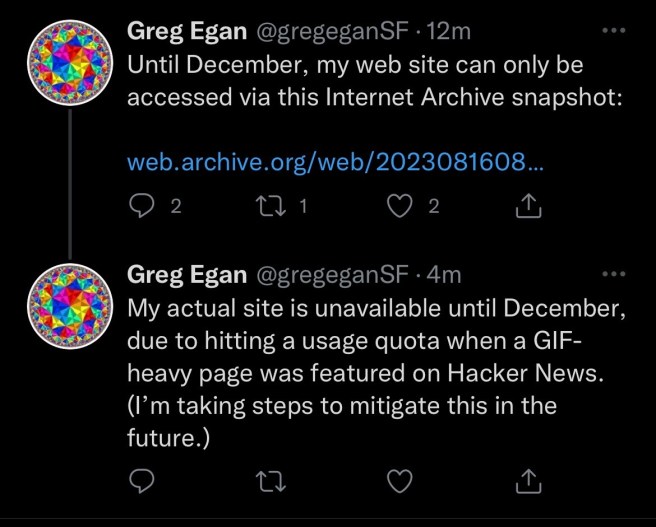
sometimes you hear people muse, “why did we ever start putting all our online content in these untrustworthy centralized walled gardens?” anyhow this is why

Man yeah when’s the last time you heard of someone getting Slashdotted?

Before this, I mean.


Tags:

#disappointed permanent resident of The Future #this post was queued because my to-reblog list is too long and I didn’t want to dump it on you all at once

{{previous post in sequence}}


brin-bellway:

maryellencarter:

heroofthreefaces:

riseofthecommonwoodpile:

riseofthecommonwoodpile:

smartphone storage plateauing in favor of just storing everything in the cloud is such dogshit. i should be able to have like a fucking terabyte of data on my phone at this point. i hate the fucking cloud

this is gonna make me sound very Old Man Yells At Cloud but i just hate how many things in my life assume i will always have access to a quick, reliable internet connection and almost cease to function without it. Obviously certain things Have To Have An Internet Connection, but i want to be able to listen to music if my service is bad. i want to still watch movies if Netflix is down. i want to have a working map when i can’t get a cell signal. nearly every tech product these days bears the fingerprint of the extremely internet-rich places they are developed, high rent offices in Seattle, San Francisco, etc.. I think often the idea of the internet not being available is so remote to them it doesn’t even factor in to development. i remember when the Xbox One was debuted and Microsoft was almost mockingly like “if you don’t have reliable fast internet, then don’t bother buying this”, and there was such backlash they completely went back on so much of that. But now that attitude is just the tech norm.

I don’t trust the cloud.

This makes me happy I don’t use my phone for going online

i mean you can get a terabyte phone but it costs like $1600 USD (give or take a couple hundred, idk, i’m not looking it up)

what really pisses me off is that the samsung flagship phones have completely phased out their sd card slots. you can’t get a cell phone with expandable storage anymore

Yeah, it’s such bullshit that it’s a whole ordeal to dig up a model with a microSD slot now.

I *do* have a 2020-model phone (a slightly different model of which is still in production) with a half-terabyte microSD† in it. (For CAD$155 instead of CAD$70 I could have gotten a full terabyte of microSD, but I didn’t have the budget. Mind you, I *could* upgrade later, without having to replace the whole phone…) But that’s because a microSD slot was my single highest priority when deciding what model to buy, absolutely non-negotiable: if I’d cared any less, I’d probably have ended up with a Pixel or a OnePlus.

Hmm, I wrote an extremely outdated guide to orienting your phone setup around not having reliable Internet access in 2015, and a substantially outdated guide in 2018, so it sounds like I’m due for another one. Be right back.

[three months of on-and-off tinkering later]

Okay, here’s “Tips on Offline-First Smartphones, 2023 Edition”.

†Some of the specs for that phone model you’ll see around will say it takes “up to 128 GB”, but don’t be fooled: 64 GB – 2 TB microSDs are the same backwards-compatibility tier. If a phone can take 32 GB, it might not be able to take 64, but if it can take 64 it can take 2048.


Tags:

#bringing this back since I’ve seen some of the more despairing versions of this thread being passed around again recently #and yes‚ I do have a copy of my Tumblr on my phone #multiple copies‚ in fact: [a tumblr-utils output] and [a scrape of my WordPress mirror converted to Kiwix format] #(and technically also the text-only export from WordPress but I *really* don’t want to have to bootstrap from that one) #(that one is very last-resort) #(cheap‚ though: 6.8 MB) #101 Uses for Infrastructureless Computers #disappointed permanent resident of The Future #proud citizen of The Future #Brin owns *two* 2010’s computers now #fun with loopholes #this post was queued because my to-reblog list is too long and I didn’t want to dump it on you all at once

pkann18:

Youtube vs. Adblockers

Copy and pasting from Reddit user Mike J Smith on the Reddit page for ublock origin, an adblocker extension:

Condensed Update for Newcomers:

  1. YT is making a concerted anti-adblock push via a tattler script tied to a “3 strikes and you’re out” style warning message.
  2. Each time you click on a video that WOULD have shown you ads, the tattler script detects that you blocked it and you’re given a warning popup. This can be X’ed out of quickly, it’s just a warning.
  3. After 3 warnings on a given account, it no longer allows you to close the warning popup, thus acting as a soft block on that YT account until YT’s tattler script no longer detects ad-block running. As of right now, it does not lock your other Google services and it does not count as a traditional account ban.
  4. To protect the new tattler script from our jamming efforts, YT is also updating it at least once a day and sometimes multiple times, basically trying to force us into a war of attrition in coding hours. This naturally has put a MASSIVE strain on the volunteer team and will probably result in extended outages on YT as they try to keep up. They are holding their own, but just barely.
  5. None of the uBO team are paid for this, they are volunteers with day jobs. The success of their efforts will depend largely on what YouTube decides to do next, because fighting their legions of paid coders off indefinitely would be impossible. If YouTube wants to kill adblock forever with sheer force, it’s within their power – we are all hoping they’re just “shaking the tree” to see what falls out and they’ll stop once their accountants are satisfied.
  6. The soft block is only tied to the individual account, not the IP. Thus, FreeTube still works fine and you can still view videos logged out. If you export your history, subs and playlists to Freetube, the only thing you’ve really lost is your ability to comment. I miss it, but not enough to give $20 a month to a pack of scavenging vultures.

So What Do I Do Now???

Look at the original post in the original thread, find the bold headline midway down that says “I followed the 4 steps, but I’m still experiencing issues”. Directly below that is a line that says “The latest fix for anti-adblock was made on [date] and currently corresponds to ID [xxxxxxx]”.

The ID refers to the version of YouTube’s tattler script that it is capable of defeating. Compare that number to the bottom line on this list: https://pastefy.app/G1Txv5su/raw. The listings look like: “https://www.youtube.com/s/desktop/ea2534f4/jsbin/desktop_polymer_css_polymer_serving_disabled.vflset/desktop_polymer_css_polymer_serving_disabled.js”. The bolded portion is the ID number you want to compare it to.

If the numbers are the same, then the tattler has been temporarily neutralized by the volunteer team. Once you purge and update your caches, soft locked accounts will be open again and no warnings will be issued. Use it while you can. Don’t forget to purge & update or it won’t work.

If the numbers don’t match, the volunteer team hasn’t caught up yet and the tattler script is still active. You will still be warned and soft-blocked. Give them 4-5 hours to catch up.


Tags:

#oh is *that* why I haven’t encountered the anti-adblock? #because I don’t leave my Google account logged in? #huh #the more you know #fun with loopholes #Youtube #disappointed permanent resident of The Future #this post was queued because my to-reblog list is too long and I didn’t want to dump it on you all at once

reimeichan:

PSA: If you are using Pluralkit or Tubberbox, go save your avatar files NOW.

Discord has been implementing a feature where direct links to images uploaded to Discord will no longer work after 24 hours. If you want more information, please check out this post by twilight-sparkle-irl. As Pluralkit and Tubberbox both use the direct links for images uploaded to discord for member avatars, this will likely affect these two bots.

I’ve talked to the Pluralkit devs and they have informed me that Pluralkit and Tubberbox devs are in talks with Discord to see how this will affect the bots. No updates as of yet but once I hear anything I’ll update this post.

In the meanwhile, I highly suggest everyone to save alter avatars if they can. I’ll be providing a link to an external tool that you can use in the reblogs of this post.

UPDATE: One of the helpers/mods for Pluralkit/Tupperbox has made a post about the situation. I definitely recommend people to read it when they can. If Tumblr breaks the link, I have a reblogged version of this post with the link there.


Tags:

#the PSAs I’ve seen focus mostly on Pluralkit et al because it’s easier to overlook the effects on them #but this does also mean that in general‚ using Discord as an image host in non-Discord places is going to break #so here is your warning to go and settle your Discord-image-hosting affairs #(TBH Discord should never have allowed completely unrestricted image hosting in the first place) #(it was never going to last: all that allowing it does is) #(encourage your users to come to rely on something that will inevitably be yanked out from under them) #((I feel like the overall impression I’ve gotten from all the various posts about enshittification and zero-interest-rate phenomena)) #((is that we do not‚ actually‚ have a high enough tech level to pull off an image-heavy Internet)) #((we can pretend‚ for a while‚ but the debts come due)) #PSA #Discord #disappointed permanent resident of The Future #101 Uses for Infrastructureless Computers #amnesia cw?

kontextmaschine:

So if I told you someone was using century-old hand-crafted artisanal methods to adapt traditional folk tales into a quaintly obsolete art form from the American Golden Age that would sound like the most twee, precious, non-normie thing ever and I just described Disney animation.

Disney’s pretty weird like that. Like, take the parks. They’re combinations of Coney Island and World’s Fairs with this undisguisable midcentury earnestness. These are places that get seriously psyched about the potential of novel transit modalities.

And the theming – “Let’s look forward to the wonderful future of space exploration, celebrate our roots in farm towns and the frontier west, AND enjoy the exotic charm of the South Pacific and Old Dixie!”

THERE IS A PAGEANT WHERE ROBOTS PAY TRIBUTE TO EXECUTIVE-DRIVEN WHIG HISTORY.

Oh. Oh. And. “The rides aren’t very thrilling, but your kids will love the chance to explore the worlds of all their favorite authors – A.A. Milne, J.M. Barrie, Kenneth Grahame, Mark Twain, AND Lewis Carroll – while you’ll marvel at the exquisite background design.”

(Sun-dappled Edwardian neoteny and obsessive set decoration. Wes Anderson makes movies like Walt Disney made parks.)

And we’d recognize this all as a weird thing to exist in 2015 if we weren’t just used to it as the background noise of America. Like, I don’t really watch TV so I don’t see commercials much these days.

Oh man, they’re a trip in their own right if you’ve stopped taking them for granted. Like, “oh hey, for the next 30 seconds some of our best artists are going to use all their techniques and leverage all your emotions and desires and every social value in a masterful, unapologetic, and unforgettable bid for you to give us money, and then everyone will move on and no one will acknowledge this even happened.”

But the Disney World commercials in particular – you notice they don’t really make a case for going to Disney World, or even really explain what Disney World is. Because they’re not pitching Disney World, they’re reminding you of Disney World. It’s not “hey, Disney World is a thing you could go to”, it’s “hey, maybe it’s time for this generation’s pilgrimage”.

Disney’s weird. It’s kind of a company, but also custodian of some of the cultic functions of American culture, something like the priestly colleges of ancient Rome.

Like, they maintain sites of pilgrimage. I’m not saying that as a joke. Back of the envelope calculation, Americans go to Disney parks at a rate 7 times higher than Muslims go to Mecca. (The line between “tourist trap” and “religious site” has always been thin.)

And they’re custodians of the national narrative. Like I’ve said, they pitch “continuity with prewar small town and earlier frontier culture” as a fundamental, almost taken-for-granted aspect of Americanness with a confidence and charm you don’t often see these days. And I mean, hell, the Disney animated canon itself basically is to America what Grimm’s was to Germany.

And as custodians, they curate that narrative – like, we joke about “you know your identity group’s made it in America when you get your own Disney princess”, and laugh at the people reediting Disney character designs to look like their specific subgroup, but that only works because it’s fucking true, your identity group’s made it in America when you get your own Disney princess. I’ve worked with Disney Channel casting, and they mix ethnicities with the same care, precision, and scale that Pfizer mixes drugs.

And that robot pageant, the Hall of Presidents? Look at this history. It started out in the ‘70s as a celebration of consensus history and popular triumph, with character actors playing great men and Civil War tensions understood as a challenge to national unity. In 1993 it was reworked by Eric Foner to be narrated by Maya Angelou, use “regular people” unknowns to portray more vulnerable takes on historic figures and re-frame the Civil War in terms of slavery as a moral challenge. In 2009 they redid it again, mostly keeping the changes but bringing back some of the old Hollywood charm and putting Morgan Freeman as the voice of civic authority.

And like, as a representation of how America understands itself and its history, correct. That is absolutely, in every way, 100% correct.

(In the other direction, Walt Disney originally wanted to call it “One Nation Under God”, which yikes)

They say American copyright terms keep getting extended under pressure from Disney who wants to keep hold of all their founding properties, I almost wonder if it wouldn’t be less of a corruption of the civic system to just carve out special protections for Disney in recognition of their distinct role in America.

But… at the end of the day, it’s all just a strategy to maximize profits.

I used to be a lot more libertarian than I am now, and one of their tribal boogiemen, the idea of a “Ministry of Culture” – a government that sees the national culture as its domain, to shape as it will, “as it will” meaning as it always does with governments “through the instrument of bureaucracy” – that still rankles.

But what’s the alternative, though? You think about it and you realize it’s this – the national mythos rests in the hands of a publicly traded corporation.

(And then you maybe start to appreciate WHY having your king as the head of your church once made sense as a symbol of liberty and self-determination.)

((And start to recall the CIA going around giving grants to the avant-garde with a certain fondness.))

We live in the capitalpunk AU.


Tags:

#a few years ago OP began putting blanket infohazard warnings on his writing #I think his level of seriousness about that‚ from his own perspective‚ was somewhere above 0% and below 100% #but it’s been my experience that when people say stuff like that‚ they’re usually right even if they think they’re not #so I blacklisted his username #but blacklisting doesn’t apply to webpage view‚ so I did end up learning today of his death #I went back and checked the kontextmaschine posts that were on my dash today #and found that he was the one who wrote this classic post #which‚ it turns out‚ I have never actually reblogged #so‚ then‚ in honour of his memory‚ here is that one post with the thing #Disney #disappointed permanent resident of The Future #(is that tag about Disney or about the existence of mortality? yes) #death tw #this probably deserves some other warning tag but I am not sure what


{{next post in sequence}}