{{previous post in sequence}}


theopjones:

brin-bellway:

theopjones:

collapsedsquid:

Peterson may be an academic, but he’s dispensing with the academy’s constraints. His university salary is around $128,000; that now looks modest beside the $1m a year he receives in crowdfunding via the site Patreon, in return for YouTube Q&As. Traditional universities charge “unforgivable” fees, and “haven’t got a hope of surviving in their present form”, he says. He has hired three people to work on a proposal for a new online university — “user-funded at the lowest possible cost, but also crowdsourced in terms of its operation”. He is in touch with Peter Thiel, the venture capitalist who urges undergraduates to drop out. There’s a blurred line between the thinker and the salesman, and Peterson has crossed it.

Goddamn it Peter Thiel

It’s totally poisoned because Peterson is tied to it.

But the online university thing might not be a bad idea. You could probably replace quite a bit of the operation of a modern university for lecture-based subjects with a mix of pre-recorded videos, and decentralized discussion with other students, and “crowdsourced”  operation that relies on offloading some tasks to students. 

Probably the biggest issues would be to sell it as something that people consider reputable (a number of purely online universities exist and have lower costs, but they have issues building a reputation), and dealing with things like arranging for securely proctored tests. 

When you say that test proctoring would be a big issue, do you mean you think it would be a big issue for online universities *in general*, or specifically a problem for online universities who are aiming to destroy the old tertiary-education system (rather than just adding more options to it)?

My university technically has a corporeal campus, but I’ve never been there and neither have the vast majority of the other students. They have standing arrangements with a bunch of universities, community colleges, and…*looks at list*…huh, libraries too, maybe you *could* make this system work even if you’re trying to end all corporeal campuses (and so don’t want a system dependent on them continuing to exist). Anyway, they have standing arrangements with a bunch of places across the country to host the exams of the local students. My local community college charges the student a $30/exam hosting fee (to compensate for increasing their proctor’s workload and such), but other than that it’s really a non-issue.

(The computerised exams also have an option to have somebody watch you over a webcam, but I’ve never tried that.)

(now if only my university would join the reciprocal college Internet system, because as it stands I’m not allowed to use the Wi-Fi at *my own exam centre*, and it makes coordinating with my ride a lot trickier. but that’s another matter.)

I see people sometimes who think that exam proctoring is some massive obstacle that online universities will soon face and probably fail to overcome, and it’s like…

One time I read an article about how self-driving cars on public roads would be a disaster, because–not being able to make eye contact with the driver–pedestrians would have no way of knowing whether the car had noticed them and would stop for them, and the car and pedestrian would get into standoffs where neither was willing to risk moving forward (or, worse, *both* of them gave up waiting for the other at the same time). The writer appeared to think that this was insurmountable and would destroy all public goodwill towards self-driving cars.

A few months previously, I’d seen a news clip about a self-driving-car prototype with a smiley-face-shaped light on the front, which it lights up while stopping for a pedestrian in order to let the pedestrian know they’ve been noticed.

The way I felt reading that self-driving-car article is how I feel when people say online-university exam proctoring is a huge issue. The doom they are just now getting around to foretelling has already been noticed and averted, and without anywhere near as much difficulty as they think it’s going to take.

Interesting. 

Most online college classes I’ve taken have either had no proctoring system or some terrible web-based one that caused a lot of issues. One of the nearby community colleges did proctoring for a fee as a service but the classes rarely allowed that option to be used. Maybe its consistently better ran by colleges that are purely online than colleges that are mostly meatspace but offer a few online classes.


Tags:

#(June 2018) #conversational aglets #adventures in University Land #proud citizen of The Future

{{next post in sequence, branch 1}}

{{next post in sequence, branch 2}}

{{previous post in sequence}}


theunitofcaring:

I wrote a while ago about my baby roommate and novelty. The idea is that people find things interesting and exciting when they have the right amount of novelty. Things that are too predictable, like a children’s book you’ve read to a demanding kid ten thousand times, are boring. Things that aren’t predictable enough, like a long novel in a language you don’t speak, are also boring. It’s the process of forming expectations that are often right but sometimes surprised which makes something fun. So for a baby, repetitive play is fun, because every time the duck lands in the bathtub is slightly surprising; for an adult, those variants all make perfect sense and aren’t a source of thrilling novelty anymore.

But I think adults also vary tremendously in how much novelty they enjoy. There are people who reread books all the time, and people who never reread books, both of whom tend to regard each other with total incomprehension. There are people who like their nice simple job doing mostly the same thing every day, and there are people who’d die of boredom. And people are often attuned to different kinds of novelty – for me, ‘sewing dresses’ sounds like doing the same boring thing over and over again, but I bet anyone who actually does it would tell me that different fabrics and threads and stitches and fittings and other constraints make every project different.

I think we tend to talk about jobs as if everyone wants high novelty (art! research! acting! travel!) and some are forced to settle for the mindless drudgery of accounting or marketing or human resources or middle management. But that’s not how it works. Things that are an exciting and satisfying amount of novelty for some people are above the satisfying threshold for other people, and they’re just stressful and demoralizing. Things that would have some people grinding their teeth with tedium have lots of hidden novelty of just the right type for some other people.

But we don’t give kids a lot of opportunity to discover if they’re someone who would find accounting delightfully rewarding minute-to-minute. We don’t even tell them that anyone finds accounting delightfully rewarding. There isn’t really a chance, ever, to try forty things and figure out which one of them hits the right spot in your brain. Which is too bad, because I suspect that getting this right (and noticing when your job has ceased to offer it) is a major contributor to day-to-day happiness.


gnomer-denois:

Why do people think accounting is boring? Learning it is boring. Doing the day to day job… you don’t just do the same thing all day. Almost everyday it’s a juggling of what’s normal important right now and in 30 mins or an hour that’s going to change and you have to shift gears because something else has come up. The part I like the most but find the least rewarding is reconciliation projects for accounts that are years old. I can spend hours digging through tons of information to figure out what caused the problem and when it’s resolved, I solved the puzzle! But all I have to show for all that work is a couple of sentences or *maybe* a spreadsheet showing what I found. But I almost never get to really dig in on those problems because there’s always so much to do that has to be done Now.

Maybe it’s more boring in companies that have sufficient staffing.


brin-bellway:

I have really been feeling that lack-of-opportunity-to-figure-out-if-you-would-like-doing-accounting lately. *Specifically* regarding accounting.

There’s a draft I never got around to posting that talks about how I’ve been considering the possibility of changing my major from computer science to accounting, but that it’s hard to tell whether that’s a good idea because I have so little sense of what accountants actually *do*. (I interact with enough programmers that at least I have some sense of what *they* do.)

I enjoy making my family’s financial spreadsheets and gathering and crunching the numbers on what possible frugality-efforts would get us, but I don’t know how suggestive that really is.

@gnomer-denois (it won’t actually let me ping you, but since I’m reblogging directly from you you’ll probably still see it), if I may ask, what made you decide to become an accountant?


gnomer-denois:

Um, well. My degree in floral design (BS in Horticulture) wasn’t proving very useful since I didn’t have the equity to open my own store. Then I realized that, despite my rebelling against my math teacher mother, I do actually like math. I was on the fence between engineering and accounting but I prefer the more basic number manipulation to the higher level math.

My grandfather was an accountant after he retired from the Air Force, but a bunch of uncles and cousins are engineers, so that part could have gone either way. I had already taken an intro to accounting course during my first BS, and while it was confusing at first, once it clicked it made sense and I knew I could do it.

Also, at the time I started my BS in Accounting, most job listings for accountants required a BS and most for engineers required an MS. Since then there were stricter requirements put in place to sit for the CPA exam that mean I’ve needed to go on to a Masters of Accountancy, though I suspect if it was worked right that might not be necessary for everyone, depending on state/country. Recently I’ve been considering going on for my PhD and becoming a professor.

It sounds like you enjoy doing cost-benefit analysis and some other things that might lend well towards managerial accounting. Www.imanet.org has information about that if you are interested.


brin-bellway:

Thank you! That sounds promising.

Traditionally I take two consecutive days off from school-related tasks after finishing a semester, but I will look through that website after I’ve had a chance to recover.

I have one intro-level elective slot left in my computer-science major, so I can take intro to accounting without any sunk costs (the credits will still count towards my degree even if I continue with CS). I’m planning to do that next semester, and we’ll see how it goes.


justice-turtle:

@tigerkat24 I can’t recall if our housemate the accountant does tumblr (or I’d just message her directly), but perhaps you could ask if she’d be interested in talking to Brin about what-accountants-do?


Tags:

#(November 2017) #(this bit never went anywhere) #(but in any case my sense of what accountants do has improved enough since this post to think it worth pursuing) #((though if any accountants would like to talk to me about what their job is like I remain interested in hearing it)) #conversational aglets #adventures in University Land #adventures in human capitalism


{{next post in sequence}}

Accounting terms as a metaphor for life

swimmer963:

I just had a conversation about the difference between conceptualizing your own life as something like a balance sheet, versus something like a profit & loss statement, and I’m finding this a surprisingly fruitful analogy. 

Balance sheet: You are tracking assets and liabilities – a snapshot overview of your position in the world. Assets might be literal money and stuff, intangibles like skills, youth, attractiveness, family ties, or even more nebulous, like memories of good experiences. If you’re looking at your life from a balance sheet perspective, you are a collector, trying to gather and hold onto as much of the good as possible. Surveying your life and noting that you’re holding a good-sized pool of equity (of all types) will feel safe and successful. Giving up possessions, forgetting childhood memories, or drifting away from friends and family, might feel like losing a part of yourself. I associate this model with a diachronic sense of self. 

(There is probably some possible analogy here re depreciation on assets, that I’m too tired to unpack right now). 

Profit & loss: You are tracking revenue and expenditures – the rate of change over time, and whether your trajectory is positive on net. Recent good experiences, learning and personal growth and skills gained, and literal money-earning potential feel like success and safety, as does having more than enough energy and motivation to fuel your ongoing day-to-day life; putting in unsustainable amounts of effort, spending yourself to stay afloat, feels like the worst kind of failure. Your absolute position, and where you were five years ago, both matter less. Noticing that you’ve left something behind (friends, family, an old sense of self) in your race for forward momentum, probably doesn’t hurt as much. I associate this viewpoint with being more episodic. 

I tend toward the profit & loss (which makes sense, I’m more episodic than many people I know), and I think I’ve moved even further in that direction in recent years, an adaptation to the life I’ve chosen – it doesn’t feel like I have the luxury to sit around accumulating assets and stability and a comfortable position to survey my life. The categories of revenue I’m currently pulling in are totally different from what I was tracking five years ago, when I was a nurse in Canada, and that seems fine. I’m not the same person as I was then. 

I think this does make me more vulnerable towards vicious spirals in bad times, and over-updating on how things have gone recently. 

I was unfamiliar with the terms “diachronic” and “episodic” sense of self, so I looked them up and found this [link].

The post mentions diachronics often “pitying” episodics, but I find my main emotion is not *pity* but *defensiveness*. The web of associations I’m getting is mostly people (they usually call themselves Buddhists; I don’t know enough about Buddhism to know how central an example they are) who think that [lacking a sense of a cohesive, continuous self] is both the objectively more true and subjectively superior way to live, and that the highest goal in life is to obtain it. IME, the one being pitied is usually *me*. I wonder what kind of circles 2012!RONBC travelled in.

Interestingly, given your examples, for much of my life “how much money do I currently have saved up” has been a *much* larger factor in the strength of my financial position than “how much income am I likely to make in the near future”. I’ve spent a *lot* of time over the years living primarily off of savings, and these days I do sometimes tend to view income, not as directly going to expenses, but as a way of acquiring savings that one then *actually* uses.

And come to think of it, this isn’t even the first time that someone has connected that with me having a stronger continuity of self [link], though not in quite the same sense that you’re talking about.

I don’t really know where I’m going with this, but it’s interesting stuff.


Tags:

#reply via reblog #adventures in human capitalism #adventures in University Land #is the blue I see the same as the blue you see #amnesia cw?


{{next post in sequence}}

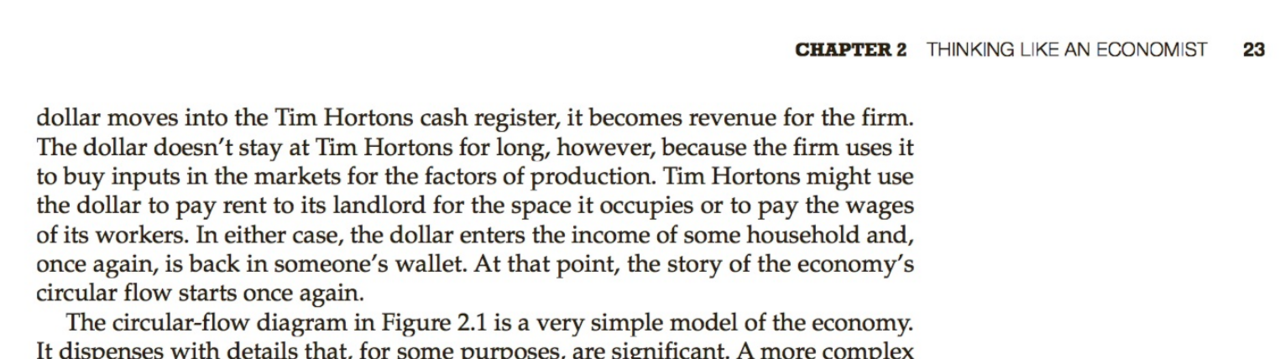
they were not kidding when they said this economics textbook had been adapted for Canadian audiences, huh


Tags:

#this image file on my computer is named ”Have We Mentioned Lately We’re Canadian.png” #(I wonder what this example is in the original American) #oh look an original post #our home and cherished land #adventures in University Land #reactionblogging #bluespace #(not *exactly* but it does seem to have a similar blurring between the picture and the other elements of the page)

theunitofcaring:

A weirdly large share of productivity advice is about increasing how many hours in your day you spend doing work. 

My current job is not a good example here because it doesn’t come in discrete little units, but my last job did. My last job was to write profiles of software engineers. They took about 15minutes to write when I was in the swing of things, but it was often hard to get myself into the mode where I could work on them. Sometimes I’d spend the whole day slowly slogging through them. Sometimes I’d procrastinate all day and then do all of them with two hours left in the day. 

The maximally productive day, for that job, would have been to finish all of my work by 10am and then spend the rest of the day relaxing. 

Nearly all productivity tools and apps would consider the ‘most productive’ day to be the one where I spent ten hours working on profiles. 

I get why they do this. You have more volitional control over how much time you spend working than over how much work you get done when you do, and it can be discouraging to strive for something that’s not really in your control. For many people and many tasks, how much time you work and how much you get done are pretty strongly correlated. And it’s easier to track time spent than progress accomplished.

But nonetheless, it seems pretty damaging for this to be the focus of nearly all productivity advice. The rare things which are instead results-oriented seem to do well. Duolingo rewards lessons completed, not time spent doing them. 4thewords rewards words written. The people I know seem to like them and stick with them a lot more than with time-trackers or strategies to squeeze more workday out of their lives. 

I think most people trying to be more productive should try both a ‘track how much time you spend working! spend more!’ approach and a ‘here’s how much you have to achieve today! try for the earliest possible completion time!’ approach, so you can give yourself a chance at hitting on whatever works best.

I find that what works best for me is neither “spend as much time as possible” nor “do a set amount” (mind you, I don’t think I’ve tried the particular variant “do a set amount *as quickly as possible*”; that might work a little better), but rather “you have this much time available, do as much as possible within that period”.

Both more-time and result-based methods tend to make me work more slowly because it feels like there’s little reason not to, whereas if I only have a certain amount of time I want to make it count. My job pays by the hour, and I actually do really well under that system: it motivates me to make myself useful, because I want my employer to get his money’s worth.

Meanwhile, with university, it’s unfortunate that my schedule is not as conducive to “spend Exactly Four Hours working on school assignments” as it used to be, and I *am* pretty sure that I go through schoolwork more slowly now that I’m not doing that. I’ve been considering ways I might tweak my approach to allow for rigid school times while still being able to fulfil my duties as my workplace’s emergency fill-in person (that is to say, while having a somewhat unpredictable work schedule).


Tags:

#yes I do best with strict scheduling but signed up for a job with an explicit condition of ”must be able to show up on short notice” #look local minimum wage is super high compared to my cost of living #so by my standards even this fast-food job pays *very* well #most weeks I work 16 hours and make very nearly enough to support myself #reply via reblog #is the blue I see the same as the blue you see #adventures in University Land #in which Brin has a job #adventures in human capitalism

another-normal-anomaly:

thetasteoffire:

apricops:

I’m gonna pitch a show as “like Game of Thrones but even more gritty and realistic” and then it’s nothing but a baron handling land estimates and organizing road repairs and stuff. There’ll be an entire episode about how a peasant gets brought to court for letting milk cattle graze on communal pastureland even though it’s supposed to be reserved for draft animals.

my ten-episode plan from the writer’s room of this blessed show:
ep. 1: meet the accounting staff of this magical kingdom in a far-off land
ep. 2: land estimates, plenary powers of wizards employed by the office of the royal treasury, and how tax code intersects with succession laws of absolute primogeniture when the lineage in question may have extra-planar ancestry
ep. 3: a full-hour hearing with flashbacks on how mrs. Jones’ cow grazing actually violates three local statutes, is in line with a conflicting royal decree (potentially issued under ensorcelled compulsion), and is entitled to binding arbitration via fey courts. mrs. jones is not entitled to said arbitration, the cow is. 
ep. 4: how land rights and taxation applies to druid circles and sentient treefolk, especially when said land is technically owed fealty to both a human and inhuman entity. we never see any treefolk.
ep. 5: the differing rights and responsibilities of yeomen who freehold land near a lord’s manse vs. yeomen who freehold land held by the lord’s vassals vs. burghers in cities surrounded by forty-foot high gilded walls inscribed with runes so terrible they will burn a man’s flesh just from touching. extensive tax comparisons are made based on type of property held and crop status (cereal crop taxed x, but fiber crops taxed y).
ep. 6 – 9: ep. 3 but for a host of other problems: conflicting tax status for nobles who hold different positions (especially if they technically owe themselves fealty), bridges (just like…in general), a revolt started by a miller, and tax-deductible status for magical family heirlooms and whether or not being part of a dragon’s hoard can be considered “held in escrow.”
ep. 10: the queen kills the king. this is never explained but on a rewatch, isn’t surprising. it does rattle the staff as they look to cook the books and make sure they get paid as revolution sweeps the land. a brief aside is delved into concerning mercenaries. this takes less than five minutes; the rest of the episode concerns a detailed archive of back-taxes owed by the rebel dukes. 

I would watch the shit outta this


Tags:

#story ideas I will never write #and I’ll also throw in #adventures in University Land

{{previous post in sequence}}


Update:

I am now officially an accounting major.

(Specifically, I’m in the one-year† accounting certificate program. This then leads into the two-year† advanced accounting certificate, and from there a bachelor’s.)

I’m coming up on the end of this semester, and next semester I’m going to take a course (microeconomics) that–though mandatory for accounting–doesn’t fit into any of my remaining slots for a CS program, so I figured it was time.

†”Year” here being a standardised unit of measurement meaning “10 courses”. At my current part-time rate I expect it will take me about two years to get the first-level certificate.


Tags:

#adventures in University Land #oh look an original post #oh look an update #a couple nights ago #(after I’d already decided to do this) #Mom and I were talking about how my ”first job” was accounting data-entry #when I was a pre-teen Dad would give me a nickel for every receipt I typed into his household-expense-tracking program #”we should have known then” she said‚ only partly joking #(I wrote this draft a couple days ago) #(today I took my final exam for this course and signed up for econ) #((I didn’t *have* to do them in that order that’s just how it worked out)) #(I’m going to take a week off from school and then get a head start on reading the economics textbook) #(it’s an ebook so it’ll probably have arrived by then)

Sort-of-tagged by @maryellencarter.

the last movie you watched: I don’t know. I wouldn’t be surprised if I haven’t watched a movie beginning-to-end since seeing Mockingjay Pt 2† in a theatre. I’m not really big on video.

(Which is also why I haven’t done the favourite-movies-as-gifs meme @agapi42 tagged me in. Sorry, Agapi: I do appreciate that you thought of me, but I don’t think I’m the right person to do that meme.)

Edit: wait, hang on, I saw The Force Awakens (I think shortly after it came out on DVD), and that would have been more recent than Mockingjay. So that puts a new cap on how long ago the most recent movie could have been.

the last tv series you watched: There is…a distinct possibility that I have not sought out any TV since Daily Planet ended. Again, not big on video. Mom has been watching The Worst Witch and Merlin, usually while I am in the room.

the last webseries you watched: I know I watched Red vs Blue a few years back (think I got partway through S12). Neither my sense of the boundaries of “webseries” nor my sense of what time things happened is good enough to say if there were any more recent than that.

the last comedy special you watched: I agree with maryellencarter, re: what does this even mean.

Hmm…*googles “comedy special”*

This appears to mean a recorded stand-up act, especially but not necessarily on Netflix. It has been so long since I watched stand-up that I really couldn’t say who it was, let alone which specific act.

the last podcast you listened to: Talk the Talk, as is traditional on the ride over to an exam. (I had my accounting midterm today.) The episode in question was apparently locked behind a Patreon paywall some time after I downloaded it, but it’s about Chinese puns and censorship.

the last game you played:
     Video game: Flight Rising. My familiar fund is coming along nicely, though gems per se are a bit hard to come by at the moment what with the new Starmap gene.
     Board game: Wormhole, a locally-designed trivia game (mostly history and geography, with the occasional science question) my parents found at Value Village (thrift store chain, pretty much the Canadian version of Goodwill). I later saw it at a board-game store for 90% off, so I guess it wasn’t too popular. (And indeed, nothing relevant comes up when I google it.) It’s okay as trivia games go, though the difficulty level of the questions feels pretty variable (and they aren’t divided into distinct difficulty levels).
    App game: I don’t play these much at the moment. Whenever Pokemon Go sends me a “we miss you, here’s some free stuff to entice you back” code I pop in, redeem it, and then immediately leave, so technically Pokemon Go. (I figure there’s a good chance I’ll start playing again at some point, and I might as well acquire a stockpile of double-XP items and egg incubators for if/when that happens.) Actually *playing* might have also been Pokemon Go, or it might have been sudoku.

the last book you read: Hmm. My reading has mostly not been in book form lately. Probably Welcome to Floating Point. (That’s just the first one, not the whole trilogy: I haven’t finished the rest yet.) The author’s habit of using “spoke” rather than “said” as the default speech marker is a little irritating, but I liked it otherwise.

Alternately, if you want something more traditionally published and/or costing money: Pyramid of Peril. (Though, in fairness re: costing money, the audiobook is now free. But I already owned the ebook, and I prefer text to audiobooks anyway.)

the last comic book you read: I don’t read comic books myself.

the last webcomic you read: I think XKCD was more recent than Parhelion.

the last song you listened to: “Tried”, by Assemblage 23.

the last musical you listened to: I don’t really do these either. By default, then, “Once More, With Feeling”: the only musical whose soundtrack I own.

the last thing you searched online: Online, I’m not sure. I looked up kewra on Wikipedia this afternoon, but it wasn’t online because I didn’t have Wi-Fi. (Well, come to think of it I didn’t actually *check* if the Indian food store had public Wi-Fi, but I doubt they did.)

the last outfit you left the house in: A green Girl Scout camp T-shirt (Girl *Scout*, not Girl Guide: that’s how old this shirt is), brown leggings, plain white socks from the big pack I bought in Florida upon finding the socks I’d brought weren’t enough for all the walking around Disney I was doing, hiking boots, utility belt††, one-litre water bottle on shoulder strap.

(I don’t especially *like* camping, but I tend to wind up with Camper Aesthetic anyway, as a side effect of prepper tendencies. I never leave the house *intending* to spend the night in the woods, but I also never leave the house without enough gear that I *could*, if necessary, do so. Also, hiking boots are comfortable.)

(For the record, it has never yet been necessary. I have still never used my foil blanket. But if I ever need it, there it will be.)

the last completely unnecessary thing you purchased: I was going to say McDonalds food, but it was a post-exam treat, which disqualifies it by the rules maryellencarter’s answer uses.

Mind you, I normally go to Tim Hortons–which is noticeably cheaper than McDonalds–for my post-exam treat, so arguably the *additional* $5 vs getting a Timmies bagel *was* completely unnecessary. (But I had a coupon for a free medium fry and drink with purchase, and it had been a long time–actually, hang on, I can literally look that up: it’d been a little over two years–since I bought any McDonalds, so I decided to go for it this time.)

†Fun prosopagnosia fact: Katniss Everdeen looks a lot like I would without glasses, but Jennifer Lawrence looks nothing like me.

††Maybe I should make an updated list of utility-belt contents: I keep finding myself wanting to link to it and only having the 2012 version available.


Tags:

#when Mom asks me what I want for my birthday/Hanukkah and I’ve run out of ideas #I look at the camping section of Amazon and see if I can find any Useful Thing inspiration there #pretty sure that’s how I found the solar-powered phone charger #(which I don’t own yet but I expect I’ll get it for my birthday) #oh look an original post #meme #adventures in University Land #food #(ever since the Pillowfort thing I’ve been noticing just how often my posts link to previous posts on my Tumblr) #(almost any post where I contribute significantly #–rather than just ”hey here’s a neat thing”– #is part of a broader context of my other writings) #(and many of said writings are comments) #(the following category tag was added retroactively:) #101 Uses for Infrastructureless Computers

swimmer963:

My favorite thing about my accounting prof is how adorably indignant he is about some of the arbitrary conventions that come with his life’s work. Some representative quotes: 

On the topic of materiality: “So at one point someone noticed employees were taking office supplies home and made a new rule that you had to request them from the clerk. To which the correct answer is ‘screw you, stop being a goddamned clown, it’s a 50¢ post-it note, IT’S NOT MATERIAL!”

On the topic of audits: “Of course, if they *were* committing fraud, you would literally never know because they could show me whatever book with whatever coding rules they wanted. One time I DID find an error in the books and I was so excited, I ran to my supervisor to show them, and they said ‘all right, good job, now you write up why it’s immaterial.’ I’ve never been so disappointed.” 

Miscellaneous:

“Land doesn’t depreciate” 

“It’s now a lesser truck than it was” 

“Is the operating cycle more or less than a year? If they’re selling fish it’d BETTER be less” 

“You know, what made the first computers commercially viable wasn’t the Internet or anything cool like you kids do these days, it was that they could do accounting” (I have no idea if this is actually true but it was cute) 

“The quick version is that the whole thing is stupid, but I’m going to teach it anyway” 

“The statement of cash flows is a pretty pointless report but GAAP made it mandatory soooo here we go” 

>>(I have no idea if this is actually true but it was cute)<<

IIRC, it depends on what you mean by “first” computer. Like, not the *first* first computers, but in the 80’s spreadsheet software was a Very Big Deal and an important factor driving computer sales.

*goes to find some stuff on Wikipedia*

Here are the Wiki entries for two of the big spreadsheet programs of the time, VisiCalc and Lotus 1-2-3.


Tags:

#in which Brin is very much [a CS major about to switch to accounting] #(I originally learned the stuff above from a textbook) #I feel like the original post qualifies for the tag #I cannot believe I actually understand this #adventures in University Land #reply via reblog #unfortunately I’m too brainfoggy from a cold to study right now #I might be able to manage working on the household financial statement though #as that is somewhat more informal #illness mention #history

theopjones:

collapsedsquid:

Peterson may be an academic, but he’s dispensing with the academy’s constraints. His university salary is around $128,000; that now looks modest beside the $1m a year he receives in crowdfunding via the site Patreon, in return for YouTube Q&As. Traditional universities charge “unforgivable” fees, and “haven’t got a hope of surviving in their present form”, he says. He has hired three people to work on a proposal for a new online university — “user-funded at the lowest possible cost, but also crowdsourced in terms of its operation”. He is in touch with Peter Thiel, the venture capitalist who urges undergraduates to drop out. There’s a blurred line between the thinker and the salesman, and Peterson has crossed it.

Goddamn it Peter Thiel

It’s totally poisoned because Peterson is tied to it.

But the online university thing might not be a bad idea. You could probably replace quite a bit of the operation of a modern university for lecture-based subjects with a mix of pre-recorded videos, and decentralized discussion with other students, and “crowdsourced”  operation that relies on offloading some tasks to students. 

Probably the biggest issues would be to sell it as something that people consider reputable (a number of purely online universities exist and have lower costs, but they have issues building a reputation), and dealing with things like arranging for securely proctored tests. 

When you say that test proctoring would be a big issue, do you mean you think it would be a big issue for online universities *in general*, or specifically a problem for online universities who are aiming to destroy the old tertiary-education system (rather than just adding more options to it)?

My university technically has a corporeal campus, but I’ve never been there and neither have the vast majority of the other students. They have standing arrangements with a bunch of universities, community colleges, and…*looks at list*…huh, libraries too, maybe you *could* make this system work even if you’re trying to end all corporeal campuses (and so don’t want a system dependent on them continuing to exist). Anyway, they have standing arrangements with a bunch of places across the country to host the exams of the local students. My local community college charges the student a $30/exam hosting fee (to compensate for increasing their proctor’s workload and such), but other than that it’s really a non-issue.

(The computerised exams also have an option to have somebody watch you over a webcam, but I’ve never tried that.)

(now if only my university would join the reciprocal college Internet system, because as it stands I’m not allowed to use the Wi-Fi at *my own exam centre*, and it makes coordinating with my ride a lot trickier. but that’s another matter.)

I see people sometimes who think that exam proctoring is some massive obstacle that online universities will soon face and probably fail to overcome, and it’s like…

One time I read an article about how self-driving cars on public roads would be a disaster, because–not being able to make eye contact with the driver–pedestrians would have no way of knowing whether the car had noticed them and would stop for them, and the car and pedestrian would get into standoffs where neither was willing to risk moving forward (or, worse, *both* of them gave up waiting for the other at the same time). The writer appeared to think that this was insurmountable and would destroy all public goodwill towards self-driving cars.

A few months previously, I’d seen a news clip about a self-driving-car prototype with a smiley-face-shaped light on the front, which it lights up while stopping for a pedestrian in order to let the pedestrian know they’ve been noticed.

The way I felt reading that self-driving-car article is how I feel when people say online-university exam proctoring is a huge issue. The doom they are just now getting around to foretelling has already been noticed and averted, and without anywhere near as much difficulty as they think it’s going to take.


Tags:

#reply via reblog #adventures in University Land #proud citizen of The Future


{{next post in sequence}}