#anything that makes me laugh this much deserves a reblog #food #surveys #this post was queued because my to-reblog list is too long and I didn’t want to dump it on you all at once
#carving this into the monolith to provide context for the next couple of jokes #(FTR I voted for flour) #food #surveys #sort of #this post was queued because my to-reblog list is too long and I didn’t want to dump it on you all at once
here is a concept: time travel cop, fish & wildlife division
most of their job is dealing with the kinds of assholes who think black market tiger cubs are a great idea right up until someone gets mauled, except these are even bigger assholes with black market Smilodon cubs that they are even less equipped to care for
this is the most straightforward and therefore relatively headache-free part of their job, because it’s the same “put that thing back where it came from or so help me” song and dance every time
it’s also significantly less depressing than the trophy hunters who don’t even want an alive extinct animal. those are extra annoying because you have to undo the time travel that let them kill that poor Megatherium or thylacine or anklyosaur or whatever, and it’s always so much extra paperwork.
and those people suck, definitely, and have fully earned a stint in Time Jail. no question. but they still do not create anywhere near as much work as the obsessive hobbyists with their exhaustively careful best practices and worryingly good track-covering. also, weirdly, it’s almost always birds with them?
like. the guys who will flagrantly abuse Time Law to bird-nap breeding pairs just long enough to raise one clutch of eggs apiece, and return them seamlessly to their spots on the timeline. who are so determined to keep their pet (ha) projects going that no one even realizes what they’re doing until they have an entire stable breeding population of passenger pigeons up and running. who are now the reason that reps from six different zoos are about to start throwing hands right in front of you over who gets dibs.
those guys cause the most paperwork. and half the time they’re snapped up by the same zoo or wildlife preserve that gets their colony of ivory-billed woodpeckers or Carolina parakeets or — once, very memorably — giant fucking South Island moa, and they never even spend a day in Time Jail.
Ooh! There have been a few “surprise, not extinct!” events recently, again weirdly almost always birds, though occasionally fish. What if they really did go extinct, but someone from 2459 went back to 1900, built up a minimum breeding population in 2459, and then released them into the wild in 2000, 2005, 2010, and 2015? Releasing new groups every five years in our century would avoid a sudden suspicious population surge and no one would think to look for the culprit in their own century because Jerdon’s Babbler (real-world example, rediscovered in 2014) has always been there/then.
You could build a novel around the relationship between the time cop and the rogue bird lover. The time cop caught the bird lover over the passenger pigeons. They went to time jail for 10 years outside the timeline, and then were hired to manage the passenger pigeons by an accredited zoo’s. The time cop suspects they’re still up to something, but other than the passenger pigeons, all they appear to be doing is raising research colonies of perfectly ordinary birds. Except all the species they’re working with were believed to be extinct at one point….
One thing real world zoos do now is…well…something like elven changelings if you think about it. They time the mating of a captive breeding pair to that of an isolated wild breeding pair in places where inbreeding is a serious risk. Then they swap a captive-born offspring for a wild-born–each breeding pair unknowingly raising a foster. Both zoos and the wild population get improved genetic diversity, without the risk inherent in “rewilding” a zoo-born adult. Doing that with birds and time travel would be even easier–grab an egg, take it to the future, raise and breed it, take an egg back to the original nest. The original parents raise their grandchild, not their child.
The hardest part for me would be explaining why the time cop thought this was wrong!
oh I love all of this. i think the time cop would eventually just be like “PLEASE get a license from an accredited zoo already so i can stop having to deal with you” but the accredited zoos aren’t on board with the “release into the wild 200 years ago” part of the scheme
and also our rogue bird enthusiast has a white whale and that white whale is Haast’s eagle
A secondary character could be the person responsible for saving cheetahs from extinction twice, 100,000 years ago and again 12,000 years ago. Alternately the idiot who caused the two near extinctions.
Or no, the cheetahs were an early legal attempt at extinction reversal that spurred the creation of the laws our rogue bird enthusiast is flouting. Cheetahs were hunted to near extinction by time travelers 100,000 years ago. The reestablished breeding population was so low that it led to the second near extinction 12,000 years ago–and the species’s whole precarious existence since. Both hunting safaris and extinction reversal were banned at the same time.
Cheetahs are so inbred that any two unrelated cheetahs have a better chance of matching for a skin graft than two human siblings do. As the saying goes, cheetahs never win.
oh man. so the version of this that’s rapidly coalescing in my head is very Parks & Rec/B99 in tone and style, which is why the department has to have a cartoon mascot that everyone is deeply embarrassed by. I was going to have it be a dodo (“don’t be a dodo, kids! leave the integrity of the timestream intact!”) but now I think it has to be a cheetah
additional worldbuilding:
a good chunk of their job is just accompanying legit researchers on authorized expeditions, which is boring as hell and mostly involves saying “no don’t touch that” every two minutes.
sometimes the authorized expedition is to a place that’s gonna get obliterated by a volcano in 48 hours, and there is at least one member of the department who thinks he should be allowed to bring a dune buggy/parasail/dirt bike/future extreme sport item of choice when this happens. he is not, and he is mad about it.
there is a tropical fish enthusiast working in the department. her home aquarium setup has completely flawless paperwork for every species, and anyone who says any of them were ever extinct is a filthy liar.
one of the sergeants is a Neanderthal. his name is Dave. technically he doesn’t need a job because he could live off the massive lawsuit settlement he won for being abducted from the Upper Paleolithic as a toddler by a well-meaning bioarchaeologist, but he likes to keep busy. he’s not complaining about having indoor plumbing and vaccines and all, but jeez, people, there are limits, y’know? he has a minnesota accent and this is never acknowledged or explained.
the season 1 finale revolves around a tank of extremely poisonous dart frogs that may or may not have gotten loose in the office. or the tank is empty because their removal from the timestream was successfully prevented. it’s definitely one of those.
Tags:
#story ideas I will never write #time travel #this probably deserves some warning tag but I am not sure what #this post was queued because my to-reblog list is too long and I didn’t want to dump it on you all at once
From the moment I started using computers, I wanted to help other people use them. I was everyone’s tech support for years, which prepared me for the decade or so when I was a CIO-for-hire. In the early days of the internet, I spent endless hours helping my BBS friends find their way onto the net.
Helping other people use technology requires humility: you have to want to help them realize their goals, which may be totally unlike your own. You have to listen carefully and take care not to make assumptions about how they “should” use tech. You may be a tech expert, but they are experts on themselves.
This is a balancing act, because it’s possible to be too deferential to someone else’s needs. As much as other people know about how they want technology to work, if you’re their guide, you have to help them understand how technology will fail.
For example, using the same memorable, short password for all your services works well, but it fails horribly. When one of those passwords leak, identity thieves can take over all of your friend’s accounts. They may think, “Oh, no one would bother with my account, I’ve got nothing of value,” so you have to help them understand how opportunistic attacks work.
Yes, they might never be individually targeted, but they might be targeted collectively, say, to have their social media accounts hijacked to spread malware to their contacts.
Paying attention to how things work without thinking about how they fail is a recipe for disaster. It’s the reasoning that has people plow their savings into speculative assets that are going up and up, without any theory of when that bubble might pop and leave them ruined.
It’s hard to learn about failure without experiencing it, so those of us who have lived through failures have a duty to help the people we care about understand those calamities without living through them themselves.
That’s why, for two decades, I’ve always bought my hardware with an eye to how it fails every bit as much as how it works. Back when I was a Mac user — and supporting hundreds of other Mac users — I bought two Powerbooks at a time.
I knew from hard experience that Applecare service depots were completely unpredictable and that once you mailed off your computer for service, it might disappear into the organization’s bowels for weeks or even (in one memorable case), months.
I knew that I would eventually break my laptop, and so I kept a second one in sync with it through regular system-to-system transfers. When my primary system died, I’d wipe it (if I could!) and return it to Apple and switch to the backup and hope the main system came back to me before I broke the backup system.
This wasn’t just expensive — it was very technologically challenging. The proliferation of DRM and other “anti-piracy” measures on the Mac increasingly caused key processes to fail if you simply copied a dead system’s drive into a good one.
Then, in 2006, I switched operating systems to Ubuntu, a user-centric, easy-to-use flavor of GNU/Linux. Ubuntu was originally developed with the idea that its users would include Sub-Saharan African classrooms, where network access was spotty and where technical experts might be far from users.
To fulfill this design requirement, the Ubuntu team focused themselves on working well, but also failing gracefully, with the idea that users might have to troubleshoot their own technological problems.
One advantage of Ubuntu: it would run on lots of different hardware, including IBM’s Thinkpads. The Thinkpads were legendarily rugged, but even more importantly, Thinkpad owners could opt into a far more reliable service regime that Applecare.
For about $150/year, IBM offered a next-day, on-site, worldwide hardware replacement warranty. That meant that if your laptop broke, IBM would dispatch a technician with parts to wherever you were, anywhere in the world, and fix your computer, within a day or so.
This was a remnant of the IBM Global Services business, created to supply tech support to people who bought million-dollar mainframes, and laptop users could ride on its coattails. It worked beautifully — I’ll never forget the day an IBM technician showed up at my Mumbai hotel while I was there researching a novel and fixed my laptop on the hotel-room desk.
This service was made possible in part by the Thinkpad’s hardware design. Unlike the Powerbook, Thinkpads were easy to take apart. Early on in my Thinkpad years, I realized I could save a lot of money by buying my own hard-drives and RAM separately and installing them myself, which took one screwdriver and about five minutes.
The keyboards were also beautifully simple to replace, which was great because I’m a thumpy typist and I would inevitably wear out at least one keyboard. The first Thinkpad keyboard swap I did took less than a minute, and I performed it one-handed, while holding my infant daughter in my other hand, and didn’t even need to read the documentation!
But then IBM sold the business to Lenovo and it started to go downhill. Keyboard replacements got harder, the hardware itself became far less reliable, and they started to move proprietary blobs onto their motherboards that made installing Ubuntu into a major technical challenge.
Then, in 2021, I heard about a new kind of computer: the Framework, which was designed to be maintained by its users, even if they weren’t very technical.
The Framework was small and light — about the same size as a Macbook — and very powerful, but you could field-strip it in 15 minutes with a single screwdriver, which shipped with the laptop.
I pre-ordered a Framework as soon as I heard about it, and got mine as part of the first batch of systems. I ordered mine as a kit — disassembled, requiring that I install the drive, RAM and wifi card, as well as the amazing, snap-fit modular expansion ports. It was a breeze to set up, even if I did struggle a little with the wifi card antenna connectors (they subsequently posted a video that made this step a lot easier):
The Framework works beautifully, but it fails even better. Not long after I got my Framework, I had a hip replacement; as if in sympathy, my Framework’s hinges also needed replacing (a hazard of buying the first batch of a new system is that you get to help the manufacturer spot problems in their parts).
My Framework “failed” — it needed a new hinge — but it failed so well. Framework shipped me a new part, and I swapped my computer’s hinges, one day after my hip replacement. I couldn’t sit up more than 40 degrees, I was high af on painkillers, and I managed the swap in under 15 minutes. That’s graceful failure.
That was more than a year ago. In the intervening time, I’ve got to discover just how much punishment my Framework can take (I’ve been back out on the road with various book publicity events and speaking engagements) and also where its limits are. I’ve replaced the screen and the keyboard, and I’ve even upgraded the processor:
I’m loving this computer so. damn. much. But as of this morning, I love it even more. On Thursday, I was in Edinburgh for the UK launch of “Chokepoint Capitalism,” my latest book, which I co-authored with Rebecca Giblin.
As I was getting out of a cab for a launch-day podcast appearance, I dropped my Framework from a height of five feet, right onto the pavement. I had been working on the laptop right until the moment the cab arrived because touring is nuts. I’ve got about 150% more commitments than I normally do, and I basically start working every day at 5AM and keep going until I drop at midnight, every single day.
As rugged as my Framework is, that drop did for it. It got an ugly dent in the input cover assembly and — far, far worse — I cracked my screen. The whole left third of my screen was black, and the rest of it was crazed with artefacts and lines.
This is a catastrophe. I don’t have any time for downtime. Just today, I’ve got two columns due, a conference appearance and a radio interview, which all require my laptop. I got in touch with Framework and explained my dire straits and they helpfully expedited shipping of a new $179 screen.
Yesterday, my laptop screen stopped working altogether. I was in Oxford all day, and finished my last book event at about 9PM. I got back to my hotel in London at 11:30, and my display was waiting for me at the front desk. I staggered bleary-eyed to my room, sat down at the desk, and, in about fifteen minutes flat, I swapped out the old screen and put in the new one.
That is a fucking astoundingly graceful failure mode.
Entropy is an unavoidable fact of life. “Just don’t drop your laptop” is great advice, but it’s easier said than done, especially when you’re racing from one commitment to the next without a spare moment in between.
Framework has designed a small, powerful, lightweight machine — it works well. But they’ve also designs a computer that, when you drop it, you can fix yourself. That attention to graceful failure saved my ass.
If you hear me today on CBC Sunday Magazine, or tune into my Aaron Swartz Day talk, or read my columns at Medium and Locus, that’s all down to this graceful failure mode. Framework’s computers aren’t just the most exciting laptops I’ve ever used — they’re the most exciting laptops I’ve ever broken.
[Image ID: A disassembled Framework laptop; a man’s hand reaches into the shot with a replacement screen.]
Wow, this reminds me of the last laptop that I didn’t absolutely despise in six months: my old Panasonic Toughbook that I used to have for the regular fieldwork I had to do. Heavy, clunky, thick, and nigh indestructible.
I’ve had one of these for about a year now and it’s pretty fantastic. I don’t do all that much with it, but it was fantastically simple to put together (I also got the DIY edition), and it’s going strong with Linux. Pretty much every problem I’ve had with it is with Linux and not the underlying hardware.
If you need a new laptop (and can afford the Framework), please consider getting it. You’ll have a laptop you can maintain and upgrade easily, while also supporting a company committed to DIY and treating their customers with respect.
Tags:
#huh #*poke* #a Framework with loosely equivalent specs to what I currently have costs more than three times as much #and of course the trouble with highly repairable and upgradeable tech is that *people don’t dump it on eBay* #so you’re always paying that new-car premium #I’m glad that this exists though #maybe someday #the more you know #disappointed permanent resident of The Future #this post was queued because my to-reblog list is too long and I didn’t want to dump it on you all at once
#surveys #sort of #The Great Tumblr Apocalypse #this post was queued because my to-reblog list is too long and I didn’t want to dump it on you all at once
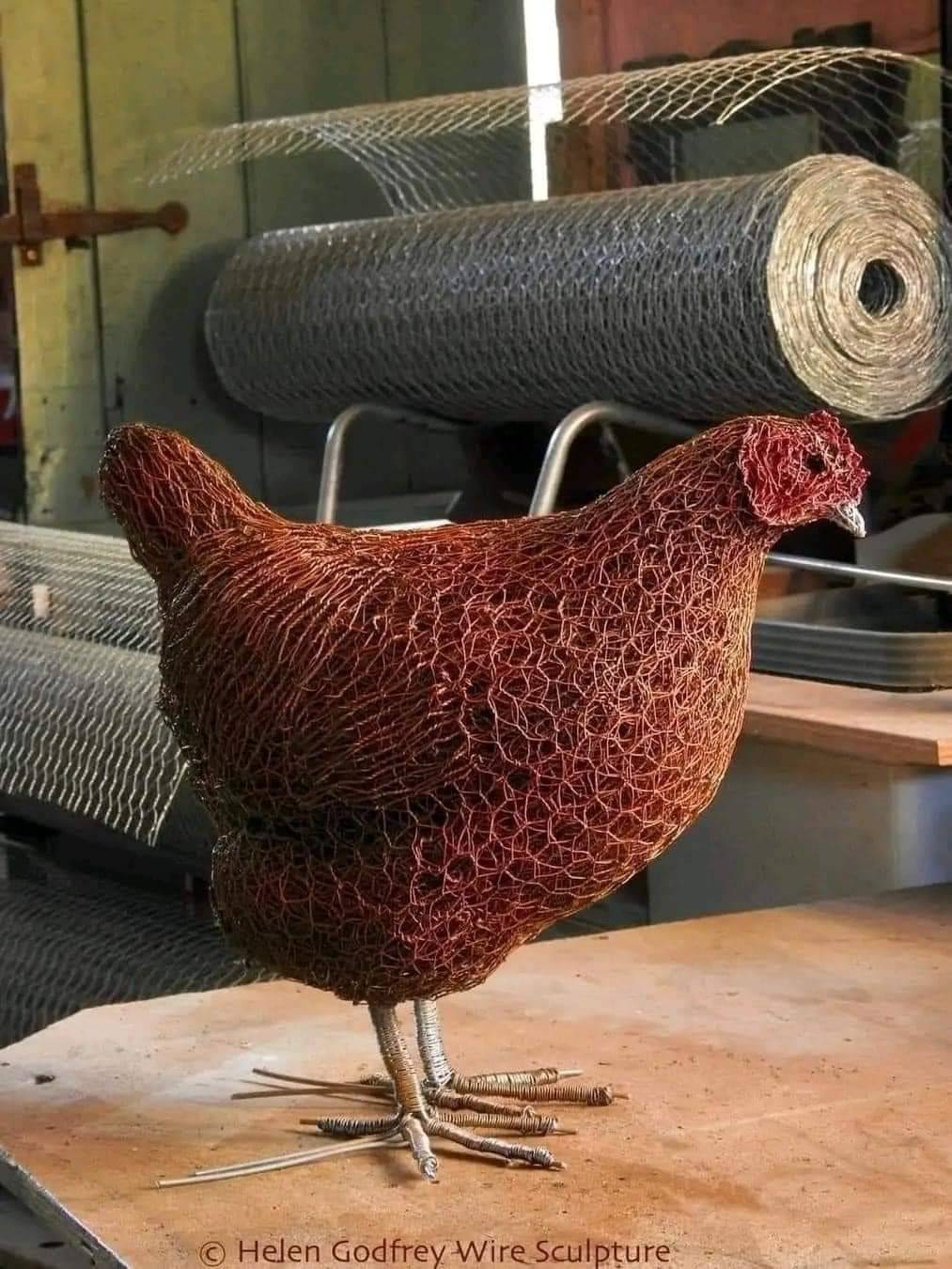
Beautiful red hen made out of chicken wire by Helen Godfrey Wire Sculpture i have seen this shared around chicken pages on facebook.
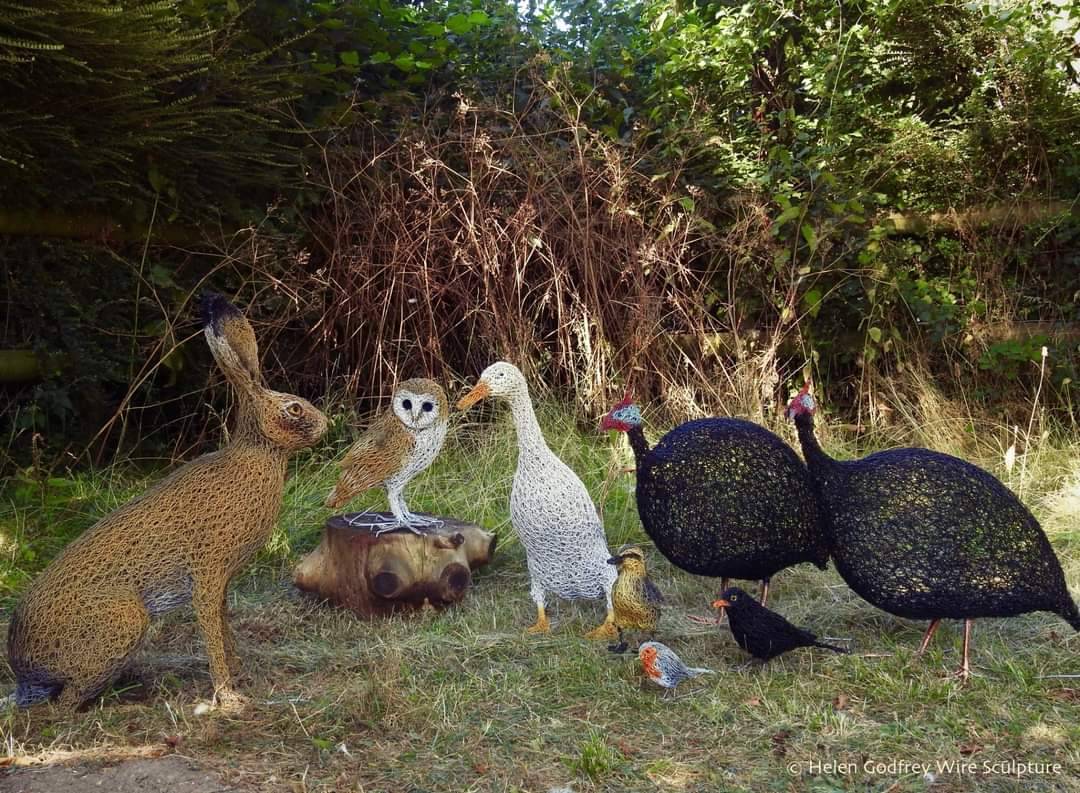
I really liked this hen so i went to the artists page and I am floored at the skill and beauty of these sculptures. Anyone who has built anything with the help of chicken wire knows that it is not an easy material to work with but this artist is able to make very realistic organic shapes with it. I love the softness, i love the wire people and how the wild birds use them as perches.
Mother duck with duckling
Runner beans, they are so funny and whimsical
Sculptures about to go to their new home, the hare and owl are amazing and the guineas look just like the real thing lol
A beautiful barn owl
A cute little wren
The wire women. I love how soft their curves are
Im so thankful that i got to see this artists work its so sweet.
Here is her store page but i dont think she has any new sculptures up yet.
I’m loving this new trend of people going to zoos and participating in animal enrichment. We use to observe large exotic animals for our entertainment, but the fact is that we are now trying to make ourselves equally as entertaining for them. It’s interactive, completely parpicipatory and I would argue that eventually someone’s gonna come up with something new enough that it expland ethologists understanding about how some animals think, problem solve, communicate and feel and I think its fantastic.
Human: play?
Aquatic creature from an entirely different branch of the animal tree: play!
Tags:
#adorable #dolphins #this post was queued because my to-reblog list is too long and I didn’t want to dump it on you all at once
PEOPLE WITH NORMAL SEXUAL INTERESTS: Surrounded by an endless sea of hyperstimulus pornography human brains aren’t equipped to handle, doomed to become porn addicts, unable to sustain arousal in the presence of other human beings
PEOPLE WITH INCREDIBLY NICHE FETISHES: Encounter porn they like roughly as often as a child growing up in the 80s might stumble upon an adult’s Playboy stash, maintain normal brain chemistry, belong to welcoming communities where they can find partners with shared interests
Tags:
#the author of ”Give These People a Break” came out with a second bonus chapter and‚ not unrelatedly‚ I am thinking about this post again #I always did pity the people (presumably out there) who are actually into the kind of women they use in sex-sells commercials #must be awful to have everybody and their brother trying to hijack your salience mechanisms #but it’s more than just a matter of salience‚ isn’t it? #until recently† I had never read porn that was actually well-suited to my tastes #(and not for lack of trying) #(everything was cousin conditions and approximations and picking my way carefully through minefields of squick) #but now I have #don’t get me wrong‚ I’m genuinely very glad to have that experience #I absolutely endorse that #I would all three of want/like/approve having *some* more works like it #…but I think I begin to see how it could pose a problem‚ if there were *thousands* #overall I do still believe I will probably do okay in #the rapidly approaching future where you can get competently written incredibly niche porn made to order out of a vending machine #(I’ve handled access to superstimuli decently well in the past) #(not perfectly‚ but like‚ a solid B+) #but in August I was casually confident that of *course* it would be okay‚ and that’s not the case anymore #[†I originally wrote here ”when I first read OP”‚ but then I actually dug up the post I was thinking of and I saw it eleven days *later* #(maybe etirabys’s reblog wasn’t the first one I saw: OP *is* actually years old (2019-12-16) and it *feels* like it’s been around for years #but etirabys’s was the one that came to mind)] ↩ #tag rambles #that one post with the thing #sexuality and lack thereof #is the blue I see the same as the blue you see #disappointed permanent resident of The Future #this probably deserves some warning tag but I am not sure what #apocalypse cw? #drugs cw?
Silly Putty implies the existence of serious putty.
I believe that is called C4
Tags:
#I didn’t actually laugh aloud but it still amused me enough to reblog #this post was queued because my to-reblog list is too long and I didn’t want to dump it on you all at once
You suddenly switch bodies with your icon. On a scale of 1 to 10, (10 being the highest value) how well are you coping with that change?
suddenly realizing how abnormal it is to have your actual face as your icon on here
Tags:
#really depends on what timeframe we’re talking about here #being a plant would be soothing and all but I wouldn’t want to be stuck like that indefinitely #(and as for the other direction‚ what happens to *my* body) #(is it just comatose?) #this post was queued because my to-reblog list is too long and I didn’t want to dump it on you all at once #icons #surveys