Concept: YA fantasy/sci-fi setting with the obligatory child-sorting algorithm where one of the categories is clearly just House Awesome, except the big book three twist is that the people in charge are aware the setting runs on story logic, and the true purpose of House Awesome is to serve as a narrative quarantine for kids who’ve been identified as potential protagonists.
(At first you think it’s going to follow the standard trajectory where a single rugged individualist rises above the rest and Smashes The System, but in reality that’s precisely the problem: the system works because the various heroic destinies in play end up burning up all their energy trying to assert narrative dominance, leaving the outside world mostly unaffected. The actual moral message is some heavy-handed Aesop about the perils of unchecked individualism.)
I like the idea of putting all the potential protagonists together and watching them spend all their time trying to one-up each other to become the “ONE, TRUE PROTAGONIST!” Killing them off is just asking for someone to get away and over through you, keeping them at war among themselves may cost more but is better in the long term, just make sure to stop co-operation through unfair advantages.
Precisely. If the baddies tried to murder all the potential protagonists, they’d be providing them with a Common Enemy For Former Rivals To Set Aside Their Differences And Unite Against – they’re genre-savvy enough to know how that ends. Better to indulge them and channel their heroics into harmless one-upmanship until their endlessly serialised adventures wander off into narrative irrelevance.
Ironically, the only way to overcome the baddies’ evil scheme is to stop acting like you’re the hero of the story!
(Would it be too on-the-nose for the fellow-student-antagonist the genre requires to be a thinly disguised Harry Potter expy that takes a good, hard look at exactly what sort of person would become a magic cop straight out of high school? Yes, very likely it would. We’re gonna do it anyway.)
So do we have a viewpoint character in this theoretical story?
Given the premise, I think the most appropriate framing would be to present it as an anthology-style short story collection, with each story focusing on a different potential protagonist. Imagine if Wayside School was somehow even more meta than it already is and you’ll have roughly the right idea.
(Heck, maybe even get multiple authors in on it to really drive the point home. It’s almost a shame it’s too late to make a NaNoWriMo prompt out of it. Oh, well – there’s always next year!)
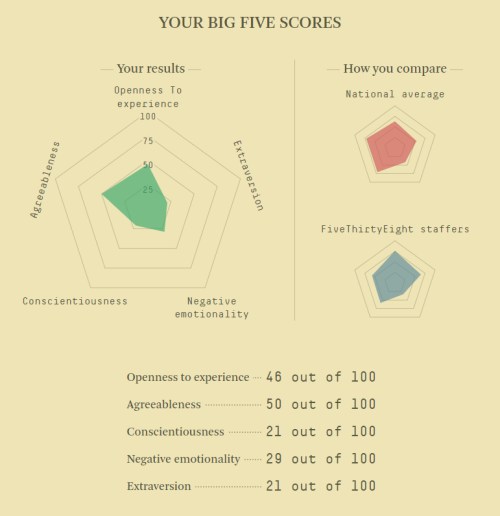
Follow the link above to be in the “group” I made so that you can compare your score against the average. (Hopefully. It seems not to want to load the results when I refresh the page…)
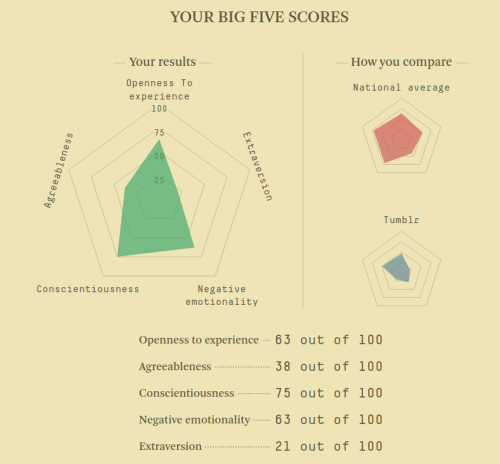
we’re doin big 5 I guess:
My first thought was that it was attempting to tell me what I want to hear: most of these are rather “better” figures than I was getting on Open Psychometrics a couple years back.
Then I looked at the more detailed breakdown, and a lot of my supposed middle-of-the-road-ness is from having very high scores in some subcategories and very low scores in others, which “averages out” when seen at lower resolutions. Are you very anxious but not depressed? Congratulations, your negative emotionality is “moderate”.
(Except conscientiousness, which is a nice symmetric equilateral triangle with every vertex at ~75.)
((…wait, how does the *average* American have *75th* percentile conscientiousness))
This version seems to place somewhat more emphasis on *treating* people well when it comes to agreeableness, as opposed to Open Psychometrics’ questions which were pretty much purely about how you felt about them on the inside, and that difference is most of what dragged me from 12 up to 38. I am a proverbial kitten who thinks of nothing but murder.
—
“You might also have a low opinion of your own looks.” I look plain in a vaguely pleasant manner, which is *exactly how I like it*, thank you very much
“A lot of the outcomes that correlate with low agreeableness, like being chronically bullied (or bullying) or having a criminal record, don’t kick in until someone’s score is down in the 10th percentile.”
I guess that makes the two sets of numbers not directly comparable, then.
—
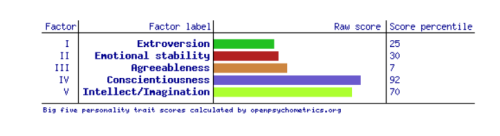
I just went and took the Open Psychometrics one again to see how they portray their results, and it looks like this:
And yeah, you can really see the difference grading on a curve makes, huh. Like, if you hear “your score is 7 out of 100″ you would not intuitively expect so much of the agreeableness bar to be filled, but I guess their other test-takers are so agreeable that moderately low agreeableness is enough to make you way below average.
Tags:
#is the blue I see the same as the blue you see #memes #surveys #anger management #replies
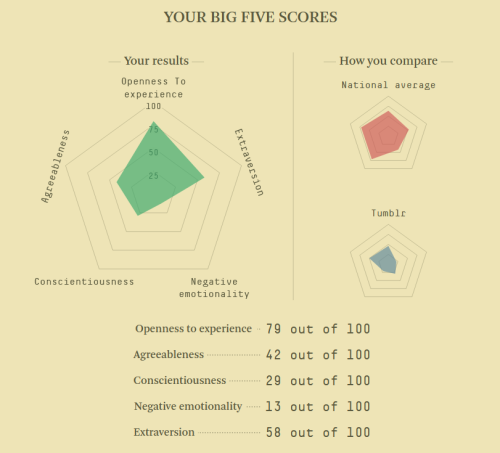
Follow the link above to be in the “group” I made so that you can compare your score against the average. (Hopefully. It seems not to want to load the results when I refresh the page…)
we’re doin big 5 I guess:
My first thought was that it was attempting to tell me what I want to hear: most of these are rather “better” figures than I was getting on Open Psychometrics a couple years back.
Then I looked at the more detailed breakdown, and a lot of my supposed middle-of-the-road-ness is from having very high scores in some subcategories and very low scores in others, which “averages out” when seen at lower resolutions. Are you very anxious but not depressed? Congratulations, your negative emotionality is “moderate”.
(Except conscientiousness, which is a nice symmetric equilateral triangle with every vertex at ~75.)
((…wait, how does the *average* American have *75th* percentile conscientiousness))
This version seems to place somewhat more emphasis on *treating* people well when it comes to agreeableness, as opposed to Open Psychometrics’ questions which were pretty much purely about how you felt about them on the inside, and that difference is most of what dragged me from 12 up to 38. I am a proverbial kitten who thinks of nothing but murder.
—
“You might also have a low opinion of your own looks.” I look plain in a vaguely pleasant manner, which is *exactly how I like it*, thank you very much
is there like. Theory. about the definition of the self through the objects we surround ourselves with? i feel so much more like Myself ever since i got my shirt again and i am curious what the philosophy side of tumblr has to say about it
While I do get the part-of-me feeling most strongly with computers, I occasionally get it with other stuff too. I’m not sure how much of it is just an autism not-liking-change thing, but there definitely does seem to also be an aspect of “affirming my identity as the sort of person who would have X”.
(I’m sure that’s the holy grail of marketing, but I think it very much *can* be both natural and healthy. I absolutely endorse my desire to be the sort of person who would have a utility belt.)
Clothing can have additional aspects: I think the feeling I get from wearing my Girl Guide jacket primarily operates through some of the same mechanisms as weighted blankets, feeling more comfortable and confident when well-covered.
Tags:
#philosophy #reply via reblog #is the blue I see the same as the blue you see #clothing #transhumanism #autism