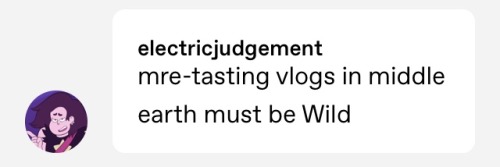
[wakes up in a cold sweat] but what were the rations like during the Wars of the Jewels
“Hello friends, it’s Braddoc Meryhill back again with something TRULY INCREDIBLE that my wife’s second-cousin’s neighbor (the one with the gorgeous tomatoes) brought back from the post-house in Bree. I’ve been writing letters and digging through mathom-houses and making the acquaintances of many strange folk for many years, hoping to find someone who could get one of these for me, and I’d begun to lose hope that any still existed! But look! All my work has finally been rewarded!
What I have here is a genuine elvish ration from the First Age, still in its original wrapping and therefore still (theoretically) fit to eat. Now, they say that elves have a way of wrapping food in leaves that makes the contents last indefinitely, but six thousand years is a long time even for them! This might be the closest we’ll ever get to testing that theory, since “forever” isn’t quite measurable, but six thousand years… whoo boy! I still can’t quite believe I’m about to open, and then hopefully taste, a piece of ancient history! My hands are shaking.
I’ll guess that this was probably a Sindarin ration, since it’s wrapped in leaves and the Noldor usually used woven cloth for theirs, but later in that Age the Noldor picked up the leaf technique, so we won’t know for sure until we see what’s inside. I’ll just carefully tug at the little tab in this corner, and… oh! It just unfolds! How clever! To think that I’m the first person to do that since it was first packed! Incredible!
All right, let’s see what we have here:
There are two wafers of a sort of waybread, about eight inches square, and the leaves are wrapped around them so that the bread forms a sort of frame on either side for the other items. A ration sandwich, if you will. I imagine this was to make them easier to stack. It’s been knocked around a bit, so all the corners are crumbling off, but it smells all right to me.
Inside the bread we have four more little square leaf-packets. This first one has… oh, it opens into a little cup-shape, that’s delightful. Why, these look like… they’re grubs! Roasted and salted grubs, I think. Heavens, elves will eat just about anything! I happen to know, through my uncle’s neighbor whose grandmother once met some wood-elves, that little creepy-crawlers like this are still considered a very attractive and nutritious snack. The things I do for history’s sake, my friends.
In the second packet, we have what appears to be… raisins? I can’t tell, but if they are raisins, that would probably make this a Noldorin ration, since at this time the Sindar usually made wine out of honey and forest fruit instead of grapes. They’re still plump, and they smell just fine. The whole thing is just in beautiful condition.
This next packet just has a little powder in it? Let me smell. Oof, that’s strong. It smells very herbal, almost spicy. This must be a refreshing beverage, perhaps some sort of tea. You’ll remember when I opened that ration from the Last Alliance and found a small vial of miruvor? I wonder if the elves of the First Age had such rations as well. This particular ration does not. A pity, but I’m curious about this anyway. I’ll add a little water to it now.
Our last packet is—oh, it unfolds into a little bowl! I’ll never get bored of this ingenuity. There’s a little dried cake inside, and it crumbles between my fingers when I pinch it. It has a savory smell. I remember reading that the elves would carry soups and porridges in this form, so I’ll add a little water to it and see what happens.
That might take a minute to reconstitute, so in the meantime, a little context for those of you unfamiliar with elvish rations. This doesn’t look like much food—hardly even a quick second breakfast—but elves need very little compared to either hobbits or big folk. This ration could have lasted several days in lean times, but ideally an elf-warrior would consume a full ration every day they were on the march. In camp, they would communally prepare and eat fresh meals. Each warrior had a personal meal-kit with a little plate and utensils that folded up like a compact mirror—you can see mine in the case behind me. It’s very precious, so I don’t use it.
Oh, I just noticed that there’s steam coming from the beverage and the soup! That’s remarkable! They’ve formulated it so that it heats up when you add water to it! Wow! I’ve never seen anything like that before. I imagine it would be a great morale-booster in the field. Well, that must mean it’s ready, so let’s dig in. I’ll start with the drink.
Hmm. It is very strong indeed. I’m getting a hint of exotic spices and an earthy, roasty flavor… it must be coffee! It was said to be extremely beloved by the Noldor, and they traded for it through their ill-fated alliance with the Easterlings—incredible, just incredible, I’m holding not only a cup of history, but a cup of inter-kindred politics as well! That also gives us a better hint as to when this ration was made. It was likely made in preparation for what became known as the Nirnaeth Arnoediad, the “Battle of Unnumbered Tears” in our tongue, to be carried by a member of the Union of Maedhros. If that is the case, it’s even more amazing that this ration survived at all. I could study nothing but its history for the rest of my life and still not know how it came out of Beleriand and into my hands.
This waybread seems like it would go well with the coffee. Ah, it does seem to be a little stale, but no worse than a loaf of ordinary bread exposed to the air for a day or so. Hmm. Very crunchy. Almost biscuit-like. Not much flavor, but it is packed with nuts and seeds. Definitely nutritious, if not very exciting. Ooh. It is much better when dipped in the coffee.
Moving along to the soup, since it seems to be fully moistened. And piping hot, I’ll never be over that. It doesn’t smell rancid, thankfully. Just like a thick, chickeny, vegetable-y stock, with some bits floating in it. It seems they threw a bit of everything into a pot, cooked the devil out of it, spread it out to dry, and then pressed it into cakes. It’s quite salty, but inoffensive. It doesn’t seem like much, but again, I’d imagine that a warrior on a winter campaign would welcome anything hot.
The raisins are definitely raisins, I’m sure. Wouldn’t be out of place in a scone at my tea table. Not much else to say about them, except that I’m astonished that they’re so fresh, just like the rest.
Well, my friends, I’ll admit that I’ve been dreading the grubs, but I won’t put it off any longer. It isn’t the way we do things, but surely the elves know what they’re about!
Oh dear. I can see their little legs. The things I do, friends. The things I do.
Euuurgh. It’s crunchy. I am picturing nothing but feelers and eyeballs.
Hm. Swallowing it took an extra try, but the whole experience was not as bad as I was anticipating. A bit like a salted pumpkin seed, with a little bit of a… hm… a buggy flavor is the only word for it. I’d better try another one to see if I can get a better perspective on it.
Hmm. They’re rather addictive. I’m still a bit repulsed, but I can’t stop eating them. I’d love to chat with an elf about this—for instance, I’d love to know how they got the idea in the first place. I know I wouldn’t just pick a bug off the ground and decide to eat it, but perhaps that’s just my hobbitish sensibilities speaking.
Well, we’ve come to the end of this ration, and I feel that I’ve closed a chapter of my own life. This is perhaps the oldest thing ever eaten by a mortal, and perhaps even by anyone! I can now say that I’ve put the claim of imperishable elvish food-storage techniques to the test, and I’d have to say that the rumors and tales are, if not proven, at least plausible. Yes! The elves really do wrap their rations in such a way that they keep fresh “forever”! That is unless I’ve been sold a counterfeit, in which case I shall take my golf-club and find the person responsible.
Thank you for all your kind and curious responses up to now! I’m not sure I’ll be able to surpass this First Age, Noldorin, Union of Maedhros army ration in the future, but I hope you will stick around to find out! As always, I remain your intrepid friend Braddoc Meryhill, unless this ration turns on me sometime in the night!”
Tags:
#Lord of the Rings #fanfic #food #and mostly as a warning tag: #in which Brin has a food poisoning phobia
“It was acceptable. I understand he was irritated by my precise recitation of the length of time since we had seen each other, during the small talk phase.”
“Hmm. You might try being less precise? Or suggest some uncertainty in your estimation? Like, ‘Five years, more or less,’ that sort of thing?”
“I have attempted such artifice in the past, yes, with Captain Jackson of the USS Ranger.”
“Was that any good?”
“It took me three days to convince them that I was not an impostor and that I should be released from the brig.”
Tags:
#Star Trek #DS9 #fanfic #anything that makes me laugh this much deserves a reblog
My entry for the RtB tabletop game jam is done! This is a game that exists for those of us who aren’t getting enough heinous villainy in their day-to-day, and need an opportunity to set pretend fires, commit pretend murders, and kidnap pretend orphans. Isn’t that what everyone really wants to do, deep down? Hunt down some orphans, murder the people protecting them, and abduct them in order to steal their exorbitant inheritance? Yes, is what I’ve decided the answer to that question is.
Tags:
#A Series of Unfortunate Events #games #interesting
Light and dark have different meanings to honeybees.
Light means being outside, means doing work, and means being in danger.
Darkness means home (although not necessarily your home), means a promise of being with your friends and siblings (if it’s your home), means being safe (if you get in).
See, honeybees have this neat behavior where their guard bees will let bees from other hives into their own hive… but only if they bribe the guards with a bit of nectar! (this is the only part of this post that you’ll find in actual books about bees)
As far as I can tell, this is basically evolution sort of independently coming up with the concept of hospitality? Like, if everyone lets random well-behaved bees rest in their hives for a bit, then bees that get lost don’t necessarily have to die. At the same time, requiring tokens like that makes it harder to just be straightforwardly exploited. This all ends up making the species as a whole just that much more robust.
All of which helps to explain where the traditional honeybee beliefs about what night is comes from.
Night is the home of the night-bees, they say, and you have to get home before it enters the land, or they’ll get to you.
There’s even a series of myths about a legendary bee called Third Scout of the Southwestern-Lilacsmell who collects the nectar of a legendary flower that’s hard to describe without the particular technical terms bees use to describe flowers but is said to grant eternal youth, and then gets blown away by a particularly strong gust and doesn’t manage to get back home before dark, but! manages to parlay her way into the hive of the night-bees in exchange for her ambrosia.
The stories then go on to describe her adventures in the hive of the night-bees, as she encounters them and their strange customs and pets and tastes of their strange honey and bread (as is required of bee-hospitality), until she manages to make it back home to finally deliver what she has left of the immortality-nectar to her queen…
Hello friends!!! On this April 1st I- with neither guile nor ill-intent- invite you all to listen to Rick Astley’s Never Gonna Give You Up with me, because it’s a fun song that I enjoy. You’re a free agent in this decision entirely. Happy April Fools Day
Tags:
#April Fools #music #legitimate Rick Astley #Tumblr traditions
if u make clark kent say soda you are grossly mischaracterizing him and i wont stand for it
the real reason no one thinks clark is superman is bc they’re all east coasters who constantly mock clark’s usage of “pop” so they never connect mr. “soda” superman to mr. clark “pop” kent
Tags:
#anything that makes me laugh this much deserves a reblog #(I moved from the East Coast to the Great Lakes) #(and often I will say pop just to keep people from giving me That Look) #(you can’t just say ”soda” without it being a Statement) #(and I’m not here to make Statements I’m just trying to ring up your food) #our home and cherished land #food #in which Brin has a job #Superman
The main reason I ever wanted to write a Hungarian mythology-based urban fantasy is that I needed to see someone do Bread Magic in a mundane modern setting.
Bread Magic shows up in a variety in Hungarian fairytales. It works like this: when someone evil, usually the devil, sometimes a dragon, wants to come into your house and hurt you, usually by taking your children, what you do is put a loaf of bread on the windowsill. It will speak for you.
When evil demands admission, the bread will say: First, they buried me under the ground, and I survived. When I sprouted, they cruelly cut me down with sickles, and I survived. They threshed me with their flails and I survived. They ground me to flour with their millstones and I survived. They put me in a bowl and kneaded me, then they put me in a hot oven to bake me, and I survived. Have you done all these things? Until you do all these things and survive, you have no power here.
This is pretty powerful magic I think, and it makes sense in a country where wheat is the staple crop and bread is the staple food. If you have bread, you are alive, if you have no bread, you are dead, therefore bread is life. It was customary to refer to wheat as “life” well into the twentieth century, and not in high literary circles either: rural seasonal workers negotiated their wages in so and so many sacks of life.
And I totally want someone to do bread magic with a shitty store-bought muffin.
There was a similar Greek fairy tale where narrating the torments of the flax was used as a delay tactic. Like, the parents would be out working in the field and the ogre would come to take the child away, and the clever grandma would say “sure, BUT FIRST, you must let me tell you the passions of the flax”. (As in “the passions of Christ”, meaning the sufferings.) Making cloth out of flax is a hell of a job with many many stages, you dunk it in water for days, you dry it, you shred it, all sorts of things (I don’t actually know what things, I’m a city kid…), so grandma would start droning very slowly and very sadly “they taaaaaaaaake the flaaaaaaaaax, they drowwwwwwn it in waaaaaaaater” and the imagery was out of a medieval torture manual and it sounded like a funeral dirge and it went on for ages, until the ogre couldn’t stand it any more and went “fuck this, I’m out, keep your damn child”.
Folk tales have some Good Takes, such as “brains over brawn” (that’s why they’re so fundamentally roguish – once in a while you’ll get a mighty warrior bashing things, but mostly it’s common peasants tricking the powerful with nothing but wits and sheer nerve), “storytelling will get you a long way”, and “grandmas are awesome”. Which may be a little self-serving (I mean, grandmas tell the tales…), but still: they earned it.
For the torments of anthropomorphised plants see also: John Barleycorn.
There were three men came out of the west, their fortunes for to try And these three men made a solemn vow John Barleycorn must die
They’ve ploughed, they’ve sown, they’ve harrowed him in Threw clods upon his head And these three men made a solemn vow John Barleycorn was dead
They’ve let him lie for a very long time, ‘til the rains from heaven did fall And little Sir John sprung up his head and so amazed them all
They’ve let him stand ‘til Midsummer’s Day ‘til he looked both pale and wan And little Sir John’s grown a long long beard and so become a man
They’ve hired men with their scythes so sharp to cut him off at the knee They’ve rolled him and tied him by the waist serving him most barbarously
They’ve hired men with their sharp pitchforks who’ve pricked him to the heart And the loader he has served him worse than that For he’s bound him to the cart
They’ve wheeled him around and around a field ‘til they came unto a barn And there they made a solemn oath on poor John Barleycorn
They’ve hired men with their crabtree sticks to cut him skin from bone And the miller he has served him worse than that For he’s ground him between two stones
And little Sir John and the nut brown bowl and his brandy in the glass And little Sir John and the nut brown bowl proved the strongest man at last
The huntsman he can’t hunt the fox nor so loudly to blow his horn And the tinker he can’t mend kettle or pots without a little barleycorn
I HAVE NO IDEA, I remember vaguely the story from when I was a kid, but I can’t remember where I read it (or heard it?), and I didn’t find it online. ‘Cause I searched.
It’s also an expression in greek, though it’s a bit outdated, you can say “that poor man has gone through the passions of the flax”, meaning he’s had a very hard life. Or, if you’re a drama queen, you can say something like “fucking bureaucracy! I went through the torments of the flax to get that bloody permit!”. This makes searching for the fairy tale all the more difficult. I’m sorry. :(
In Swedish, two of the steps in working with flax are called “arguing with the flax” (bråka lin) and “heckling the flax” (häckla lin). That says something about how the fiber is treated…