pileofknives:

60e9b70ad31cf6fcdfbc096968b31a07c3e80e26

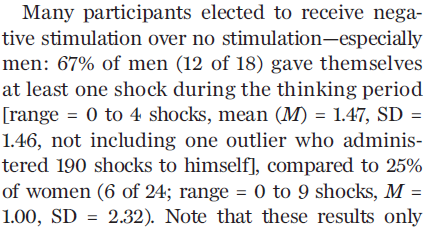
“I bet it doesn’t hurt that bad, I don’t have time for this shit.”


whatifweanarchist:

“at least one”


sexhaver:

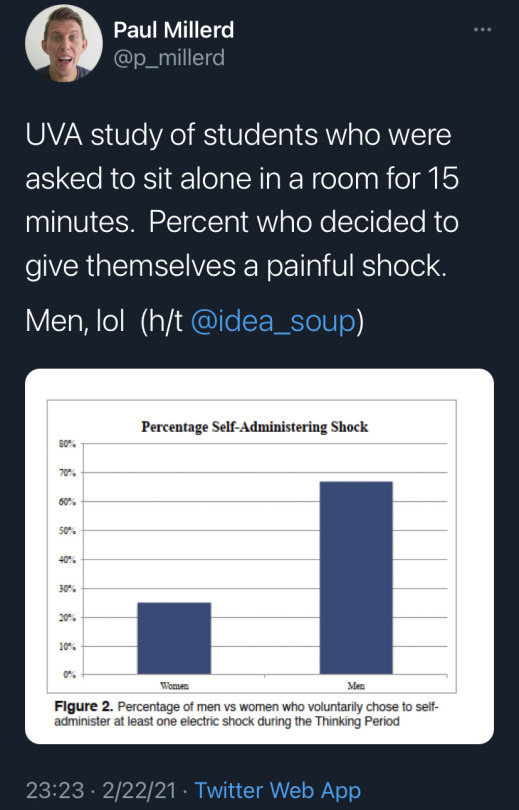
now this is a gender binary i can get behind


carnival-phantasm:

Very generous of them to describe it as the “Thinking Period”


retiredmahoushoujo:

ad067ad5ab66686b5e20ed26c13546a34d9bb97e

They correctly excluded the outlier Electroshocks Georg


shacklesburst:

everything about this is extremely underpowered, except for electroshocks georg, who, by now, must be extremely overpowered


rustingbridges:

you’d think they would have been able to get more than 50 undergraduates to do. it doesn’t take a long time and requires answering no surveys

Also, psych researchers have a reputation for lying their asses off to the subjects regarding [what a study is actually about] until after it’s over. I would seriously consider pressing the button once or twice just to see if they were telling the truth about it being a shock button.

(Not sure if I’d *do* it, but I’d seriously consider it, and I would definitely wonder if it was some sort of covert test that I was failing by not pressing it.)


Tags:

#the first draft of this post only had commentary in the form of the tags #”basically what shacklesburst said” #”I’m not comfortable with the gender-focused framing here but I’m reblogging for Electroshocks Georg” #but–while I’m still primarily reblogging for Electroshocks Georg–I realised I did in fact have something to say #reply via reblog #the power of science #sexism cw #this probably deserves some other warning tag but I am not sure what #anything that makes me laugh this much deserves a reblog #Spiders Georg

animatedamerican:

dialmformara:

agitatedtortoise:

animatedamerican:

so tonight I’m at synagogue, listening to the Purim Night reading of the Book of Esther, like you do

and near the end of this chapter my brain presents me with the following:

nooooo ooooone plots like Haman
calls the shots like Haman
plans a genocide by casting lots like Haman

(It only works with the Hebrew pronunciation of Haman, which, like Gaston, is accented on the second syllable.)

By the time we get home my brain has added:

for there’s none so well-favored and kingly
yes, we all can be certain of that
he’s so rich that his pockets are jingly
and he looks really sharp in a three-cornered hat

*face in hands*

Petition to sing this every year at Purim.

I shared this with my dad, and he added:

No one’s spruce as Haman,
Nor abstruse as Haman;
No one’s half as good tying a noose as Haman!
He’ll use gallows in all of his decorating!
No one else hangs as well as Haman!

niiiiice

@maryellencarter, here it is, and thanks for the reminder to reblog it this year.


Tags:

#Tumblr traditions #Purim #Judaism #death tw? #I still have never actually listened to the song this is parodying

seat-safety-switch:

Winter is always this horrific balance. On one hand, it’s too cold to wash a car. You’d have to be stupid to be out there in -20°C, running out of your house with a bucket of boiling water, trying to get to your panels before it instantly freezes solid just from touching the outside air. On the other hand, the city keeps putting road salt down like they own a dividend stake in the abstract concept of salt. You need to wash, and yet you can’t.

Now, I also know what you amateur scientists are going to say. “It can’t rust, it’s too cold for the endothermic reaction of iron oxidation to occur, you’re fine to wait to wash the car when it warms up.” Then it’ll be rusting! Do you also wait for your enemies to wake up before you stab them to death? Don’t answer that. Also, I’m pretty sure I read somewhere that Mars is red because it’s made of rust, and it’s hard to get a lot colder than there, too.

Most “car people” just shrug their shoulders at this problem and buy a cheap winter beater. This vehicle is sacrificial, they say. It does not bother me that it is corroding away before my very eyes, because doing so prevents my nice Lexus from developing spots of rust as well. These people also must have a “parts kid,” just in case something happens to their firstborn, because every car is special and unique and deserves to be preserved. Plus, if they keep buying up and destroying all the $1000 rust buckets, then what am I going to drive?

Last week, I awoke one morning from uneasy dreams to find myself in possession of the answer. I would simply add a sacrificial coating to my vehicle, encasing it in an inch of bulletproof and saltproof epoxy. So far, this method has worked really well. The salt just slides right off it, and onto the car behind me. There’s just one downside: since the doors no longer open, I have to keep the window rolled down all the time so I can get in and out. You might think this is “cool,” like the Dukes of Hazzard, but Bo and Luke never had to deal with trying to get a pregnant raccoon out from the back seat of their Volare.


Tags:

#anything that makes me laugh this much deserves a reblog #unreality cw #this probably deserves some other warning tag but I am not sure what

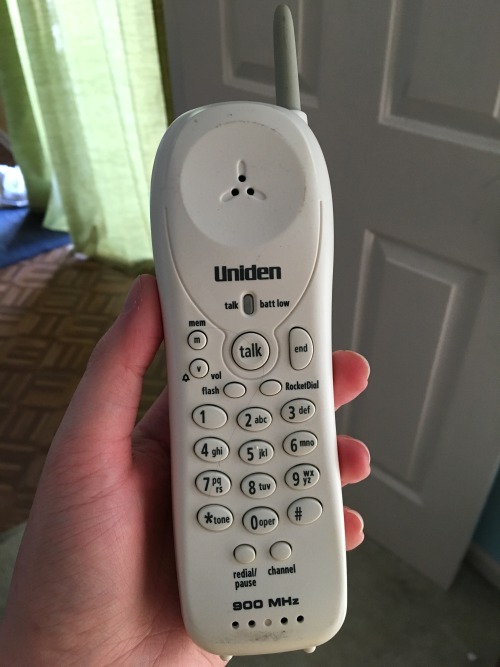
oh my god i’m cleaning out my desk and i found my first phone

{{previous post in sequence}}


scotchtapeofficial:

tumblr_inline_oqoru7etay1rpryux_500

it was a fucking house phone that i was so stoked to have because it was mine that i kept in my own room and i cannot believe technology has progressed at the speed of FUCKING light to the point where this is a hilarious artifact to have had in like 6th grade and now theres kindergarteners with iphones


princess-peridot:

How did you know if you dialed the right number


scotchtapeofficial:

each button made a different tone so the numbers you dialed a lot became a subconscious melody in your head and if you hit the wrong button by accident it would sound like a wrong note in a song you know by heart


teaboot:

i can’t beleive that is a legitimate question in my lifetime


poipoipoi-2016:

It’s a legitimate question *now*.  

Because people don’t do this and this is terrible UX. 


brin-bellway:

Do you notice how the question says “how did you know if you dialed the right number” *full stop*, but the *answer* is specific to “numbers you dialed a lot”?

Yeah, dialing numbers you *didn’t* dial a lot–which was just about all of them if you were a kid! it’s not like kids have much reason to talk on house phones, not being in charge of coordinating any appointments and not having had much time to accumulate friends-no-longer-in-physical-proximity!–was *exactly* as anxiety-ridden as it sounds. It’s such a relief to have screens to double-check with. Even *dumbphones* like the phone at work have screens now.

(Plus phones with screens *also* make the button tones, as a second layer of defence. Do y’all not have the button tones on your smartphones? Did you turn them off?)


maryellencarter:

I’m not sure if the button sounds on my phone defaulted to off or if I turned them off by choice, but I have never felt any need to turn them on. This probably relates to the fact that I can’t remember a melody without words and that phone numbers do not adhere to the melodic principles of Boethius anyway (okay, I never actually made any sense of Boethius, but he was the “Great Book” cited on Why Music We Don’t Like Is Objectively Bad and as a side note Stop Liking Pentatonic As A Scale It’s Unchristian) uhhh where was I. Right. I can’t remember numbers anyway, I can’t remember the little tune associated with the numbers, so they just all sound wrong. It occurs to me though, and the deficiencies of my auditory memory may be assessed by the fact that I’m not actually sure, but in the part of my day job that involves helping set up brand new phones and then telling the person “now please dial our test call number which is such and such”, I don’t think I usually hear dialing beeps before the announcement. Maybe new smartphones come with the dialpad beeps off by default.

There is a distinct possibility that smartphone button tones are opt-in, and my family is just in the habit of switching them on. As it happens, my first-ever SIM card† is currently in the mail, so I guess it will soon be time for me to investigate a phone app’s settings myself.

@sigmaleph​ [link], there’s still the part where you’re waiting for them to pick up! And it’s been my experience that often *somebody else* will pick up the phone, and then you have to sort out whether this person is sharing a phone line with the intended person or whether they’re completely unrelated.

†not counting the PC Mobile one that came with my first phone, which I never activated


Tags:

#reply via reblog #Brin owns *two* 2010’s computers now #proud citizen of The Future #amnesia cw #is the blue I see the same as the blue you see

Anonymous asked: Are quatenary ammonium compounds proven to destroy SARS-COV-2? I remember recommendations to use alcohol-based handwash in preference to BAC but that was back in the spring so maybe they’d just not got around to testing BAC.

{{previous post in sequence}}


So, a couple things there.

1. Since coronaviruses, being dependent on an envelope, are generally one of the easier viruses to destroy, my baseline initial assumption was that standard disinfectants work. I know there *are* some bottles of ammonium-chloride-based disinfectant sprays at the grocery store now advertising themselves as “approved for use against COVID-19”, though I haven’t looked into the details of such approvals myself.

(Also, if you replace store-bought quat wipes with homemade quat wipes, any change in effectiveness will not be because of problems common to all quat-based cleaners.)

2. I gather that SARS-CoV-2 fomites aren’t a big deal, except maybe under extreme circumstances like caring for COVID patients: it’s the airborne stuff you gotta worry about.

This is mostly a general zeitgeist thing and I don’t have many links on hand, but off the top of my head there’s the argument-from-salad-bars [link].

The main reason to disinfect stuff is to prevent COVID *scares*. All else equal, catching a cold during a pandemic is worse than catching a cold under normal circumstances, because now you have to worry about whether it’s actually the plague. Plus if you catch a *really* bad flu and end up hospitalised, that’s one step closer to overwhelming the hospital (and god help you if they’re *already* overwhelmed).

I personally haven’t been disinfecting my respirator (I wash my hands after touching it if it’s been out in the last 3 – 4 days; if possible, I also wash *before* touching it), but OTOH I have 15+ years’ experience with tracking potential-fomite statuses in my head and exercising caution in what I touch accordingly. For people who haven’t trained on that until it becomes second nature (perhaps because they didn’t have the threat of horrific colds to motivate them [link]), disinfection often makes sense.

(Plus ULine was out of stock when I bought my filters, so I have the pink-circle ones. There’s only so much disinfection I’d be able to do.)

I *do* disinfect my smartphone after every outing, but I was already in the habit of doing that before COVID-19. (Note that I have a screen protector and a case, though you *might* still be able to get away with it without those.)

P.S. Since apparently we’re talking about quaternary ammonium in more than just an aside now, while we’re at it: *don’t* use ordinary cotton for your homemade disinfectant wipes! [a source]

P.P.S. Oh, also, I just noticed the term “handwash” in your ask. That might have something to do with it, since you’re not supposed to use quaternary ammonium as hand sanitiser: it’s a mild skin irritant. (To be completely honest I occasionally end up doing it anyway at work, but that is part of why I use shitloads of moisturiser.)


Tags:

#covid19 #tales from the askbox #illness tw #the more you know

Let’s talk respirators!

{{previous post in sequence}}


nuclearspaceheater:

brin-bellway:

What’s a respirator?

Short version: it’s like a mask, but better. *Much* better.

Let’s put the headline news up front: if you maintain an airtight seal at all times, a P100 respirator blocks 99.97% of incoming viral particles. [source]

Yeah. 99.97%. That’s a *lot*.

(Specifically, we are going to be talking about what’s called “elastomeric” respirators. These have a base unit made of plastic and silicone, with attachment points on the cheeks for swappable filters.)

99.97%?! What’s the catch?! There’s gotta be a catch, right?

A few catches, but generally nothing dealbreaking.

The filtered air is very dry: take frequent breaks if you can to go outside (or somewhere else with clean air) and drink some water. I work 4 – 5 hour shifts for 2 – 3 straight days a week with a respirator and no water breaks, and that’s *doable* but dehydrating.

They muffle your voice a bit more than masks do. You’ll have to speak louder and probably be more careful with enunciation than usual, and talking on the phone will be very difficult.

The 99.97% figure is for *incoming* air. An elastomeric respirator does not, by default, filter outgoing air at all. This is okay for two reasons: one, since you can’t spread a disease you don’t have, protecting yourself *is* protecting others. Two, for even more protection of others you can tape a layer of cloth over the valve on the bottom of the respirator.

They cost more up-front (about USD$30 for a base unit and USD$11 per pair of filters), but they last for such a long time (more on that later) that in the long run it’s actually very economical.

So why isn’t everyone using them already?

Mostly because people don’t know about them. Cloth masks were supposed to be a stopgap measure until we had a chance to manufacture more respirators, but word never got out when the respirators had caught up. They do *sometimes* go out of stock still, but they’re very often available now.

Also, the kind of respirators we’re going to be talking about here are aimed at construction workers, which means people looking for “medical” masks tend to overlook them. But a particle is a particle, and there’s no reason you can’t use construction respirators against germs. In fact, in some ways they work even *better* against germs than they do against construction fumes.

What do I need to know about how to wear them?

First, check the fit. Take off your glasses if you have them, then put the base unit on and adjust the straps until the seal is airtight without being painful. You won’t be able to get an airtight seal if there’s facial hair in the way: you’ll need to at *least* trim it down very far, and probably shave it.

To confirm that the seal is airtight, there are two methods depending on whether the filters are attached right now.

  • If the filters are *not* attached: cover the attachment points with your palms and try to breathe *in*. If you can’t, the seal is airtight. (Except for the attachment points themselves, of course: *those* are big gaping holes in your seal if they don’t have filters on them. But we’ll be fixing that soon.)
  • If the filters *are* attached: cover the valve at the bottom with your palm and try to breathe *out*. If you can’t, the seal is airtight.

(You’ll want to confirm the seal every time you put the respirator on.)

Next, take a pair of filters and screw them onto the attachment points. (This is much easier to do if you’re not wearing the respirator while you’re doing it.) Be sure to screw them on very tightly, otherwise they might fall off. (I didn’t screw them on tightly enough my first time, and it was pretty scary when one of them fell off in the middle of a crowded restaurant. But now that I’ve gotten them on correctly, they stay put.)

Now you can wear it. If you have glasses, take them off first, then gently rest them on top of the respirator’s nose once you’ve put it on. Check the seal as above to make sure it’s airtight.

Once a week or after every outing, whichever is less frequent, wipe down the silicone (the part that sticks to your face and forms the seal) with some mild cleaning solution to keep the skin oils from building up. You can also wipe down the outside if you are concerned about fomites, but note that of the two styles of filter (more on that later) you can *only* wipe down the plastic cartridges, *not* the pink cloth circles. Here is the official manufacturer’s guide on cleaning these respirators [link]: note that “quat” is janitorial jargon for the type of cleaning solution that Lysol wipes are dipped in.

(Bonus tip: if you’re having trouble sourcing disinfectant wipes, look for bottles of “quaternary ammonium” *next* to the barren disinfectant-wipe section at the grocery store, put it in a spray bottle diluted to the level stated on the bottle instructions, then heavily spritz a paper towel with it. Voila, a disinfectant wipe!)

According to the CDC [link], the filters last somewhere between a month and a year depending on how much you need to conserve resources and how well you can avoid getting them wet or dirty. The main limiting factor on longevity is that the filters get clogged with fumes and dust from the construction work: if you’re not *doing* construction work or similar fume-heavy activities, they can keep going for ages. If you can still breathe through it and the filter hasn’t been wet, you’re good.

Where can I get them?

Depends on where you live.

United States of America:

Base unit (currently USD$27.81): https://www.amazon.com/3M-Facepiece-Respirator-Respiratory-Protection/dp/B008MCUT86

Filters:

If possible, I recommend getting them from ULine: https://www.uline.com/Product/Detail/S-20007/Reusable-Respirators/3M-7093-Hard-Shell-Particulate-Filter-P100

ULine has the water-resistant plastic-cartridge filters, is a very reputable dealer, and sells for a good per-pair price. The only trouble is that they sell 6 pairs at a time: split a pack with a group of 3 people if you can, so that each of you will have one spare set.

If you really need a smaller pack or if ULine is out of stock, you *can* get the pink-circle kind from Amazon: 3 pairs for USD$28.90 (https://www.amazon.com/3M-2091-Particulate-Filter-Pairs/dp/B00KYX8JBU), 1 pair for USD$12.80 (https://www.amazon.com/3M-50051131070009-Particulate-Filter-2091/dp/B07571LKP4).

The pink-circle filters are *not* water-resistant: try not to stay out in the rain very long or otherwise get them wet, and don’t try to disinfect them (just avoid touching them instead, and wash your hands if you do have to). Also, counterfeits occasionally slip into Amazon’s stocks: try Amazon filters on when you first get them, and if you can still smell anything through them, demand a replacement. You should *not* be able to smell anything through a true P100 filter.

Canada:

Base unit (CAD$44.19): https://www.amazon.ca/dp/B008MCUT86/

Filters:

Canada has branches of both ULine and Amazon. Read the tips I gave the Americans on filter selection: the same things apply.

ULine (6 pairs for CAD$89): https://www.uline.ca/Product/Detail/S-20007/Reusable-Respirators/3M-7093-Hard-Shell-Particulate-Filter-P100

Amazon (2 pairs for CAD$24.71): https://www.amazon.ca/Particulate-Nuisance-Organic-Release-2097PA1/dp/B007STCT00/

Amazon (1 pair for CAD$16.95): https://www.amazon.ca/3M-2097-Particulate-Filter/dp/B00328IAO0/

Other countries:

I don’t have links for these on hand. For the base unit, check your hardware and general stores for “3M model 7502 respirators”; for the filters, look for “3M bayonet-style P100 filters” and prefer the plastic cartridges over the pink circles if possible. If you can’t find any of those, try looking into other elastomeric respirators, but I don’t have any experience with other ones so you’d be on your own there. Remember that you should not be able to smell anything through an airtight P100 respirator: if you put the filters on and can still smell stuff, something’s wrong with those filters, go back to the seller and get them to either give you a better set or refund you.

Getting a respirator has been a life-changer for me, and I hope it can help you too. If you found this useful or know someone who would, please let people know.

Important correction: You can actually smell lots of things thru a properly working, plain P100 respirator, because many of the things that we can smell are gasses, which particulate filters do nothing against. This is fine for this purpose: SARS-CoV-2 and droplets that carry it are particles.

As I recall, I was surprised that you’d stopped smelling things when you got yours, but found out that the specific filters you were using were P100 filters with nuisance organic vapor filtering. These contain a relatively small amount of activated carbon which absorbs organic vapors at levels below occupational exposure limits that would require heavier vapor protection, as well as most of the vapors you’d smell in ordinary life, at ordinary concentrations.

Huh. That’s very good to know. I defer to your expertise.

(I’d seen multiple reviews saying that the *two* ways of detecting counterfeits were “suspiciously light” and “scent infiltration”, but since the intended audience doesn’t already have experience with these and wouldn’t know when one feels suspiciously light, I only kept the second one in.)

I would, in that case, recommend nuisance organic vapor filtering for the psychological benefits: respirator-specific anosmia is a great way to subconsciously reassure yourself that you’re not getting exposed to anything *else* in the air. (Admittedly this may be more of a me thing: since I’ve been using anti-pollen masks for years, I’m very accustomed to judging air quality by the amount of scent that gets through. (For pollen, the occasional whiff and a *bit* of background is generally fine, but if my sense of smell seems completely unimpaired I need to replace my mask.))

@nicdevera [link], I have occasionally tried jogging to work when I was running a bit late, and I find I can’t jog for very long in my respirator: I can’t quite get enough airflow. Biking would probably depend on how hard you’re pushing it.

(I get my exercise on a home treadmill, but I recognise that I am incredibly fortunate to have the housing space and stability for one, and also to have gotten it circa 2014 when demand was quite low and you could often pick a used one up for the price of moving it.)

It is becoming increasingly clear that I should have put this post under a read-more: not only is it fairly long, it’s going to need updates. @wingedcatgirl, @moral-autism, @sophia-epistemia, @drethelin: I don’t suppose y’all would be willing to go reblog the read-more version instead?


Tags:

#reply via reblog #covid19 #the more you know #oh look an update #illness tw


{{next post in sequence}}

Let’s talk respirators!

{{previous post in sequence}}


hunterstheorem:

brin-bellway:

What’s a respirator?

Short version: it’s like a mask, but better. *Much* better.

Let’s put the headline news up front: if you maintain an airtight seal at all times, a P100 respirator blocks 99.97% of incoming viral particles. [source]

Yeah. 99.97%. That’s a *lot*.

(Specifically, we are going to be talking about what’s called “elastomeric” respirators. These have a base unit made of plastic and silicone, with attachment points on the cheeks for swappable filters.)

99.97%?! What’s the catch?! There’s gotta be a catch, right?

A few catches, but generally nothing dealbreaking.

The filtered air is very dry: take frequent breaks if you can to go outside (or somewhere else with clean air) and drink some water. I work 4 – 5 hour shifts for 2 – 3 straight days a week with a respirator and no water breaks, and that’s *doable* but dehydrating.

They muffle your voice a bit more than masks do. You’ll have to speak louder and probably be more careful with enunciation than usual, and talking on the phone will be very difficult.

The 99.97% figure is for *incoming* air. An elastomeric respirator does not, by default, filter outgoing air at all. This is okay for two reasons: one, since you can’t spread a disease you don’t have, protecting yourself *is* protecting others. Two, for even more protection of others you can tape a layer of cloth over the valve on the bottom of the respirator.

They cost more up-front (about USD$30 for a base unit and USD$11 per pair of filters), but they last for such a long time (more on that later) that in the long run it’s actually very economical.

So why isn’t everyone using them already?

Mostly because people don’t know about them. Cloth masks were supposed to be a stopgap measure until we had a chance to manufacture more respirators, but word never got out when the respirators had caught up. They do *sometimes* go out of stock still, but they’re very often available now.

Also, the kind of respirators we’re going to be talking about here are aimed at construction workers, which means people looking for “medical” masks tend to overlook them. But a particle is a particle, and there’s no reason you can’t use construction respirators against germs. In fact, in some ways they work even *better* against germs than they do against construction fumes.

What do I need to know about how to wear them?

First, check the fit. Take off your glasses if you have them, then put the base unit on and adjust the straps until the seal is airtight without being painful. You won’t be able to get an airtight seal if there’s facial hair in the way: you’ll need to at *least* trim it down very far, and probably shave it.

To confirm that the seal is airtight, there are two methods depending on whether the filters are attached right now.

  • If the filters are *not* attached: cover the attachment points with your palms and try to breathe *in*. If you can’t, the seal is airtight. (Except for the attachment points themselves, of course: *those* are big gaping holes in your seal if they don’t have filters on them. But we’ll be fixing that soon.)
  • If the filters *are* attached: cover the valve at the bottom with your palm and try to breathe *out*. If you can’t, the seal is airtight.

(You’ll want to confirm the seal every time you put the respirator on.)

Next, take a pair of filters and screw them onto the attachment points. (This is much easier to do if you’re not wearing the respirator while you’re doing it.) Be sure to screw them on very tightly, otherwise they might fall off. (I didn’t screw them on tightly enough my first time, and it was pretty scary when one of them fell off in the middle of a crowded restaurant. But now that I’ve gotten them on correctly, they stay put.)

Now you can wear it. If you have glasses, take them off first, then gently rest them on top of the respirator’s nose once you’ve put it on. Check the seal as above to make sure it’s airtight.

Once a week or after every outing, whichever is less frequent, wipe down the silicone (the part that sticks to your face and forms the seal) with some mild cleaning solution to keep the skin oils from building up. You can also wipe down the outside if you are concerned about fomites, but note that of the two styles of filter (more on that later) you can *only* wipe down the plastic cartridges, *not* the pink cloth circles. Here is the official manufacturer’s guide on cleaning these respirators [link]: note that “quat” is janitorial jargon for the type of cleaning solution that Lysol wipes are dipped in.

(Bonus tip: if you’re having trouble sourcing disinfectant wipes, look for bottles of “quaternary ammonium” *next* to the barren disinfectant-wipe section at the grocery store, put it in a spray bottle diluted to the level stated on the bottle instructions, then heavily spritz a paper towel with it. Voila, a disinfectant wipe!)

According to the CDC [link], the filters last somewhere between a month and a year depending on how much you need to conserve resources and how well you can avoid getting them wet or dirty. The main limiting factor on longevity is that the filters get clogged with fumes and dust from the construction work: if you’re not *doing* construction work or similar fume-heavy activities, they can keep going for ages. If you can still breathe through it and the filter hasn’t been wet, you’re good.

Where can I get them?

Depends on where you live.

United States of America:

Base unit (currently USD$27.81): https://www.amazon.com/3M-Facepiece-Respirator-Respiratory-Protection/dp/B008MCUT86

Filters:

If possible, I recommend getting them from ULine: https://www.uline.com/Product/Detail/S-20007/Reusable-Respirators/3M-7093-Hard-Shell-Particulate-Filter-P100

ULine has the water-resistant plastic-cartridge filters, is a very reputable dealer, and sells for a good per-pair price. The only trouble is that they sell 6 pairs at a time: split a pack with a group of 3 people if you can, so that each of you will have one spare set.

If you really need a smaller pack or if ULine is out of stock, you *can* get the pink-circle kind from Amazon: 3 pairs for USD$28.90 (https://www.amazon.com/3M-2091-Particulate-Filter-Pairs/dp/B00KYX8JBU), 1 pair for USD$12.80 (https://www.amazon.com/3M-50051131070009-Particulate-Filter-2091/dp/B07571LKP4).

The pink-circle filters are *not* water-resistant: try not to stay out in the rain very long or otherwise get them wet, and don’t try to disinfect them (just avoid touching them instead, and wash your hands if you do have to). Also, counterfeits occasionally slip into Amazon’s stocks: try Amazon filters on when you first get them, and if you can still smell anything through them, demand a replacement. You should *not* be able to smell anything through a true P100 filter.

Canada:

Base unit (CAD$44.19): https://www.amazon.ca/dp/B008MCUT86/

Filters:

Canada has branches of both ULine and Amazon. Read the tips I gave the Americans on filter selection: the same things apply.

ULine (6 pairs for CAD$89): https://www.uline.ca/Product/Detail/S-20007/Reusable-Respirators/3M-7093-Hard-Shell-Particulate-Filter-P100

Amazon (2 pairs for CAD$24.71): https://www.amazon.ca/Particulate-Nuisance-Organic-Release-2097PA1/dp/B007STCT00/

Amazon (1 pair for CAD$16.95): https://www.amazon.ca/3M-2097-Particulate-Filter/dp/B00328IAO0/

Other countries:

I don’t have links for these on hand. For the base unit, check your hardware and general stores for “3M model 7502 respirators”; for the filters, look for “3M bayonet-style P100 filters” and prefer the plastic cartridges over the pink circles if possible. If you can’t find any of those, try looking into other elastomeric respirators, but I don’t have any experience with other ones so you’d be on your own there. Remember that you should not be able to smell anything through an airtight P100 respirator: if you put the filters on and can still smell stuff, something’s wrong with those filters, go back to the seller and get them to either give you a better set or refund you.

Getting a respirator has been a life-changer for me, and I hope it can help you too. If you found this useful or know someone who would, please let people know.

“Normies don’t know about this ridiculous-looking, uncomfortable, and unpleasant thing” is not why people aren’t using these.

Do you really, actually believe that I’m going to reach an audience of *normies* here?

Also, one of the great things about anti-ingress protection is that if other people opt not to wear it, that is *their* problem, not yours. You don’t have to fuck around with the game theory and herd effects and a-*bit*-of-anti-ingress-as-a-consolation-prize of cloth masks: it’s just “each person who wears it is one more person protected”, full stop. If even *one* person starts using a respirator because of this post, that is a job well done.

P.S. To be clear: this post was inspired by people complaining about being stuck without human contact for months and (they believe) potentially years at a time, because it was that or probably end up as a COVID vector.

Uncomfortable? Unpleasant? Compared to *what*? Not to solitary confinement.

(Ridiculous-looking, I’ll grant you, and I’ll grant that that deserved a mention.)


Tags:

#reply via reblog #oh look an update #discourse cw #covid19 #illness tw #long post


{{next post in sequence}}

Let’s talk respirators!

{{previous post in sequence}}


{{This version of the guide is outdated. See https://wp.brinbellway.net/lets-talk-respirators-psa-version/ for the up-to-date guide.}}


What’s a respirator?

Short version: it’s like a mask, but better. *Much* better.

Let’s put the headline news up front: if you maintain an airtight seal at all times, a P100 respirator blocks 99.97% of incoming viral particles. [source]

Yeah. 99.97%. That’s a *lot*.

(Specifically, we are going to be talking about what’s called “elastomeric” respirators. These have a base unit made of plastic and silicone, with attachment points on the cheeks for swappable filters.)

99.97%?! What’s the catch?! There’s gotta be a catch, right?

A few catches, but generally nothing dealbreaking.

The filtered air is very dry: take frequent breaks if you can to go outside (or somewhere else with clean air) and drink some water. I work 4 – 5 hour shifts for 2 – 3 straight days a week with a respirator and no water breaks, and that’s *doable* but dehydrating.

They muffle your voice a bit more than masks do. You’ll have to speak louder and probably be more careful with enunciation than usual, and talking on the phone will be very difficult.

The 99.97% figure is for *incoming* air. An elastomeric respirator does not, by default, filter outgoing air at all. This is okay for two reasons: one, since you can’t spread a disease you don’t catch, protecting yourself *is* protecting others. Two, for even more protection of others you can tape a layer of cloth over the valve on the bottom of the respirator.

They cost more up-front (about USD$30 for a base unit and USD$11 per pair of filters), but they last for such a long time (more on that later) that in the long run it’s actually very economical.

So why isn’t everyone using them already?

Mostly because people don’t know about them. Cloth masks were supposed to be a stopgap measure until we had a chance to manufacture more respirators, but word never got out when the respirators had caught up. They do *sometimes* go out of stock still, but they’re very often available now.

Also, the kind of respirators we’re going to be talking about here are aimed at construction workers, which means people looking for “medical” masks tend to overlook them. But a particle is a particle, and there’s no reason you can’t use construction respirators against germs. In fact, in some ways they work even *better* against germs than they do against construction fumes.

(Edit: Okay, yes, also they look funny, but people in 2019 would have told you masks looked funny too.)

What do I need to know about how to wear them?

First, check the fit. Take off your glasses if you have them, then put the base unit on and adjust the straps until the seal is airtight without being painful. You won’t be able to get an airtight seal if there’s facial hair in the way: you’ll need to at *least* trim it down very far, and probably shave it.

To confirm that the seal is airtight, there are two methods depending on whether the filters are attached right now.

  • If the filters are *not* attached: cover the attachment points with your palms and try to breathe *in*. If you can’t, the seal is airtight. (Except for the attachment points themselves, of course: *those* are big gaping holes in your seal if they don’t have filters on them. But we’ll be fixing that soon.)
  • If the filters *are* attached: cover the valve at the bottom with your palm and try to breathe *out*. If you can’t, the seal is airtight.

(You’ll want to confirm the seal every time you put the respirator on.)

Next, take a pair of filters and screw them onto the attachment points. (This is much easier to do if you’re not wearing the respirator while you’re doing it.) Be sure to screw them on very tightly, otherwise they might fall off. (I didn’t screw them on tightly enough my first time, and it was pretty scary when one of them fell off in the middle of a crowded restaurant. But now that I’ve gotten them on correctly, they stay put.)

Now you can wear it. If you have glasses, take them off first, then gently rest them on top of the respirator’s nose once you’ve put it on. Check the seal as above to make sure it’s airtight.

Once a week or after every outing, whichever is less frequent, wipe down the silicone (the part that sticks to your face and forms the seal) with some mild cleaning solution to keep the skin oils from building up. You can also wipe down the outside if you are concerned about fomites, but note that of the two styles of filter (more on that later) you can *only* wipe down the plastic cartridges, *not* the pink cloth circles. Here is the official manufacturer’s guide on cleaning these respirators [link]: note that “quat” is janitorial jargon for the type of cleaning solution that Lysol wipes are dipped in.

(Bonus tip: if you’re having trouble sourcing disinfectant wipes, look for bottles of “quaternary ammonium” *next* to the barren disinfectant-wipe section at the grocery store, put it in a spray bottle diluted to the level stated on the bottle instructions, then heavily spritz a paper towel with it. Voila, a disinfectant wipe!)

According to the CDC [link], the filters last somewhere between a month and a year depending on how much you need to conserve resources and how well you can avoid getting them wet or dirty. The main limiting factor on longevity is that the filters get clogged with fumes and dust from the construction work: if you’re not *doing* construction work or similar fume-heavy activities, they can keep going for ages. If you can still breathe through it and the filter hasn’t been wet, you’re good.

Where can I get them?

Depends on where you live.

United States of America:

Base unit (currently USD$27.81): https://www.amazon.com/3M-Facepiece-Respirator-Respiratory-Protection/dp/B008MCUT86

Filters:

If possible, I recommend getting them from ULine: https://www.uline.com/Product/Detail/S-20007/Reusable-Respirators/3M-7093-Hard-Shell-Particulate-Filter-P100

ULine has the water-resistant plastic-cartridge filters, is a very reputable dealer, and sells for a good per-pair price. The only trouble is that they sell 6 pairs at a time: split a pack with a group of 3 people if you can, so that each of you will have one spare set.

If you really need a smaller pack or if ULine is out of stock, you *can* get the pink-circle kind from Amazon: 3 pairs for USD$28.90 (https://www.amazon.com/3M-2091-Particulate-Filter-Pairs/dp/B00KYX8JBU), 1 pair for USD$12.80 (https://www.amazon.com/3M-50051131070009-Particulate-Filter-2091/dp/B07571LKP4).

The pink-circle filters are *not* water-resistant: try not to stay out in the rain very long or otherwise get them wet, and don’t try to disinfect them (just avoid touching them instead, and wash your hands if you do have to). Also, counterfeits occasionally slip into Amazon’s stocks: try Amazon filters on when you first get them, and if you can still smell anything through them, demand a replacement. You should *not* be able to smell anything through a true P100 filterEdit: @nuclearspaceheater, who is a more experienced respirator user than I am, reports that many genuine P100 filters *do* let some scent through: I merely happened to have filters with some extra vapor filtration. I’ve seen reviews saying that fakes are suspiciously light, but it’s hard to tell if you don’t already know how much they should weigh, plus that *also* might have been a vapor-vs-nonvapor distinction. It’s possible that the people complaining about counterfeit filters from Amazon are just straight-up mistaken and they’re all fine, but I would still go with ULine for the water resistance if nothing else.

Canada:

Base unit (CAD$44.19): https://www.amazon.ca/dp/B008MCUT86/

Filters:

Canada has branches of both ULine and Amazon. Read the tips I gave the Americans on filter selection: the same things apply.

ULine (6 pairs for CAD$89): https://www.uline.ca/Product/Detail/S-20007/Reusable-Respirators/3M-7093-Hard-Shell-Particulate-Filter-P100

Amazon (2 pairs for CAD$24.71): https://www.amazon.ca/Particulate-Nuisance-Organic-Release-2097PA1/dp/B007STCT00/

Amazon (1 pair for CAD$16.95): https://www.amazon.ca/3M-2097-Particulate-Filter/dp/B00328IAO0/

Other countries:

I don’t have links for these on hand. For the base unit, check your hardware and general stores for “3M model 7502 respirators”; for the filters, look for “3M bayonet-style P100 filters” and prefer the plastic cartridges over the pink circles if possible. If you can’t find any of those, try looking into other elastomeric respirators, but I don’t have any experience with other ones so you’d be on your own there. Remember that you should not be able to smell anything through an airtight P100 respirator: if you put the filters on and can still smell stuff, something’s wrong with those filters, go back to the seller and get them to either give you a better set or refund you. Edit: This is not necessarily true and indeed there might not be counterfeits at all: check the edit in the USA section for more details.

Getting a respirator has been a life-changer for me, and I hope it can help you too. If you found this useful or know someone who would, please let people know.

Postscript, 2021-09-14: It has been my experience that nuisance-vapour filtration wears out after 3 – 4 months. If you value its psychological benefits (I don’t know about you, but nothing reassures my subconscious about air quality quite like respirator-specific anosmia), or have additional uses in mind for your respirator such that you need nuisance-vapour filtration, I recommend planning to replace your filters about that often.

Also, here is a nice pocket umbrella I got to protect my non-water-resistant filters from unexpected rain. No more standing at the threshold of my workplace stuffing my respirator into a plastic bag! It makes a pretty good parasol, too.


Tags:

#covid19 #masks #the more you know #illness tw #PSA #oh look an original post

{{next post in sequence}}