Today, we’re expressing gratitude for the opportunity to rove on Mars (#ThanksOppy) as we mark the completion of a successful mission that exceeded our expectations.
Our Opportunity Rover’s last communication with Earth was received on June 10, 2018, as a planet-wide dust storm blanketed the solar-powered rover’s location on the western rim of Perseverance Valley, eventually blocking out so much sunlight that the rover could no longer charge its batteries. Although the skies over Perseverance cleared, the rover did not respond to a final communication attempt on Feb. 12, 2019.
As the rover’s mission comes to an end, here are a few things to know about its opportunity to explore the Red Planet.
90 days turned into 15 years!
Opportunity launched on July 7, 2003 and landed on Mars on Jan. 24, 2004 for a planned mission of 90 Martian days, which is equivalent to 92.4 Earth days. While we did not expect the golf-cart-sized rover to survive through a Martian winter, Opportunity defied all odds as a 90-day mission turned into 15 years!
The Opportunity caught its own silhouette in this late-afternoon image taken in March 2014 by the rover’s rear hazard avoidance camera. This camera is mounted low on the rover and has a wide-angle lens.
Opportunity Set Out-Of-This-World Records
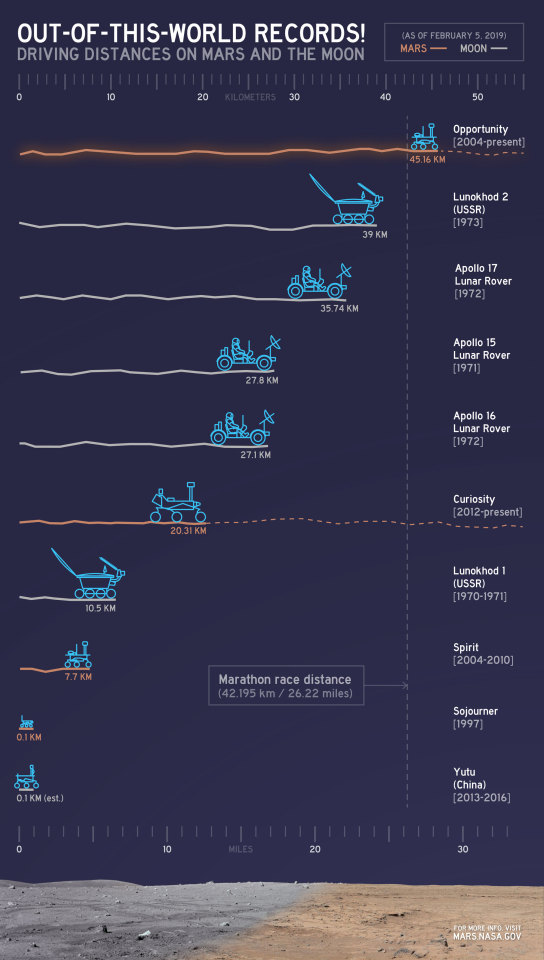
Opportunity’s achievements, including confirmation water once flowed on Mars. Opportunity was, by far, the longest-lasting lander on Mars. Besides endurance, the six-wheeled rover set a roaming record of 28 miles.
This chart illustrates comparisons among the distances driven by various wheeled vehicles on the surface of Earth’s moon and Mars. Opportunity holds the off-Earth roving distance record after accruing 28.06 miles (45.16 kilometers) of driving on Mars.
It’s Just Like Having a Geologist on Mars
Opportunity was created to be the mechanical equivalent of a geologist walking from place to place on the Red Planet. Its mast-mounted cameras are 5 feet high and provided 360-degree two-eyed, human-like views of the terrain. The robotic arm moved like a human arm with an elbow and wrist, and can place instruments directly up against rock and soil targets of interest. The mechanical “hand” of the arm holds a microscopic camera that served the same purpose as a geologist’s handheld magnifying lens.
There’s Lots to See on Mars
After an airbag-protected landing craft settled onto the Red Planet’s surface and opened, Opportunity rolled out to take panoramic images. These images gave scientists the information they need to select promising geological targets that tell part of the story of water in Mars’ past. Since landing in 2004, Opportunity has captured more than 200,000 images. Take a look in this photo gallery.
From its perch high on a ridge, the Opportunity rover recorded this image on March 31, 2016 of a Martian dust devil twisting through the valley below. The view looks back at the rover’s tracks leading up the north-facing slope of “Knudsen Ridge,” which forms part of the southern edge of “Marathon Valley
There Was Once Water on Mars?!
Among the mission’s scientific goals was to search for and characterize a wide range of rocks and soils for clues to past water activity on Mars. In its time on the Red Planet, Opportunity discovered small spheres of the mineral hematite, which typically forms in water. In addition to these spheres that a scientist nicknamed “blueberries,” the rover also found signs of liquid water flowing across the surface in the past: brightly colored veins of the mineral gypsum in rocks, for instance, which indicated water flowing through underground fractures.
Oh, Tumblr, thanks for hiding a really important reblog with some really important commentary from me. What else are you pretending hasn’t been said?
In just a minute or so, I’ve found two more cases where this happened.
That means it’s happening all the time.
WHAT THE HELL.
Were they all first-degree reblogs of asks? Reblogs of asks, if they are reblogged directly from the OP, show up as commentary-less in the notes regardless of whether they actually lack commentary. Reblogs of reblogs do show commentary. (I don’t remember if the intermediary reblog needs to have commentary or not, but I don’t think it does.)
This is a long-standing and widely known bug, but not always widely known enough.
(Probably we should adopt a social norm of avoiding commentary on first-degree ask reblogs. If one really wants to reblog an ask to respond to it, and there isn’t already a first-degree reblog available, one first reblogs it without commentary (perhaps a small note to one’s followers that one is about to add something) and then reblogs oneself to add the commentary.)
(Is there some sort of centralised wiki or something for unofficial Tumblr documentation? Spreading each individual fact through word of mouth does fit with the general usage style of Tumblr, but the coverage isn’t always that great.)
I did not know this. This is pretty dumb, though. I agree, tumblr really does need a wiki or something.
It was still a thing last I checked, anyway. In your activity, can you see the reblog notification for the first-degree ask in the popcorn conversation? Does the notification include the asterisk?
Also, I once tried reblogging an ask from someone other than the OP, but where mine was the first reblog in the chain to include commentary, and it didn’t notify properly. It looks like the first-degree ask *does* need to have something in it for the next degree to show up.
uh I can’t find that post in my activity at a glance but I remember looking at the time and it matched what you were describing.
I’ve been on Twitter lately since it’s part of my job (not in the sense anyone told me to do it, just in the sense lots of traffic comes from there and lots of conversations happen there which I need to stay on top of) and the ways it’s different than Tumblr are interesting.
I actually like Tumblr’s atmosphere a lot better. I super don’t know how much of this is who I choose to follow on each platform, and it’s plausible that this is 100% selection effects, but I feel like most of the people who are mad here are mad from personal experience about bad stuff that’s affecting them, even if they’ve picked a wildly unproductive or inappropriate paradigm to use to engage with it. People are upset that their community doesn’t have stuff they need, or upset that the words they use to describe their experiences are getting used differently by other people. And – even when I think they’re wrong, it’s really valuable to understand what things are hurting people.
On Twitter people are mostly mad about the news of the day. And it’s not that the news of the day doesn’t matter and doesn’t affect thousands or hundreds of thousands or millions of people, but the vast majority of the reactions are not about how the news affects people, by people affected. They’re broader and more narrativizing and more focused on who wins and who loses, and unless you have the pitch-perfect personal angle I think it’s regarded as a little self-centered to engage with the news by thinking about the things that are hurting you and why they’re hurting you.
Also, most people on Tumblr are young and I see them grow and evolve a lot over time. Most people on Twitter are older and it’s kind of rare to see them change their minds.
I think serious ideas from way outside your bubble are more likely to reach you on tumblr, since people have enough time and space to spell them out at enough length they seem interesting even to people who don’t already agree.
And… I’m less sure about this one, but I think tumblr might have already built up some immunity to some of the pure-outrage conversations that I see on twitter a lot. Most people here are survivors of at least one fandom blowing itself up over disagreements that were deeply felt and deeply hurtful but, ultimately, didn’t make the world a safer place for a single person, and I feel like most people who I follow on here are pretty good at identifying those dynamics when they crop up. I do not think most people on Twitter has gotten good at this yet. And wow, I hope they do soon.
Tags:
#interesting #Tumblr: a User’s Guide #Twitter #discourse cw?
People complain a lot about the “hot political takes interspersed with anime girls” Tumblrs, but I find them less jarring than the “hot political takes interspersed with GIFs of ejaculating penises” Tumblrs.
I am once again reminded that other peoples’ experiences of the internet can be very different from mine.
Now I’m wondering how many people reading this fall into the “this is a reminder of how different other people’s experiences can be” camp and how many into the “god, do I know that feel” camp.
(Personally, I’m in know-that-feel.)
I am also in know-that-feel territory.
I have literally never encountered pornography during my use of tumblr as a content aggregation/blogging site.
Oh, don’t get me wrong, it wasn’t the *pornography* that was the unwanted interruption.
Possibly I should have put the rest of my original reply in the main text body rather than the tags:
#there is a time and a place for reading hot political takes and it is *not* while looking for porn #look I get that you want to demonstrate your SJ-ness in order to reassure people that #just because you write *fiction* about women getting brainwashed doesn’t mean you support The Patriarchy in actuality #but you could just *link* to your politics blog from your porn blog
—
(I mean, the penis GIFs *per se* are also annoying, but I accept that a search for porn will involve wading through some of those. Plenty of people *are* in fact into that sort of thing, even if I’m not.)
Tags:
#reply via reblog #sexuality and lack thereof #is the blue I see the same as the blue you see #our roads may be golden or broken or lost #nsfw text
Hey everybody, the ArchiveTeam tumblr project is up and running!
If you have resources, please install Archiveteam’s warrior program to contribute to the project! It’s very easy to set up on and install on any computer, there are step by step instructions at http://tracker.archiveteam.org/tumblr/
We’re already up to 11TB and 187 million blogs archived, but we’re going to need a lot more help to get all the NSFW content before the 17th!
main project discussion takes place irc at #tumbledown on efnet, and you can add blogs to be saved using this google form: https://goo.gl/RtXZEq
Where did you get the 187-million figure from? It makes sense that the ~65k figure on the tracker would just be the sex blogs, since all of the blogs I’ve seen go by on it have been sex blogs, but I didn’t see any information regarding non-sex blogs.
I have unlimited Internet, cheap electricity, and a cool climate, so I’m in a pretty good position for (small-scale) volunteer computing. I’ve been running a warrior for a couple days now. I’ve been leaving my laptop on overnight because if I’m interpreting the instructions right, you only get to pause a task for a few hours before it’s considered abandoned and re-assigned, and I didn’t want to lose work. (especially since my current task has been 22 hours and counting; some of these blogs are pretty big)
I think I’ll continue helping out with their other projects once this one is finished: archiving is (as anyone reading this blog has probably noticed) a pet cause of mine. Since it mostly just needs bandwidth and doesn’t take much CPU, I can even run it and World Community Grid at the same time without problems (anti-disease efforts are my other pet cause).
nightpool replied to this post with:
the 187 number came from scott’s recent tweet, i’m not aware of the source of it but considering that he literally owns the computer all of these are uploading to (before being sent to the archive) he’s reasonably authoritative on the subject
Tags:
#(December 2018) #this concludes the retroactive application of my new aglet policy #(I looked at Twitter user @textfiles and was not able to find the figure) #(since it was not really that important I didn’t bother to dig further) #101 Uses for Infrastructureless Computers #The Great Tumblr Apocalypse #The Last Tumblr Apocalypse #(still helping with their other projects by the way) #(they’re kind of saturated right now but I leave the client program running anyway) #(sometimes I get a task to run if I happen to be close enough to the front of the line when they’re handing out a batch) #(and next time there’s an all-hands-on-deck project I’ll be ready to leap into action)
I’m an oldie who used to use Semagic but I haven’t done a backup in a while and I believe Semagic doesn’t work anymore. Let me pitch this to the crowd.
as far as i know there’s no great way to do it right now, though I would ask over on DW, they would have a better idea. iirc they do intend to build a native backup tool in the future but I probably read that in, like 2013, so it’s worth asking about again.
Wait they have a native exporter now??? Holy crap I had no idea that was a thing. The fact that it’s CSV/XML sucks but dang I’ll take it over nothing. Thanks @brin-bellway, this is gonna come in super handy for me.
Anyway as far as comments go I actually just use my email as an archive. Not ideal but it’s better than nothing. (You can also get your own comments emailed to you.) There might be a tool that does still work with DW but if there is I don’t know it, unfortunately.
I appreciate the effort, but I think we cross-posted. I just figured out how to fix the access-lock problem with wget [link].
I hope you find it handy too! :)
:’) i saw it about three seconds after i posted. the world is funny sometimes.
i’ll give that a shot too! i’ve never tried wget but what better time than now to learn.
Tags:
#(December 2018) #conversational aglets #Dreamwidth #101 Uses for Infrastructureless Computers
I just had a conversation about the difference between conceptualizing your own life as something like a balance sheet, versus something like a profit & loss statement, and I’m finding this a surprisingly fruitful analogy.
Balance sheet: You are tracking assets and liabilities – a snapshot overview of your position in the world. Assets might be literal money and stuff, intangibles like skills, youth, attractiveness, family ties, or even more nebulous, like memories of good experiences. If you’re looking at your life from a balance sheet perspective, you are a collector, trying to gather and hold onto as much of the good as possible. Surveying your life and noting that you’re holding a good-sized pool of equity (of all types) will feel safe and successful. Giving up possessions, forgetting childhood memories, or drifting away from friends and family, might feel like losing a part of yourself. I associate this model with a diachronic sense of self.
(There is probably some possible analogy here re depreciation on assets, that I’m too tired to unpack right now).
Profit & loss: You are tracking revenue and expenditures – the rate of change over time, and whether your trajectory is positive on net. Recent good experiences, learning and personal growth and skills gained, and literal money-earning potential feel like success and safety, as does having more than enough energy and motivation to fuel your ongoing day-to-day life; putting in unsustainable amounts of effort, spending yourself to stay afloat, feels like the worst kind of failure. Your absolute position, and where you were five years ago, both matter less. Noticing that you’ve left something behind (friends, family, an old sense of self) in your race for forward momentum, probably doesn’t hurt as much. I associate this viewpoint with being more episodic.
I tend toward the profit & loss (which makes sense, I’m more episodic than many people I know), and I think I’ve moved even further in that direction in recent years, an adaptation to the life I’ve chosen – it doesn’t feel like I have the luxury to sit around accumulating assets and stability and a comfortable position to survey my life. The categories of revenue I’m currently pulling in are totally different from what I was tracking five years ago, when I was a nurse in Canada, and that seems fine. I’m not the same person as I was then.
I think this does make me more vulnerable towards vicious spirals in bad times, and over-updating on how things have gone recently.
I was unfamiliar with the terms “diachronic” and “episodic” sense of self, so I looked them up and found this [link].
The post mentions diachronics often “pitying” episodics, but I find my main emotion is not *pity* but *defensiveness*. The web of associations I’m getting is mostly people (they usually call themselves Buddhists; I don’t know enough about Buddhism to know how central an example they are) who think that [lacking a sense of a cohesive, continuous self] is both the objectively more true and subjectively superior way to live, and that the highest goal in life is to obtain it. IME, the one being pitied is usually *me*. I wonder what kind of circles 2012!RONBC travelled in.
Interestingly, given your examples, for much of my life “how much money do I currently have saved up” has been a *much* larger factor in the strength of my financial position than “how much income am I likely to make in the near future”. I’ve spent a *lot* of time over the years living primarily off of savings, and these days I do sometimes tend to view income, not as directly going to expenses, but as a way of acquiring savings that one then *actually* uses.
And come to think of it, this isn’t even the first time that someone has connected that with me having a stronger continuity of self [link], though not in quite the same sense that you’re talking about.
I don’t really know where I’m going with this, but it’s interesting stuff.
Fascinating! I haven’t experienced much pity or judgment from either direction on the episodic-vs-diachronic spectrum, and I don’t think I’ve interacted with the Buddhist type much. I’m also not all that extreme on the episodic end, and both styles make a lot of sense to me.
Reading your post, I’m reminded that 10 years ago, I was a *lot* further on the “income is a way to acquire savings that you then live off” end of the spectrum. At some point in the last 5 years or so, I passed a threshold from most of my resources being in literal savings, to most of my resources being in my ability to keep obtaining resources in future. (I guess, in this handwavy model, a nursing degree is sort of an intangible asset? On some level I would be *delighted* if I had to fall back on this; I miss nursing.) I think most of my personal resources are in the form of “reputation in my community as a skilled ops person”. That’s also a sort of intangible asset, if you squint at it sideways… (I am starting to stretch the accounting metaphors pretty far here).
In any case, at one point I considered it mandatory to have 1-2 years of runway in savings (back in Canada, when a year’s living costs were like $30K). Then, later on, I spent down those savings in order to get married, move to Australia, later move to the Bay Area, and generally have my life go in completely unexpected directions. I spent a while being *terrified* by the instability and chaos of it, and I’ve become ok with it by reminding myself that my security and ability to survive the future rests, not on my current pile of resources, but on my accumulated skills, social capital, and resilience/ability to land on my feet.
Some of my current sense of security comes from other fall-back assets, like having family who will let me live rent-free in their spare room for three months on a week’s notice. Knowing I have that luxury gives me a lot more willingness to take risks and optimize less for security. But I’m definitely not optimizing for financial security right now – it would be madness to live in the Bay Area on a nonprofit salary if I was. And there are unlikely-but-not-that-unlikely scenarios, like getting seriously ill and being unable to work for a while, that I’m not really protecting against.
Hmm. I can imagine someone looking at this exact situation more from a balance sheet perspective, and focusing on the overall status of “intangible assets” like job skills and social networks, rather than mostly looking at their impact on the profit & loss statement and the delta over recent time periods to judge how well things are going. This spectrum reminds me a bit of Spencer Greenberg’s post on Stability vs Acceleration as different life strategies: https://www.facebook.com/spencer.greenberg/posts/10104091893110202
Tags:
#(December 2018) #conversational aglets #adventures in human capitalism #adventures in University Land #is the blue I see the same as the blue you see #amnesia cw? #(I just now read that Stability vs Acceleration post and yes it does remind me a lot of diachronic vs episodic) #(in that I am so accustomed to being pressured towards an acceleration I don’t want that #merely *mentioning* the existence of a continuum immediately makes me feel defensive) #(since I know what people who bring it up tend to say next) #((in a PM a while back I described myself as #”tending to measure my life’s progress in terms of the number of potential disasters I’ve mitigated #and the extent to which I’ve mitigated them”)) #101 Uses for Infrastructureless Computers