Anonymous asked: Hi! Those books about kids and their inner worlds seems fascinating; do you remember what they were? I’d love to read them

{{previous post in sequence}}


brin-bellway:

theunitofcaring:

I think one of them was Siblings Without Rivalry, but I don’t know if that was the one with the ice-throwing story. I just read the first chapter because it was free on Amazon and I’m kind of alarmed I read it as a small child; it’s all about horrific intrafamily bullying and parents talking about how much witnessing this makes them hate their kids. Then again, I’ve repeatedly had the experience over the last few years of going ‘wow I read what when I was seven’ (Animorphs, yikes) so maybe small children are just actually pretty resilient.

(please stand by)

Huh, interesting. I tend to have the opposite experience: “wait, *this* was enough to terrify me when I was seven?” (There are a few episodes of mid-series Red Dwarf like that. They were trying to play the suspense for laughs, but back then I reacted as if it were played straight.)

It’s kind of comforting to see how I’ve improved. I tend to think of myself as fairly psychologically fragile, but compared to child!me I’m a goddamn juggernaut.

(it’s…probably for the best I never read Animorphs)


Tags:

#I did read a parenting book my parents had lying around when I was about nine #I don’t recall its specific problems #–and there may not have been anything specific so much as a general aura– #but I thought it was rather patronising and offensive #(as I had suspected it would be) #reply via reblog #my childhood #Animorphs #is the blue I see the same as the blue you see

Anonymous asked: Hi! Those books about kids and their inner worlds seems fascinating; do you remember what they were? I’d love to read them

theunitofcaring:

I think one of them was Siblings Without Rivalry, but I don’t know if that was the one with the ice-throwing story. I just read the first chapter because it was free on Amazon and I’m kind of alarmed I read it as a small child; it’s all about horrific intrafamily bullying and parents talking about how much witnessing this makes them hate their kids. Then again, I’ve repeatedly had the experience over the last few years of going ‘wow I read what when I was seven’ (Animorphs, yikes) so maybe small children are just actually pretty resilient.

(please stand by)


Tags:

#zeroth degree asks #(technically this one is a first-degree ask but it’s the same idea)


{{next post in sequence}}

msmarvel:

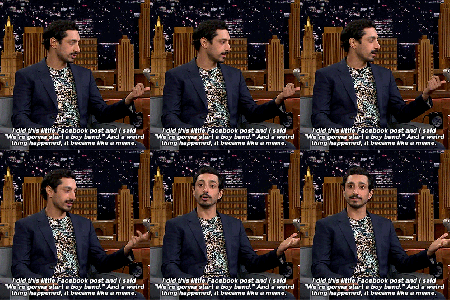
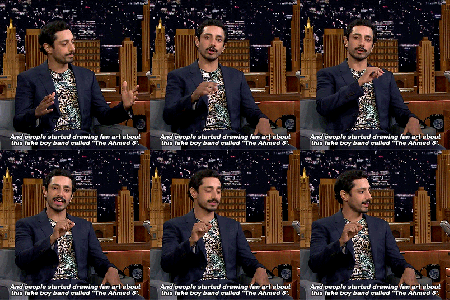
Riz Ahmed Could Start a Boy Band with Guys He Met During an Airport Security Search.


Tags:

#Ahmed^3 #oh look an update #(this post was actually still sitting in my consider-reblogging from the *last* time JT reblogged it) #(I suppose I might as well reblog the newer one) #((normally I don’t let them sit *quite* that long)) #((but I was having some browser issues a while back and figured getting rid of every tab with moving parts (like GIFs) might help)) #((so I left this as a URL in a notepad window where it was much easier to neglect))

radioactivepeasant:

On the topic of humans being everyone’s favorite Intergalactic versions  of Gonzo the Great:
Come on you guys, I’ve seen all the hilarious additions to my “humans are the friendly ones” post. We’re basically Steve Irwin meets Gonzo from the Muppets at this point. I love it. 

But what if certain species of aliens have Rules for dealing with humans?

  • Don’t eat their food. If human food passes your lips/beak/membrane/other way of ingesting nutrients, you will never be satisfied with your ration bars again.
  • Don’t tell them your name. Humans can find you again once they know your name and this can be either life-saving or the absolute worst thing that could happen to you, depending on whether or not they favor you. Better to be on the safe side.
  • Winning a human’s favor will ensure that a great deal of luck is on your side, but if you anger them, they are wholly capable of wiping out everything you ever cared about. Do not anger them.
  • If you must anger them, carry a cage of X’arvizian bloodflies with you, for they resemble Earth mo-skee-toes and the human will avoid them.
    • This does not always work. Have a last will and testament ready.
  • Do not let them take you anywhere on your planet that you cannot fly a ship from. Beings who are spirited away to the human kingdom of Aria Fiv-Ti Won rarely return, and those that do are never quite the same.

Basically, humans are like the Fair Folk to some aliens and half of them are scared to death and the others are like alien teenagers who are like “I dare you to ask a human to take you to Earth”.


dalekteaservice:

We knew about the planet called Earth for centuries before we made contact with its indigenous species, of course. We spent decades studying them from afar.

The first researchers had to fight for years to even get a grant, of course. They kept getting laughed out of the halls. A T-Class Death World that had not only produced sapient life, but a Stage Two civilization? It was a joke, obviously. It had to be a joke.

And then it wasn’t. And we all stopped laughing. Instead, we got very, very nervous. 

We watched as the human civilizations not only survived, but grew, and thrived, and invented things that we had never even conceived of. Terrible things, weapons of war, implements of destruction as brutal and powerful as one would imagine a death world’s children to be. In the space of less than two thousand years, they had already produced implements of mass death that would have horrified the most callous dictators in the long, dark history of the galaxy. 

Already, the children of Earth were the most terrifying creatures in the galaxy. They became the stuff of horror stories, nightly warnings told to children; huge, hulking, brutish things, that hacked and slashed and stabbed and shot and burned and survived, that built monstrous metal things that rumbled across the landscape and blasted buildings to ruin.

All that preserved us was their lack of space flight. In their obsession with murdering one another, the humans had locked themselves into a rigid framework of physics that thankfully omitted the equations necessary to achieve interstellar travel. 

They became our bogeymen. Locked away in their prison planet, surrounded by a cordon of non-interference, prevented from ravaging the galaxy only by their own insatiable need to kill one another. Gruesome and terrible, yes – but at least we were safe.

Or so we thought.

The cities were called Hiroshima and Nagasaki. In the moment of their destruction, the humans unlocked a destructive force greater than any of us could ever have believed possible. It was at that moment that those of us who studied their technology knew their escape to be inevitable, and that no force in the universe could have hoped to stand against them.

The first human spacecraft were… exactly what we should have expected them to be. There were no elegant solar wings, no sleek, silvered hulls plying the ocean of stars. They did not soar on the stellar currents. They did not even register their existence. Humanity flew in the only way it could: on all-consuming pillars of fire, pounding space itself into submission with explosion after explosion. Their ships were crude, ugly, bulky things, huge slabs of metal welded together, built to withstand the inconceivable forces necessary to propel themselves into space through violence alone.

It was almost comical. The huge, dumb brutes simply strapped an explosive to their backs and let it throw them off of the planet. 

We would have laughed, if it hadn’t terrified us.

Humanity, at long last, was awake.

It was a slow process. It took them nearly a hundred years to reach their nearest planetary neighbor; a hundred more to conquer the rest of their solar system. The process of refining their explosive propulsion systems – now powered by the same force that had melted their cities into glass less than a thousand years before – was slow and haphazard. But it worked. Year by year, they inched outward, conquering and subduing world after world that we had deemed unfit for habitation. They burrowed into moons, built orbital colonies around gas giants, even crafted habitats that drifted in the hearts of blazing nebulas. They never stopped. Never slowed.

The no-contact cordon was generous, and was extended by the day. As human colonies pushed farther and farther outward, we retreated, gave them the space that they wanted in a desperate attempt at… stalling for time, perhaps. Or some sort of appeasement. Or sheer, abject terror. Debates were held daily, arguing about whether or not first contact should be initiated, and how, and by whom, and with what failsafes. No agreement was ever reached.

We were comically unprepared for the humans to initiate contact themselves.

It was almost an accident. The humans had achieved another breakthrough in propulsion physics, and took an unexpected leap of several hundred light years, coming into orbit around an inhabited world.

What ensued was the diplomatic equivalent of everyone staring awkwardly at one another for a few moments, and then turning around and walking slowly out of the room.

The human ship leapt away after some thirty minutes without initiating any sort of formal communications, but we knew that we had been discovered, and the message of our existence was being carried back to Terra. 

The situation in the senate could only be described as “absolute, incoherent panic”. They had discovered us before our preparations were complete. What would they want? What demands would they make? What hope did we have against them if they chose to wage war against us and claim the galaxy for themselves? The most meager of human ships was beyond our capacity to engage militarily; even unarmed transport vessels were so thickly armored as to be functionally indestructible to our weapons.

We waited, every day, certain that we were on the brink of war. We hunkered in our homes, and stared.

Across the darkness of space, humanity stared back.

There were other instances of contact. Human ships – armed, now – entering colonized space for a few scant moments, and then leaving upon finding our meager defensive batteries pointed in their direction. They never initiated communications. We were too frightened to.

A few weeks later, the humans discovered Alphari-296.

It was a border world. A new colony, on an ocean planet that was proving to be less hospitable than initially thought. Its military garrison was pitifully small to begin with. We had been trying desperately to shore it up, afraid that the humans might sense weakness and attack, but things were made complicated by the disease – the medical staff of the colonies were unable to devise a cure, or even a treatment, and what pitifully small population remained on the planet were slowly vomiting themselves to death.

When the human fleet arrived in orbit, the rest of the galaxy wrote Alphari-296 off as lost.

I was there, on the surface, when the great gray ships came screaming down from the sky. Crude, inelegant things, all jagged metal and sharp edges, barely holding together. I sat there, on the balcony of the clinic full of patients that I did not have the resources or the expertise to help, and looked up with the blank, empty, numb stare of one who is certain that they are about to die.

I remember the symbols emblazoned on the sides of each ship, glaring in the sun as the ships landed inelegantly on the spaceport landing pads that had never been designed for anything so large. It was the same symbol that was painted on the helmets of every human that strode out of the ships, carrying huge black cases, their faces obscured by dark visors. It was the first flag that humans ever carried into our worlds.

It was a crude image of a human figure, rendered in simple, straight lines, with a dot for the head. It was painted in white, over a red cross.

The first human to approach me was a female, though I did not learn this until much later – it was impossible to ascertain gender through the bulky suit and the mask. But she strode up the stairs onto the balcony, carrying that black case that was nearly the size of my entire body, and paused as I stared blankly up at her. I was vaguely aware that I was witnessing history, and quite certain that I would not live to tell of it.

Then, to my amazement, she said, in halting, uncertain words, “You are the head doctor?”

I nodded.

The visor cleared. The human bared its teeth at me. I learned later that this was a “grin”, an expression of friendship and happiness among their species. 

“We are The Doctors Without Borders,” she said, speaking slowly and carefully. “We are here to help.”


flicker-serthes:

Aaaaaaaaaaaaaahhhhhhhhhhhhhhhhhhhh


thephilosophersapprentice:

THE ENDING

*cries with joy*


piscine-unrelated:

@figmentforms


Tags:

#long post #storytime #aliens #death tw #illness tw #I feel like this probably deserves some additional warning tag but I’m not sure what
I would like to thank @kaylin881 for providing all the fun of stalking people on the Internet without the ethical issues.

(spoilers regarding Kaylin’s Amenta characters follow)

While reading this post, shortly after reading this post (and its OOC comments), a thought hit me:

“Are reject-your-reality and existing-while-red *siblings*?”

Basic public demographics line up: same country, appropriate genders, they’re the same age but Amentans do have twins sometimes so that’s not especially strong counterevidence. And they’re both written by the same person, which counts for something.

I did some digging in their archives, and:

Reject-your-reality/existing-while-red’s brother: intelligent and loves literature/intelligent and loves literature; red†/red; teacher†/teacher; bad springs/bad springs.

Existing-while-red/reject-your-reality’s sister: mild springs, main problem with spring is patients hitting on her on work/mild springs, main problem with spring is customers hitting on her on work; doctor/person who patches up reject-your-reality’s injuries.

Neither ever seems to refer to their sibling as being older or younger than they are.

(…did you make both of them have a tag for talking about their sibling *specifically* to aid this kind of analysis?)

Plus this bit.

This post has suddenly gotten much funnier, like a non-sexual version of that Batman post that was going around recently. (”Sometimes he joins us.”)

(It’s possible I’m late to the game here, but in my defence I hadn’t been following reject-your-reality very closely. And if you’ve ever made any OOC comments explicitly revealing this, I missed them.)

Thank you again for the fun game! I do love a good stalking puzzle.

†These could be construed as cheating, but I’m not Amentan and I never said I’d restrict myself to only sources of information accessible to Amentans.


Tags:

#if this were the real world I would be much less confident in my conclusion #but in fiction ”this is all a coincidence” solutions should be given less weight #(although I suppose there’s still ”it’s a deliberate false trail”) #Amenta #oh look an original post


{{next post in sequence}}

{{previous post in sequence}}


brin-bellway:

.

When I read stuff about What Pre-Pubescent Sexuality Is Like, the traits they describe tend to divide up into “I was never like that” (example: no sense of propriety) and “I’m still like that” (example: sexuality as having to do with oneself, not something interpersonal).

When I read stuff about What Adult Sexuality Is Like, the traits they describe tend to divide up into “I’ve always been like that” (example: capacity for sexual arousal) and “I’m still not like that” (the thing that comes to mind is just the inverse of the still-like-that pre-pubescent one, but there’s probably others).

The transition from pre-pubescent sexuality to adult sexuality is called “awakening”.

What I am saying here is: I, a dozing fetishist, have a perpetually half-awake sexuality.

If there is a God, He loves puns.


Tags:

#sexuality and lack thereof #people who can distinguish between their drive for sleep and drive for sex fascinate me #oh look an original post #puns #nsfw text?

.


Tags:

#nothing that I’m about to post is wrong as such #but it contains some keywords that might set off an enforcer having a poor-reading-comprehension day #so the actual content will be in a reblog in an attempt to avoid the public tags/search


{{next post in sequence}}

{{previous post in sequence}}


shedoesnotcomprehend:

brin-bellway:

shedoesnotcomprehend:

cptsdcarlosdevil:

Disney Descendants hogwarts house sorting fanfic. I am a simple person with simple needs like EXPLAINING TO EVERYONE THAT BEN IS NOT A GRYFFINDOR YOU DUMBFUCKS

this is excellent, and has also made me want to write sorting snippets for my characters

Keep reading

Are those last three any relation to this show?

they are indeed! “my characters” is loose usage, there – I play them in glowfic occasionally, but they are originally from the show in question. which is excellent, and I am delighted to find someone else who knows it!

:D

God, it’s been ages. I’ve only watched through it once, back in late 2012 (and technically very early 2013), on a recommendation from @justice-turtle.

I liked it. I did not entirely understand it, but I gather it is not a show that anyone entirely understands.

(I wonder if I still have it around here somewhere. I know I have some S&S fanfiction links buried in old bookmarks. *looks* Like this one!)


Tags:

#Sapphire and Steel #reply via reblog