changeling-droneco asked: as youre very both old school fandom and also someone who works to preserve old fandom content, what do you think is the best way to print off and preserve fanfics? I’ve been wanting to start to move my many many many archived pdfs into actual physical copies but ive been way too intimidated to really look deep into it so I was wondering if you had a preference

prismatic-bell:

Okay, so.

My preference is “yes.” Yes, I want you to archive them. Yes, I want you to save them. I’ve worked to preserve 1960s teen pulp mags, for fuck’s sake, it can’t get much worse than that, and I’m grateful to have them.

With that said, pick any or all of the following options to make your physical printouts last longer:

–select acid-free paper
–bind by sewing, not stapling
–store in archival sleeves, like the ones you use for old comic books

And now, pick any or all of the following options to make my life easier as a historian (or, you know, the lives of the historians who come after me):

–include the title
–include the author’s name
–include the fandom name
–include which version of the canon, if relevant (e.g. the OG Transformers show vs the Michael Bay movies)
–include the date, or at least year, of publication
–include the summary
–include the site of origin, including the URL

All of these things are called provenance and help not only to identify a specific work, but to place it within its cultural context. As an amusing example: I recently got into James Bond, and decided to go through every fic in the main pairing tag, in chronological order. There came a point where suddenly, out of nowhere, there were like two solid pages of nothing but A/B/O, which I previously had not seen at all. I had a suspicion, so I looked it up, and sure enough–those two pages appeared within just a couple of weeks of the corresponding Supernatural episode. Having publication dates let me determine that. If I were a historian trying to piece together a long-ago puzzle instead of going “lol I live on the hellsite, I bet I know exactly where this came from,” that would be a huge datapoint. I could probably find a similar sudden explosion in other fandoms, as well–and if we’re going far enough in the future, if Supernatural were to just vanish off the face of the planet along with its entire fandom, historians could still trace that it existed and even determine some of its events based on when certain tropes begin to appear in other fandoms. And further, the fact that its tropes and major events appear in so many other fandoms would allow those historians to say “this must have been a very, very popular story.” (This isn’t just me making shit up to sound important, by the way. This is literally how we have records of a lot of things throughout antiquity and even into the Renaissance. The more copies there are of something, or the more references that are made to a thing in other things, the more likely it is for at least part of it to survive. This is literally how we know about Shakespeare’s two lost plays–he was a popular enough playwright that quartos of his plays were advertised for sale.)

Whew! Now let’s get into stuff you could do that would make me, as a historian, scream with delight if I were to open your folder full of labeled, acid-free fanfiction fifty years from now:

–write a little something about why you picked this particular fic to preserve in hard copy when doing so is bulky and time-consuming compared to the easy instant storage of the internet, yes, even if your reason is “I’m trying not to use my phone in bed because the screen keeps me awake but this story is soothing to reread”
–write a little something about who you are, even if it’s just “my name is X, my age is Y, I live in Z, I printed this out in 2022”

And last but not least:

Marginalia. Marginalia. Marginalia, my beloved. That’s when you write your thoughts in the columns on the sides, underline stuff, circle it, and so on. Having marginalia means I actually get a window into your thoughts as you read–your perspective, stuff that stuck out to you, places the story made you feel some kind of serious emotion. And yes, this goes for everything. Villain A kills Hero B and you write “YOU MOTHERFUCKER” in the margin, that tells Future Historian Me that you really loved Hero B, you were invested in seeing her succeed, and that this scene really resonated with you. One of my most treasured possessions in the fandom museum is a copy of the novelization of the Help! movie the Beatles did. This particular copy is very worn–unsurprising, it was a cheap paperback even when it was printed–but also, its original owner apparently took it to the movie theatre and

wrote notes in the margins indicating all the things happening onscreen that weren’t in the book. What does this tell me? WELL. Let’s go ahead and take a look:

1) the written ink doesn’t look any newer than the book, so I’m guessing a little when I say this was the original owner and in the theatre, but I have an actual datapoint I’m basing that on
2) based on handwriting and the main demographic of the Beatles audience at the time, this was a young woman, probably a teenager.
3) she went to see the movie more than once (some notes are in pencil, some in ink, but the handwriting is all the same)
4) she was dedicated to making sure every moment of the movie was preserved. This was an era before home video players, so once the movie left theatres, she had no guarantee of seeing it again.
5) while the book is worn, it’s not beaten all to shit. It was read a lot, but there’s no evidence it was mistreated, so it was probably a prized or at least respected possession.

What can I extrapolate from this, with the understanding that I mean “what theories can I reasonably form but not prove”? Well. She was probably a pretty big fan, since she went to see the movie at least twice and also bought the book. Maybe she wanted to keep the story after the movie was gone. Maybe she was looking for answers for some teen mag contest like “find these things in the Help! movie and win a chance to meet the Beatles.” Maybe she had a friend who wasn’t allowed to go to the movie. You know what the most tantalizing possibility is to me, although I’ll never be able to prove it and actual ethics as a historian mean I can only present it as one among many possibilities? Maybe she did it as a source reference for writing fanfiction. We don’t know. We can’t know, because I have no idea who the original owner was or if she’s even still alive and no way to trace her. But that? In terms of fandom history, that is a fucking gold mine. Pure 24-karat all through. From a strictly historical view, that’s worth more than the animation cel I’ve got in there, and I paid over a hundred bucks for that thing.

So yeah! That was a lot of words to say “just do it.” But there’s your answer!

changeling-droneco:

Oh this is super helpful I had never even HEARD of acid-free paper before this, and I had no idea how important things like dates and notes in the margins could be! Also gives me an excuse to practice sewing again for the first time in years if stapling isn’t the best idea. I still have plenty of my own research to do because I care deeply about a lot of these stories and I want to do them justice. I’m also just really glad there’s people like you who go “Who cares if its a shitty first attempt? I have worse and I love it immensely not just despite of it but in some ways because of it!” it really takes the edge of my anxiety about not being perfect.

prismatic-bell:

LAST TIME, ON “NINA BLOGS FANDOM HISTORY”:

Make me scream in glee by doing these things!

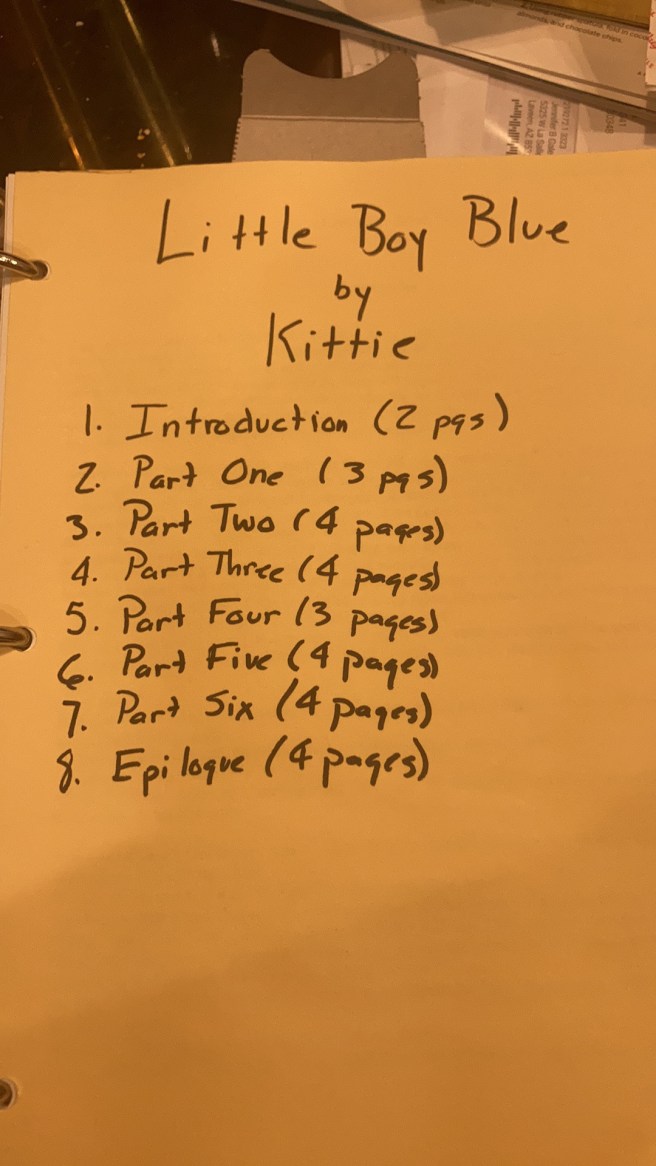
@sailorzeo can confirm she just saw me do just that, when she handed me an old book of printed fanfiction (actual quote upon her finding it: “SQUEEAK!!”). I’m looking through it right now, and when I say whatever you write, WHATEVER you write, provides provenance and context?

0776c1fa01a04f9aff3faed1ff4227343931440d

This is from 1996. Today it would almost certainly be measured in total word count. But in Ye Olde Days, you had to watch how much content you were putting per part because dial-up was slow and people wanted to read their fic when they were still young; measuring in pages or K/KB (kilobytes, not thousands) was the standard.

This is literally a look at the customs of fandom before broadband or even DSL were widespread. And it’s a single handwritten page. Look at everything there! How Zeo (and the author) chose to organize it; the length compared to modern-day fic; the way it’s segmented. (Looking at the fic itself, the formatting is also way different than modern formatting. Good, but different.)

And at least in theory, via the Wayback Machine or archive.org, I could still go find this fic online, because the name of the webpage is included on the printouts.

WRITE. YOUR. PROVENANCE.
starsdreaming:

I’m going to add a little bit that will make historians love you even more when you write the provenance down. Add the date you downloaded the fic.

When you are sourcing online information for research papers and the like, you have to put the date you found the info, because it can change on the web page. The information on the reference page is roughly

“Author, title, journal name, volume, number, year, url, date accessed” or

“Author, title, url, date accessed” for something short

prismatic-bell:

Important addition.

moreroads:

…..i have thousands of words worth of comments that Ive left on fic. many that have been replied to and that I still have access to download also……

do….do historians want that too?

@prismatic-bell

prismatic-bell:

YEP.

Just the idea thrills me. Comments are a form of marginalia! They’re sharing your thoughts, but with the author this time. The fact that we can do that so instantly is unmatched in history and it absolutely changes the way people engage with the text.


Tags:

#history #101 Uses for Infrastructureless Computers #fandom #amnesia cw? #this post was queued because my to-reblog list is too long and I didn’t want to dump it on you all at once #P.S. this‚ the only Backup Awareness Week post that was *already* in my queue before Backup Awareness Week hit #concludes our queue of Backup Awareness Week posts #be safe out there #(P.P.S. this afternoon‚ 2023-11-10‚ I was thinking over which fics to maybe do this with while I was washing dishes) #(this dusk I saw the post again while rearranging my queue) #(and‚ I want you to know‚ an hour later a new chapter of ”Give These People a Break” came out) #(and…yeah‚ if I end up doing this I’m doing that one first) #(it is important to know that you are not alone)

birdantlers:

it genuinely makes me sad and kinda upset when someone purges all their old art off the internet like. barring harmful content what if someone liked that. What if someone would have. And now nobody will ever know and it’s just gone. even people’s old invader zim askblogs or whatever getting deleted feels like a micro alexandria to me and that’s just something I made up. I wasn’t even thinking of a specific one it just stresses me out. Is this the autism I don’t get why nobody else seems to freak internally abt it like I do. I see artists whose blogs I’ve never even looked at go like “man so glad I deleted all my old stuff it’s so clean” or saying they throw out art from when they were kids I’m like. how are you not hurling. How is that not distressing that is literally your tree rings why would you do that. I want to see what’s out there. people want to see it I promise someone out there likes it

don’t they??? Does everyone get quietly irrationally upset by this as me, or is this just hyperfixation/autism/some amalgam of the two. I’m not a hoarder or obsessive compulsive or anything like that so i wonder..

Anyways. reblog if you had a favorite amateur youtube animator in your childhood whose channel got nuked without a trace one day that you still think about.


Tags:

#in 2011 there was a set of filk lyrics‚ ”Hark‚ the Weeping Angels Sing”‚ going around Tumblr #the blog I read it on was run by a Doctor Who fictive who deactivated a few months later #(I gather that a while after that‚ that system was discovered to now be running a blog making fun of ”cringy” multiples) #(so this probably *does* count as someone deleting stuff because they think their past self is too cringe) #(although I *think* it was someone else who actually wrote that OP) #can’t find any copies of those lyrics anywhere #I wrote down what I could remember‚ and recorded myself singing it #but I’m missing a verse #I still wonder if there are any other remaining copies that I just can’t find #(*my* post about it doesn’t show up on search engines‚ after all) #((though if you search the title‚ my SoundCloud page for it does show up)) #101 Uses for Infrastructureless Computers #amnesia cw #this probably deserves some other warning tag but I am not sure what #this post was queued because my to-reblog list is too long and I didn’t want to dump it on you all at once

maryellencarter:

szczyrkowa-deactivated20230924:

i am totally going to come across as a boomer in this post but as an engineer it’s common sense to not build systems with a single point of failure. and i’m starting to realize that our usage of the smart phone is exactly that. a single point of failure. the calling/texting is the implied function of the smartphone, which is fine. that’s what it’s built for. but nowadays we don’t think to keep a physical map or atlas or gps unit in our car because our phone has google maps. we don’t keep address books anymore because it’s all stored in our contacts. i serve customers who no longer carry a wallet/physical card because it’s all on their phone. this is literally a single point of failure. if you lose or break your phone when you are in a foreign place you are fucking screwed. maybe you’re still screwed even in your home town because so many people have become accustomed to using a smart phone to take them anywhere.

as someone who worked in the cell phone industry for five years: this. your email requires two factor authentication to your phone. setting up a new iphone requires two factor authentication to your old iphone. putting a new phone on your phone number requires two factor authentication to a previously active phone on your account. if you ever lose your phone or if it refuses to wake up one day, god help you because no one in the industry can


Tags:

#yes this #one is none‚ folks #disappointed permanent resident of The Future #101 Uses for Infrastructureless Computers #I have specifically arranged my cloud-storage setup to *not* require 2FA #(there *are* multiple layers of encryption involved‚ but–carefully–only with passwords that I’ve memorised) #so that‚ if it came down to it‚ I could bootstrap back into having a full copy of my archives #–complete with version history– #with nothing but my memories and a computer with Internet access #the potential-future mes who just fled a burning home with nothing but pajamas and (bedroom-table) respirator have enough problems already #also‚ check your government services and see if they sell paper maps #Ontario will sell you one for five bucks #I have one in my bug-out bag #this post was queued because my to-reblog list is too long and I didn’t want to dump it on you all at once

bright-eyed-sunshine:

psycheterminal:

Treat anything on Discord as media that will be lost

Do not use Discord to host your files. Do not rely on Discord to preserve your text. DO NOT RELY ON DISCORD FOR ANY KIND OF PRESERVATION OR HOSTING!!

It CAN be lost, it WILL be lost! You must consider Discord as a part of the Core Internet, controlled by one company that hosts the servers.

I thought it was impressive at first that it replaced IRC, but now I am horrified. If the company behind Discord went under today, how many friends would you lose?

How many relationships? How much writing?

You may think this won’t happen, but I remember when AIM went down and along with it, entire novels worth of interaction with my oldest friend.

IT CAN HAPPEN TO YOU. IT WILL HAPPEN AGAIN. NO COMPANY IS INFALLIBLE.

Back up your files! Download anything you’ve saved to Discord NOW, before the API changes go into effect! And DO NOT RELY ON THEM FOR HOLDING IMPORTANT FILES!

Here is a program that lets you download any and all of your discord DMs, your servers, everything. You can set the format (raw text, html (dark and light), and others. You can even download the uploaded files not just the text, though that may be just for the command-line version not the GUI window version.

GitHub – Tyrrrz/DiscordChatExporter: Exports Discord chat logs to a file

Please back up your conversations, your stories. I have a backup of everything I care about that runs once a week, with full attachment backups every several months. I write stories on discord, and would be devastated if someone happened to them. You have to have your own local copies of every file you care about.


Tags:

#Discord #amnesia cw #101 Uses for Infrastructureless Computers #PSA #recs #DiscordChatExporter is amazing #highly‚ highly recommended #though note that due to limitations on Discord’s end‚ it can’t preserve info on *who* used reaction emojis #if you’re extremely stubborn like me‚ you can open up the raw HTML and manually edit that into the hovertext #if not‚ don’t let the perfect be the enemy of the good #even an unmodded export is incredibly valuable #(from my perspective‚ here on the other side of the queue‚ I reblogged that post on offline-first smartphones less than an hour ago) #(and I will note that the *text* of DiscordChatExporter HTML exports is visible on mobile‚ but not the images) #(even if you turned media downloads on (and do make sure to turn media downloads on)) #(not sure if there’s some tinkering I could do to make that work: I *mostly* re-read chat logs on a laptop) #this post was queued because my to-reblog list is too long and I didn’t want to dump it on you all at once

bisexualbaker:

bisexualbaker:

Why do people keep recommending Dreamwidth as a Tumblr alternative, when Dreamwidth and Tumblr are so different?

To be flat-out honest, it’s because Dreamwidth has so many things that Tumblr users say they want, even if it’s also lacking a lot of features that Tumblr users have come to love:

  • Dreamwidth has incredibly lax content hosting rules. I’d say that it’s slightly more restrictive than AO3, but only just slightly, and only because AO3’s abuse team has been so overwhelmed and over-worked. Otherwise, the hosting policies are pretty similar. You want to go nuts, show nuts? You can do that on Dreamwidth.
  • In fact, Dreamwidth is so serious about “go nuts, show nuts”, it gave up the ability to accept transactions through PayPal in 2009 to protect our ability to do that. (It’s also one reason why Dreamwidth doesn’t have an app: Dreamwidth will never be beholden to Apple’s content rules this way.)
  • Dreamwidth cares about your privacy; it doesn’t sell your data, and barely collects any to begin with. As far as I’m aware, it only collects what it needs to run the site. The owners have also spoken out on behalf of internet privacy many times, and are prepared to put their money where their mouth is.
  • No ads. Ever. Period. They mean it. Dreamwidth is entirely user funded.
  • Posts viewed in reverse chronological order; no algorithm, opt-in or otherwise. No algorithm at all. No “For You” or “Suggested” page. You still entirely create and curate your own experience.
  • The ability to make posts that only your “mutuals”, or even only a specific subset of your “mutuals”, can see. Want to make a post that’s only open to Bonnie, Clyde, Butch, and Cassidy? You can do that! Want to make a post that’s only open to Bonnie and Butch, but Clyde and Cassidy can’t see shit? You can do that, too!
  • The owners have forsworn NFTs and the blockchain in general. Not as big a worry now as it was even a year ago, but still good to know!
  • We are explicitly the customers of Dreamwidth. Dreamwidth wants to make us happy, so any changes they make (and they do make changes) are made with us in mind, and after exploring as many possibilities as they can.
  • Dreamwidth is very transparent about their policies and changes. If you want to know why they’re making a specific change, or keeping or getting rid of a feature, they will tell you. You don’t have to find out ten months later that they’re locked into a contract to keep it for a year (cough cough Tumblr Live cough cough).

So those are some things that Tumblr users would probably love about Dreamwidth.

Another reason Dreamwidth keeps being recommended is that a significant portion of the Age 30+ crowd spent a lot of earlier fandom years on a site known as LiveJournal. Dreamwidth may not be much like Tumblr, but it it started out as a code fork of LiveJournal, so it will be very familiar to anyone who spent any time there. Except better.

Finally, we’re recommending Dreamwidth because some of the things that Tumblr users want are just… not going to happen on the web as it is now. Image hosting is the big one for this. Maybe in the future, the price of data will be much cheaper, and Dreamwidth will be able to host as much as we all want for a pittance that a fraction of the userbase will happily pay for everyone, but right now that’s just not possible.

Everywhere you want to go that hosts a lot of images will either be running lots of ads, selling your data, or both.

Dreamwidth knows how much it costs to host your data, and has budgeted for that. They are hosting within their means, within our means.

Dreamwidth is the closest thing we may ever get to AO3 as a social media platform. One of the co-owners is from, and still in, fandom; she knows our values, because they are also her values. It may as well be the Blogsite Of Our Own.

TL;DR: There is no website that has everything that Tumblr wants and nothing that it hates. Dreamwidth at least has all of the important stuff covered.


Tags:

#yes this #I have maintained an outpost on Tumblr‚ but I moved my home base to Dreamwidth after the Purge #and I’m very happy with it #Dreamwidth #The Great Tumblr Apocalypse #recs #this post was queued because my to-reblog list is too long and I didn’t want to dump it on you all at once

canmom:

youzicha:

canmom:

Hypothetical Decentralised Social Media Protocol Stack

if we were to dream up the Next Social Media from first principles we face three problems. one is scaling hosting, the second is discovery/aggregation, the third is moderation.

hosting

hosting for millions of users is very very expensive. you have to have a network of datacentres around the world and mechanisms to sync the data between them. you probably use something like AWS, and they will charge you an eye-watering amount of money for it. since it’s so expensive, there’s no way to break even except by either charging users to access your service (which people generally hate to do) or selling ads, the ability to intrude on their attention to the highest bidder (which people also hate, and go out of their way to filter out). unless you have a lot of money to burn, this is a major barrier.

the traditional internet hosts everything on different servers, and you use addresses that point you to that server. the problem with this is that it responds poorly to sudden spikes in attention. if you self-host your blog, you can get DDOSed entirely by accident.

scaling hosting could theoretically be solved by a model like torrents or IPFS, in which every user becomes a ‘server’ for all the posts they download, and you look up files using hashes of the content. if a post gets popular, it also gets better seeded! an issue with that design is archival: there is no guarantee that stuff will stay on the network, so if nobody is downloading a post, it is likely to get flushed out by newer stuff. it’s like link rot, but it happens automatically.

IPFS solves this by ‘pinning’: you order an IPFS node (e.g. your server) not to flush a certain file so it will always be available from at least one source. they’ve sadly mixed this up in cryptocurrency, with ‘pinning services’ which will take payment in crypto to pin your data. my distaste for a technology designed around red queen races aside, I don’t know how pinning costs compare to regular hosting costs.

theoretically you could build a social network on a backbone of content-based addressing. it would come with some drawbacks (posts would be immutable, unless you use some indirection to a traditional address-based hosting) but i think you could make it work (a mix of location-based addressing for low-bandwidth stuff like text, and content-based addressing for inline media). in fact, IPFS has the ability to mix in a bit of address-based lookup into its content-based approach, used for hosting blogs and the like.

as for videos – well, BitTorrent is great for distributing video files. though I don’t know how well that scales to something like Youtube. you’d need a lot of hard drive space to handle the amount of Youtube that people typically watch and continue seeding it.

aggregation/discovery

the next problem is aggregation/discovery. social media sites approach this problem in various ways. early social media sites like LiveJournal had a somewhat newsgroup-like approach, you’d join a ‘community’ and people would post stuff to that community. this got replaced by the subscription model of sites like Twitter and Tumblr, where every user is simultaneously an author and a curator, and you subscribe to someone to see what posts they want to share.

this in turn got replaced by neural network-driven algorithms which attempt to guess what you’ll want to see and show you stuff that’s popular with whatever it thinks your demographic is. that’s gotta go, or at least not be an intrinsic part of the social network anymore.

it would be easy enough to replicate the ‘subscribe to see someone’s recommended stuff’ model, you just need a protocol for pointing people at stuff. (getting analytics such as like/reblog counts would be more difficult!) it would probably look similar to RSS feeds: you upload a list of suitably formatted data, and programs which speak that protocol can download it.

the problem of discovery – ways to find strangers who are interested in the same stuff you are – is more tricky. if we’re trying to design this as a fully decentralised, censorship-resistant network, we face the spam problem. any means you use to broadcast ‘hi, i exist and i like to talk about this thing, come interact with me’ can be subverted by spammers. either you restrict yourself entirely to spreading across a network of curated recommendations, or you have to have moderation.

moderation

moderation is one of the hardest problems of social networks as they currently exist. it’s both a problem of spam (the posts that users want to see getting swamped by porn bots or whatever) and legality (they’re obliged to remove child porn, beheading videos and the like). the usual solution is a combination of AI shit – does the robot think this looks like a naked person – and outsourcing it to poorly paid workers in (typically) African countries, whose job is to look at reports of the most traumatic shit humans can come up with all day and confirm whether it’s bad or not.

for our purposes, the hypothetical decentralised network is a protocol to help computers find stuff, not a platform. we can’t control how people use it, and if we’re not hosting any of the bad shit, it’s not on us. but spam moderation is a problem any time that people can insert content you did not request into your feed.

possibly this is where you could have something like Mastodon instances, with their own moderation rules, but crucially, which don’t host the content they aggregate. so instead of having ‘an account on an instance’, you have a stable address on the network, and you submit it to various directories so people can find you. by keeping each one limited in scale, it makes moderation more feasible. this is basically Reddit’s model: you have topic-based hubs which people can subscribe to, and submit stuff to.

the other moderation issue is that there is no mechanism in this design to protect from mass harassment. if someone put you on the K*w*f*rms List of Degenerate Trannies To Suicidebait, there’d be fuck all you can do except refuse to receive contact from strangers. though… that’s kind of already true of the internet as it stands. nobody has solved this problem.

to sum up

  • primarily static sites ‘hosted’ partly or fully on IPFS and BitTorrent
  • a protocol for sharing content you want to promote, similar to RSS, that you can aggregate into a ‘feed’
  • directories you can submit posts to which handle their own moderation
  • no ads, nobody makes money off this

honestly, the biggest problem with all this is mostly just… getting it going in the first place. because let’s be real, who but tech nerds is going to use a system that requires you to understand fuckin IPFS? until it’s already up and running, this idea’s got about as much hope as getting people to sign each others’ GPG keys. it would have to have the sharp edges sanded down, so it’s as easy to get on the Hypothetical Decentralised Social Network Protocol Stack as it is to register an account on tumblr.

but running over it like this… I don’t think it’s actually impossible in principle. a lot of the technical hurdles have already been solved. and that’s what I want the Next Place to look like.

This is something that I have been daydreaming about for a long time also. I agree by far the biggest problem would be to actually get people to use it, but still it’s interesting to think about the technical issues…

I think aiming specifically to “recreate tumblr” actually helps with some of the questions. If people routinely reblog posts, then it would be natural for them to also “seed” those posts, giving some redundancy. The client could store posts that you have viewed locally, so that they don’t go away too easily and you can reblog them later if the links rotted.

Also, the way to discover content/users on tumblr is that you see it reblogged by someone you follow, so there is no recommendation algorithm that can be manipulated. There is a trade-off between privacy and discoverability: if (like Twitter) likes and follows are public, then anyone can make “client-side” recommendations based on “liked by somebody who is followed by many users that you follow”, etc.

Making follower/following-lists are public would also have a nice bonus effect on direct messaging. You can always sign and publish the public keys of anyone you interact with, to construct a PGP-style web-of-trust. This system would be really resistant to eavesdropping. As soon as you knew even a single correct identity (e.g. because someone emailed it or published it on their web page or gave you a physical business card), then any attempt to man-in-the-middle you would instantly unravel. We could have secure communications without needing a centralized certificate authority.

Apart from data availability, I think some other problems are:

Naming. One problem with P2P systems is that it’s hard to create globally unique nicknames. I want to be “youzicha”, but without a central party, how can you enforce that nobody else uses the same nickname? Actually, nowadays you can use a blockchain to do it, but this is pretty heavy-handed, you would need to include some kind of rationing or payments or proof-of-work to prevent people from immediately nickname-squatting every short name. I think it’s better give up on unique names altogether, so that people’s unique identifier is just their public key, and then they can publish whatever metadata they like to make themselves easier to find. ICQ used to work this way, with users being identified by just a number but no human-readable nickname.

Anonymization. We don’t think about it so often, but one service that centralized companies provide to us is to act as anonymizing proxies. It works both ways: I can publish this tumblr pseudonymously as “youzicha” without disclosing my real-world identity, and also I can look at peoples post on Twitter and Tumblr without them being aware of it. If everything was purely P2P, you would see each page view (and the IP-address of the person who made it) in real-time, which seems like a nerve-wracking experience.

I think this is a genuine advance: back in the old Usenet days people generally posted under their full government names, which maybe worked well because Usenet as a whole was a kind of subculture, but now people constantly doxx each other and having the wrong political opinions can damage your career. (C.f. the debate surrounding Facebook, Google+ and their “real names” policy.) If the system doesn’t provide anonymity it seems important to at least make this fact very clear in the user interface, users could get burnt. Maybe automatically do some IP geo-lookups to illustrate the kind of information it leaks.

Blocklists, spam, harassment. As you noted above this seems like a big problem.

But if implemented well it could be a selling point, because the current solutions are so disliked. On the being-censored side, sites like Hacker News and Twitter play weird mind games to secretly shadow-ban you, which feels disrespectful. On the censoring sites, people who deal with a lot of incoming messages find the current blocking solutions too blunt. If you provided an elaborate (Turing complete?) policy language, a thousand flowers could bloom: shared blocklists, “topics” like USENET newsgroups which anyone can post to, and then “overlay” newsgroups which are moderated, etc. Popular bloggers could do the Luna thing where you have pay them (using some cryptocurrency) to see your message.

Peoples could publish their rules for receiving messages, which would serve several purposes. First, clients can avoid routing messages which would be discarded anyway (a kind of distributed DoS-protection, as a replacement for Cloudflare). Second, your client software can usefully advice you (“sorry, because of spam rules this message cannot be sent to PopularBlogger. In order to unblock it, do one of (1) build up a posting history of n messages on X Forum, (2) have your message approved by a moderator in group Z, (3) get a friend-of-a-friend introduction from one of the following people, …”). And most importantly, you can performatively block Nazis and post really elaborate DNI lists.

Beheading and child abuse videos. I think this is a bigger problem than “if we’re not hosting any of the bad shit it’s not on us”, because if a social media system is truly censorship-resistant the government will not allow it to exist for long. Interestingly, this is goes against some of the other desiderata: you’d want it to not be anonymous, to make it easy for the police and/or online vigilantes to chase down criminals. And you might want content to not be discoverable. (E.g. if you use BitTorrent Mainline DHT you maybe interact with people who search for bad things, but since they only provide a SHA-1 hash you never know.)

re:

#I have none of the technical knowledge to assess this ideas merits#but it totally captures what i’d need from a network#…except the no deletes thing ig#that one might be rough.

so when i say ‘no deletes’ it’s a little complicated. since this post is getting a little traction, let me explain some of the technical stuff in more detail.

the way content-based-addressing works is, instead of linking to a place on the internet (a specific server), you use something called a hash that’s computed from the file itself.

for example, let’s say you have a picture you want to share over IPFS. this picture, say.

29a4ec3531ab61d7a8cb0cadbf776a65befa3cfc

If I have a copy of this picture, I can compute something called a hash function. The hash function is essentially a pseudo-random scrambling of the data, which is usually much smaller than the actual data. For example, the SHA-256 hash of luciano.webp here is, in hexadecimal,

31F7D77DE068047411F241209C3822F0AB6CB81DC508C6C9D83B64F38F99556A

This is only 256 bits, much smaller than the actual 106KB file.

The way hash functions work, it’s very very very unlikely for two files to have the exact same hash. You can’t ‘work backwards’ from the hash to the original picture, there’s not enough data in the hash, but if you know what the hash is, and someone sends you something they claim is luciano.webp, you can very easily verify that it’s (almost certainly) the picture you’re looking for.

So the idea of all this is that you start with the hash and track down someone who has the original file and get it from them.

The way BitTorrent originally worked is that there’s a computer called a ‘tracker’, which keeps track of everyone who has a copy of luciano.webp. You can say to the tracker ‘hey I’m looking for luciano.webp, who has it?’ and the tracker will send you a list, and then you can ask each of them for a copy. A torrent file is nothing more than a list of hashes and a list of trackers.

However, sometimes the tracker will go down. It’s a single point of failure. But there’s a way around this problem…

There’s a very clever bit of tech invented for BitTorrent called a Distributed Hash Table (DHT). This makes it so that every computer on the network can be a tracker. The hash itself is used as an address to look up the computers keeping track of who has luciano.webp.

So when you join the network, you will also become a tracker for certain files. You don’t know what those files are, since it’s all based on hashes. What’s great about this is that if a tracker goes down, another computer can sub in. The DHT gives a mechanism to determine who should be the trackers for each file.

IPFS, Interplanetary File System, is an attempt to use the same tech for websites. Basically, every time you download a file across IPFS, you hold onto a copy and let the trackers know that you have it, using the hash. If someone else comes looking for that file, you can serve it to them. When you download a file, you’ll find the nearest computer that has a copy and get it from them.

One nice thing about this is that if someone else posts luciano.webp on their blog, it’s already spread across the network, and so they can just download it from the nearest person.

Of course, you don’t have unlimited storage space, so sooner or later you run out. At this point, you “flush” the oldest files that nobody has asked for recently – delete them from your computer, and tell the trackers you don’t have them anymore.

So if it’s not being downloaded, data gradually gets deleted from the computers on the IPFS. If you want data to stick around, you have to keep a computer running with instructions to never delete that file (this is called “pinning”), or pay someone else to do the same.

So when we say ‘things can’t be edited or deleted’, it’s complicated. Once you publish a file onto IPFS, it’s hard to purge it from the network quickly. If you wanted to put up version 2 of a post, people can still look up version 1 using the hash of version 1. You can delete version 1 from your computer, and tell everyone the hash of version 2, but the version 1 will stick around. (There are ways around this in IPFS – see here, here – which let you direct people to the most up to date versions of a site/file.)

So to get rid of something after you’ve released it to IPFS, you have to have everyone get rid of it. But wait around long enough, and if nobody is pinning it, and nobody is still downloading it… that file will get deleted sooner or later.

Despite the very different underlying tech, functionally this is actually pretty similar to how Tumblr already works. Once something gets reblogged, it’s out of your hands, you can’t edit or delete the copy they have on their blog. (This is in contrast to a service like Twitter, where if you delete a Tweet, it also deletes the retweets. In programming jargon, Tumblr reblogs copy by value, while Twitter retweets copy by reference.)

On Tumblr, old posts tend to be very hard to find – people delete their blogs, or change URLs, and the search sucks. On IPFS on the other hand, old posts might be flushed off the network.

So it wouldn’t be much different in practice.


Tags:

#man‚ I am so disappointed by the shining potential of IPFS getting eaten by Generic Crypto Shit #I used to run a node #(but network effects meant that I never encountered a webpage that I both wanted to pin and could meaningfully pin) #(so few of them being IPFS-based) #I used to read their newsletter #(but I noticed one day that it had been so long since #the newsletter had mentioned progress or even *hopes* towards the beautiful‚ resilient meshnet whose seed I saw in them) #I don’t know‚ have they ever recovered their course? #…I also kind of want to check in on Scuttlebutt now and see how they’re doing #The Great Tumblr Apocalypse #IPFS #disappointed permanent resident of The Future #101 Uses for Infrastructureless Computers #this probably deserves some warning tag but I am not sure what #this post was queued because my to-reblog list is too long and I didn’t want to dump it on you all at once

jadagul:

discoursedrome:

raginrayguns:

12c5b05ddaee471b74e93f1675a175b9b288617c

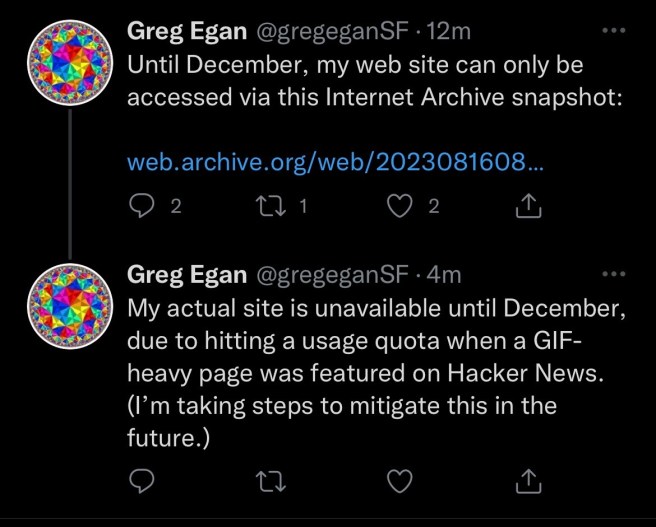
sometimes you hear people muse, “why did we ever start putting all our online content in these untrustworthy centralized walled gardens?” anyhow this is why

Man yeah when’s the last time you heard of someone getting Slashdotted?

Before this, I mean.


Tags:

#disappointed permanent resident of The Future #this post was queued because my to-reblog list is too long and I didn’t want to dump it on you all at once

{{previous post in sequence}}


brin-bellway:

maryellencarter:

heroofthreefaces:

riseofthecommonwoodpile:

riseofthecommonwoodpile:

smartphone storage plateauing in favor of just storing everything in the cloud is such dogshit. i should be able to have like a fucking terabyte of data on my phone at this point. i hate the fucking cloud

this is gonna make me sound very Old Man Yells At Cloud but i just hate how many things in my life assume i will always have access to a quick, reliable internet connection and almost cease to function without it. Obviously certain things Have To Have An Internet Connection, but i want to be able to listen to music if my service is bad. i want to still watch movies if Netflix is down. i want to have a working map when i can’t get a cell signal. nearly every tech product these days bears the fingerprint of the extremely internet-rich places they are developed, high rent offices in Seattle, San Francisco, etc.. I think often the idea of the internet not being available is so remote to them it doesn’t even factor in to development. i remember when the Xbox One was debuted and Microsoft was almost mockingly like “if you don’t have reliable fast internet, then don’t bother buying this”, and there was such backlash they completely went back on so much of that. But now that attitude is just the tech norm.

I don’t trust the cloud.

This makes me happy I don’t use my phone for going online

i mean you can get a terabyte phone but it costs like $1600 USD (give or take a couple hundred, idk, i’m not looking it up)

what really pisses me off is that the samsung flagship phones have completely phased out their sd card slots. you can’t get a cell phone with expandable storage anymore

Yeah, it’s such bullshit that it’s a whole ordeal to dig up a model with a microSD slot now.

I *do* have a 2020-model phone (a slightly different model of which is still in production) with a half-terabyte microSD† in it. (For CAD$155 instead of CAD$70 I could have gotten a full terabyte of microSD, but I didn’t have the budget. Mind you, I *could* upgrade later, without having to replace the whole phone…) But that’s because a microSD slot was my single highest priority when deciding what model to buy, absolutely non-negotiable: if I’d cared any less, I’d probably have ended up with a Pixel or a OnePlus.

Hmm, I wrote an extremely outdated guide to orienting your phone setup around not having reliable Internet access in 2015, and a substantially outdated guide in 2018, so it sounds like I’m due for another one. Be right back.

[three months of on-and-off tinkering later]

Okay, here’s “Tips on Offline-First Smartphones, 2023 Edition”.

†Some of the specs for that phone model you’ll see around will say it takes “up to 128 GB”, but don’t be fooled: 64 GB – 2 TB microSDs are the same backwards-compatibility tier. If a phone can take 32 GB, it might not be able to take 64, but if it can take 64 it can take 2048.


Tags:

#bringing this back since I’ve seen some of the more despairing versions of this thread being passed around again recently #and yes‚ I do have a copy of my Tumblr on my phone #multiple copies‚ in fact: [a tumblr-utils output] and [a scrape of my WordPress mirror converted to Kiwix format] #(and technically also the text-only export from WordPress but I *really* don’t want to have to bootstrap from that one) #(that one is very last-resort) #(cheap‚ though: 6.8 MB) #101 Uses for Infrastructureless Computers #disappointed permanent resident of The Future #proud citizen of The Future #Brin owns *two* 2010’s computers now #fun with loopholes #this post was queued because my to-reblog list is too long and I didn’t want to dump it on you all at once

sootpologist:

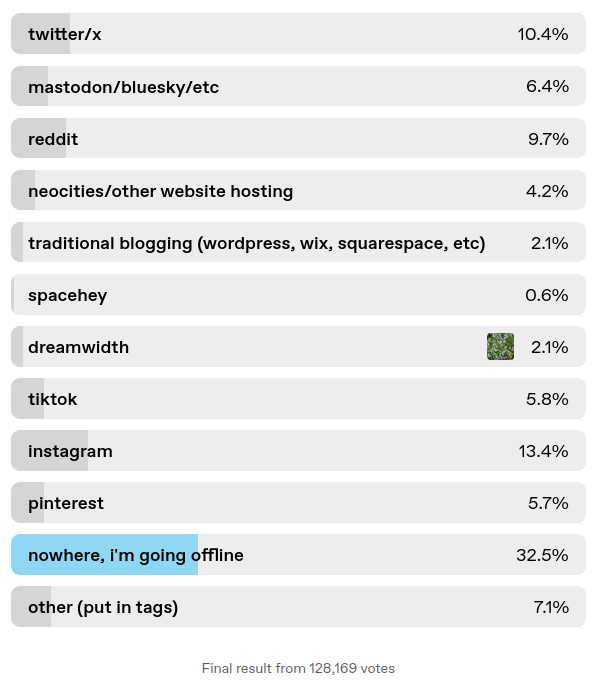
genuinely curious: if tumblr were to vanish right now, where would you set up your primary internet presence?

post-tumblr-platform-poll

purposefully picked tumblr-like social media along with some really bit ones although nothing is really like this tbh


Tags:

#The Great Tumblr Apocalypse #surveys #this post was queued because my to-reblog list is too long and I didn’t want to dump it on you all at once

delphina2k:

dduane:

smellslikebot:

how to keep following people when a major social platform implodes

(…and you don’t want to join 20 new websites)

First, get an RSS reader*:

You’ll be able to make a custom feed to follow blogs, webcomics, social media feeds, podcasts, news, and other stuff on the web all in one place. To follow something, find its “feed URL”– often marked by an icon that looks like this ↓– and paste it into your reader of choice as a new feed.

379249325018d0a2606f5020fd1b3ff2e71b79b1

Some feed URLs for social media:

  • Twitter: Feedbro can use Twitter profile URLs as feed URLs. Otherwise, use nitter.net/username/rss (or other Nitter instance) (You can get a CSV file of all the accounts you follow using “Download a user’s friends list” on Tweetbeaver)
  • Tumblr: Use username.tumblr.com/rss or username.tumblr.com/tagged/my%20art/rss to follow a blog’s “my art” tag (as an example)
  • Cohost: Use username.cohost.org/rss/public (WIP feature)
  • Mastodon: Use instance.url/@­username.rss
  • Deviantart: Info here
  • Spacehey: Info here
  • Youtube: Go to a channel in a web browser, view page source, and use Ctrl-F/Command-F to find a link that starts with “https://www.youtube.com/feeds/videos.xml?channel_id=
  • Instagram: Feedbro can use Instagram profile and hashtag URLs as feed URLs. Otherwise, Instagram doesn’t have RSS feeds, and due to aggressive rate limiting on their part, it’s not so simple to generate a feed URL.
  • Facebook: Feedbro can use public Facebook group/page URLs as feed URLs.

(If you know an artist who exclusively posts to Instagram, you may want to gently suggest that they crosspost elsewhere…)

Also see how to find the RSS feed URL for almost any site. Try using public RSS-Bridge instances or Happyou Final Scraper to generate feeds for sites that don’t have them (Pillowfort, Patreon, etc).

*You can set up your subscriptions in one reader and import them into another by exporting an OPML file.

This!

RSS feeds were a great way to keep track of things before the rise of the platforms, and (if we’re smart) they’ll be great again.

Did you know? Many webcomics can be tossed into RSS feeds, depending on how the website is built, so you’ll get notifications every time they update! This includes:

  • SpiderForest webcomics
  • Hiveworks webcomics
  • ComicFury webcomics
  • Tumblr webcomics (using that tag thing listed above)
  • Self-hosted things that use any kind of WordPress installation

(Tapas and Webtoon are in the same boat as Instagram, where the developers have limited their RSS capabilities intentionally.)

RSS is a great solution for comics that update sporadically, too!


Tags:

#ooh‚ I’ll have to try out those Nitter and RSS-Bridge tricks #101 Uses for Infrastructureless Computers #PSA #this post was queued because my to-reblog list is too long and I didn’t want to dump it on you all at once