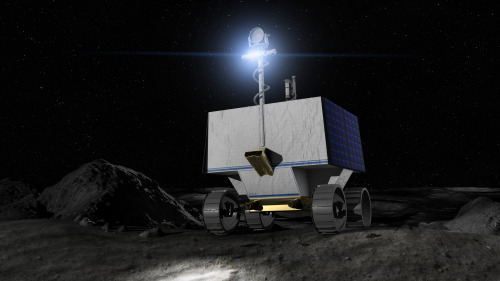
Our water-seeking robotic Moon rover just booked a ride to the Moon’s South Pole. Astrobotic of Pittsburgh, Pennsylvania, has been selected to deliver the Volatiles Investigating Polar Exploration Rover, or VIPER, to the Moon in 2023. During its 100-Earth-day mission, the approximately 1,000-pound rover will roam several miles and use its four science instruments to sample various soil environments in search of water ice. Its survey will help pave the way for a new era of human missions to the lunar surface and will bring us a step closer to developing a sustainable, long-term robotic and human presence on the Moon as part of the Artemis program.
it took me about three weeks, 30 pages, a full tube a glue, a cardboard box, two brushes, a giant popsickle stick, two chopsticks, three drinking straws, a small blade, two utility knives and about five hundred neurons but here it is. the final version of the cube, it is done and it works and its beautiful.
It’s official – we’re headed to do science on the Sun! ☀️
At 11:03 p.m. EST on Sunday, Feb. 9, Solar Orbiter, an international collaboration between the European Space Agency and NASA, launched aboard United Launch Alliance’s #AtlasV rocket for its journey to our closest star. The spacecraft will help us understand how the Sun creates and controls the constantly changing space environment throughout the solar system. The more we understand about the Sun’s influence on the planets in our solar system and the space we travel through, the more we can protect our astronauts and spacecraft as we journey to the Moon, to Mars and beyond. More here.
Image Credit: NASA Social participant, Jared Frankle
one time as a kid I forcefully shoved two magnets together, and these were the strong magnets my dad used in his shop to pick-up missing little metal bits, and I held them really tightly in the palm of my hand, went up to this one kid who legit said things like “I think black cats are bad, they should be drowned” and drew crosses on the notebooks of kids if she found out they didn’t go to church, I told her “Hey. I’m a witch. If you don’t stop trying to hurt animals and picking on kids, I’ll use my magic to throw you into the sky”, and when she dared to doubt my powers I told her that I had two “rocks” in my hand that I could send across the playground, then I opened my hand the the magnets shot off in two different directions (we were over in a spot that was empty, so no other kids were around, nobody got hurt), one of them stuck to a drainpipe and the other stuck to a fence. This kid SCREAMED, and ran to the office, and I guess had her mom pick her up from school, and then she wasn’t there for a couple of days, finally her mom called my house and claimed I had “traumatized her daughter by performing a terrifying magic trick”, and when my parents asked what I did I just said “I showed her a magnet and she flipped out. She’s not gonna be happy when she finds out about gravity, either”. eventually this kid came back to school and always made a point to come up to me and say “Hey, my mom told me not to talk to you!”, and would just be like “Good job, you already screwed that up”
Should do it ancient greek/time traveller style: Once the competition starts you aren’t allowed to use anything you didn’t find in nature or make yourself, including the clothes you wear.
The problem with that is the main limitation would be which ores and other materials you had on hand, rather than your technical prowess. Most of the event would be about prospecting rather than building stuff. Which might be truer to how progress actually goes, but less true to what the event is aiming for. And it would take many times longer.
Or what if we only let them rely on modern sources for things that they could realistically get with something they’ve already built? So like no ores until you have developed what’s needed for mining etc., but once you have you don’t have to mine it yourself?
This sounds fun, but I’ve been in the Bay Area too long, so I read “advance up the tech ladder” as founding a startup and getting acqui-hired and becoming a VP at Google or something.
I think that would also be a fun extreme sport to watch, and I think people should still have to start naked.
Tags:
#anything that makes me laugh this much deserves a reblog #(I also read it that way)
fun fact! mirrors reflect each color equally, except for green. if you have ever seen a mirror perfectly aligned in front of another mirror, a.k.a. an infinite mirror, you can look through it and see that it becomes greener and greener. therefore, mirrors are technically green!
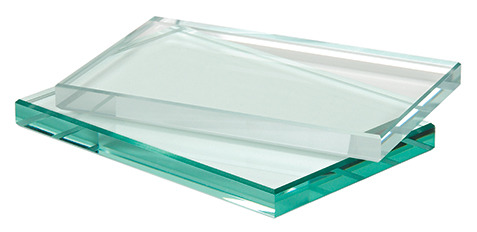
If you look edgewise through a sheet of glass you see that it’s green because of iron impurities (Google for it). Reducing the iron reduces the green.
Perfectly aligning mirrors to multiply reflections also multiplies the apparent thickness of the glass, and the green tint becomes more apparent the “deeper” each reflection seems to be.
Science is like history: it was never this interesting at school. :-)
Yep! And this is because – I’m sorry to say – mirrors are not a unique or separate substance with magical properties. Mirrors are silvered glass. They have two colors: the color of the silver, and the color of the glass. The “silver” doesn’t have to be silver, though it usually is because mirrors are traditionally made with silver nitrate, because it’s a whitish metal. You can have mirrors silvered in gold or black or red. You take literally any piece of glass, pour a coating of silver on it, seal it, and call it a mirror.
You have to seal it because otherwise it tarnishes and spots. Even though the glass protects it from air, the silver oxidizes just like any other silver, which is why antique mirrors have that funky age-spotted look.
Mirrors used in science are usually pure clear glass with no impurities (so the glass has no color) and are silvered in gold or aluminum, so they are white or gold. A warm-toned mirror would have a pink glass and would make things have a rose-gold look. Phryne Fisher, in the books, has a mirror with pink glass.
(Mirrors silvered in silver – that is, most mirrors you’ve seen – are probably faintly grey from the silver and faintly green from the cheap glass, but it doesn’t need to concern you at all – even if you noticed a strong color, you’re often so used to looking in them that your brain edits out any discrepancy – like how your nose doesn’t get in the way of your vision even though it’s right in front of your eyes all of the time.)
My grandmother had a mirror that was silvered in gold. It was a little disconcerting. The silver in mirrors is why vampires don’t have reflections. (And why the cutlery at Castle Dracula was made of gold.)
It’s true! (Source is The Journal Of I Read It Somewhere One Time, so take it with a truckload of salt, but I’m pretty sure it was a published book and not the internet, so like, only a pickup truck, not a dump truck.)
Watsonian explanation: Silver as an entity and/or concept was upset about being used to pay Judas, so as some kind of compensation God gave it evil-fighting powers, and this is why vampires don’t have reflections in silvered mirrors as well as why werewolves are killed by silver bullets. (Also works for vampires not showing up on film, because silver nitrate, although obviously that isn’t part of the ~*~original folklore~*~ and also doesn’t explain digital cameras.)
Doylist explanation: A lot of things that are traditionally anti-vampire turn out to have antibacterial properties- the only ones I remember are garlic and silver, but I think there were others- so supposedly when anti-vampire treatments helped somebody out of a decline or whatever they were actually helping fight off an infection.
What about a gold mirror with antibacterial soap or something sprayed on it?
And if it’s the silver in the cameras that made them not show up on film, that means that digital is entirely different (unless they use silver in the manufacturing – which i’m pretty sure they don’t – or if some rich person has a silver encased camera – but that still probably wouldn’t work because the lense couldn’t be encased in silver otherwise it wouldn’t work) so basically we need a modern story where the Vampires are having to come up with clever things to stay out of photos where possible because DIGITAL, but there’s that one vampire who photobombs everything and is famous on the internet for it because he’s literally everywhere.
Fun addition: DSLR digital cameras still use mirrors to flip the image into the viewfinder (and do some fun light flippy shit). The Vampire would not show up when you look through the scope but would appear in your finished photo because the mirror gets flipped out of the way when you take an actual picture. Most digital cameras now are mirrorless (there’s no viewfinder, you look directly at the screen to see what you’re photographing). HOWEVER there are some trace amounts of silver in traditional LCD displays (mostly in the receptor strip… which may impact?) and plasma displays contain a lot of silver so the only way you would be able to see the vampire is if you printed a picture out on paper.
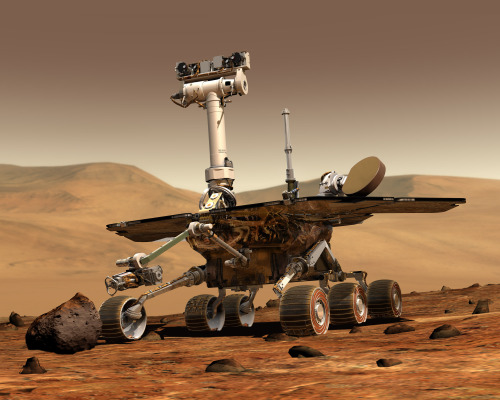
Today, we’re expressing gratitude for the opportunity to rove on Mars (#ThanksOppy) as we mark the completion of a successful mission that exceeded our expectations.
Our Opportunity Rover’s last communication with Earth was received on June 10, 2018, as a planet-wide dust storm blanketed the solar-powered rover’s location on the western rim of Perseverance Valley, eventually blocking out so much sunlight that the rover could no longer charge its batteries. Although the skies over Perseverance cleared, the rover did not respond to a final communication attempt on Feb. 12, 2019.
As the rover’s mission comes to an end, here are a few things to know about its opportunity to explore the Red Planet.
90 days turned into 15 years!
Opportunity launched on July 7, 2003 and landed on Mars on Jan. 24, 2004 for a planned mission of 90 Martian days, which is equivalent to 92.4 Earth days. While we did not expect the golf-cart-sized rover to survive through a Martian winter, Opportunity defied all odds as a 90-day mission turned into 15 years!
The Opportunity caught its own silhouette in this late-afternoon image taken in March 2014 by the rover’s rear hazard avoidance camera. This camera is mounted low on the rover and has a wide-angle lens.
Opportunity Set Out-Of-This-World Records
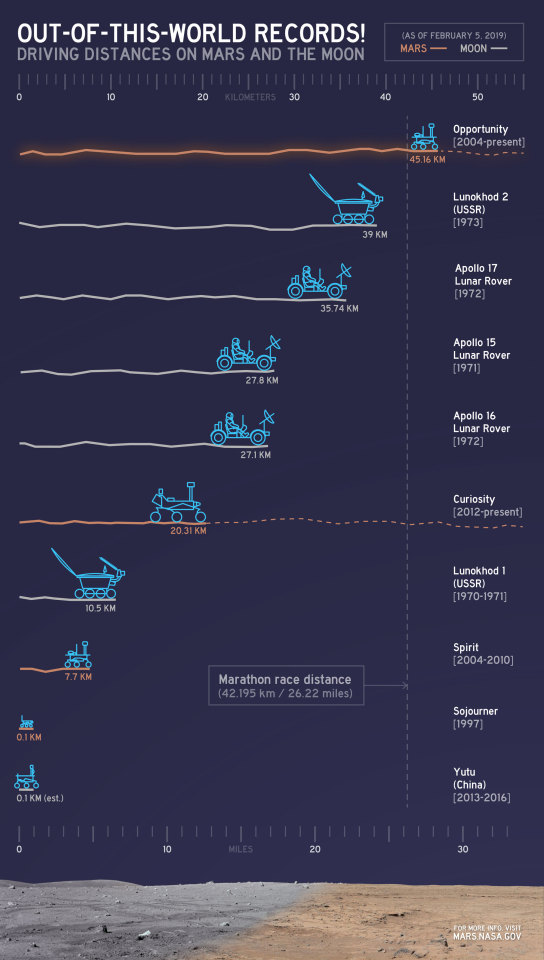
Opportunity’s achievements, including confirmation water once flowed on Mars. Opportunity was, by far, the longest-lasting lander on Mars. Besides endurance, the six-wheeled rover set a roaming record of 28 miles.
This chart illustrates comparisons among the distances driven by various wheeled vehicles on the surface of Earth’s moon and Mars. Opportunity holds the off-Earth roving distance record after accruing 28.06 miles (45.16 kilometers) of driving on Mars.
It’s Just Like Having a Geologist on Mars
Opportunity was created to be the mechanical equivalent of a geologist walking from place to place on the Red Planet. Its mast-mounted cameras are 5 feet high and provided 360-degree two-eyed, human-like views of the terrain. The robotic arm moved like a human arm with an elbow and wrist, and can place instruments directly up against rock and soil targets of interest. The mechanical “hand” of the arm holds a microscopic camera that served the same purpose as a geologist’s handheld magnifying lens.
There’s Lots to See on Mars
After an airbag-protected landing craft settled onto the Red Planet’s surface and opened, Opportunity rolled out to take panoramic images. These images gave scientists the information they need to select promising geological targets that tell part of the story of water in Mars’ past. Since landing in 2004, Opportunity has captured more than 200,000 images. Take a look in this photo gallery.
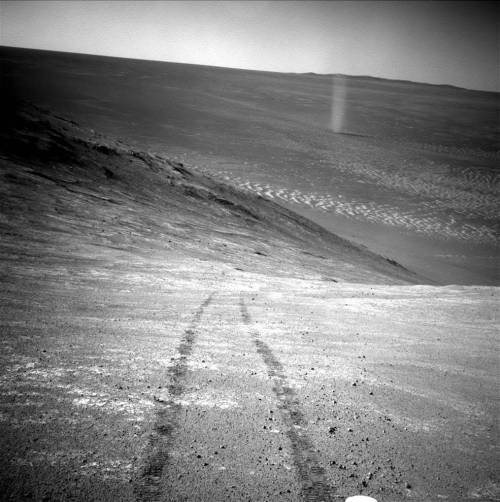
From its perch high on a ridge, the Opportunity rover recorded this image on March 31, 2016 of a Martian dust devil twisting through the valley below. The view looks back at the rover’s tracks leading up the north-facing slope of “Knudsen Ridge,” which forms part of the southern edge of “Marathon Valley
There Was Once Water on Mars?!
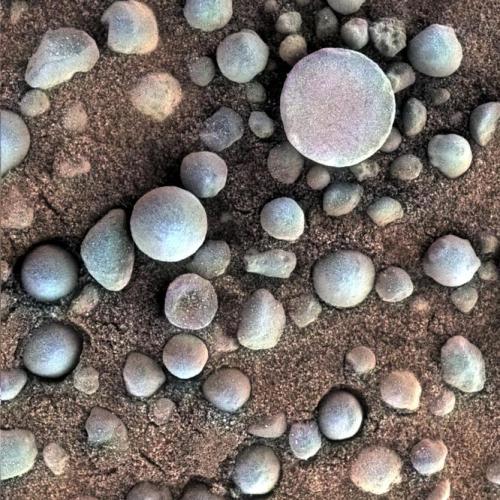
Among the mission’s scientific goals was to search for and characterize a wide range of rocks and soils for clues to past water activity on Mars. In its time on the Red Planet, Opportunity discovered small spheres of the mineral hematite, which typically forms in water. In addition to these spheres that a scientist nicknamed “blueberries,” the rover also found signs of liquid water flowing across the surface in the past: brightly colored veins of the mineral gypsum in rocks, for instance, which indicated water flowing through underground fractures.