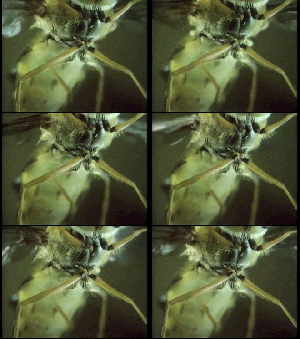
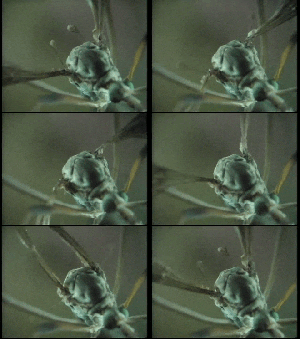
A Hoverfly (Family Syrphidae) and a Cranefly (Family Tipulidae) showcasing their halteres. Halteres are small knobbed structures that were modified from the fly’s back pair of wings. They function like a gryroscope and give the fly stability in flight. When they beat they inform the fly about the rotation of its body allowing the fly to adjust. With their halteres balancing and guiding them flies are able to preform amazing aerial aerobatics. Making them very hard to catch
NASA scientists announced today that they’ve assembled strong evidence that liquid water flows on the Martian surface. There isn’t any indication that this means there’s life on Mars, but when you keep in mind that everywhere we find water on Earth we find living things, it’s exciting stuff.
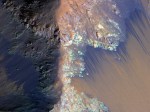
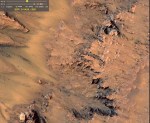
After studying years worth of images collected by the Mars Reconnaissance Orbiter, a particular feature jumped out (tour the gorgeous HiRise image library at beautifulmars). Dark streaks called Recurring Slope Lineae (RSL) appeared on a seasonal basis, coinciding with conditions that could support liquid water in the form of salty brines.
Animation of seasonal flows in Hale Crater:
Think of these RSL streaks (visible in the image gallery up top) like water flowing downhill through sand, causing it to change color as the wet stuff seeps toward the valleys below. If you’re picturing rushing rapids, it’s really more like a wet sponge. These brines, made of chlorate and perchlorate minerals, are much saltier than our own seas, which allows this water to remain liquid in Mars’ frigid climate. Saltwater is especially intriguing for astrobiologists, as salty stuff has higher odds than freshwater for supporting biological chemistry.
NASA billed this report of liquid saltwater as “major”, but this isn’t the first news of water on Mars. Martian hydrology has a long, exciting history. As far back as Mariner 9, dry river and lake beds suggested that the red planet was once much wetter, and later missions told of an ocean-covered Mars several billion years ago. As recently as April 2015, the Mars Curiosity rover found similar brines near the surface at night. We’ve also known for a while that the Mars of today is home to significant amounts of frozen water ice, enough to cover the planet in a thin, wet, puddle if it melted.
What makes today’s announcement so interesting isn’t that water exists on Mars, but that it still flows near the surface on a seasonal basis. Mars super-thin atmosphere led many to believe that any liquid water near the surface would boil away, and the dynamic nature of the wet stuff means that we’ve got a lot to learn about our planetary neighbor.
Dyscalculia: Dyscalculia is difficulty in learning or comprehending arithmetic, such as difficulty in understanding numbers, learning how to manipulate numbers, and learning facts in mathematics. It is generally seen as a specific developmental disorder.
Prosopagnosia: an inability to recognize the faces of familiar people, typically as a result of damage to the brain. (”face blindness”)
Alexithymia: an inability to identify and understand emotions and their subtleties and textures. (”emotional blindness”)
Alexithymia added by me!
~James
Actually, most prosopagnosics are born with it. (I know that study’s pretty small, but I knew of it off the top of my head, and it is proof of concept.) I’m not sure whether the crossover point has happened yet, but certainly early on most people known to have prosopagnosia got it from brain damage; however, that’s because those people had memories of not being faceblind to compare their current state to, so they knew what they were missing. Congenital prosopagnosics are far more likely than acquired ones to have a “so that’s what that is!” moment.
Also, it’s not all-or-nothing. Only the most severe prosopagnosia causes a total inability to recognise faces; the rest of us “just” take months or years of exposure to learn a given face as well as normal people would learn it immediately, and have a much greater tendency to forget faces over time.
Tags:
#prosopagnosia #reply via reblog #the more you know #tales from the prosopagnosia tag
So, let’s talk about whales. A group of mammals so highly adapted to aquatic life that some people still mistake them for fish. A group that includes some of the largest and most intelligent living creatures.
Although their earliest evolutionary ancestors were a mystery until the late 1970s, today cetacean fossils make up one of the most striking examples of transitional forms. Combined with molecular analysis, we now know them to be descendants of early even-toed ungulates, with their closest living relatives being hippos.
Every day this month I’ll be posting a new image highlighting points in whale evolution, from their terrestrial origins all the way through to modern times.
This is Indohyus, a member of an extinct group of ungulates called raoellids – the closest known sister group to cetaceans. The very earliest whales probably looked similar to this, small hoofed creatures completely unrecognizable compared to their modern aquatic descendants.
Around 60cm long (23.5in), Indohyus lived in what would become India and Pakistan about 50-48 million years ago. It had very dense bones similar to those of hippos, and probably led a semi-aquatic lifestyle comparable to modern water chevrotains, diving into water and remaining submerged to evade predators. But its main link to whales actually comes from its ear bones, with its skull showing evidence of a special structure called the involucrum.
A lot of dog owners give their dogs peanut butter. It’s great as a treat given in small quantities and most dogs love the stuff. But PLEASE check the ingredients before giving it to your dog. There is a sweetener called XYLITOL, often found in chewing gum, dental hygiene products and it can also be purchased as a sweetener itself, and now they’ve started putting it in some peanut butters. It is EXTREMELY TOXIC to dogs and can be potentially fatal if not dealt with immediately when ingested by a dog. Check the ingredients, if XYLITOL is mentioned then PLEASE DO NOT FEED IT TO YOUR DOG! If you suspect your dog has ingested XYLITOL, which can often happen through dogs finding chewing gum in bags (they like the smell of mint), or if they do happen to have peanut butter containing it, call your vet straight away. I’m a dog trainer, I see lots of goods, but I also see the bads, and the last thing I want to see is dogs coming to harm because people are unaware of this so please if there’s one thing you do then reblog this or at least tell people about it. Thank you so much!
THIS IS 100% LEGIT. Xylitol can cause a HUGE surge of insulin in dogs and in higher doses is toxic to their livers. Three grams of xylitol can kill a 65lb dog.
#death tw #dog #the more you know #we gave our dog an empty peanut butter jar to lick the remnants out of yesterday #luckily Wegmans regular peanut butter doesn’t have xylitol #(no we don’t have Wegmans in Canada) #(Wegmans peanut butter is cheaper and tastier than No Name so we buy a bunch whenever we go to America)
Hey all you lovely people who have periods, the world is starting to look a little bit brighter now that certain tampon/pad companies have started to allow people to receive small kits and samples of pads, maxi pads, liner, and tampons for free. And I mean 100% free and discreet. You just have to give them your address and name, and bam! You’ve got all the menstrual cycle products you could ever need for no cost. Links below!
The “Always” and “Poise” links are actually for their bladder
incontinence pads, just so you know. I don’t know of any reason why they
wouldn’t work for menstrual blood, but that’s not what they were designed for.
Tags:
#menstruation #the more you know #my mother sent that Always link to her friends without realising what it was #and was rather embarrassed #I don’t want that to happen to anyone else #reblogged from a random person who didn’t have any guilt tripping in their reblog chain #this blog is a guilt-trip-free zone #no exceptions #(hat tip to justice-turtle) #(I love you and respect your stance on posts with guilt trips buried in their reblog chains)
Hey Tumblr, welcome to your better blocking system. So much better that we changed its name from “Ignore” to “Block.” A proper, muscular name. Solid as a block.
Someone acting like a tool? Go ahead, block them. Here’s what they won’t be able to do:
Follow you
Message you
Like your posts
Reblog your posts
Reply to your posts
See your posts in search results
See your blog in search results
As far as their dashboard is concerned, you don’t exist.
WOOHOO!
Tags:
#Tumblr: a User’s Guide #the more you know #I am reserving judgment for now