ithelpstodream:


martinfreemanseyebrows:

desbreaux:

ithelpstodream:

glossymoss:

Omg rly ??

yes! really!

translifeline.org

US: (877) 565-8860

CANADA: (877) 330-6366

Pacific time: 8am to 2am

Mountain time: 9am to 3am

Central time: 10am to 4am

Eastern time: 11am to 5am

Alaska time: 7am to 1am

Hawaii time: 6am to 12am

Okay so I just got off the phone with them. I talked to a trans girl named Aurora & she was super helpful! She gave me a few doctors to talk to & encouraged me to seek therapy instead of just rushing to get my pills. She literally found a trans friendly therapist in my town & I would definitely recommend giving them a call!

Check out their website for monetary help here! People can apply for ID assistance in the form of microgrants, which I previously had no idea about! Also trans folks can train to be a hotline operator, how awesome is that??


Tags:

#gender #the more you know #not as discoursey as it first appears

kramergate:

tumblr_pe39j5qr1i1qg2s3q_540
tumblr_pe39j6cwhd1qg2s3q_540
tumblr_pe39j6bvyx1qg2s3q_540

intro to the dril book is just real good


Tags:

#this…this is a thing? #the more you know #(is it just me or would this book be a massive pain in the ass to proofread?) #(”is this typo an *intentional* typo or an *accidental* typo?”) #death mention #infohazards?

{{previous post in sequence}}


somnilogical:

brin-bellway:

somnilogical:

my hobby: mass downloading the entire corpuses of long-running blogs on to my phone as an epub and searching keywords when i want to talk with someone

What mass-downloading method do you use?

I, too, am interested in downloading entire blog corpuses onto my phone, and I’m curious if you have any tips/techniques for archiving more effectively.

(I’m not sure to what extent your post is joking, but I thought I’d ask the above in case it’s sufficiently serious that you actually have a real mass-downloading method in mind.)

ive used http://www.bloxp.com/ (id like something better) which converts some blogs and has trouble with others

this is a thing i do! ah but i did prepend it with the meme format of “my hobby:” which is evidence that the thing following is not, in fact, your hobby

Ooh!

For what I can tell from the initial testing: not a full solution, but for the things it *can* handle, much faster and less effort than the pasting-things-into-LibreOffice-documents (sometimes printing-pages-to-PDF) I normally do.

(Automation is like salt: I often find things are better after adding it, but it rarely occurs to me to add it unprompted.)

P.S. It did at least occur to me a mere couple of weeks after changing my podcast-downloading habits to something that would be aided by a podcatcher that I should, in fact, get a podcatcher. Although that might have been prompted by noticing that Rhythmbox has a podcatcher built-in, so maybe it doesn’t count.


Tags:

#reply via reblog #Brin owns *two* 2010’s computers now #(the following category tag was added retroactively:) #101 Uses for Infrastructureless Computers

{{previous post in sequence}}


brin-bellway:

Home!

*flop*

hooooome

The post here about unsecured borders of the world (which is to say, unsecured borders of the European Union) is going around again.

The last time I saw this post going around, there were a whole bunch of comments expressing shock that not all borders are heavily restricted. And while it did sadden me to see so many people unaware that not all borders are like…whichever borders it was they were thinking of†, it also saddened me to see them walking away with the idea that the intra-EU method is necessarily what it means to have a non-heavily-restricted border.

So, I’m repurposing this post I made in 2015.

Shown above is the border between Port Huron, Michigan and Sarnia, Ontario. (Note that my description of what border crossings are *typically* like will be describing Niagara Falls, but Sarnia is the picture I had lying around, and the one time I went through Sarnia the experience was about the same.)

The border crossing itself took maybe two minutes, and mostly because the border guard chatted about the good things he’s heard about our town. One minute for the crossing itself is more typical, plus another minute for each car ahead of you in line (but we usually cross on weekday afternoons, when the lines tend to be short).

Usually they’ll ask you where you’re going (or where you went), why, and for how long. (*Occasionally* they won’t even do that, if you show the passport of the country you’re entering, but for the most part they still do it if you’re a citizen.) Most answers I have had cause to give (“shopping for a few hours”, “visiting relatives for a week”, “Disney World!”), they just nod and wave you through, and possibly make a note so they can check if you tell the same story on your way back. If you show a U.S. passport and tell them you’re going to Canada because you live there, they will sometimes ask why you moved, but they don’t press further if you just say you like it there.

While they reserve the right to search your stuff if you give inconsistent answers to their questions or have clearly-visible contraband or maybe show a passport from a country they’re on shaky terms with or something, they do not search you by default. If you went shopping, they ask you how much you bought (and sometimes to see your receipts as well), and if your answers indicate that you’re over the duty-free limit on anything they send you over to a nearby building to pay your import taxes, which takes a few extra minutes.

I just wanted people to know that border security isn’t binary, that there exist places where there *are* guards and you *do* have to show a passport but it’s *not* a big ordeal.

I don’t have any strong opinions about what borders should be like in general: I don’t feel that I’m well enough informed on that, and TBH I’m mostly just trying to survive right now and don’t really have the energy to get well informed. (though I’d certainly be annoyed if they started making it an ordeal to go grocery shopping in New York)

But if you’re looking to develop an opinion on border security, please remember that “more borders should be like US/Canada” is a possible stance. There’s more than one way to guard a border, and you can think some ways are going too far without wanting to go full EU (and conversely, you can want to not go full EU but still think some ways are going too far).

†If you’re someone who was shocked, let me know which borders you think of when thinking of country borders. I’m curious to see where exactly our experiences differ.


Tags:

#oh look an original post #(close enough) #our home and cherished land #home of the brave #the more you know

fallynleaf:

mizufae replied to your

photoset:

no one tagged me, but i wanted to post six selfies…

that hair… HOW YOU DO THAT HAIR PLZ TEACH

:D

Buckle in, because this is going to be a LONG post. And I’m going to talk about BOG MUMMIES.

For reference, the hair in question:

tumblr_inline_p1ugmkbpwe1qcluww_540

This updo was actually what convinced me to grow my hair long in the first place (back in ye old 2008), and it has been strongly influential in my personal aesthetic ever since.

The story starts in 1938. Actually, it starts even earlier than that. In ~280 B.C., a woman died, and her body was placed in a bog, where it stayed until it was discovered in 1938, so well-preserved that the hair was still there.

This bog mummy is referred to as the Elling Woman. Here’s a bit about her.

The article talks a bit about her hair, but it’s kind of an unsatisfactory description. I found out about it when the article reached the Long Hair Community Forum in 2008, resulting in a 40-page (and counting!) thread wherein a bunch of long-haired women figured out how to recreate the hairstyle.

The ladies of LHC looked at the images of the hair, and were like: “Yep, that’s a rope braid.” “Here’s how you could do a 7-strand braid with 2-3-2 sections.” Etc. And basically, they tested out different versions, and came up with something that was cool-looking, comfortable, and practical.

Here’s the ~official~ reconstruction on the Tollund Man website:

tumblr_inline_p1uhhe8ej21qcluww_540

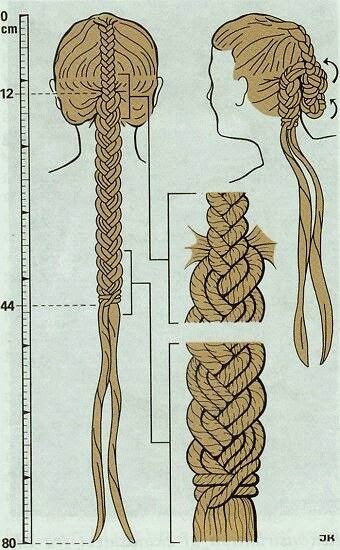
And here’s a (very confusing) diagram of how the style is supposedly constructed:

tumblr_inline_p1uhlqzwum1qcluww_540

There are several different recreations of the style floating around the LHC and youtube and the wider internet. The style also looks and works differently with different types of hair. I had to grow mine out until I could make a waist-length braid before I could really successfully do it with my hair, but my hair is medium-thick and fairly fine, so YMMV. Some people on the LHC did it with much shorter and thicker hair.

The LHC thread about it is a fun read, but it’s a bit long and meandering, and there are several conflicting sets of instructions there, so I’ll just talk about the method that I use. If you want a video aid, what I do is basically this, except I do rope braids for the bottom 2/3s instead of English braids, and I finish it by wrapping the thick braid around the middle braid, like this (I’ve never actually tried that particular method for forming the big braid, but finishing up the bun is the same).

Here’s a written description:

  1. Take the top 1/3 of your hair and braid it in a basic 3-strand braid (a.k.a. an English braid) down to a little past your neck. Tie it off so that it stays braided while you braid the rest of your hair.
  2. Separate your remaining hair into two sections (each about 1/3 of your total hair), one on the left side, and one on the right.
  3. Braid each section into a rope braid (a two-strand braid that’s made by twisting both sections in the same direction, then twisting them together in the opposite direction). Tie them off so that they stay braided. Also, I’ve found that it’s better to make the rope braids so that they’re coiled in opposite directions.
  4. Take the two rope braids, and braid them with the top/middle section of your hair that you’d braided into an English braid. You’re basically making one big English braid. After I’ve started braiding it, I slip off the elastic tie that I’d used to hold the middle braid together temporarily.
  5. Braid it as a 3-strand (that’s made up of two 2-strand rope braids, and one one-strand section that started as a 3-strand braid, so it’s sort of a 7-strand braid!) English braid all the way to the end of your hair. Take out the elastic ties around the two rope braids when you get to them.
  6. Tie the whole thing off with a single elastic tie at the end.
  7. To make the bun, you lift up the simple English braid (the one you made in step one), and you wrap the thick, complicated braid around it in a spiral.
  8. Tuck the end in as best as you can, and then secure it with whatever you want. I’ve used everything from a hair stick, a hair comb, a few bobby pins, and even a single barrette before.
  9. You’re done!

There wasn’t any evidence of any hair pins or anything like that to secure the hair found with the Elling Woman’s body. If your hair is very oiled and/or very unwashed, it might be able to hold itself in place without needing to be tied or secured. As it is, this style does work better if your hair has been oiled, or hasn’t been washed for several days.

This hairstyle is really cool for a lot of reasons, but it’s also extremely comfortable! The middle braid essentially holds the whole thing up, so you don’t experience any of the pulling you feel with some buns.

Basically, if I had to wear the same hairstyle for thousands of years, I’d definitely pick this one. It’s beautiful, versatile, comfortable, and has a really cool backstory.


Tags:

#hair #the more you know #neat #history #I am probably physically capable of doing this #but I don’t think I enjoy decorating myself enough for it to be worth the effort #(this was in fact my first thought upon seeing the picture) #(and reading the instructions did not change my mind) #that being said I’m glad this exists for people who are into that sort of thing

Solar System 10 Things: Looking Back at Pluto

nasa:

In July 2015, we saw Pluto up close for the first time and—after three years of intense study—the surprises keep coming. “It’s clear,” says Jeffery Moore, New Horizons’ geology team lead, “Pluto is one of the most amazing and complex objects in our solar system.”

1. An Improving View

tumblr_inline_pbyxbxtjbn1tzhl5u_540

These are combined observations of Pluto over the course of several decades. The first frame is a digital zoom-in on Pluto as it appeared upon its discovery by Clyde Tombaugh in 1930. More frames show of Pluto as seen by the Hubble Space Telescope. The final sequence zooms in to a close-up frame of Pluto taken by our New Horizons spacecraft on July 14, 2015.

2. The Heart

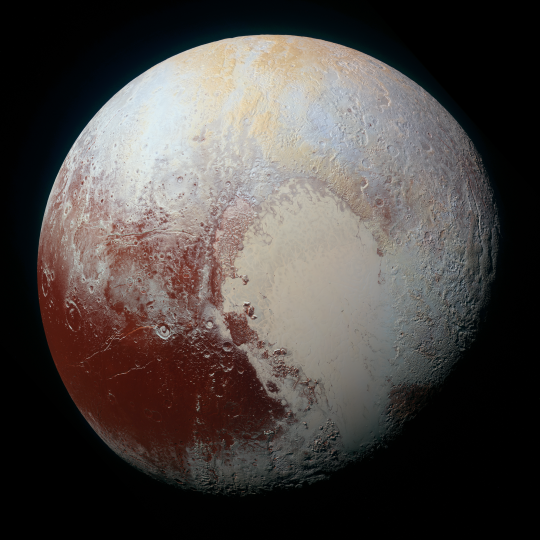
tumblr_inline_pbyxfsxwin1tzhl5u_540

Pluto’s surface sports a remarkable range of subtle colors are enhanced in this view to a rainbow of pale blues, yellows, oranges, and deep reds. Many landforms have their own distinct colors, telling a complex geological and climatological story that scientists have only just begun to decode. The image resolves details and colors on scales as small as 0.8 miles (1.3 kilometers). Zoom in on the full resolution image on a larger screen to fully appreciate the complexity of Pluto’s surface features.

3. The Smiles

tumblr_inline_pbyxgsyhfz1tzhl5u_540

July 14, 2015: New Horizons team members Cristina Dalle Ore, Alissa Earle and Rick Binzel react to seeing the spacecraft’s last and sharpest image of Pluto before closest approach.

4. Majestic Mountains

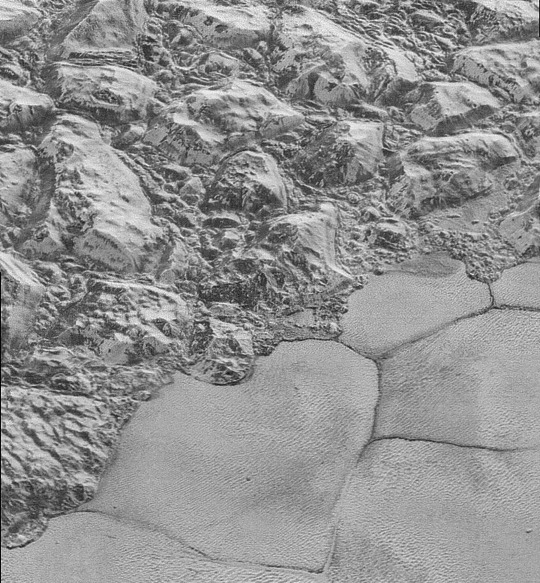
tumblr_inline_pbz0w2vjun1tzhl5u_540

Just 15 minutes after its closest approach to Pluto, the New Horizons spacecraft captured this near-sunset view of the rugged, icy mountains and flat ice plains extending to Pluto’s horizon. The backlighting highlights more than a dozen layers of haze in Pluto’s tenuous atmosphere. The image was taken from a distance of 11,000 miles (18,000 kilometers) to Pluto; the scene is 780 miles (1,250 kilometers) wide.

5. Icy Dunes

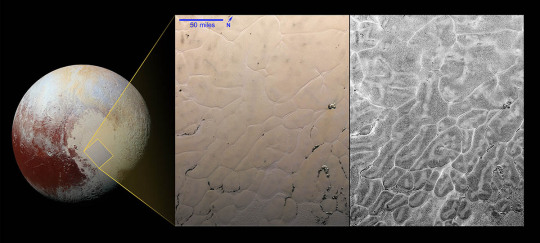
tumblr_inline_pbyxuogpsj1tzhl5u_540

Found near the mountains that encircle Pluto’s Sputnik Planitia plain, newly discovered ridges appear to have formed out of particles of methane ice as small as grains of sand, arranged into dunes by wind from the nearby mountains.

6. Glacial Plains

tumblr_inline_pbyxvgvamm1tzhl5u_540

The vast nitrogen ice plains of Pluto’s Sputnik Planitia – the western half of Pluto’s “heart”—continue to give up secrets. Scientists processed images of Sputnik Planitia to bring out intricate, never-before-seen patterns in the surface textures of these glacial plains.

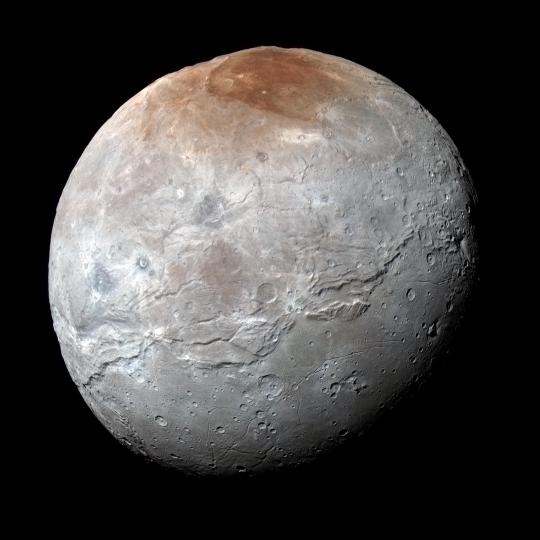
7. Colorful and Violent Charon

tumblr_inline_pbyxvyxrzk1tzhl5u_540

High resolution images of Pluto’s largest moon, Charon, show a surprisingly complex and violent history. Scientists expected Charon to be a monotonous, crater-battered world; instead, they found a landscape covered with mountains, canyons, landslides, surface-color variations and more.

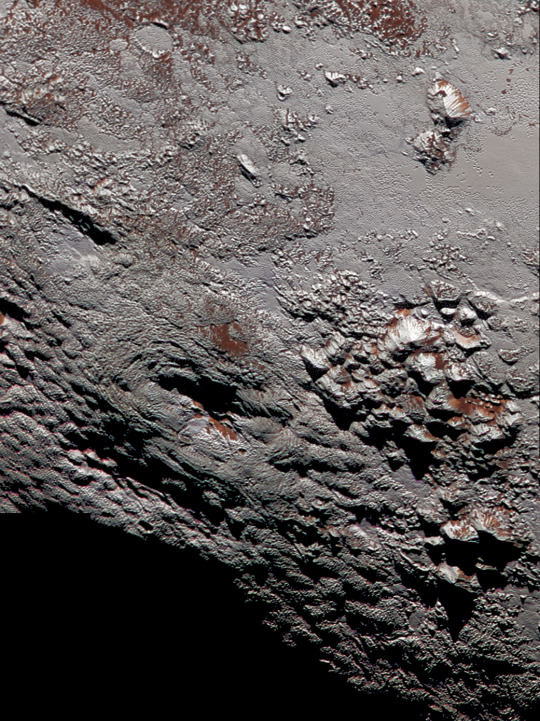
8. Ice Volcanoes

tumblr_inline_pbyxwmudwi1tzhl5u_540

One of two potential cryovolcanoes spotted on the surface of Pluto by the New Horizons spacecraft. This feature, known as Wright Mons, was informally named by the New Horizons team in honor of the Wright brothers. At about 90 miles (150 kilometers) across and 2.5 miles (4 kilometers) high, this feature is enormous. If it is in fact an ice volcano, as suspected, it would be the largest such feature discovered in the outer solar system.

9. Blue Rays

tumblr_inline_pbz0wrroj21tzhl5u_540

Pluto’s receding crescent as seen by New Horizons at a distance of 120,000 miles (200,000 kilometers). Scientists believe the spectacular blue haze is a photochemical smog resulting from the action of sunlight on methane and other molecules in Pluto’s atmosphere. These hydrocarbons accumulate into small haze particles, which scatter blue sunlight—the same process that can make haze appear bluish on Earth.

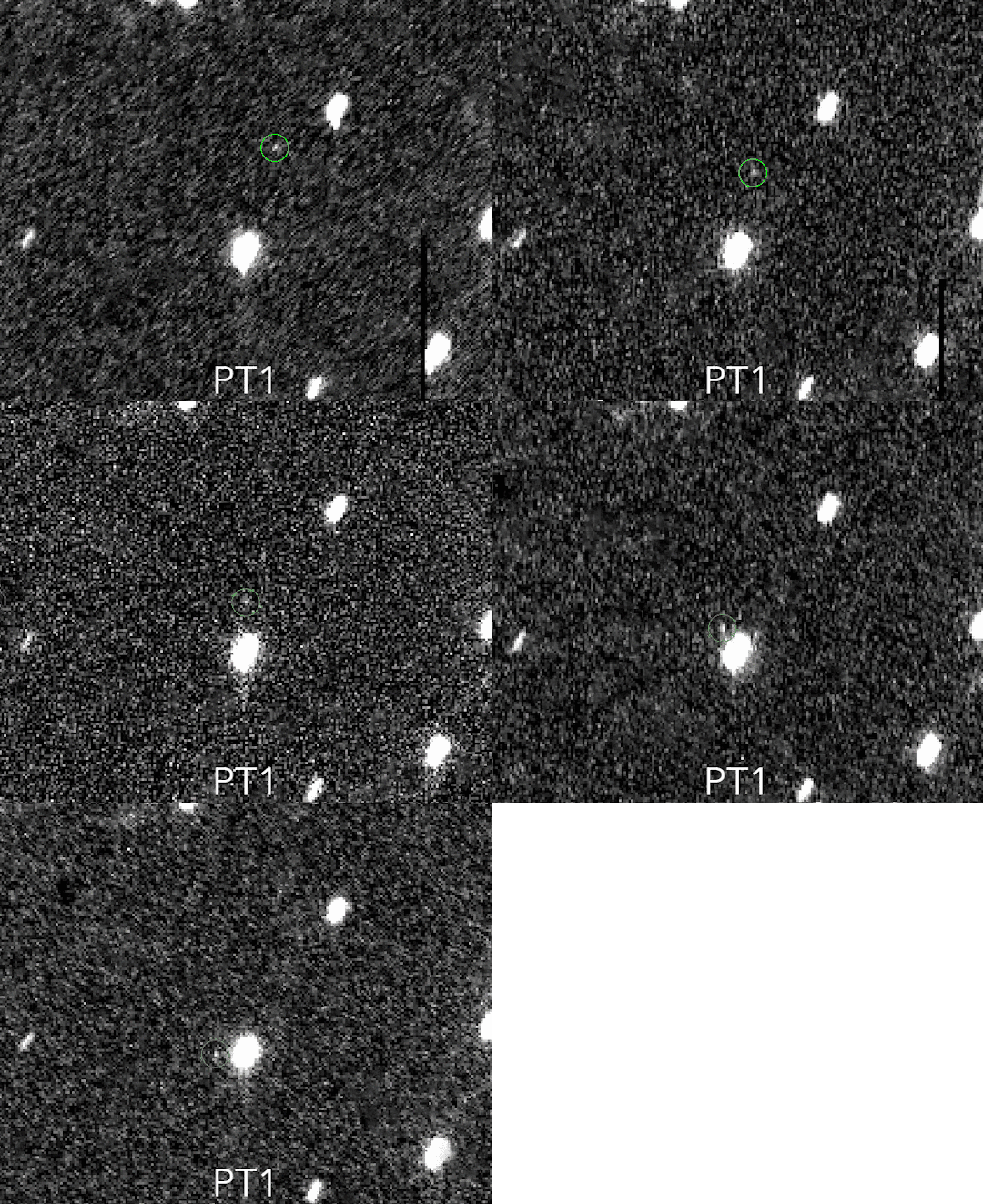
10. Encore

tumblr_inline_pbyxxwxhdb1tzhl5u_540

On Jan. 1, 2019, New Horizons will fly past a small Kuiper Belt Object named MU69 (nicknamed Ultima Thule)—a billion miles (1.5 billion kilometers) beyond Pluto and more than four billion miles (6.5 billion kilometers) from Earth. It will be the most distant encounter of an object in history—so far—and the second time New Horizons has revealed never-before-seen landscapes.

Make sure to follow us on Tumblr for your regular dose of space: http://nasa.tumblr.com.


Tags:

#ooh #I didn’t know about the Kuiper Belt Extended Mission #Pluto #space #the power of science #the more you know #long post

@sinesalvatorem, I was going to reblog your post [link], but I figure giving poverty advice in a reblog when the OP is about how one shouldn’t give poverty advice is asking for trouble (especially when OP has relatively few notes), so I’m pinging you on a fresh post instead.

>>On that note, if anyone who reads this has any life hacks wrt saving money or earning extra income, or knows online resources that have compiled a bunch of them, please tell me! I already know of quite a few, but I’m always looking for more.<<

Hey, look, a special interest!

(or, well, part special interest, part coping mechanism)

(Disclaimers: I acknowledge that for any or all of these things, you [may already do them]/[may not find them worthwhile]/[may not be able to do them at all]. If anything in the rest of this post sounds like I don’t, that’s just because it’s sometimes easier to get the words out that way.

A more specific version that I feel is particularly worth pointing out: while I have had plenty of financial difficulties and qualify as “poor” by many definitions, I have never (quite) been *broke*. Some of these tips will be stuff like “how to spend $800 in one day in order to avoid spending $1,400 over four months”, and if you never have $800 on hand at any given time feel free to ignore that (though maybe file them away for if/when you reach a point in your life where you can afford to tie up some money for a while in order to spend less in the long run).)

This has been kind of a recurring theme on my blog lately, but: housemates are so important. Finances are best played as a team sport: going it alone is sadly necessary in some situations, but it’s definitely Hard Mode, and being poor is hard enough as it is without adding more difficulty modifiers on top of it.

(It *is* painful to have to watch people you share finances with spend money in ways you don’t approve of, but–I remind myself at such times–it’s still completely worth it for all the bulk discounts and such you can get. (Although I’m sure there are *some* people out there somewhere who are careless enough with money that this would not be true, and obviously you don’t want to share finances with such people.))

People hate on Uber-type things a lot, but honestly, they really can be a lifesaver. Delivery gigs are what tipped us over into being in the black for March†. (Up ~CAD$230 over the course of that month! God, it’d been *so* long since our money had been on any kind of upward trend for any significant length of time.) Some companies in some places will also hire bicyclist or even pedestrian delivery freelancers.

People also hate on advice to avoid bank-related fees because sometimes when you’re poor they’re unavoidable, but it’s still worth checking that each fee really *is* unavoidable before resorting to it.

(You know why I switched from annual statements to quarterly? Because I found out while preparing the 2017 statement that my parents had gone below their minimum chequing-account balance (which incurs a CAD$11 fee for each month it happens) *eleven months* out of the year, and had been quietly shouldering it *even though the household as a whole had enough money to cover everyone’s minimum balances*: it was just disproportionately in the kids’ accounts because at the time only the kids were employed. I immediately insisted on providing my parents with an informal, indefinite loan to help them cover their balance††, and started doing more frequent statements so we can catch shit like that sooner.

(Apparently Dad was embarrassed and Mom didn’t want to ~burden~ her children when she was ~supposed~ to be providing for them. And I was like “You can use the money you’re saving in bank fees towards buying me food.”))

You make a remark about the restaurants in San Francisco being expensive, and of course in this part of Tumblr I hear plenty about how high the rents are. To what extent does the Bay have generally high prices across the board (or for groceries in particular: grocery prices are about to be important), and how far away do you have to get from the Bay for things to stop having that markup?

The New York trick (travel to an area with a lower cost of living, stock up on cheap groceries to bring back) is harder in a place with no nearby-ish country borders or similar clear markers of “you are now entering the Cheap Zone”, but it might still be doable there.

(I think the trick used by people who *live* in Cheap Zones is to use coupons *intended* for places with higher costs of living (with discounts sized accordingly), but which are technically valid there. Occasionally these can even be stacked: Mom almost always brings some coupons (from American websites) to New York.)

Target does ad-matching: if you show them that another store’s flyer has a sale on a certain food, they will sell you that food at the other store’s sale price, letting you avoid the hassle and transportation costs of running all over town chasing deals. (note that Target does not match produce) The Flipp app [link] will give you the flyers for a (U.S. or Canada) postal code of your choice.

Walmart does not do ad-matching as such (in America; Canadian Walmarts still do it), but if you scan your Walmart receipt into their app, they will issue you an e-gift card for the amount you *would* have saved if they allowed it.

There might be other stores in your particular area that do matching, but these are the only ones I found when I was looking this up in an Arizonan context recently. It seems to be less common in America than it is in Canada.

Running ad videos and occasionally doing other stuff through Swagbucks is a nice way to get a bit of supplemental income. I recently helped Mom write a guide to using it [link], so I will direct you there. (please use the referral links, I’d very much appreciate it)

If you have anything that gives you a discount on Amazon purchases and/or generates income in the form of Amazon credit (like, say, Swagbucks), bear in mind that Amazon has an ever-expanding selection of other stores’ gift cards [link] (including, notably, Safeway [link]), almost all of which can be purchased using Amazon credit.

There’s this one program of incentives to encourage lower electricity use during peak periods [link] that I keep getting ads for from advertisers who don’t realise I’m not Torontonian, which is only available in Toronto and parts of California (weird list, I know). Is that applicable to you, or likely to become so?

I haven’t done any freelance audio transcription for Rev [link] in a while, but you might be better suited to it than I am. (Maybe your picking-out-what-people-are-saying-at-crowded-parties ability would help you here?)

>>At one point, I even had a list of which staple items are cheaper at which stores, but homelessness means I keep moving too much for that to ever stay relevant.<<

Some grocery stores let you look up their prices online, making it easier to collect data for such lists and less painful (relatively) to keep making new ones for new places.

I recently systematically went through the websites of every cell company available in this area and determined the single best phone plan for getting our house phone to do everything we currently need it to do while paying as little as possible, and I am very glad I did. If we hadn’t been careful, we could easily have ended up paying twice as much or more.

Unfortunately, there is essentially zero overlap between my available cell companies and yours, so I can’t just skip you to the end result of “Public Mobile is great; Freedom Mobile *might* be even better *if* you’re planning to only use your phone in cities”: you’d have to either do the comparisons yourself or find somebody more local who’s done it.

Some restaurants and the occasional grocery store will give you free food on your birthday. The selection is heavily location-dependant; there are various websites listing the available things for a given place (example: https://www.favoritecandle.com/free-birthday-meals/San-Francisco/CA), though their information is often out of date and you’ll need to check with each restaurant’s own website. Most require newsletter signups (I have a dedicated email address specifically for newsletters from people who might give me free stuff); many require you to buy something else in order to receive the freebie with it, but there are a few that are outright free (except transportation costs, of course: plan your route carefully, and ideally have them be on the way to somewhere you were going anyway). Last year I got a muffin (Starbucks) and a large fruit slushie (Booster Juice): this year Starbucks has unfortunately stopped offering freebies unless you buy at least one thing from them per year (any time during the year, though, not specifically your birthday! still suitable for lots of people!), but I’ve found a couple more newsletters and am set up to get a bag of chocolate-covered almonds (Giant Tiger) and a hamburger (Harvey’s), plus another slushie. (And who knows, maybe I’ll end up at Starbucks at some point between now and November and regain muffin eligibility for this year.)

(maryellencarter, if you’re reading this, note that I’m planning to give you a pre-sifted list of these for your birthday: you don’t need to go figuring this out yourself. I’ll probably compile and send it in October sometime, so that there’ll be less time for circumstances to change while still leaving room for the restaurants to consider you to have been on their newsletter for a sufficient length of time beforehand.)

My finances tag, “adventures in human capitalism”, might have some other stuff that I missed or covered in less detail here.

†I don’t have a good picture of our finances after March yet: I’ve switched to preparing quarterly financial statements (formerly annual), but I haven’t finished collecting and processing the data from Q2, so right now it’s scattered around various bank accounts and credit-card records of four different people and I can’t see what it’s like overall.

††Honestly, I don’t really care whether they pay it back or not. Money used for things beneficial to me is mine for all practical purposes, and I’m not too concerned with whose bank account it happens to be in. (Mom expressed her gratitude at my “selflessness” recently, but I’m *really* not selfless: I’m just very aware that working together is in my own best interest. I don’t make anywhere near enough to survive alone: hell, often I can’t even contribute an equal share towards the group’s expenses, and have to find non-income ways to contribute like accounting and pest control. (I’ve gotten pretty good at killing houseflies. As long as they’re up against a window they’re easy.))


Tags:

#this post technically qualifies as: #oh look an original post #but is closer to the spirit of: #reply via reblog #adventures in human capitalism #long post #death mention #food #home of the brave #our home and cherished land


{{next post in sequence}}

Solar System 10 Things: Two Years of Juno at Jupiter

nasa:

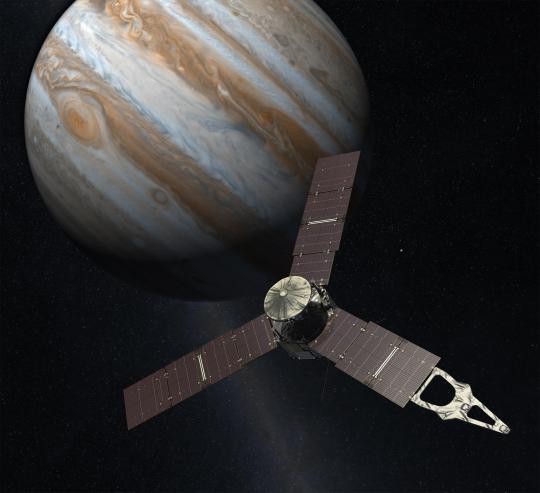
Our Juno mission arrived at the King of Planets in July 2016. The intrepid robotic explorer has been revealing Jupiter’s secrets ever since. 

Here are 10 historic Juno mission highlights:

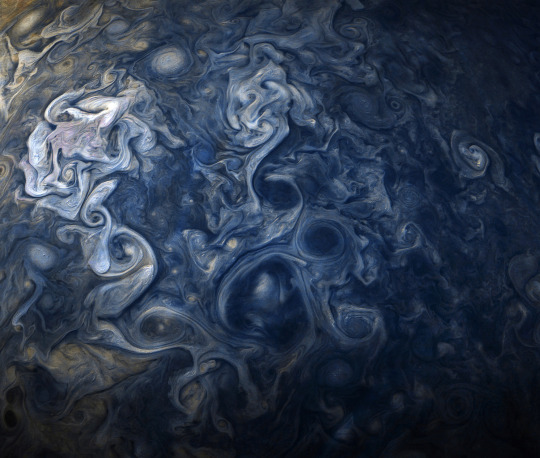
tumblr_inline_pbnlczj8bk1tzhl5u_540

1. Arrival at a Colossus

After an odyssey of almost five years and 1.7 billion miles (2.7 billion kilometers), our Juno spacecraft fired its main engine to enter orbit around Jupiter on July 4, 2016. Juno, with its suite of nine science instruments, was the first spacecraft to orbit the giant planet since the Galileo mission in the 1990s. It would be the first mission to make repeated excursions close to the cloud tops, deep inside the planet’s powerful radiation belts.

tumblr_inline_pbnlf47raj1tzhl5u_540

2. Science, Meet Art

Juno carries a color camera called JunoCam. In a remarkable first for a deep space mission, the Juno team reached out to the general public not only to help plan which pictures JunoCam would take, but also to process and enhance the resulting visual data. The results include some of the most beautiful images in the history of space exploration.

tumblr_inline_pbnlgxsj7k1tzhl5u_540

3. A Whole New Jupiter

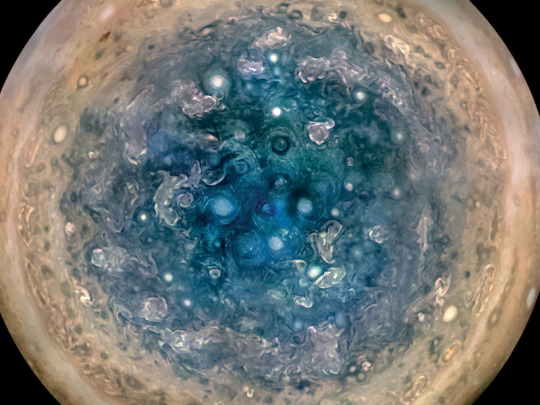
It didn’t take long for Juno—and the science teams who hungrily consumed the data it sent home—to turn theories about how Jupiter works inside out. Among the early findings: Jupiter’s poles are covered in Earth-sized swirling storms that are densely clustered and rubbing together. Jupiter’s iconic belts and zones were surprising, with the belt near the equator penetrating far beneath the clouds, and the belts and zones at other latitudes seeming to evolve to other structures below the surface.

4. The Ultimate Classroom

The Goldstone Apple Valley Radio Telescope (GAVRT) project, a collaboration among NASA, JPL and the Lewis Center for Educational Research, lets students do real science with a large radio telescope. GAVRT data includes Jupiter observations relevant to Juno, and Juno scientists collaborate with the students and their teachers.

tumblr_inline_pbnljiuyjl1tzhl5u_540

5. Spotting the Spot

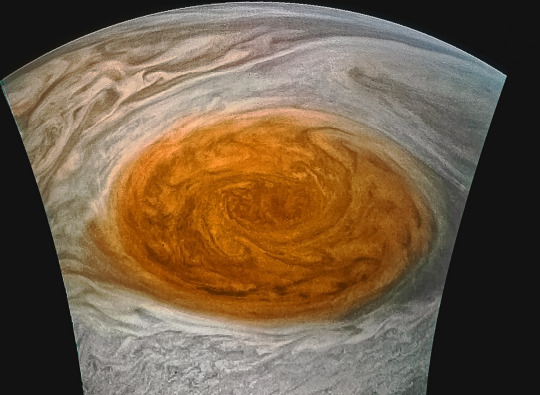
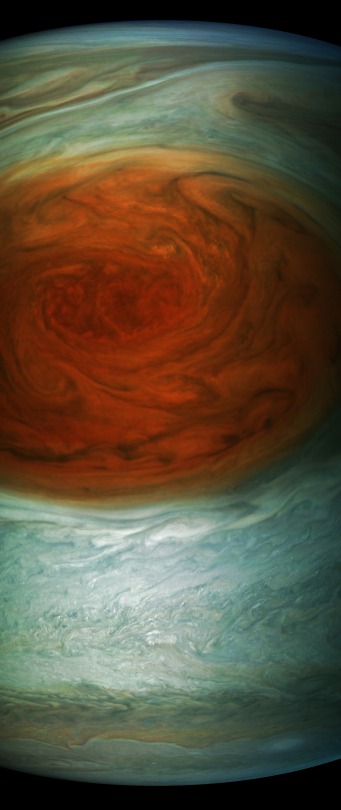
Measuring in at 10,159 miles (16,350 kilometers) in width (as of April 3, 2017) Jupiter’s Great Red Spot is 1.3 times as wide as Earth. The storm has been monitored since 1830 and has possibly existed for more than 350 years. In modern times, the Great Red Spot has appeared to be shrinking. In July 2017, Juno passed directly over the spot, and JunoCam images revealed a tangle of dark, veinous clouds weaving their way through a massive crimson oval.

“For hundreds of years scientists have been observing, wondering and theorizing about Jupiter’s Great Red Spot,” said Scott Bolton, Juno principal investigator from the Southwest Research Institute in San Antonio. “Now we have the best pictures ever of this iconic storm. It will take us some time to analyze all the data from not only JunoCam, but Juno’s eight science instruments, to shed some new light on the past, present and future of the Great Red Spot.”

tumblr_inline_pbnlldabar1tzhl5u_540

6. Beauty Runs Deep

Data collected by the Juno spacecraft during its first pass over Jupiter’s Great Red Spot in July 2017 indicate that this iconic feature penetrates well below the clouds. The solar system’s most famous storm appears to have roots that penetrate about 200 miles (300 kilometers) into the planet’s atmosphere.

tumblr_inline_pbnlr1mnvl1tzhl5u_540

7. Powerful Auroras, Powerful Mysteries

Scientists on the Juno mission observed massive amounts of energy swirling over Jupiter’s polar regions that contribute to the giant planet’s powerful auroras – only not in ways the researchers expected. Examining data collected by the ultraviolet spectrograph and energetic-particle detector instruments aboard Juno, scientists observed signatures of powerful electric potentials, aligned with Jupiter’s magnetic field, that accelerate electrons toward the Jovian atmosphere at energies up to 400,000 electron volts. This is 10 to 30 times higher than the largest such auroral potentials observed at Earth. 

Jupiter has the most powerful auroras in the solar system, so the team was not surprised that electric potentials play a role in their generation. What puzzled the researchers is that despite the magnitudes of these potentials at Jupiter, they are observed only sometimes and are not the source of the most intense auroras, as they are at Earth.

8. Heat from Within

Juno scientists shared a 3D infrared movie depicting densely packed cyclones and anticyclones that permeate the planet’s polar regions, and the first detailed view of a dynamo, or engine, powering the magnetic field for any planet beyond Earth (video above). Juno mission scientists took data collected by the spacecraft’s Jovian InfraRed Auroral Mapper (JIRAM) instrument and generated a 3D fly-around of the Jovian world’s north pole. 

Imaging in the infrared part of the spectrum, JIRAM captures light emerging from deep inside Jupiter equally well, night or day. The instrument probes the weather layer down to 30 to 45 miles (50 to 70 kilometers) below Jupiter’s cloud tops.

tumblr_inline_pbnltmwawy1tzhl5u_540

9. A Highly Charged Atmosphere

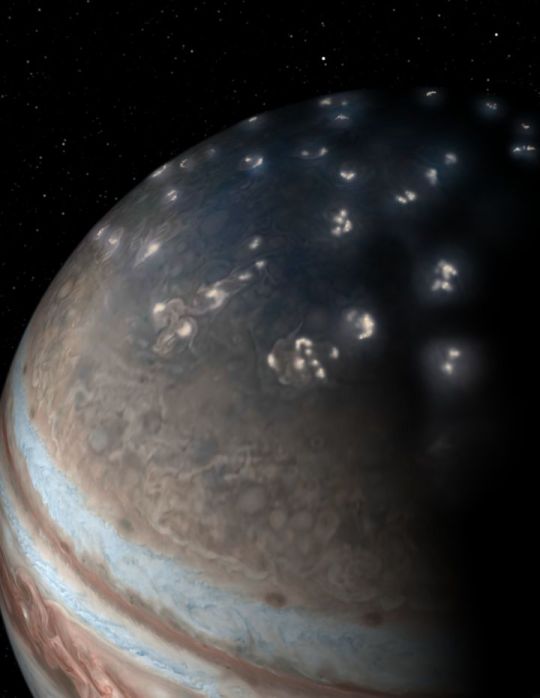
Powerful bolts of lightning light up Jupiter’s clouds. In some ways its lightning is just like what we’re used to on Earth. In other ways,it’s very different. For example, most of Earth’s lightning strikes near the equator; on Jupiter, it’s mostly around the poles.

tumblr_inline_pbnlxrigrx1tzhl5u_540

10. Extra Innings

In June, we approved an update to Juno’s science operations until July 2021. This provides for an additional 41 months in orbit around. Juno is in 53-day orbits rather than 14-day orbits as initially planned because of a concern about valves on the spacecraft’s fuel system. This longer orbit means that it will take more time to collect the needed science data, but an independent panel of experts confirmed that Juno is on track to achieve its science objectives and is already returning spectacular results. The spacecraft and all its instruments are healthy and operating nominally. ​

Read the full web version of this week’s ‘Solar System: 10 Things to Know’ article HERE

For regular updates, follow NASA Solar System on Twitter and Facebook

Make sure to follow us on Tumblr for your regular dose of space: http://nasa.tumblr.com


Tags:

#in search of replacement sources of sci-tech news I have followed the NASA Tumblr #this appears to have been a good decision #space #the power of science #the more you know #Juno

{{previous post in sequence}}

While I’m on the subject of alternate education methods having fewer obstacles than you might think, here is an example of how a homeschooler goes on field trips:

Mom: *looking at local teacher resources on the Internet*

Resources: Try taking your class for a tour at the nearby widget factory! They do tours for Grades 5 – 12, with a minimum class size of 10, and it’s only $5/student!

Mom: Hey kids, you want to tour a widget factory?

Me: Yeah!

Brother: Sure.

Mom, emailing the field-trip-coordination mailing list: Hey guys, if I can get at least 10 kids aged 10 and up together, I’ll call the widget factory and schedule a tour. Preliminary date is the second Thursday of next month. Cost is $5/kid, paid to me when you get there so I can pay for the group. I’ve already got two signed up. Who’s with me?

Parent: I’ve got three kids for the list!

Other parent: My 12-year-old’s not interested, but the 14-year-old will go.

[etc]

[second Thursday of next month]

Tour guide: Okay kids, time to settle down and at least pretend to listen to the spiel–wait. You’re already settled down, and you appear to be *actually* listening to the spiel. Huh. It’s almost like you wanted to be here.

Kids who wanted to be here: :D

Kids who didn’t want to be here: *at home, reading biology textbook*


Tags:

#seriously we got so many comments from tour guides surprised that the kids actually gave a shit about the tour #oh look an original post #homeschool #my childhood #there are *occasional* places that won’t deal with anyone but an Official School #but most places that do stuff for schools are open to homeschool groups as long as you designate one parent as the liaison #I went to a lot of tours and art workshops and cooking classes #almost every week sometimes #(the parents generally tried to spread things out so that there weren’t *multiple* trips for the same age in the same week) #the more you know

{{previous post in sequence}}

serinemolecule:

brin-bellway:

Also, I have acquired a new appreciation for AO3’s download function, which is great at facilitating archiving.

And I have acquired a new opposite-of-appreciation for fanfiction.net, which goes so far the other direction that you are *not allowed to copy text from a fic*. I did a couple of small fics by *going into the page source*, finding the fic *there*, pasting it into a LibreOffice document, and *manually replacing the br tags with line breaks* (there was probably some way to automate that last bit). Then I hit upon the solution of simply saving the entire page as an HTML file, which seems to have worked. Good: I was not looking forward to manually inserting line breaks in Chanson de Geste.

https://alanhogan.com/code/text-selection-bookmarklet

is what I personally use to copy/paste things from sites that don’t want me to. It doesn’t work on all sites, but it works on a lot of them.

Ooh, this looks promising. Thank you!


Tags:

#reply via reblog #the more you know #oh look an update #(the following category tag was added retroactively:) #101 Uses for Infrastructureless Computers


{{next post in sequence}}